-
-
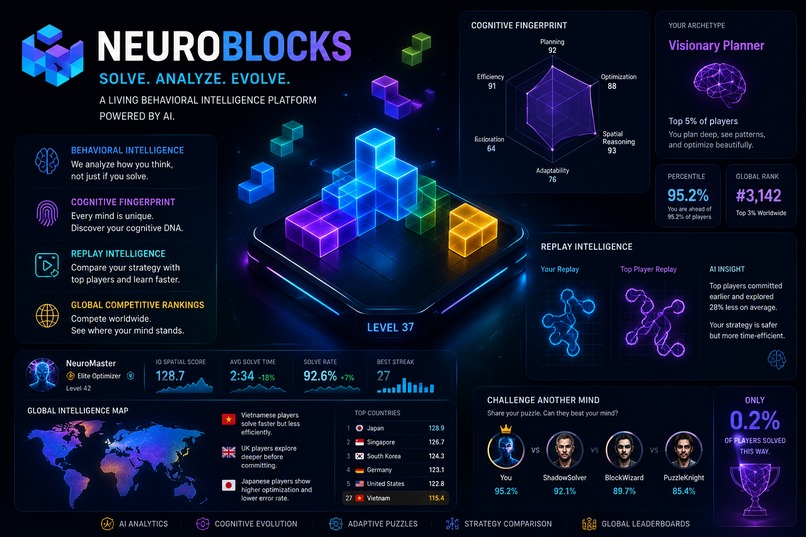
Overview of NeuroBlocks
-
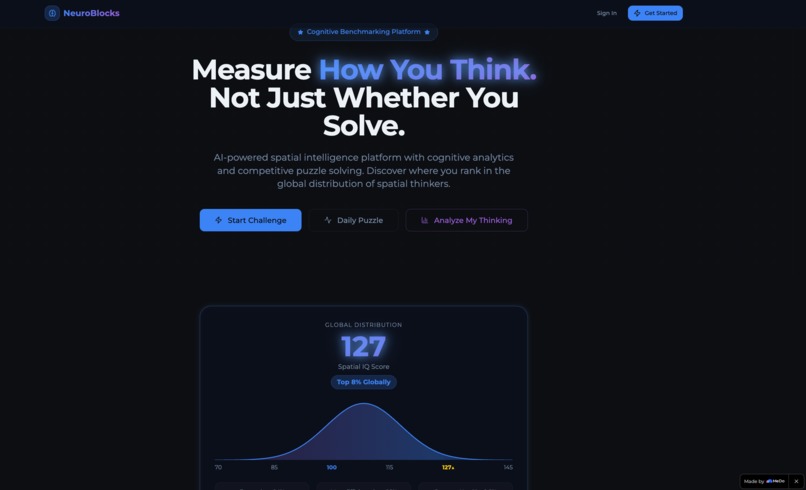
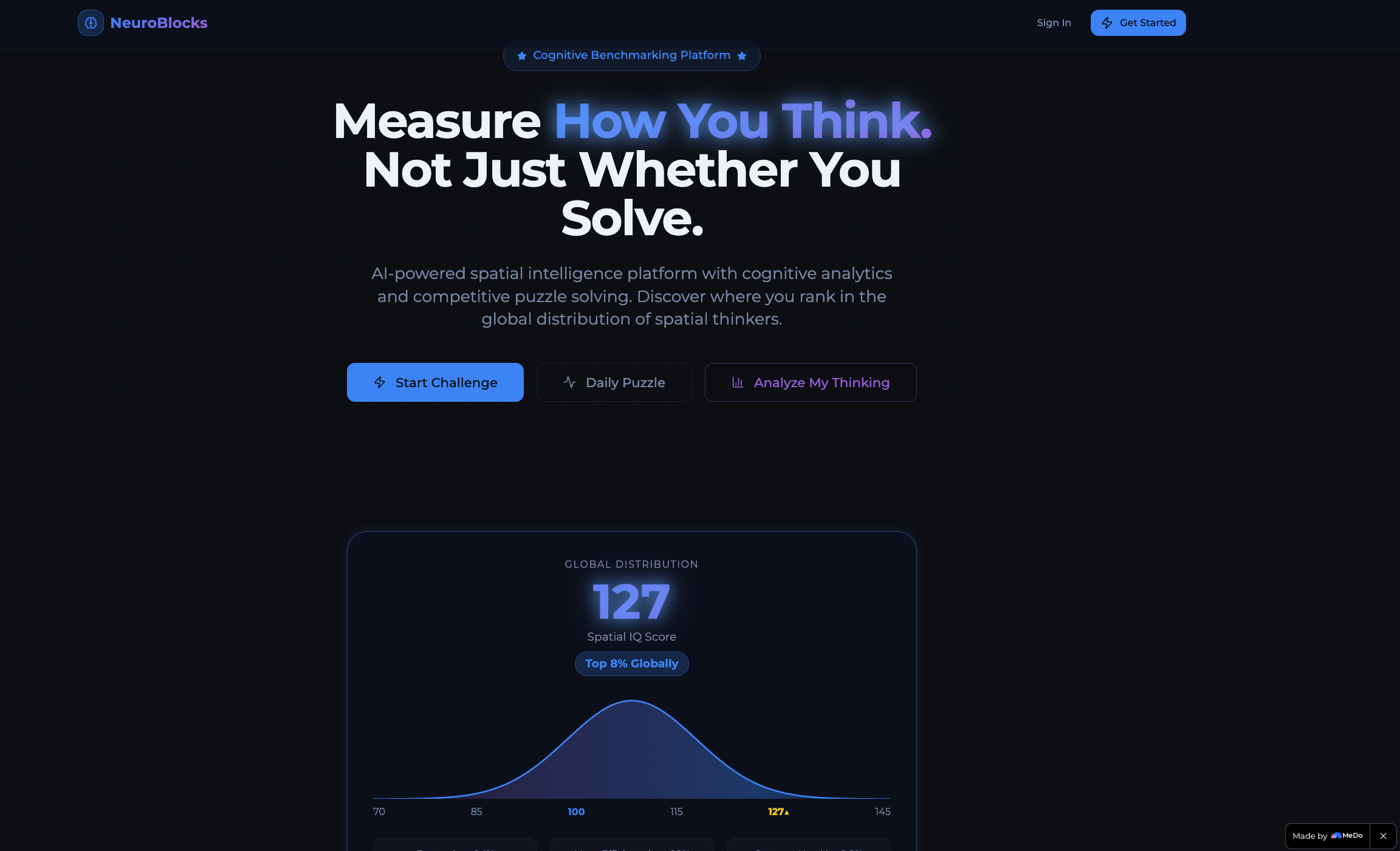
Home page
-
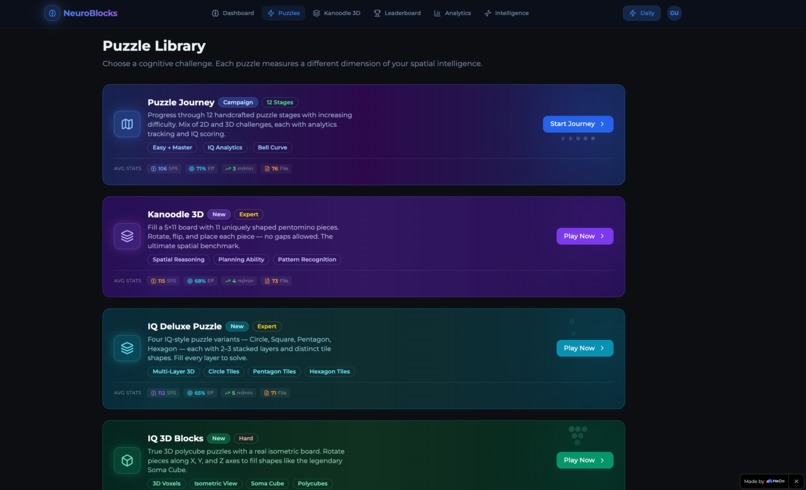
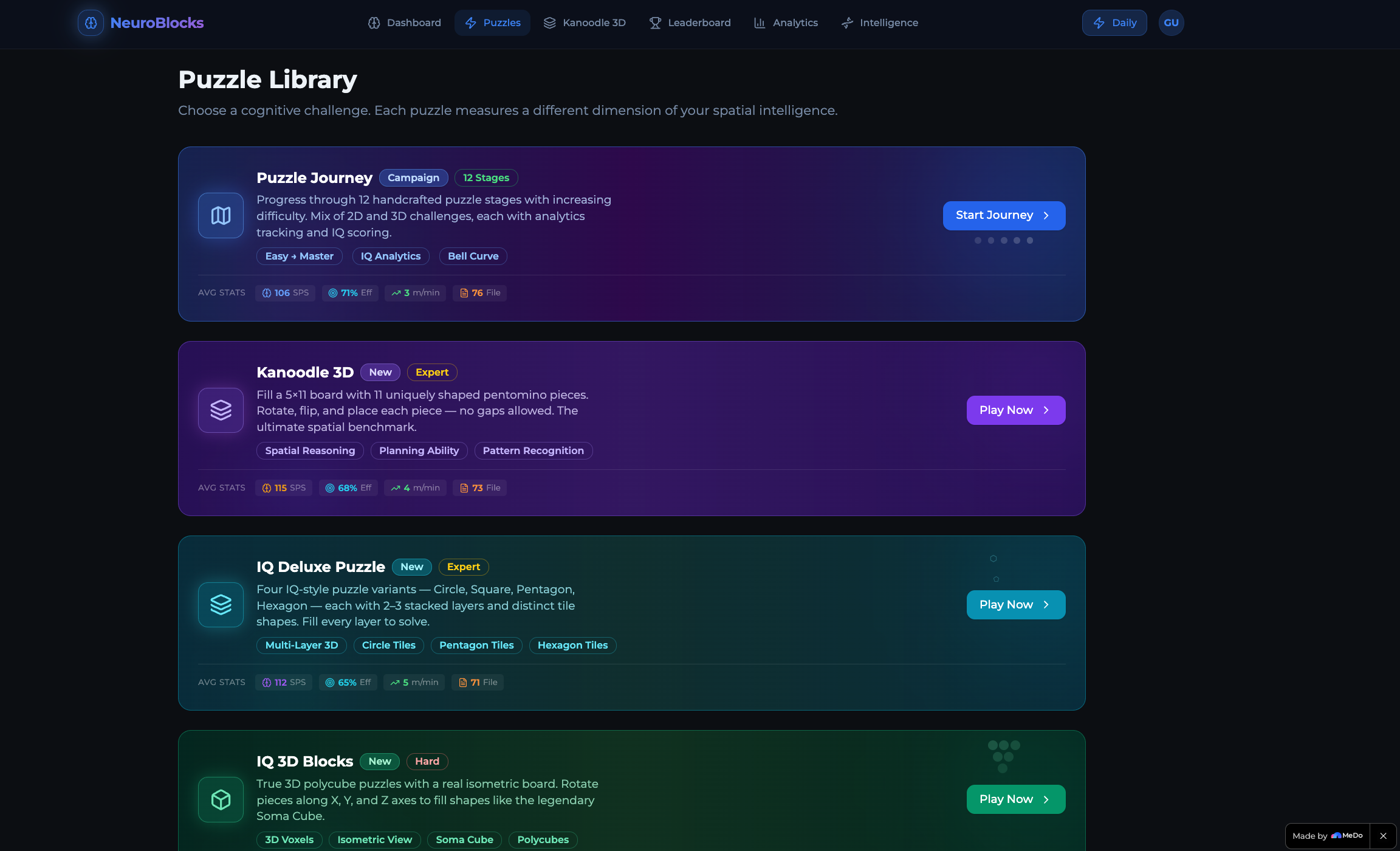
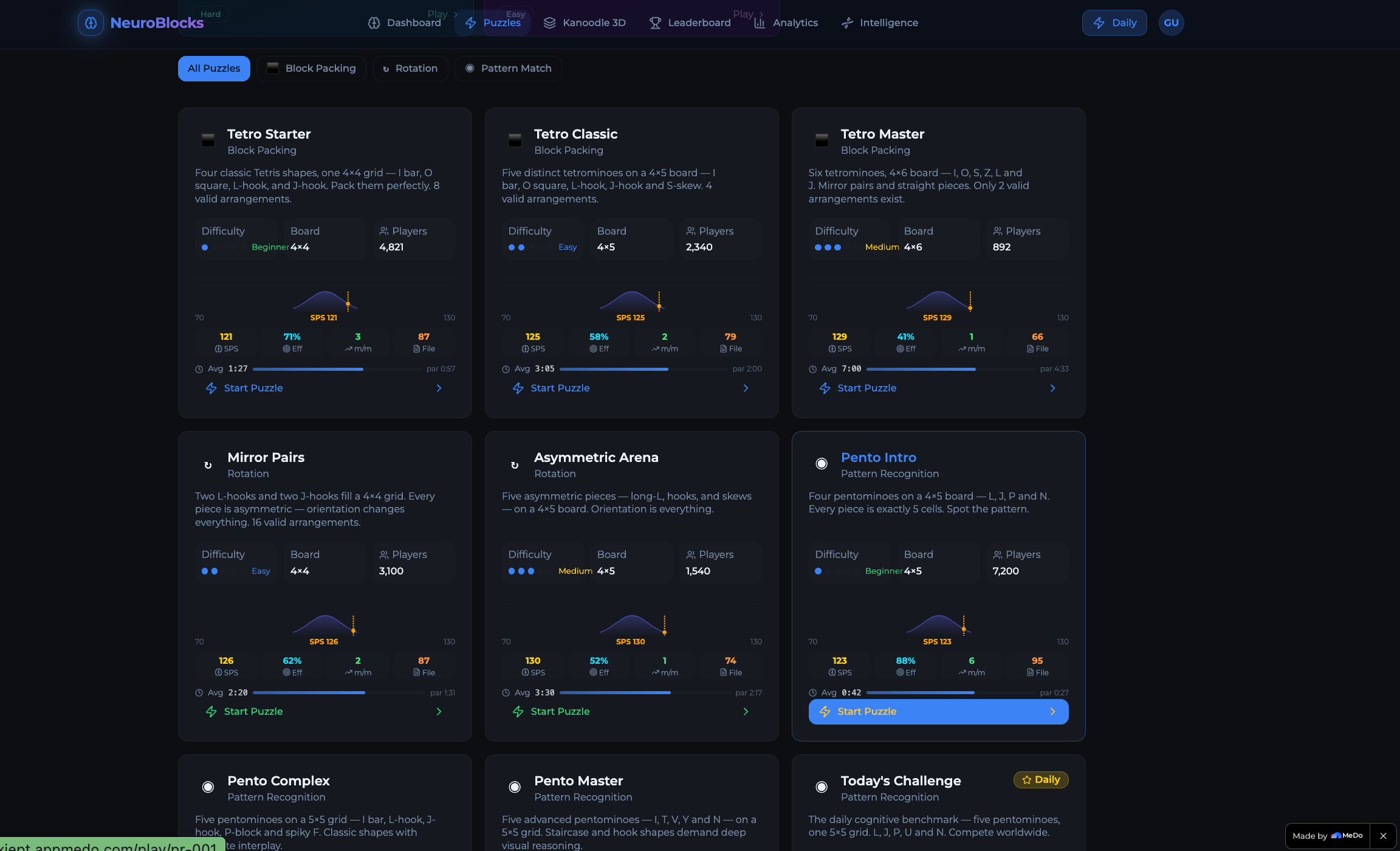
Puzzle Library: Each puzzle measures a different dimension of your spatial intelligence.
-
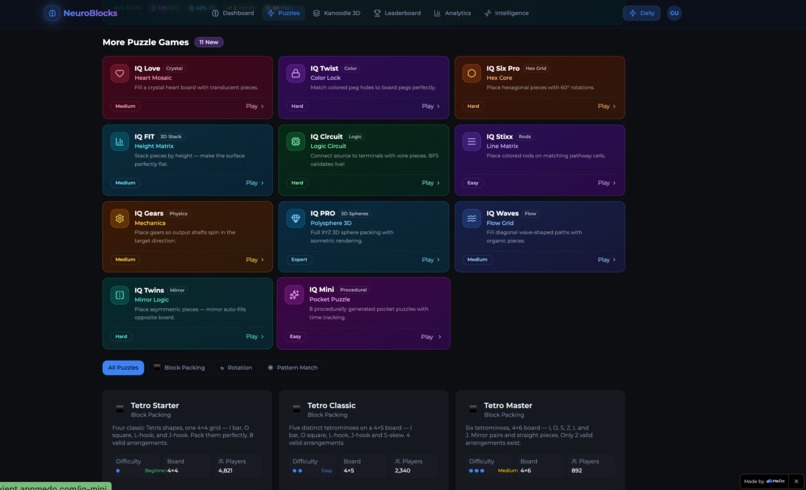
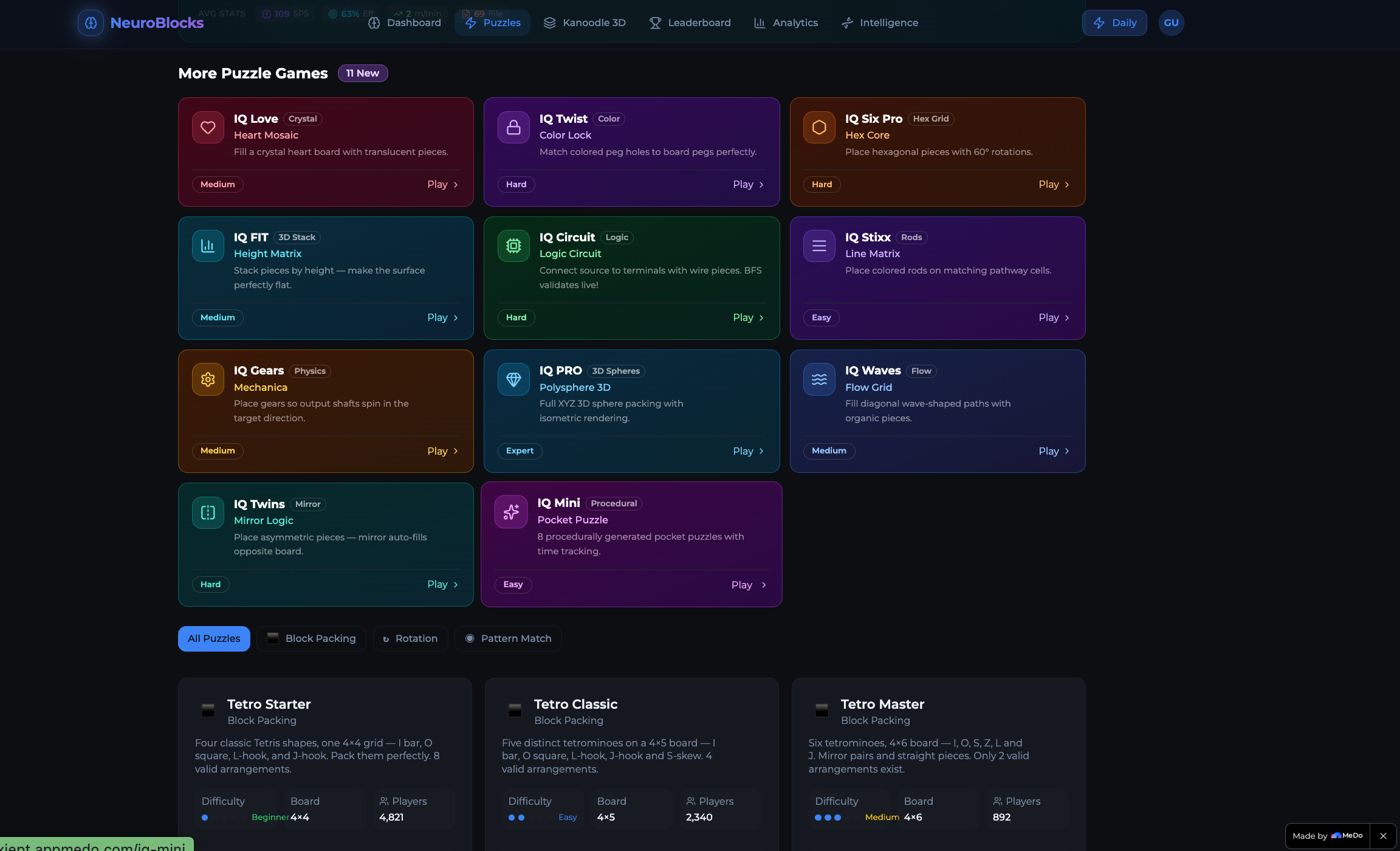
11 IQ Puzzle Games
-
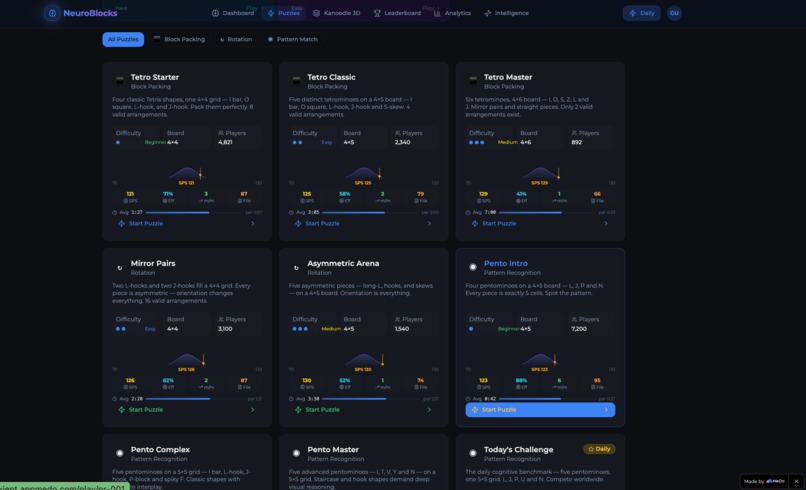
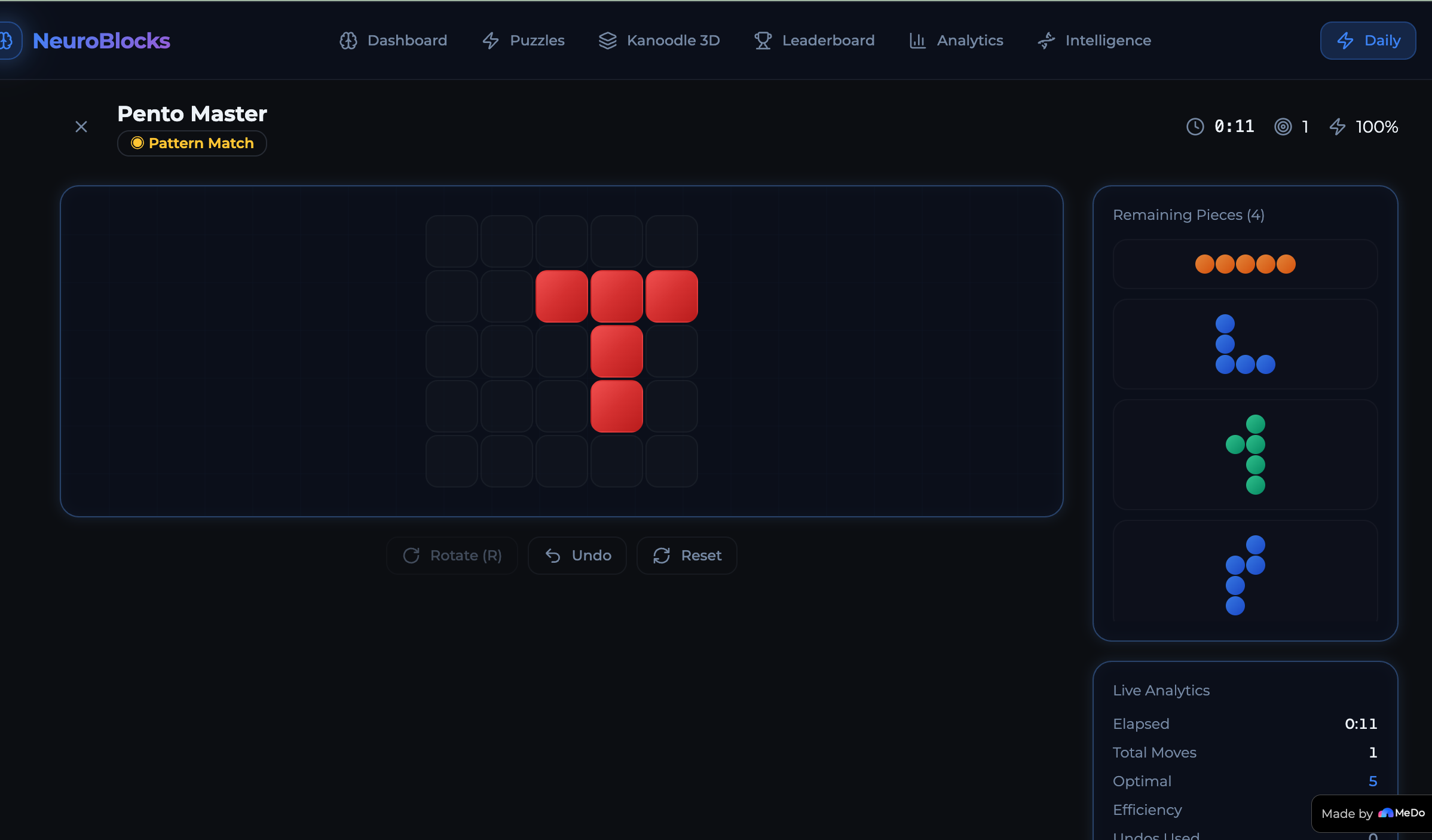
All Puzzles include Block Packing, Rotation and Pattern Match
-
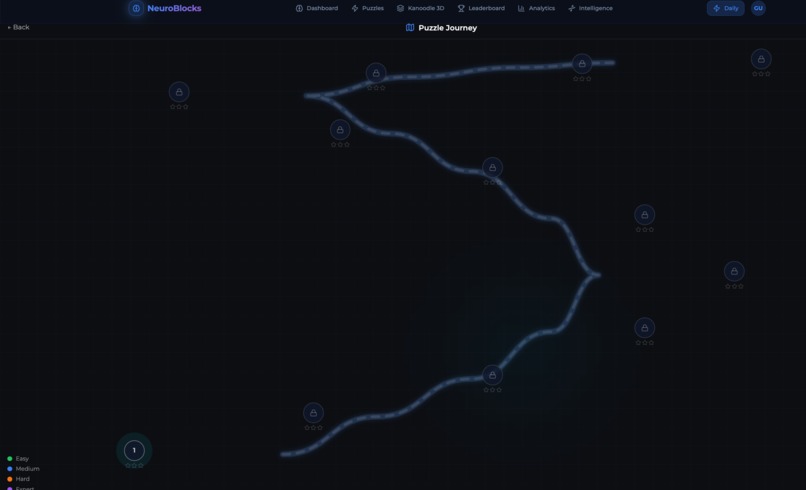
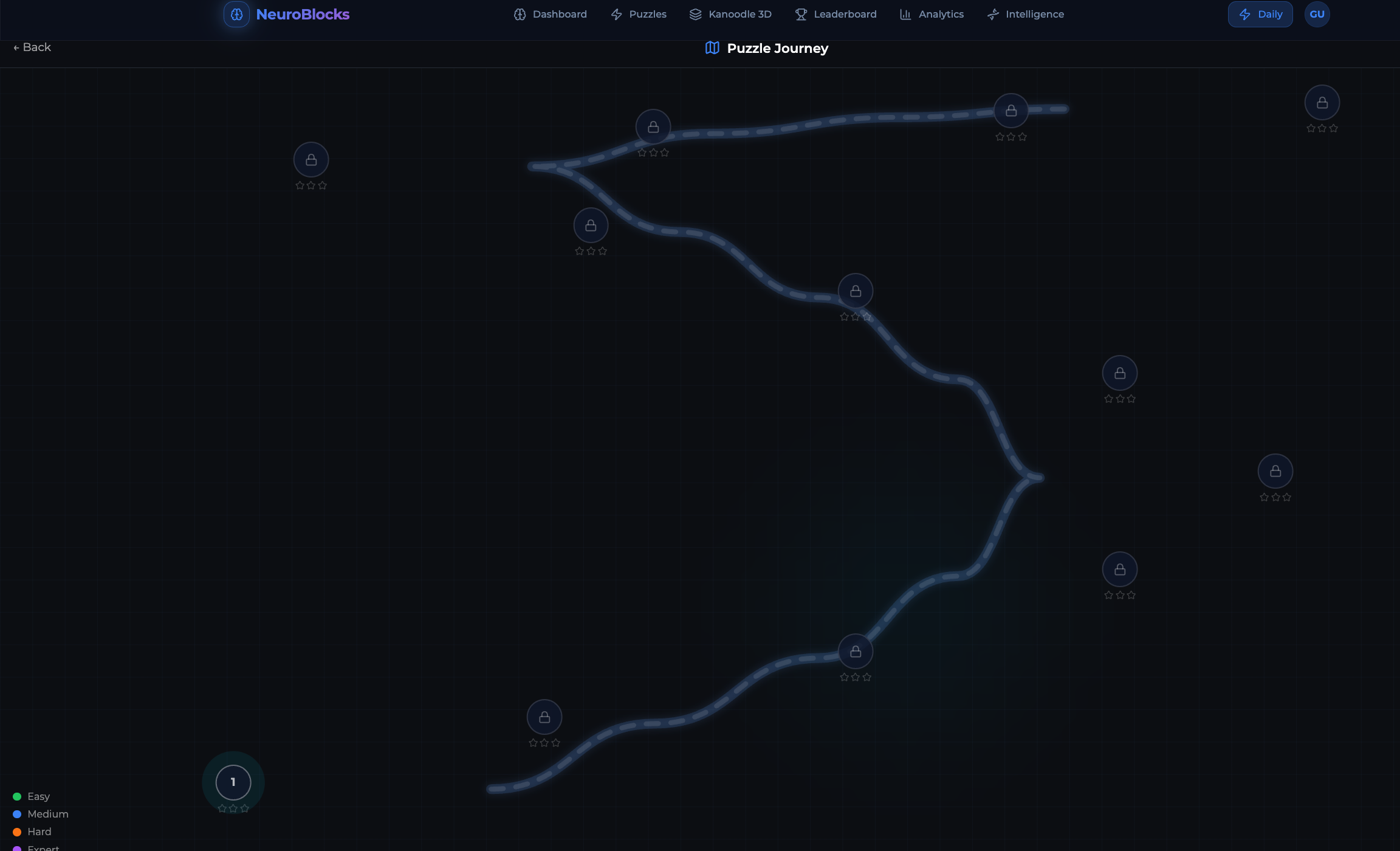
Gameprogress through 12 handcrafted puzzle stages
-
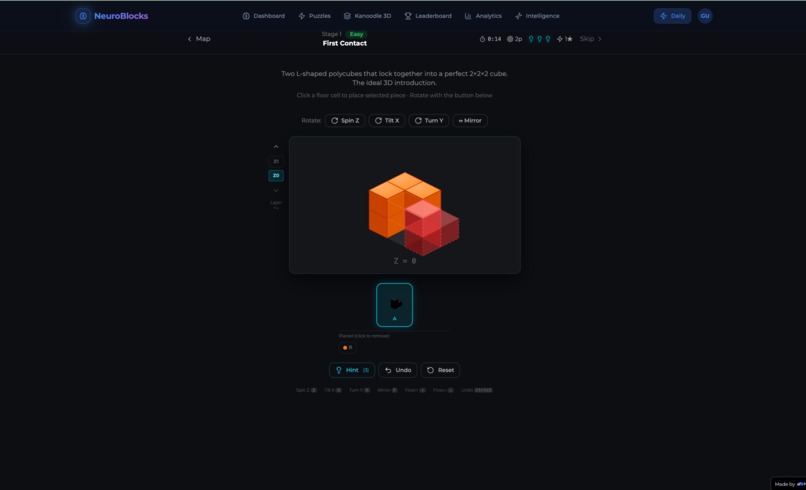
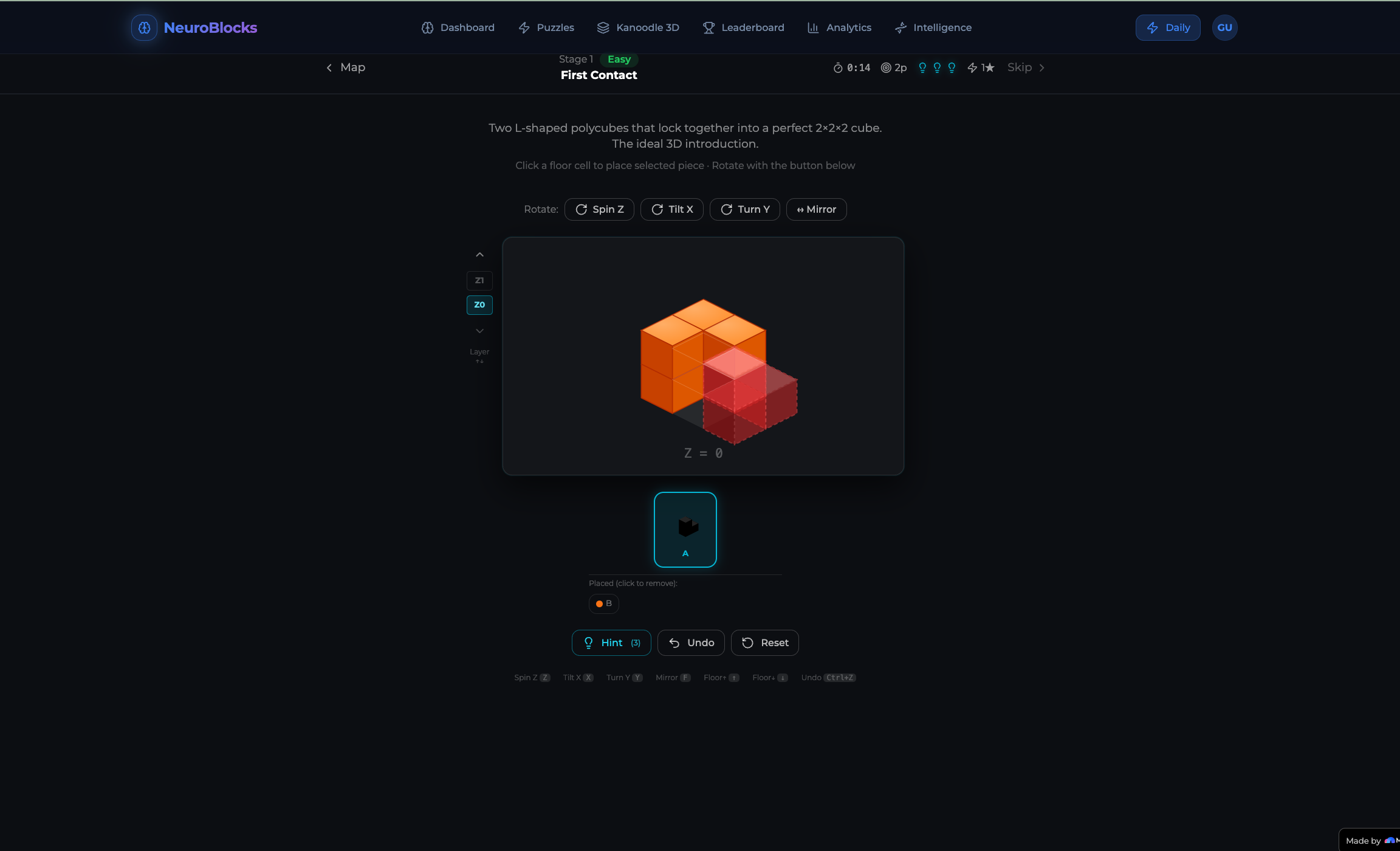
3D sample game : Two L-shaped polycubes that lock together into a perfect 2×2×2 cube. The ideal 3D introduction.
-
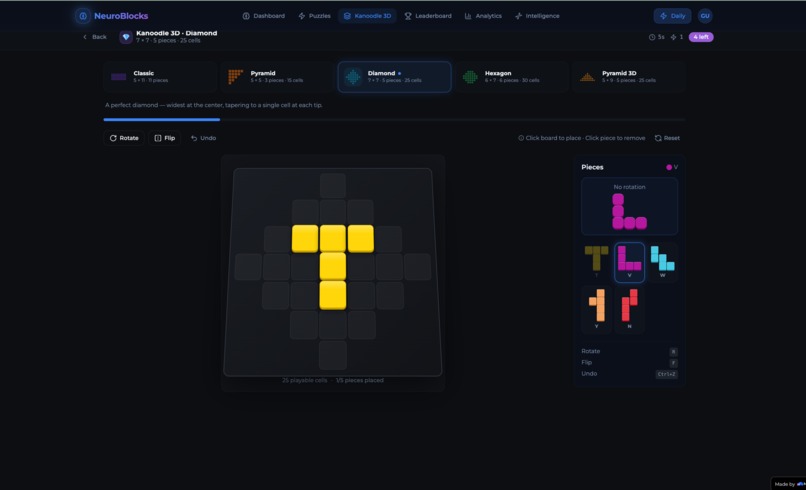
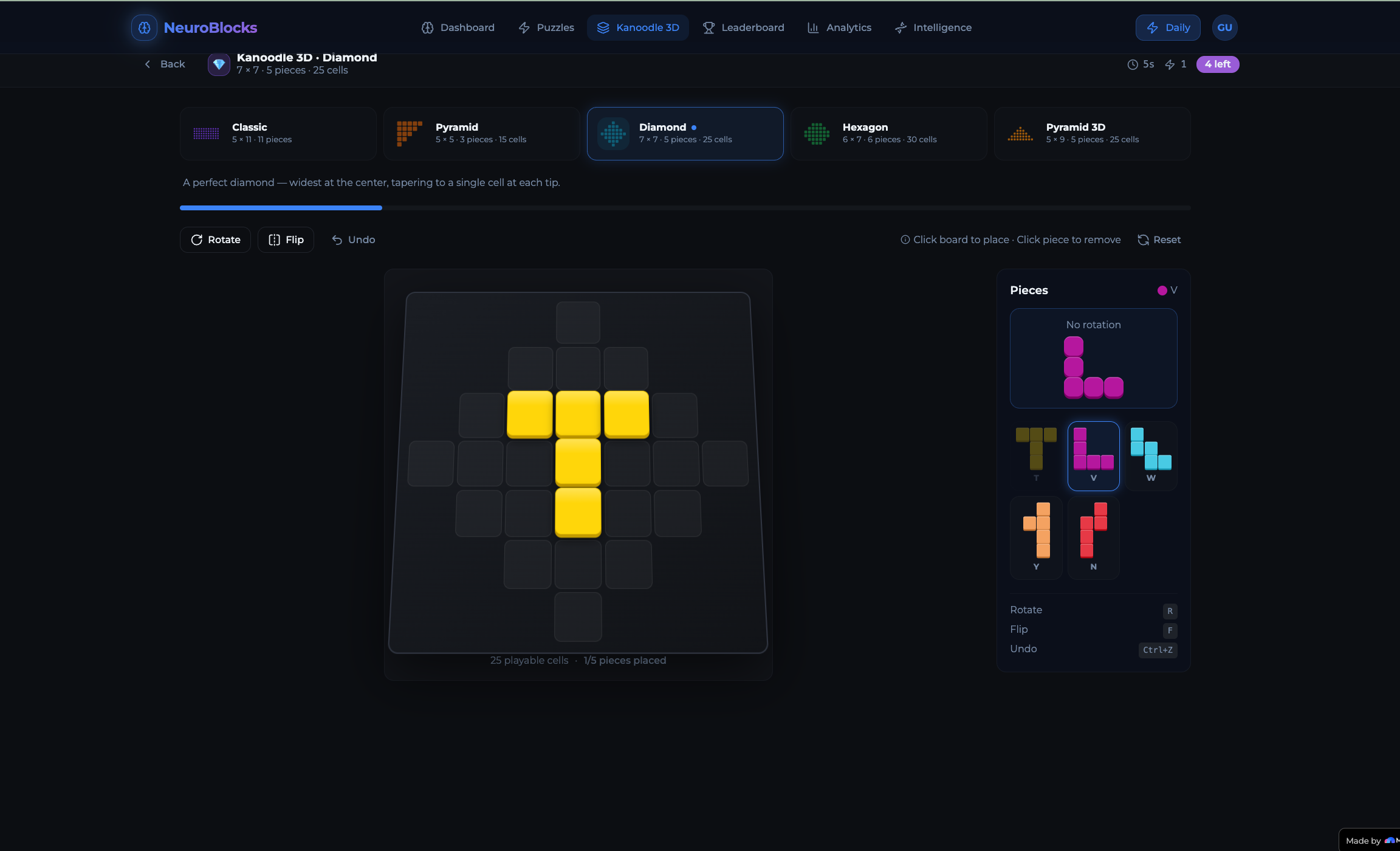
Kanoodle 3D Classic: A perfect diamond — widest at the center, tapering to a single cell at each tip.
-
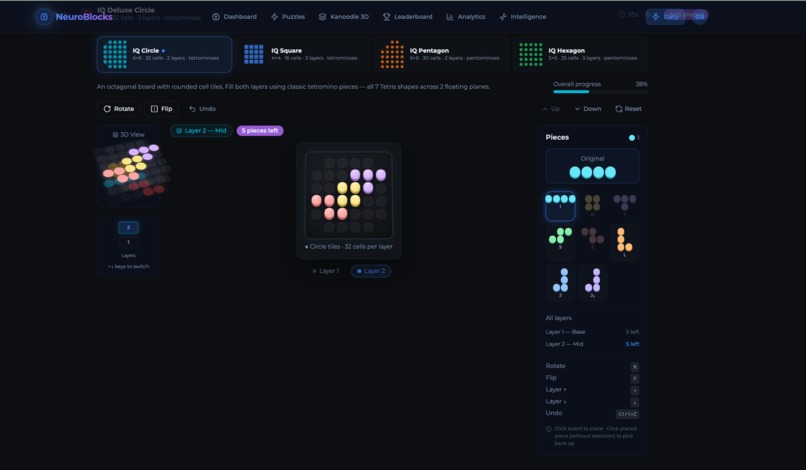
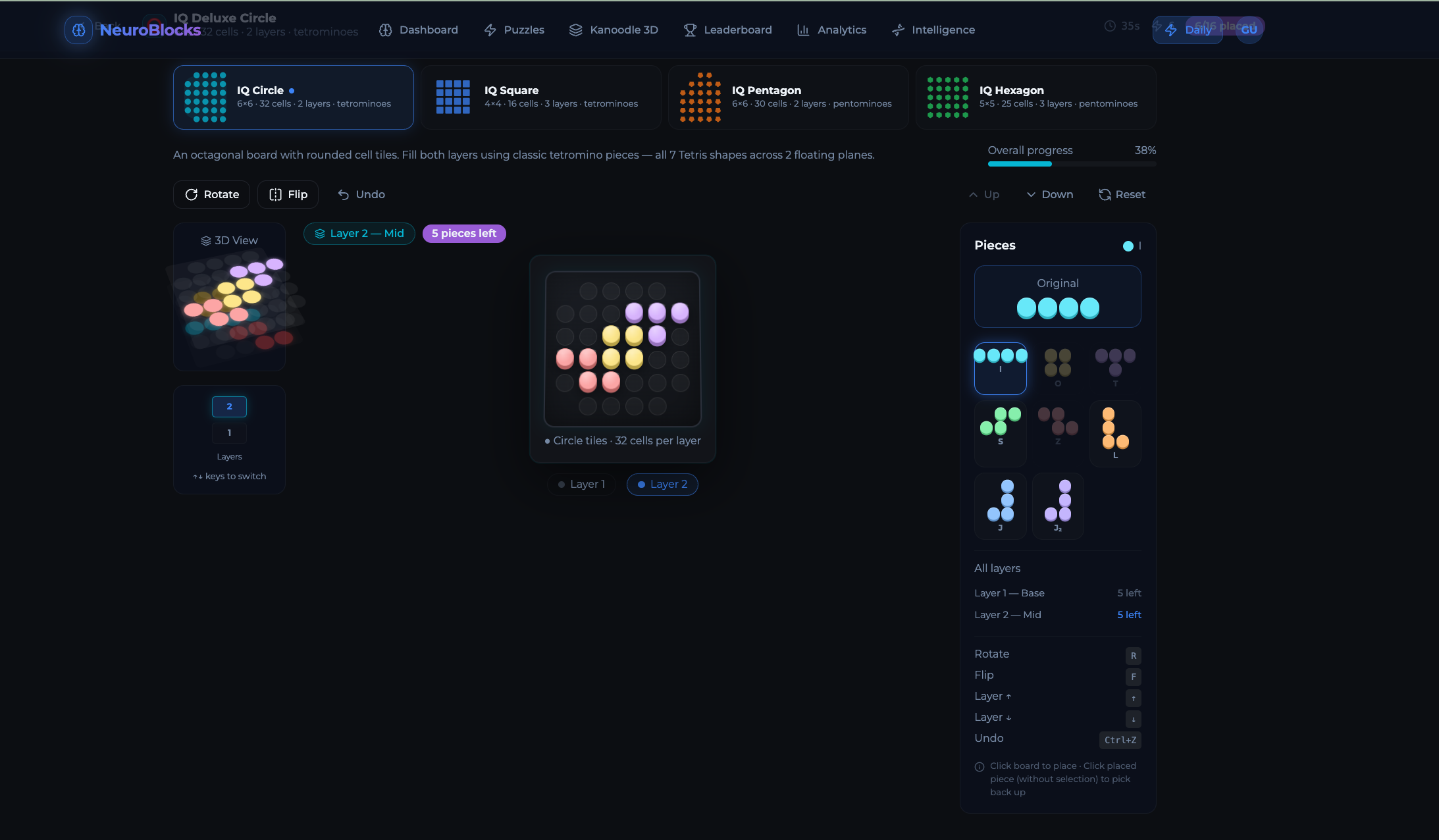
IQ Deluxe Circle: An octagonal board with rounded cell tiles.
-
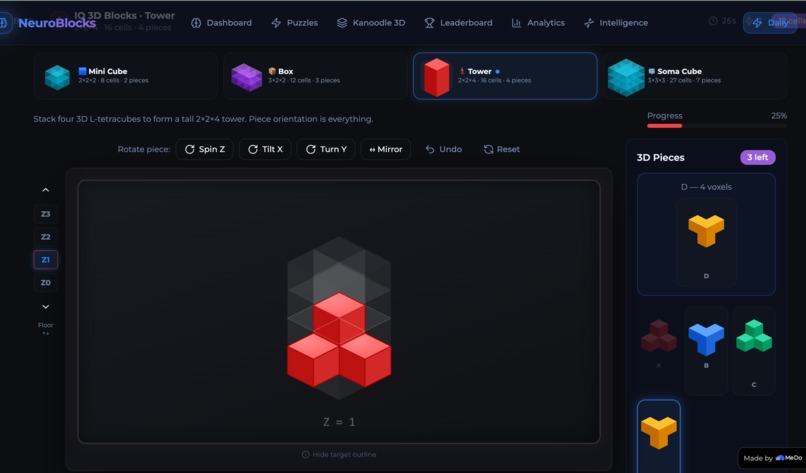
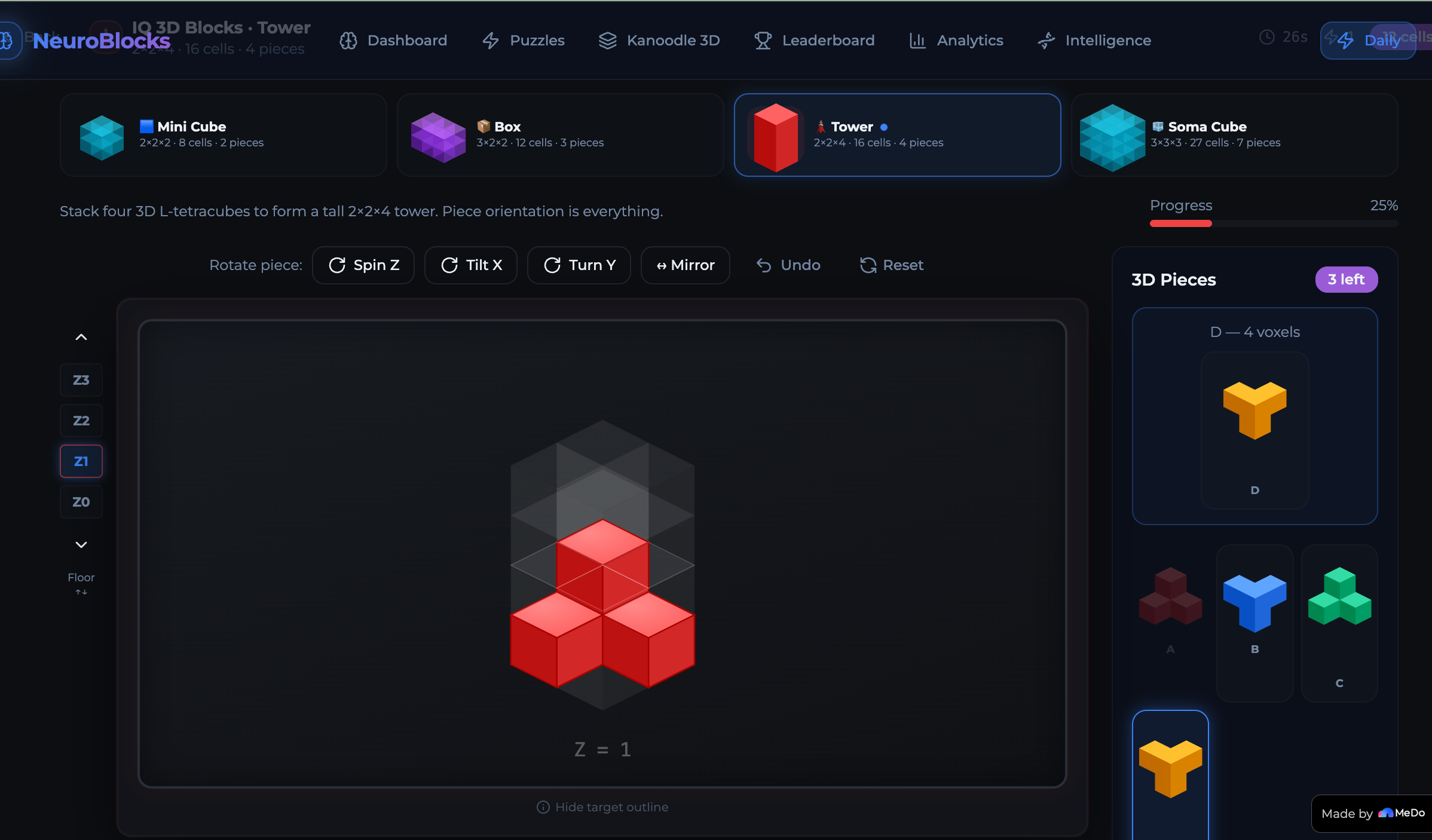
IQ 3D Blocks · Mini Cube
-
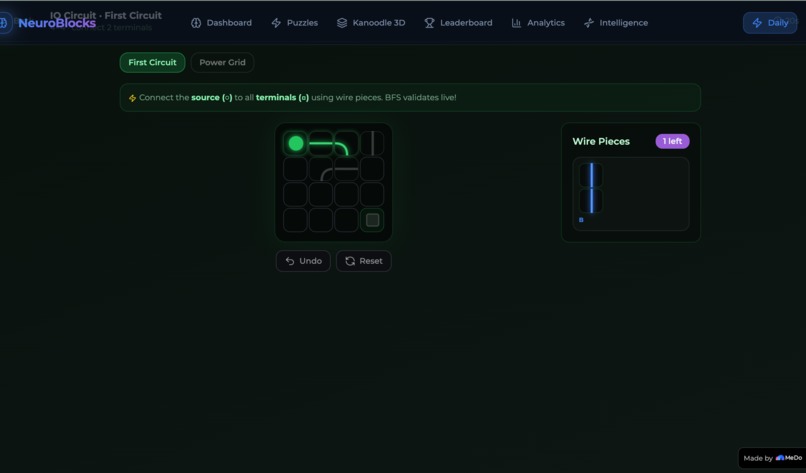
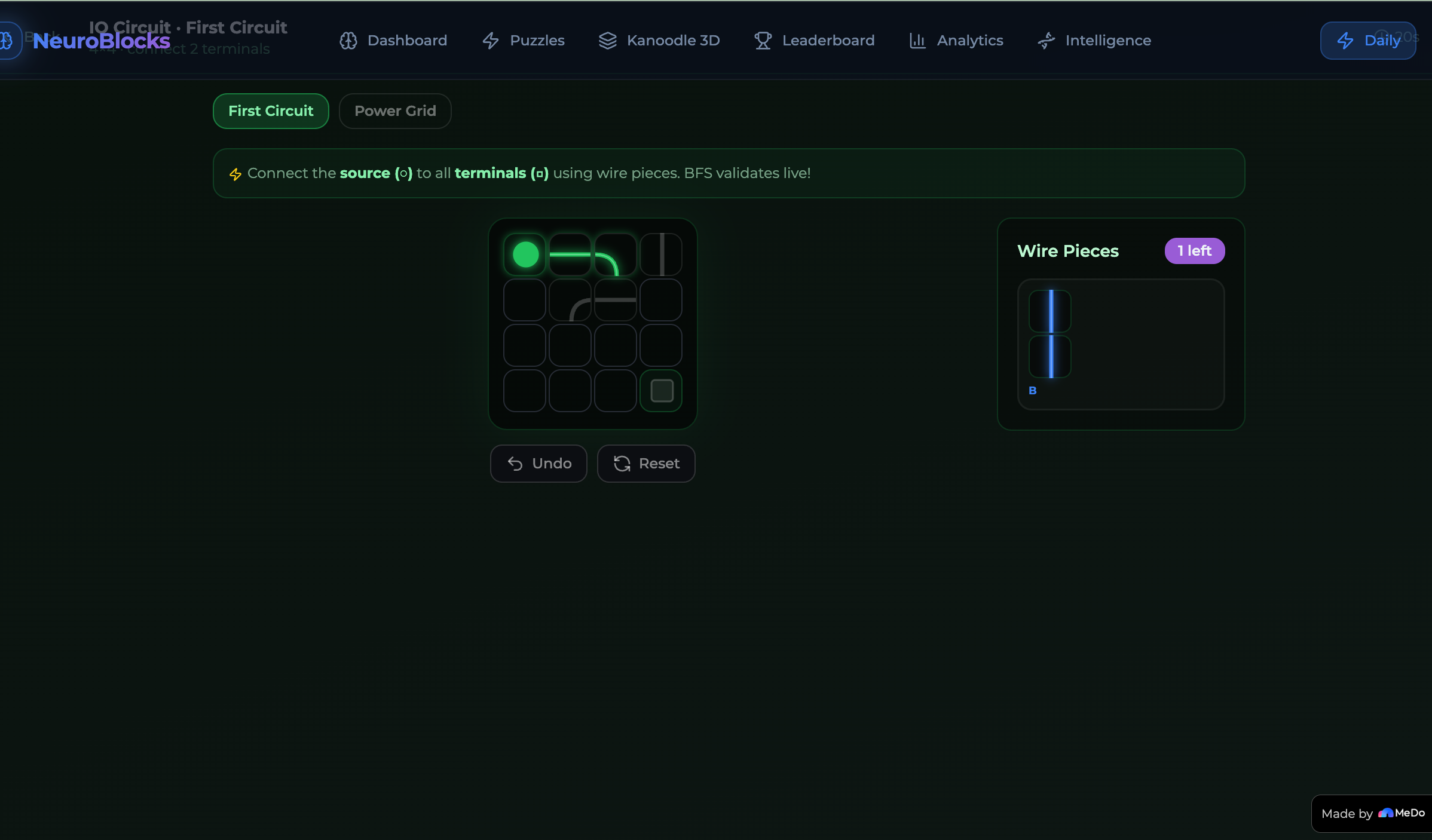
IQ Circuit · First Circuit
-
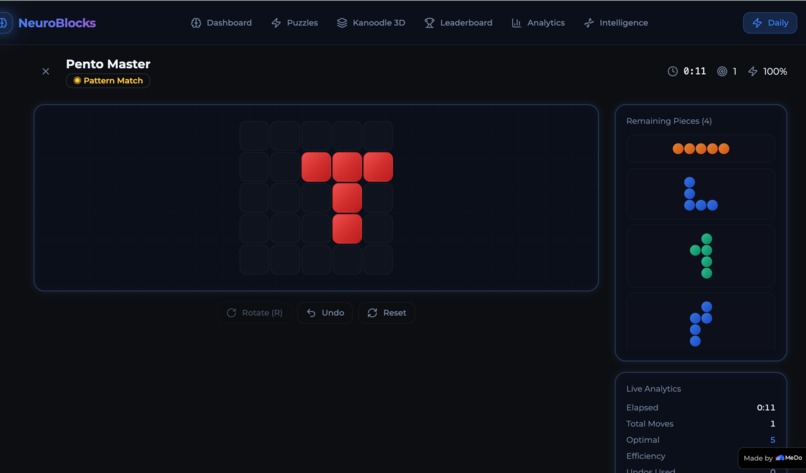
Tetro Starter : Block Packing
-
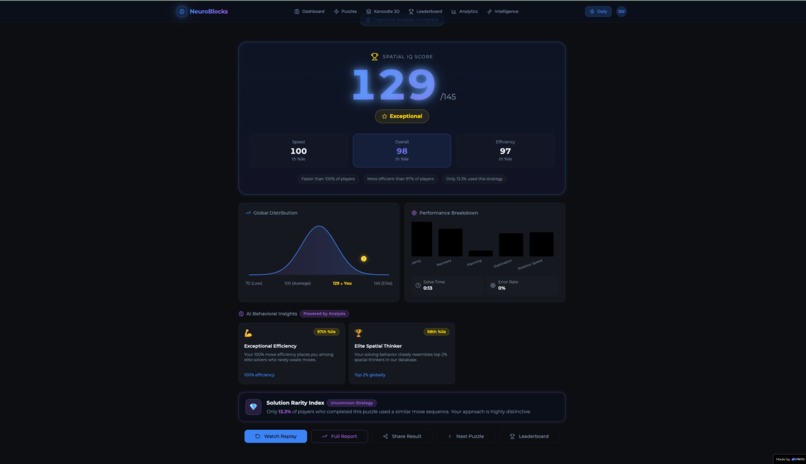
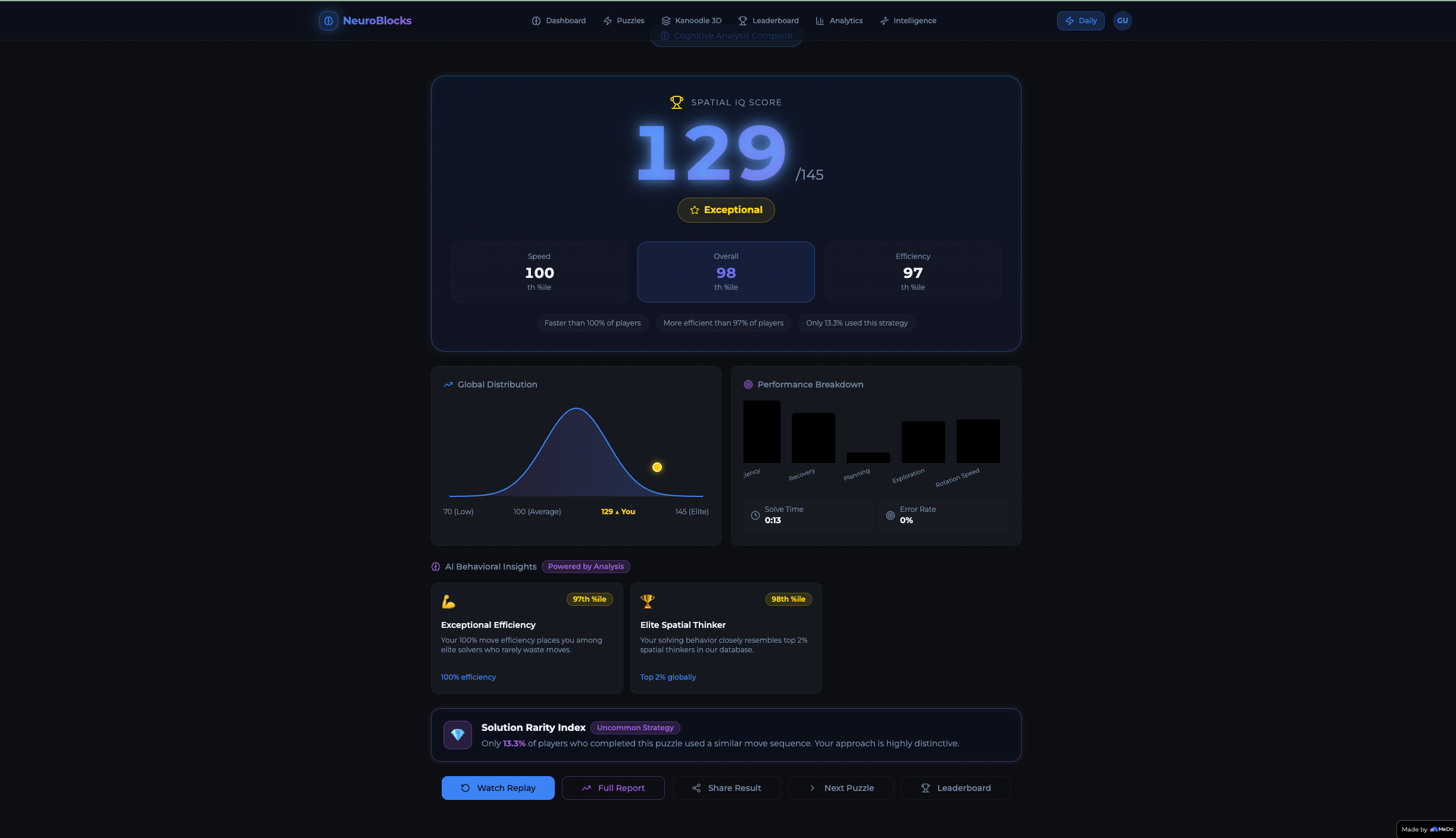
Cognitive Analysis Complete: Spatial IQ Score
-
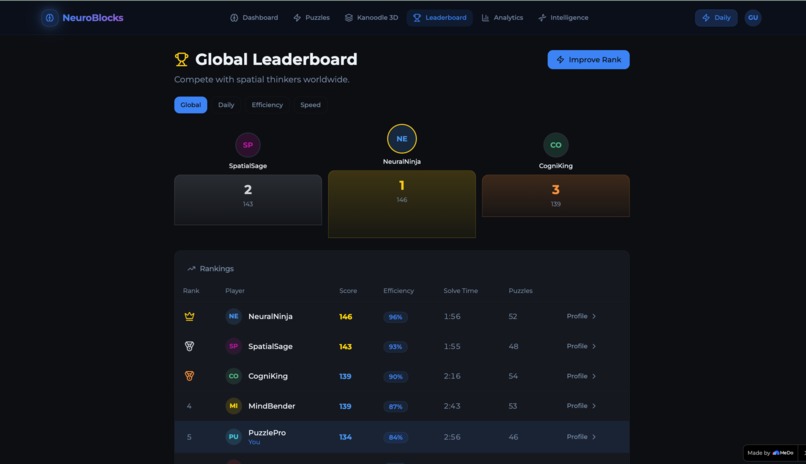
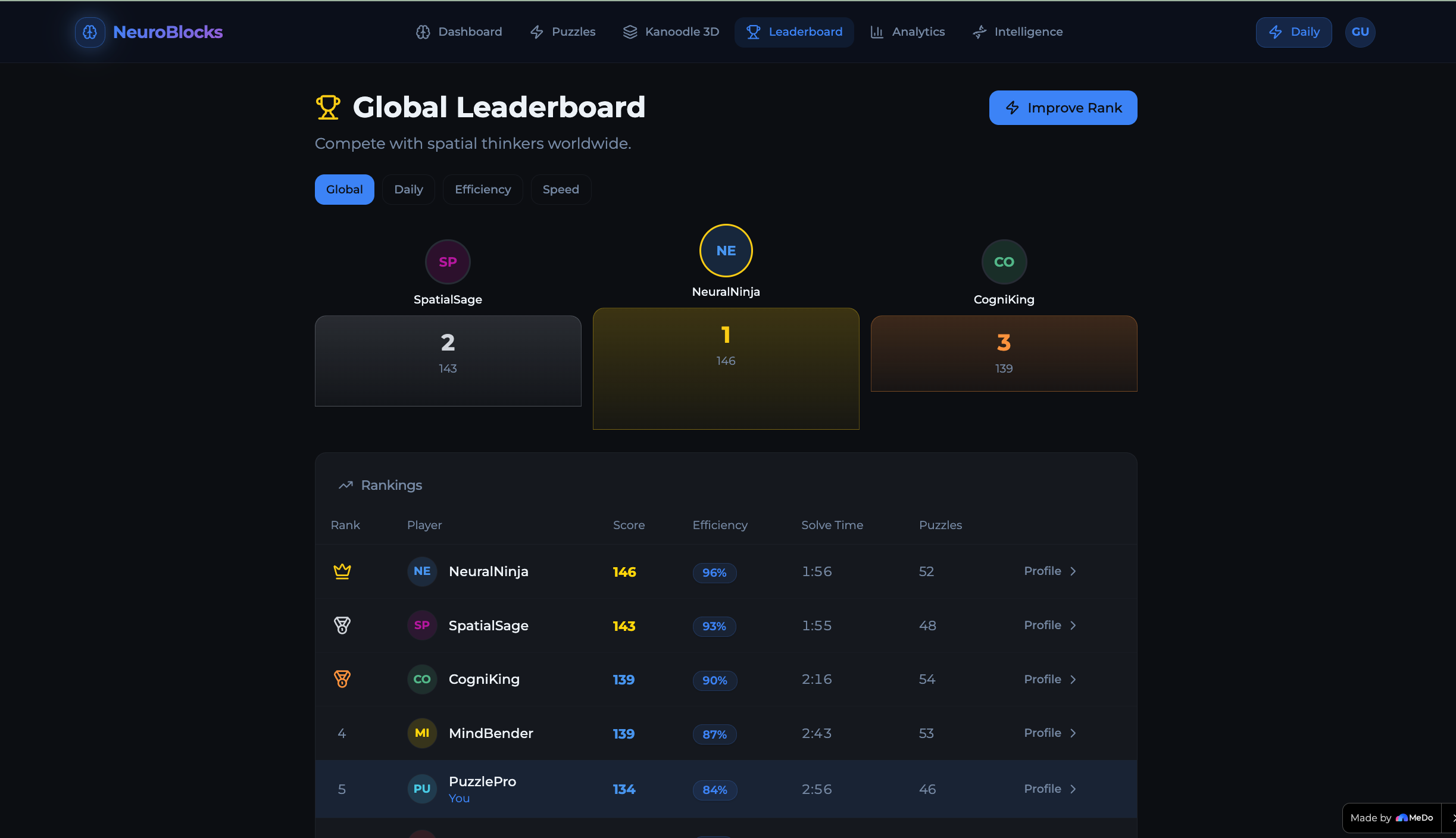
Global Leaderboard Compete with spatial thinkers worldwide.
-
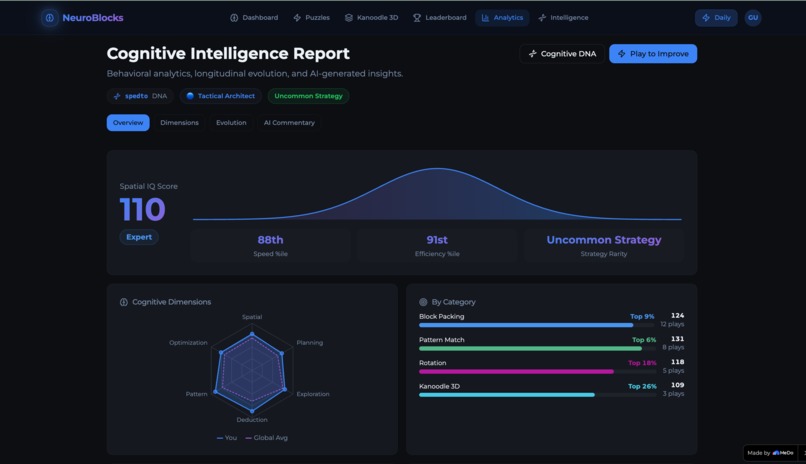
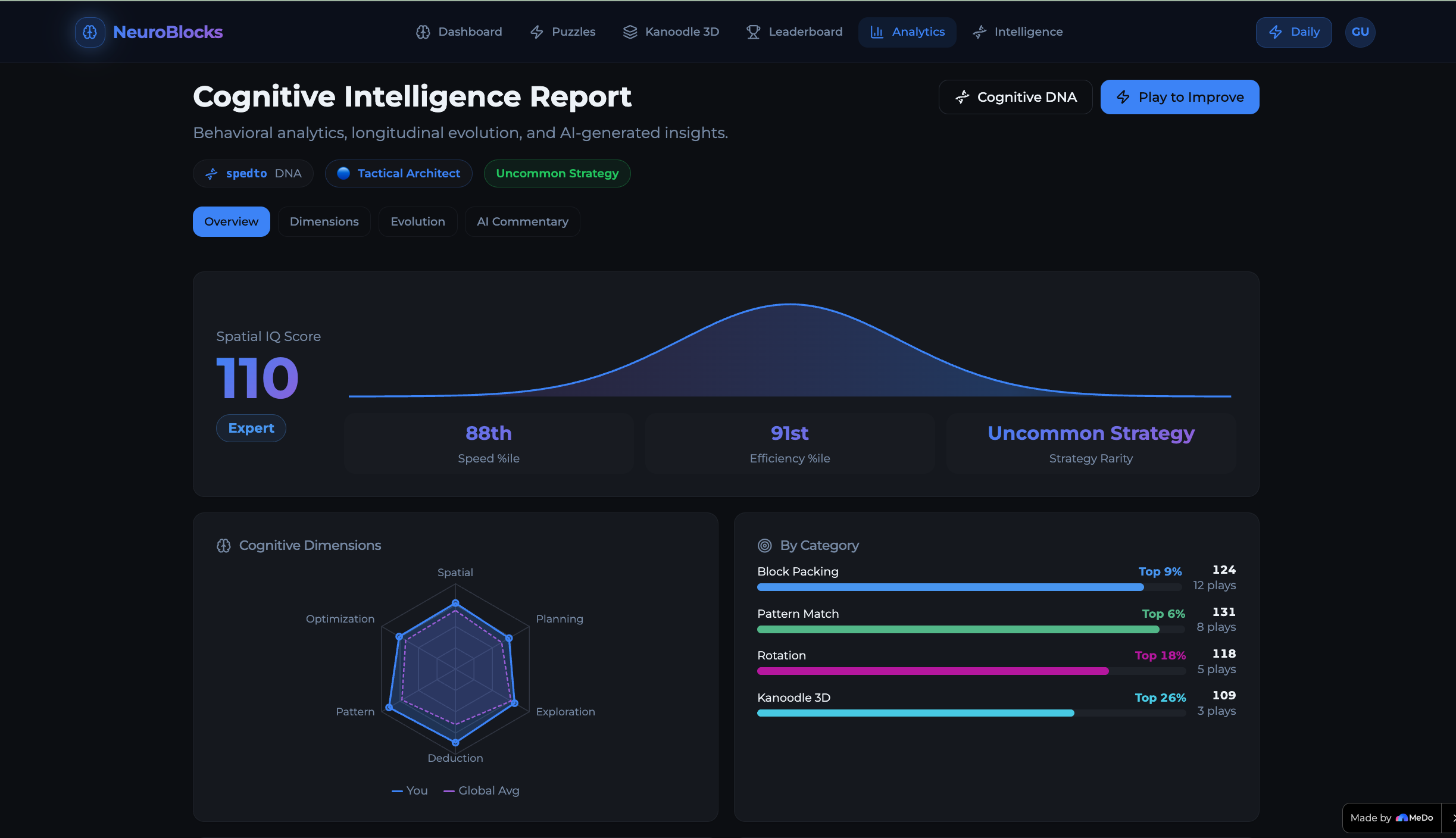
Cognitive Intelligence Report - Overview
-
Cognitive Intelligence Report - Dimensions
-
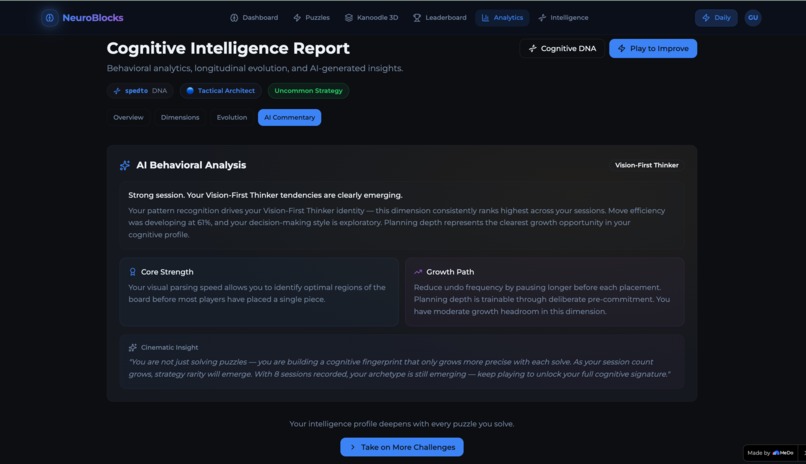
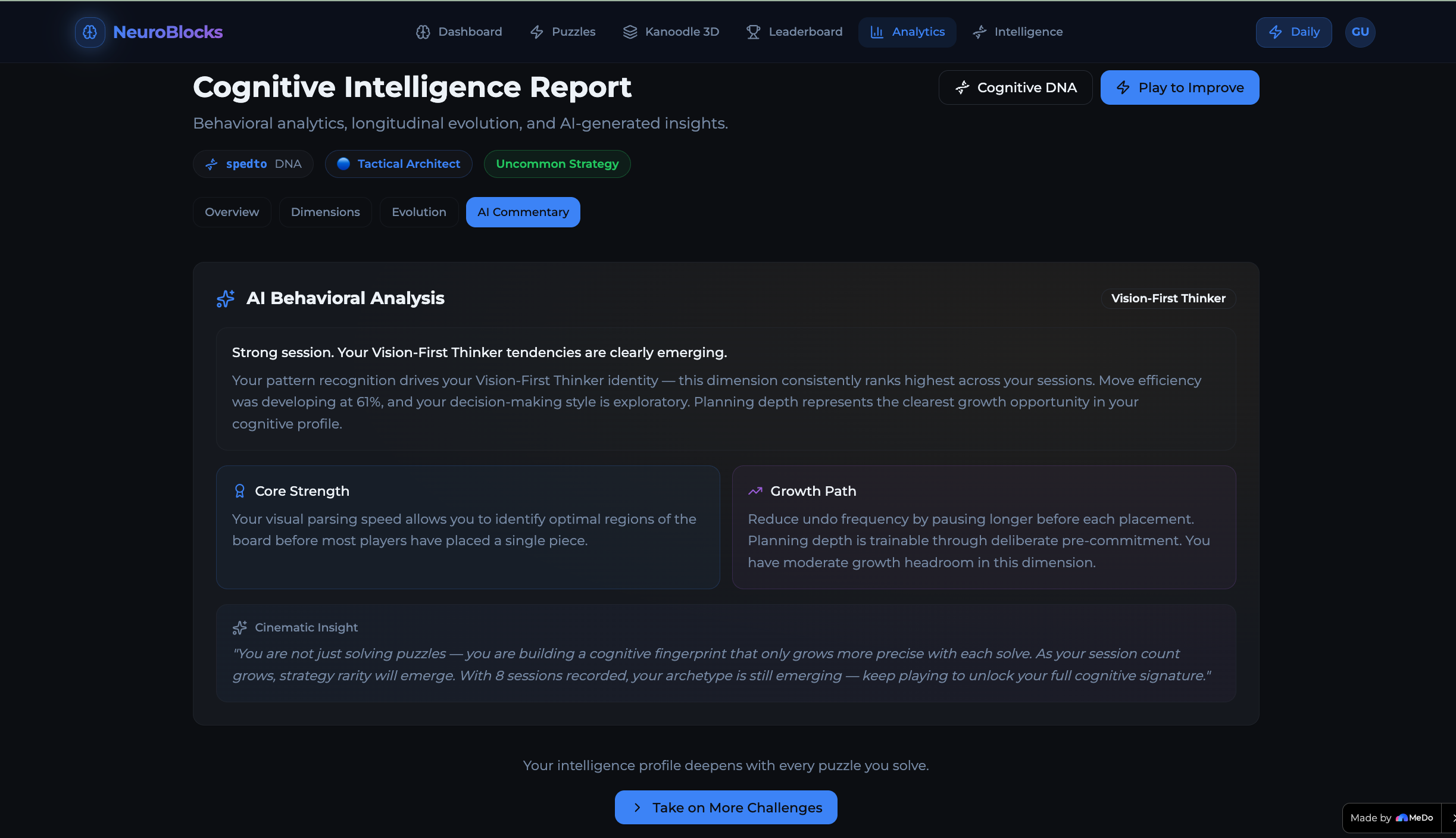
Cognitive Intelligence Report - AI Commentary
-
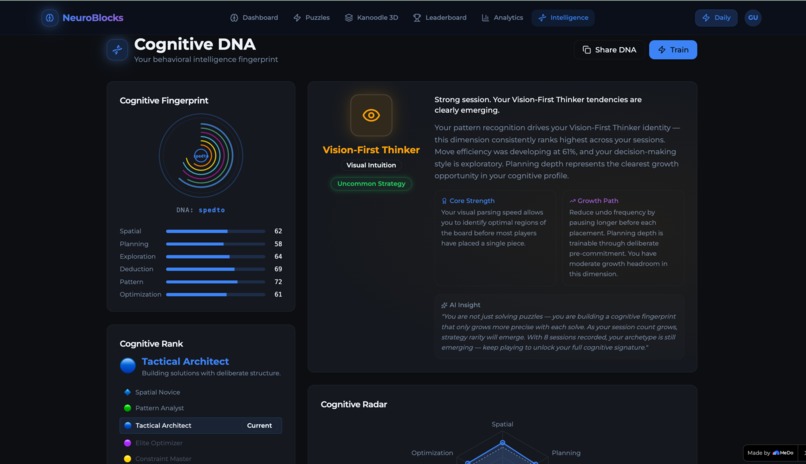
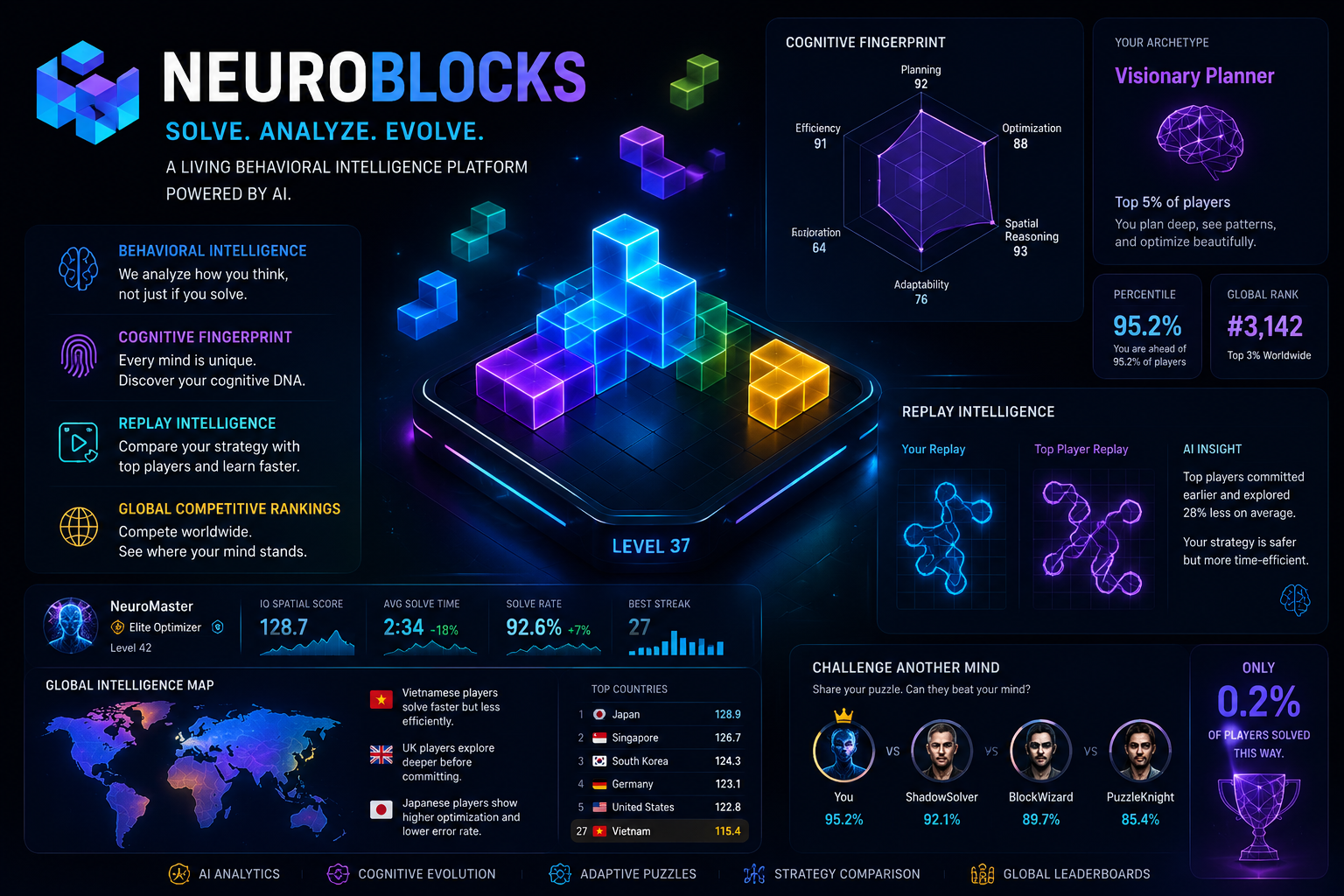
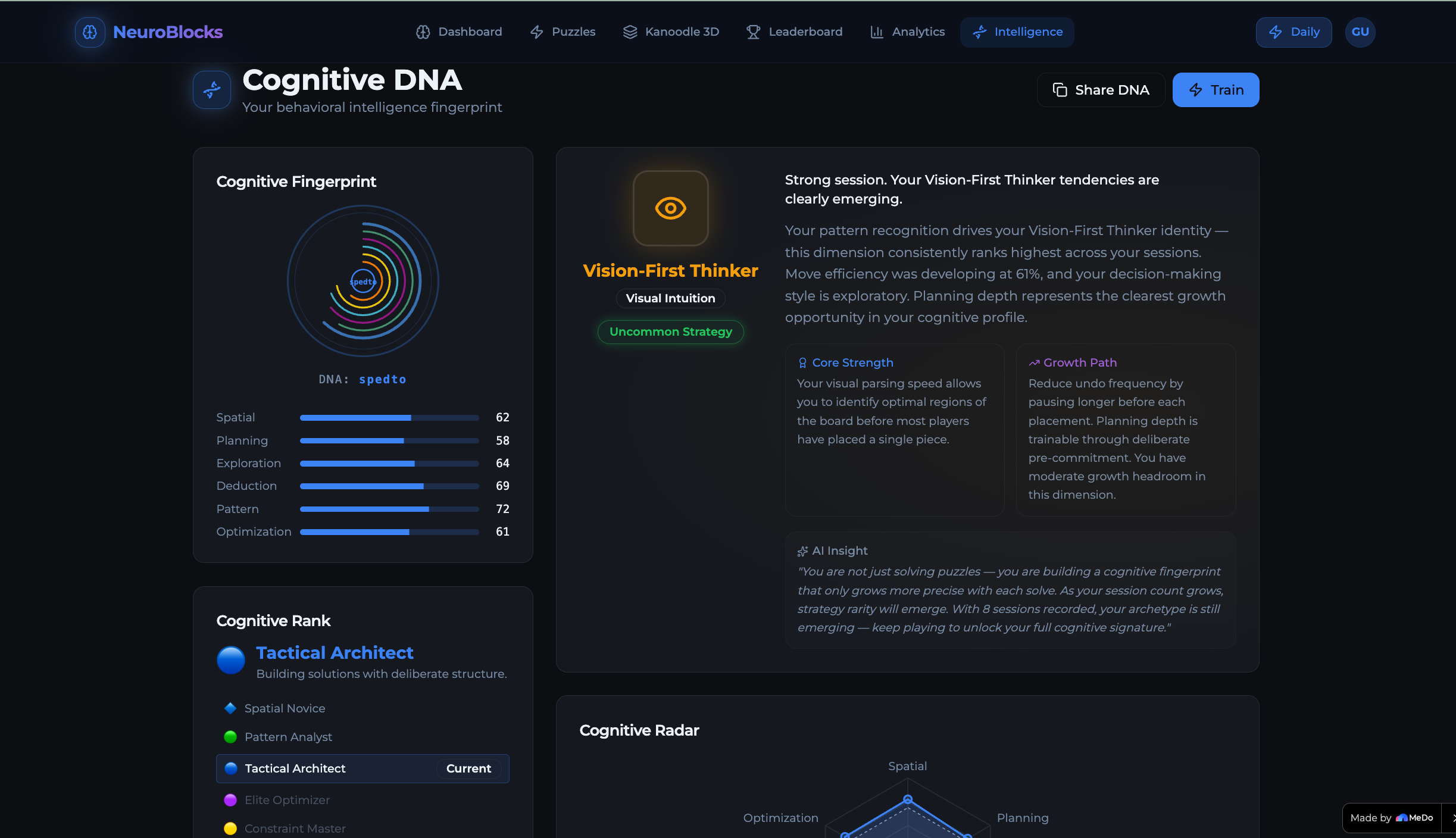
Cognitive DNA
-
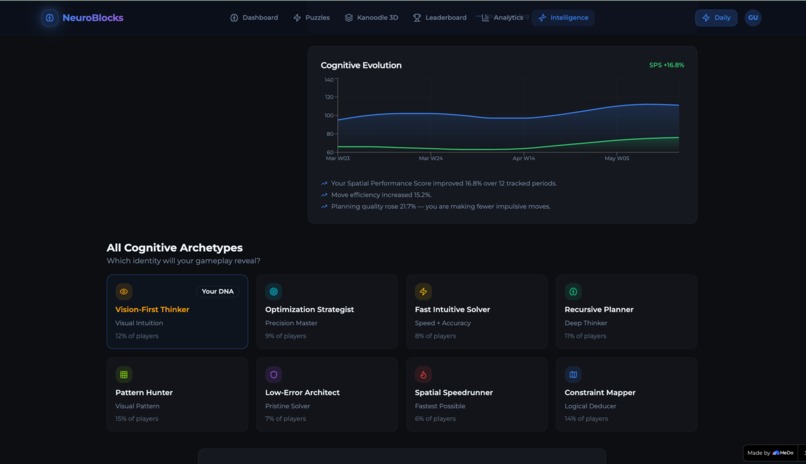
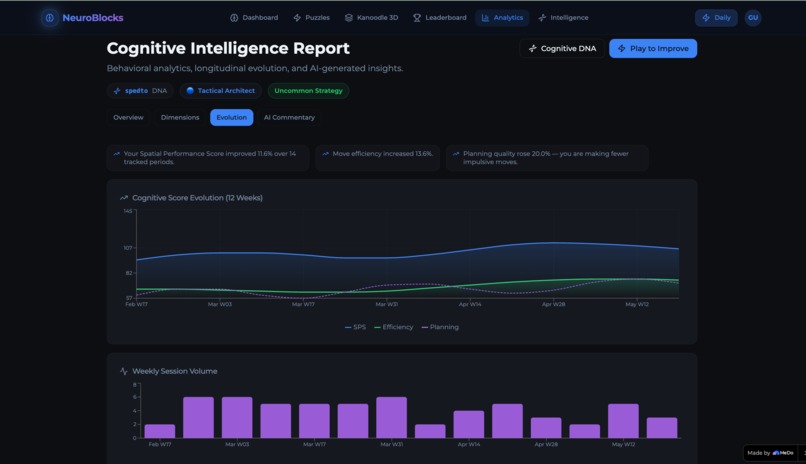
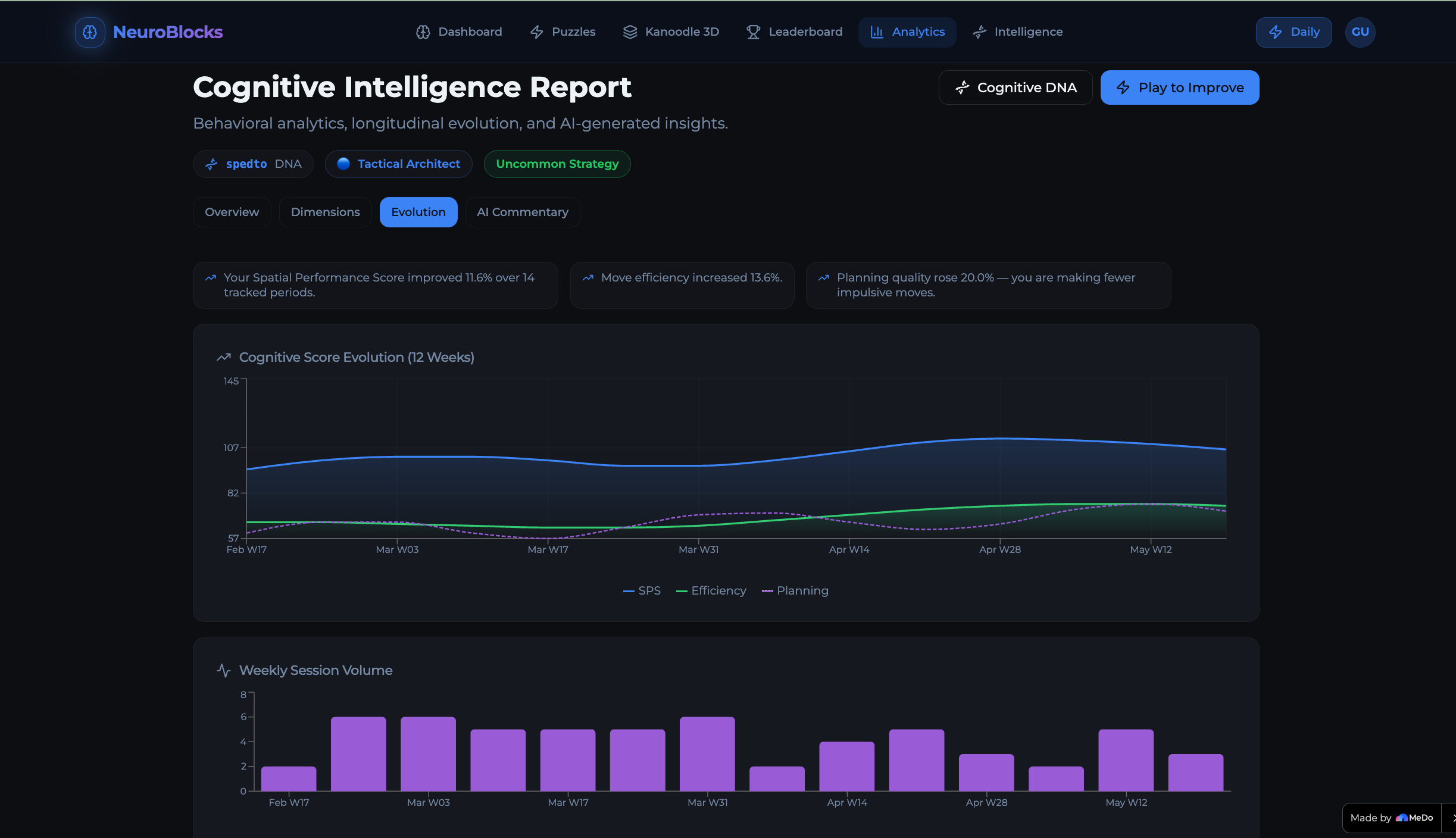
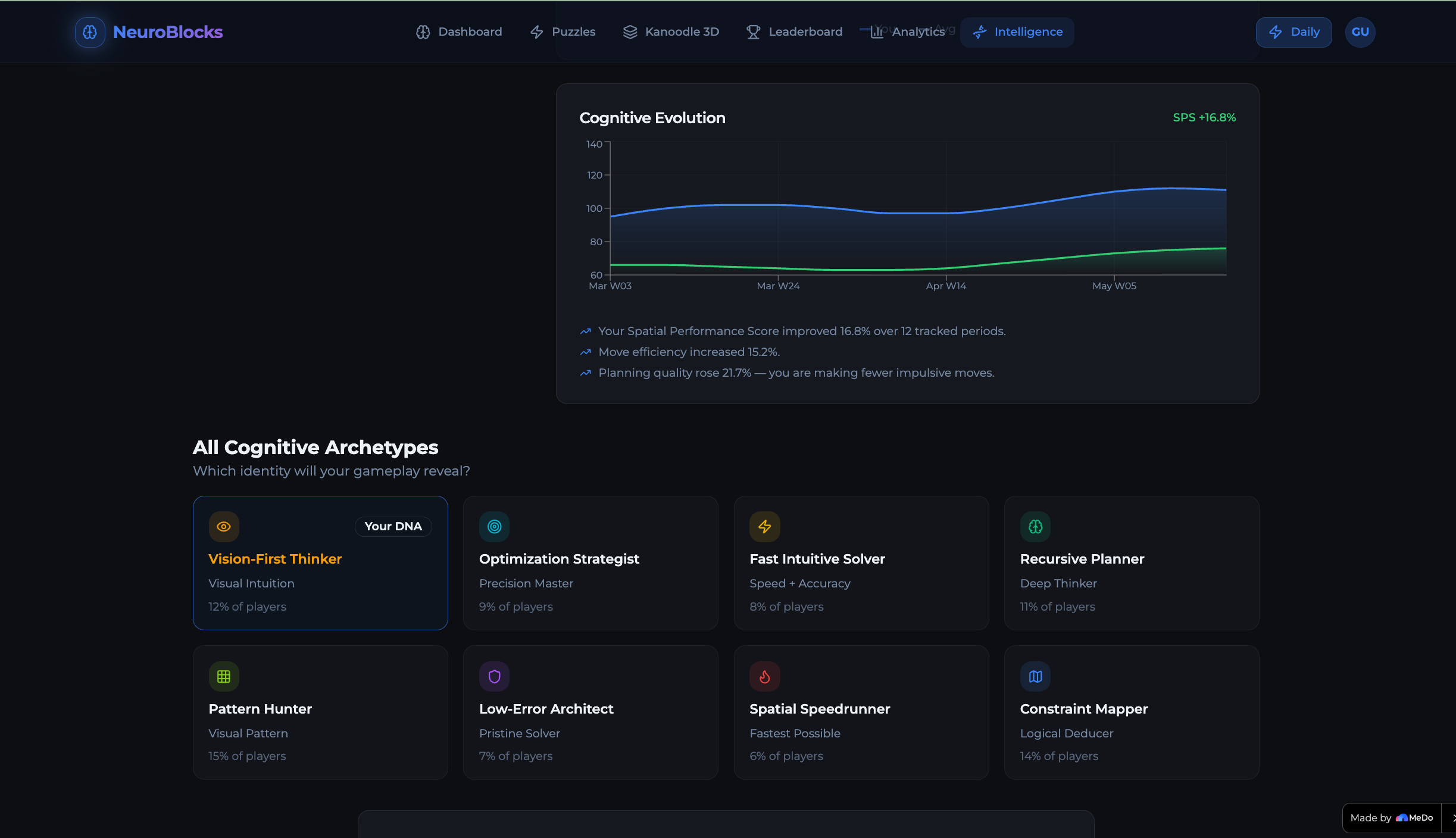
Cognitive Intelligence Report - Evolution
-
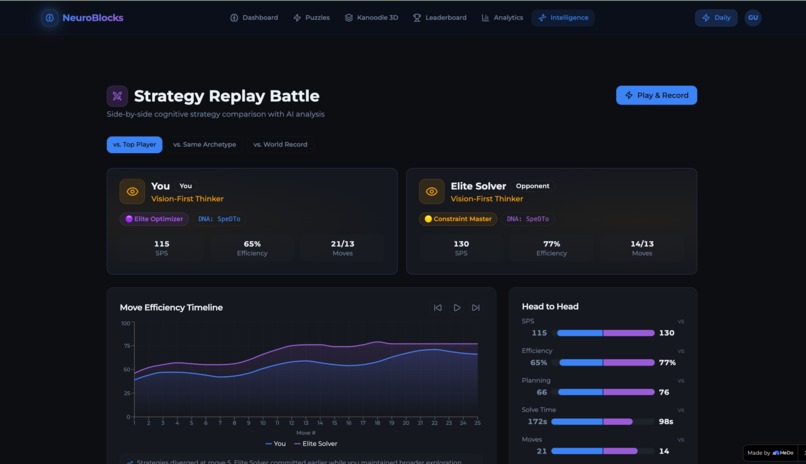
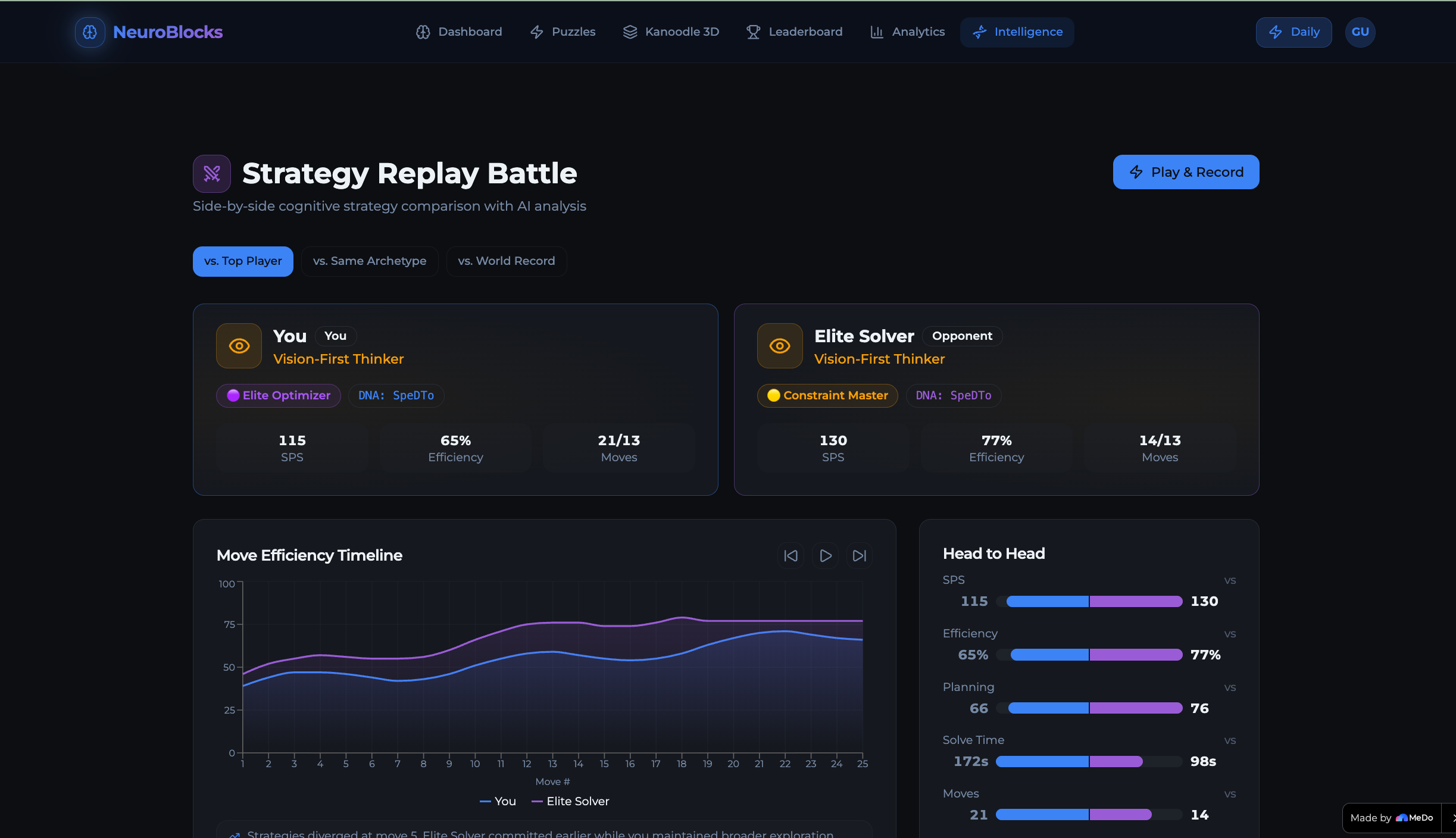
Strategy Replay Battle Side-by-side cognitive strategy comparison with AI analysis
-
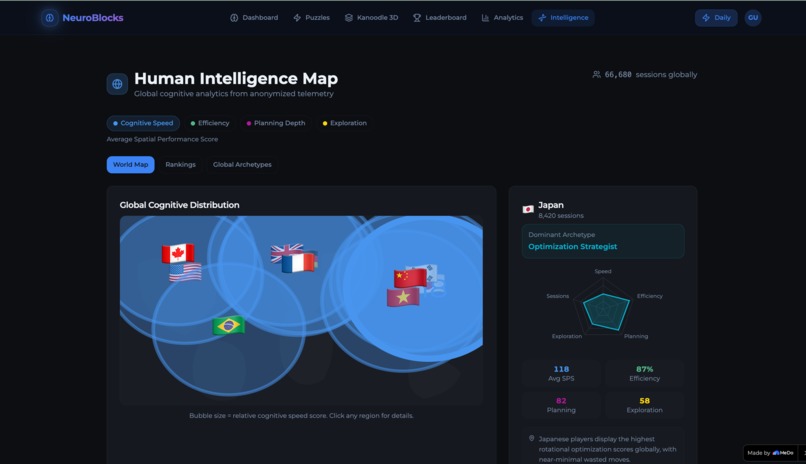
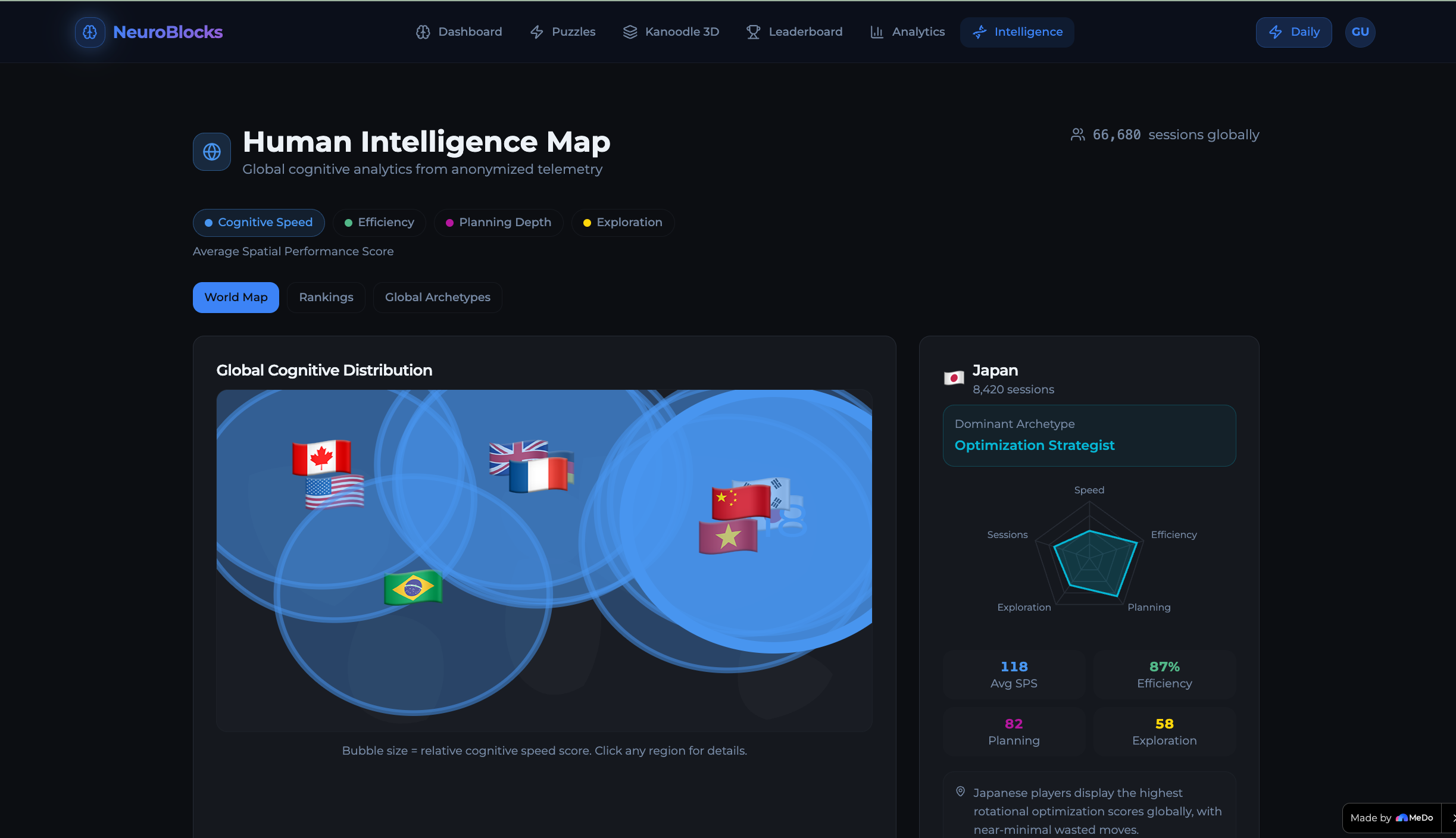
Human Intelligence Map Global cognitive analytics from anonymized telemetry
-
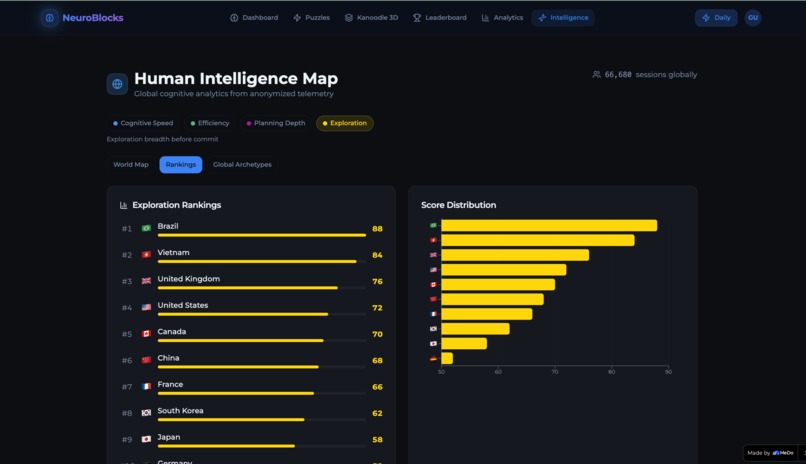
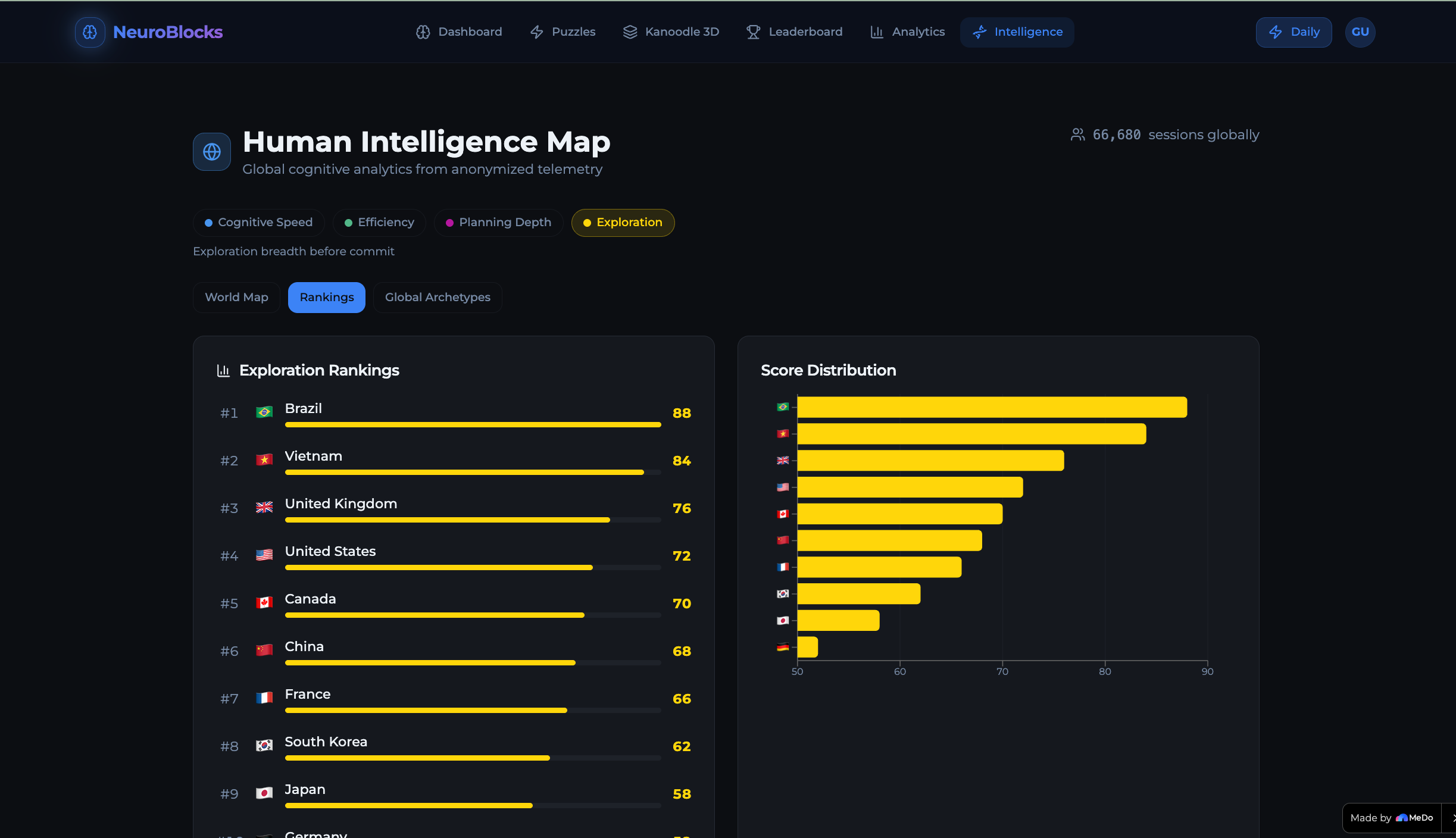
Human Intelligence Map - Rankings Exploration
-
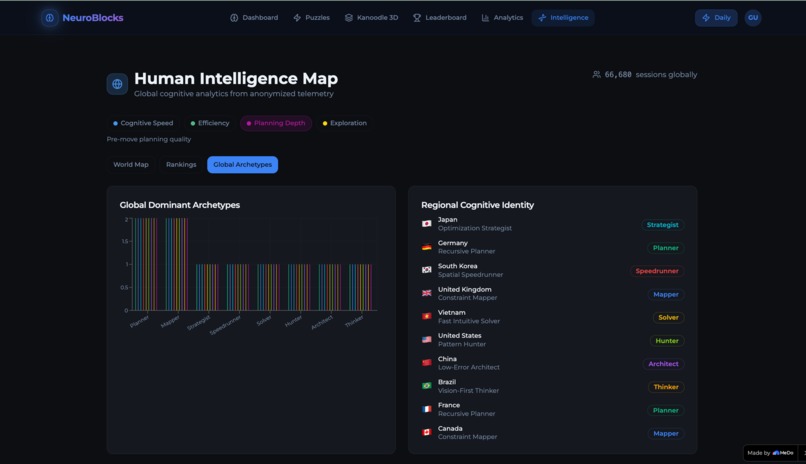
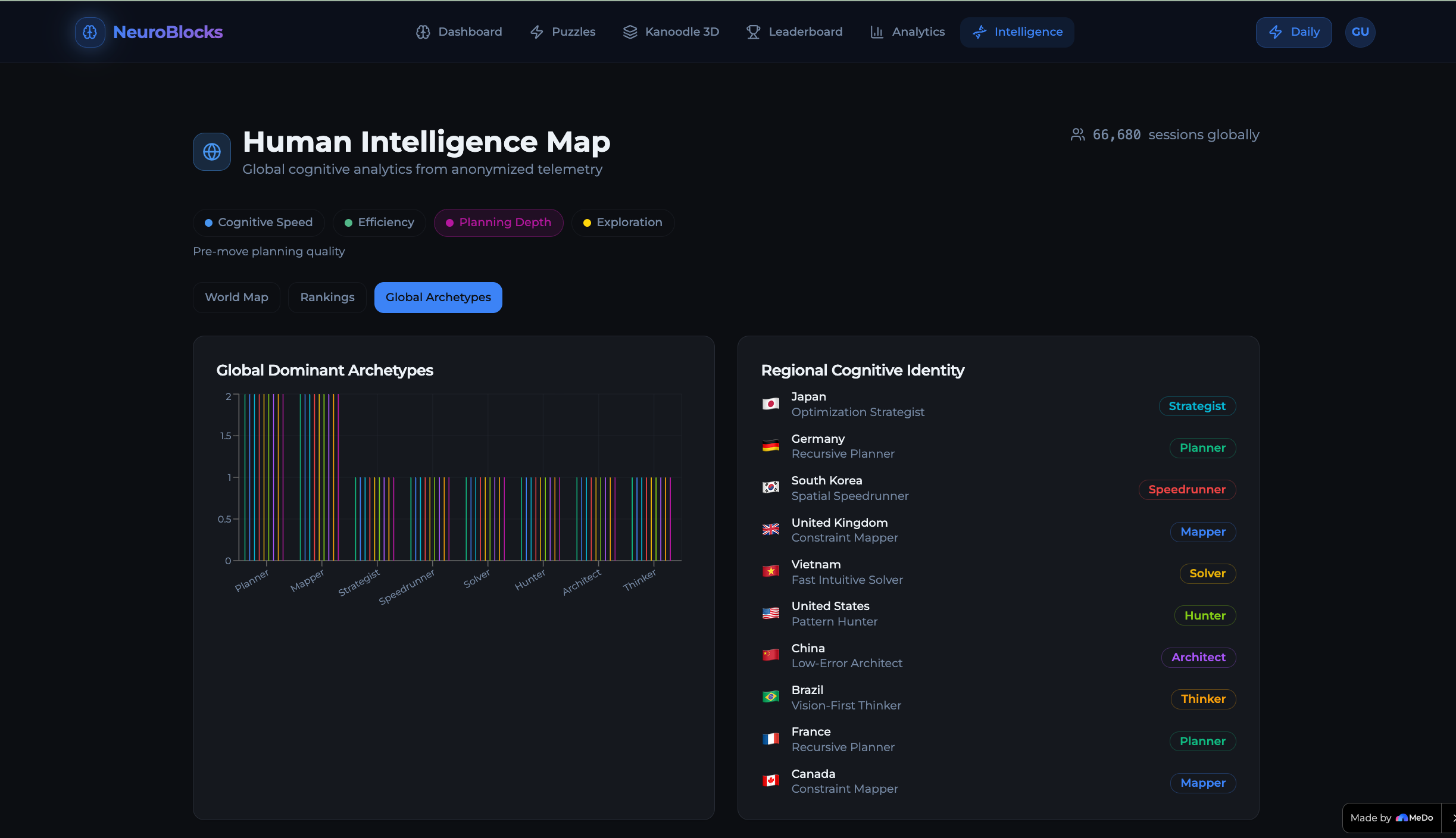
Human Intelligence Map - Global Archetypes
-
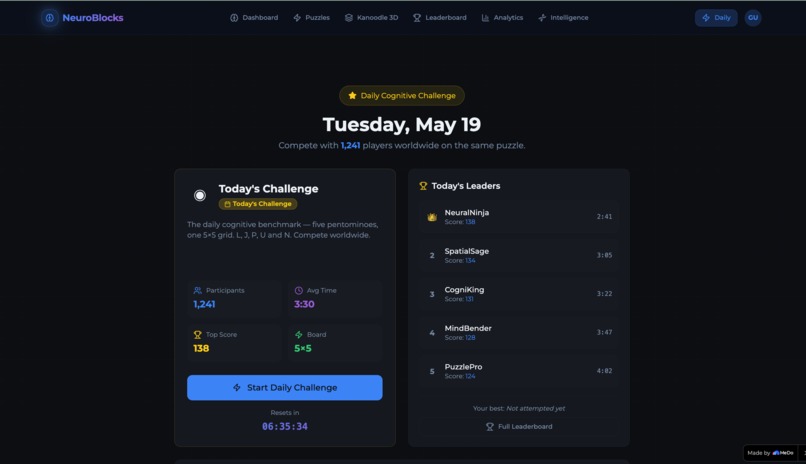
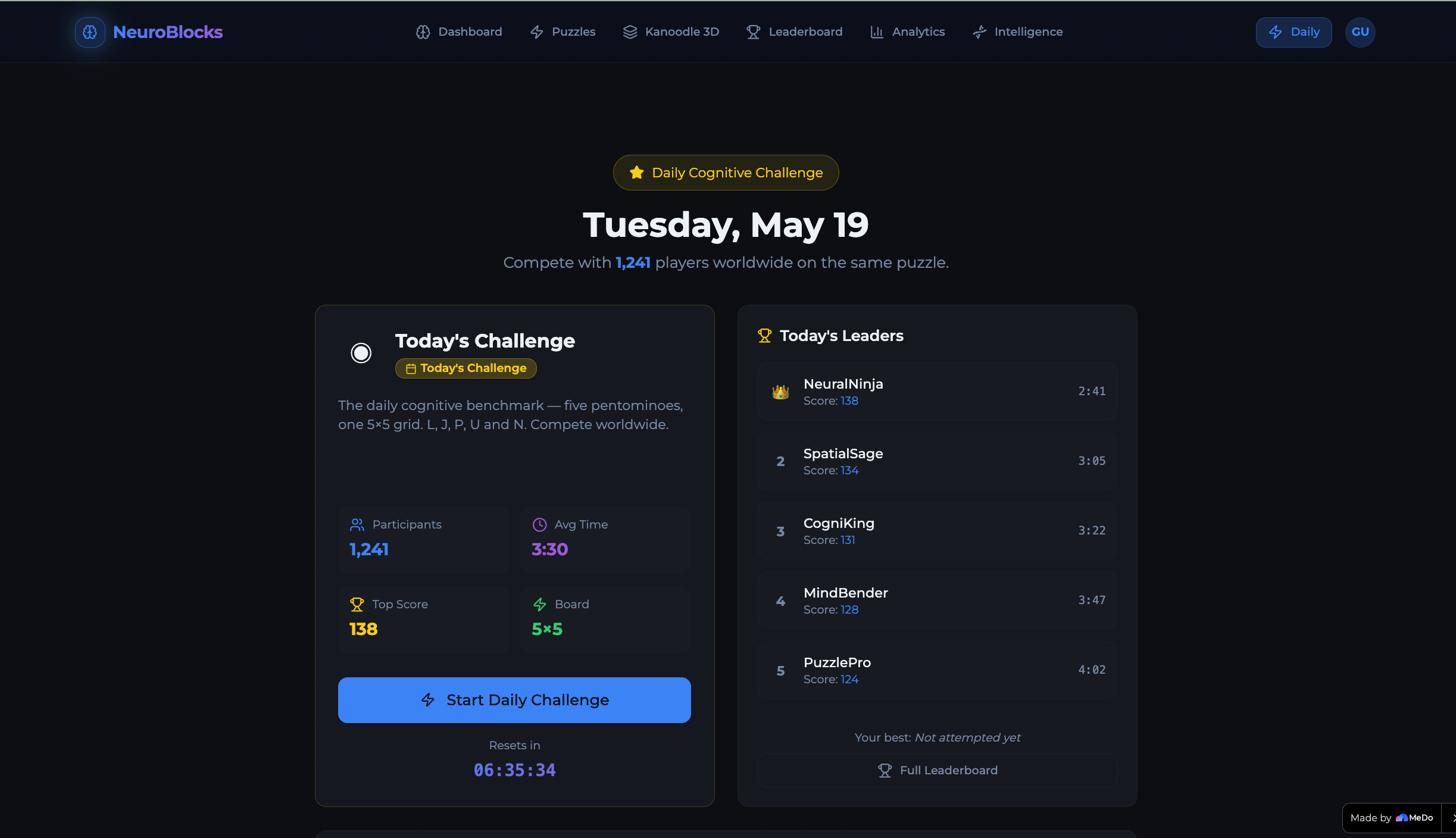
Daily Cognitive Challenge
NeuroBlocks
Measure How You Think. Not Just Whether You Solve.
NeuroBlocks is an AI-powered cognitive analytics platform disguised as a spatial puzzle game.
Instead of only checking whether a player solves a puzzle, NeuroBlocks analyzes how the player thinks while solving it.
The platform transforms puzzle-solving behavior into a living behavioral intelligence system powered by:
- telemetry analytics
- replay intelligence
- percentile ranking systems
- AI-generated cognitive insights
- strategy rarity analysis
- cognitive fingerprinting
Built with MeDo, NeuroBlocks explores how conversational AI development can rapidly create complex full-stack interactive applications that combine:
- gaming
- AI analytics
- realtime behavioral systems
- competitive intelligence ranking
- futuristic UX systems
Inspiration
Traditional IQ tests and puzzle games usually focus on only one thing:
Did the user solve the puzzle or not?
But human intelligence is far more complex.
Two players can reach the same solution using completely different cognitive strategies:
- one may solve through deep planning
- another through rapid experimentation
- another through spatial intuition
- another through optimization patterns
I wanted to build a platform that measures the process of thinking itself.
The core idea became:
“What if puzzle solving could become a realtime behavioral intelligence system?”
That vision evolved into NeuroBlocks: a futuristic cognitive esports platform combining:
- spatial puzzle gameplay
- AI analytics
- cognitive fingerprinting
- percentile intelligence ranking
- replay intelligence
- strategy rarity analysis
- global behavioral comparison
How We Used MeDo
MeDo became the core development engine behind NeuroBlocks.
Instead of manually coding every interface and architecture component from scratch, we used MeDo as a conversational full-stack development partner.
We iteratively refined the project through multi-turn prompting workflows.
Using MeDo, we generated and refined:
- gameplay architecture
- futuristic UI layouts
- animated dashboard systems
- cognitive analytics flows
- telemetry tracking structures
- replay systems
- leaderboard logic
- percentile analytics
- responsive layouts
- glassmorphism visual design systems
- realtime data visualization concepts
One of the most impressive aspects of MeDo was its ability to rapidly iterate complex UI systems through natural language conversations.
For example, we continuously refined:
- bell curve IQ-style visualizations
- cognitive report dashboards
- replay intelligence systems
- AI insight cards
- global ranking interfaces
- behavioral clustering systems
through conversational prompting and iterative AI-assisted design.
MeDo dramatically accelerated the transition from:
concept → architecture → prototype → polished experience
Core Intelligence System
NeuroBlocks tracks realtime puzzle-solving telemetry such as:
- move sequences
- rotations
- failed placements
- retries
- exploration breadth
- planning depth
- solve efficiency
- recovery patterns
- spatial reasoning behavior
The system converts gameplay telemetry into cognitive analytics.
Efficiency Formula
The core gameplay efficiency metric is:
$$ Efficiency = \frac{OptimalMoves}{UserMoves} $$
Additional analytics include:
- solve efficiency
- percentile ranking
- exploration patterns
- planning styles
- cognitive archetypes
- strategy rarity detection
- behavioral clustering
Instead of fake psychology, the AI insight system is grounded directly in measurable gameplay behavior.
Example insights:
“You rely more on visualization than brute-force exploration.”
“Your solving strategy resembles top 5% spatial thinkers.”
“You belong to a rare low-exploration high-efficiency solving cluster.”
Signature System — Bell Curve Intelligence Visualization
The signature visual identity of NeuroBlocks is the animated cognitive bell-curve system.
After every puzzle, users see:
- spatial score
- percentile ranking
- global distribution position
- efficiency comparison
- speed comparison
- rarity analysis
Examples:
- Faster than 94% of players
- More efficient than 88% of players
- Top 2% strategy rarity
The cognitive score distribution is modeled visually using a bell curve:
$$ f(x)=\frac{1}{\sigma\sqrt{2\pi}}e^{-\frac{(x-\mu)^2}{2\sigma^2}} $$
Where:
- ( \mu ) = global average spatial score
- ( \sigma ) = standard deviation
- ( x ) = user spatial score
The goal was to make intelligence analytics feel:
- cinematic
- competitive
- emotionally engaging
- socially shareable
Cognitive DNA Profiles
One of the most exciting systems we designed is the concept of a Cognitive DNA Profile.
Instead of giving users only a score, NeuroBlocks attempts to identify unique thinking styles based on telemetry behavior.
Examples include:
- Vision-First Thinker
- Recursive Planner
- Pattern Hunter
- Tactical Optimizer
- Low-Error Architect
These profiles are generated from actual gameplay metrics rather than personality quizzes.
We also designed:
- Cognitive Fingerprints
- Replay Battle Comparisons
- Strategy Overlay Systems
- Human Intelligence Mapping
- Behavioral Heatmaps
- Longitudinal Cognitive Evolution Tracking
This transforms NeuroBlocks from a puzzle game into a living behavioral intelligence platform.
Replay Intelligence System
Every puzzle session generates a complete replayable behavioral timeline.
The replay engine stores:
- move order
- timestamps
- failed placements
- rotations
- retries
- exploration patterns
Users can compare their replay against top players.
The system can generate behavioral comparisons such as:
“Top players commit earlier while you optimize through exploration.”
This creates a unique form of asynchronous cognitive competition.
Human Intelligence Map
One long-term vision for NeuroBlocks is creating a global intelligence behavior map.
The platform could analyze:
- countries
- age groups
- puzzle archetypes
- solving styles
- behavioral clusters
Examples:
- “Vietnamese players solve faster but less efficiently.”
- “UK players explore deeper before committing.”
- “High percentile solvers show lower entropy exploration patterns.”
This evolves NeuroBlocks into a large-scale behavioral intelligence dataset.
Technical Challenges
One major challenge was ensuring puzzle validity.
Some generated puzzles initially became unsolvable because piece configurations did not guarantee valid solutions.
To solve this, we redesigned the puzzle generation pipeline:
- generate solved board states first
- cut solved structures into valid puzzle pieces
- derive playable puzzle states from guaranteed solutions
This guarantees mathematically solvable puzzle configurations.
Another major challenge involved designing telemetry systems capable of tracking every user interaction while maintaining smooth gameplay performance.
We also refined:
- realtime analytics pipelines
- replay reconstruction systems
- percentile calculation systems
- ranking synchronization
- responsive gameplay interactions
What We Learned
This project taught us that modern AI-assisted development is no longer only about generating code.
It is about:
- accelerating experimentation
- refining ideas through iteration
- rapidly evolving complex systems
- combining design + analytics + interaction through conversation
MeDo enabled us to iterate at extremely high speed while exploring ambitious product ideas that would traditionally require large engineering teams.
We also learned that puzzle gameplay becomes far more meaningful when combined with behavioral analytics and AI interpretation.
Future Vision
Our long-term vision is to evolve NeuroBlocks into:
“A global behavioral intelligence platform.”
Future directions include:
- adaptive AI-generated puzzles
- realtime cognitive coaching
- cognitive esports tournaments
- global intelligence heatmaps
- educational cognitive training
- asynchronous brain-vs-brain challenges
- behavioral evolution tracking over months or years
Ultimately, NeuroBlocks aims to explore a new frontier:
Understanding Human Thinking Through Interactive Gameplay
Built With
- MeDo
- Flutter
- Firebase
- FastAPI
- PostgreSQL
- WebSockets
- Telemetry Analytics
- Realtime Ranking Systems
- AI Behavioral Systems
- Replay Intelligence Engine
Built With
- ai-analytics
- ai-insight-generation
- behavioral-telemetry
- bell-curve-visualization
- cognitive-fingerprinting
- drag-and-drop-gameplay
- fastapi
- firebase
- firestore
- fl-chart
- flutter
- flutter-riverpod
- flutter-web
- glassmorphism-ui
- go-router
- heatmaps
- material-3
- medo
- percentile-analytics
- postgresql
- puzzle-replay-engine
- radar-charts
- realtime-ranking-systems
- redis
- replay-intelligence
- responsive-ui
- websockets


Log in or sign up for Devpost to join the conversation.