-
-
MindMesh crow app icon
-
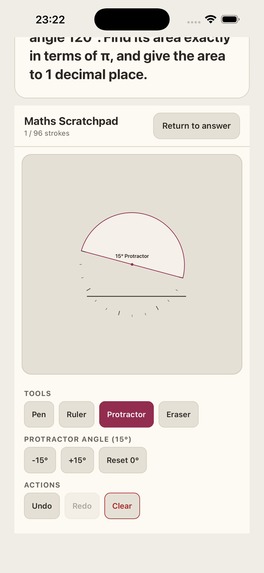
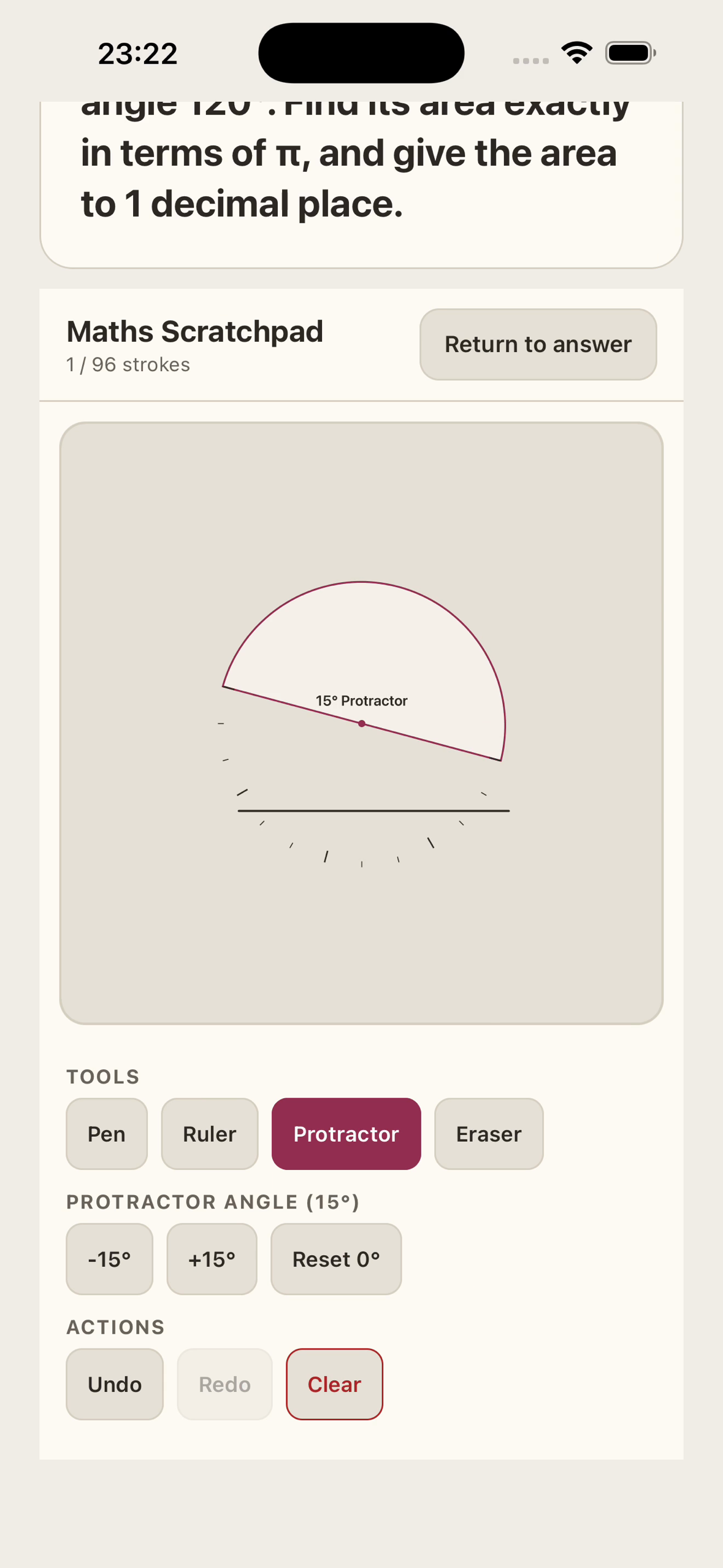
Private maths scratchpad — real simulator capture

Inspiration
Studying can mean working alone, comparing answers with friends, and needing somewhere to sketch an idea before writing an answer. MindMesh brings those activities into one study app: shared quiz rooms, independent practice, private feedback, and a drawing workspace for rough working.
What it does
MindMesh lets students join a study room, mark themselves ready, answer the same timed questions and compare their results. Each participant can review their own answers, marks and explanations. The backend controls quiz progress and scoring, and reconnecting clients recover the shared state.
The source also includes self-paced solo practice, Studio/Wood/Glass/Paper appearance choices with light and dark modes, private drawing scratchwork with geometry tools, and an earned cosmetic pet system. Companions have simple personalities and reactions; coins reward qualifying participation and buy cosmetic choices rather than better quiz scores.
Adaptive preparation creates a subject/topic-based question set and runs validation and verification before play. Multiple-choice and numerical answers are marked deterministically. Room written answers and eligible longer solo responses use a bounded AI rubric-grading path. Short solo written responses use an explicitly labelled self-assessment step. AI feedback can be wrong, and self-assessed marks are not independent grading.
The starter catalogue covers six GCSE subjects and eighteen topics. It is not a complete syllabus or a claim of exam-board accreditation. Drawing is private rough working, not submitted handwriting. Learning illustrations are curated examples rather than images generated for each question.
How it is built
MindMesh uses Expo, React Native and strict TypeScript for the client; FastAPI and PostgreSQL for application state; and Supabase Auth for sign-in. Server-side adapters handle adaptive generation and eligible written marking. Provider secrets stay on the backend. The public source targets Expo SDK 57 and includes database migrations through 0012_learning_companions.
The project began under the working name StudyRoom, which remains in technical identifiers for compatibility. The app’s own visible branding is now MindMesh and MindMesh Pro. The published repository excludes the earlier music assets and playback controls.
RevenueCat integration
The source integrates the RevenueCat SDK for a development Pro offering and entitlement, with backend checks for Pro room capacity and client-side cosmetic presentation gates. It supports RevenueCat Test Store configuration; the public source contains no configured credentials and does not claim production App Store products, real payments or revenue. Test Store is a development integration, not a live commercial store launch.
Challenges and what the implementation taught us
Keeping two clients consistent required server-owned question transitions, answer locking and reconnect recovery. Written grading introduced another failure path: a response could be accepted while marking was unavailable. The implementation exposes that state and supports controlled marking recovery rather than inventing a score.
The solo and rewards paths required separate ownership and idempotency rules. A drawing workspace also needed to preserve geometry, respect the selected theme and avoid competing with quiz navigation and timers. The main engineering lesson was to distinguish a successful interface interaction from authoritative completion, and to keep reward issuance, private review and recovery tied to server state.
The submission package separates project source from external media and documents dependency licences, outstanding evidence gaps and validation limits.
Accomplishments and validation
An earlier native development build completed a two-device multiplayer test through questions, matching results, return to the waiting room and background/reconnect recovery. One adaptive five-mark geometry test reached completion with both participants' private reviews after a marking interruption was recovered. These are observations from earlier builds, not a broad assessment of educational accuracy.
The no-music source snapshot passed strict TypeScript, 605 mobile tests and an offline iOS JavaScript export. After the visible-branding update, strict TypeScript and all 606 default mobile tests passed on the public source. Selected backend tests also passed; database-dependent skips are documented and are not passes. The exact upgraded snapshot has not received a full native build or end-to-end device validation. Later solo, drawing, theme and companion features are source implementations; earlier device testing does not establish full runtime coverage of those additions.
What is next
Our future ambition is live voice study rooms, screen sharing and a shared whiteboard, with student-led peer teaching. We also plan personalised daily practice that adapts to mistakes and progress, using retrieval-augmented generation (RAG) to ground questions and explanations in trusted learning materials. These are future roadmap ideas. The immediate priorities are validating the upgraded client and backend together on devices, broadening educational evaluation and curriculum coverage, and completing production deployment and store configuration. This is a development-stage Next Gen Award entry.
Source and validation details
Built With
- expo.io
- fastapi
- postgresql
- python
- react-native
- revenuecat
- sqlalchemy
- supabase
- typescript

Log in or sign up for Devpost to join the conversation.