-
-
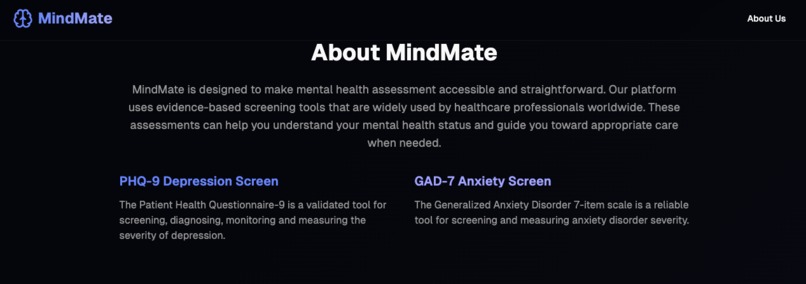
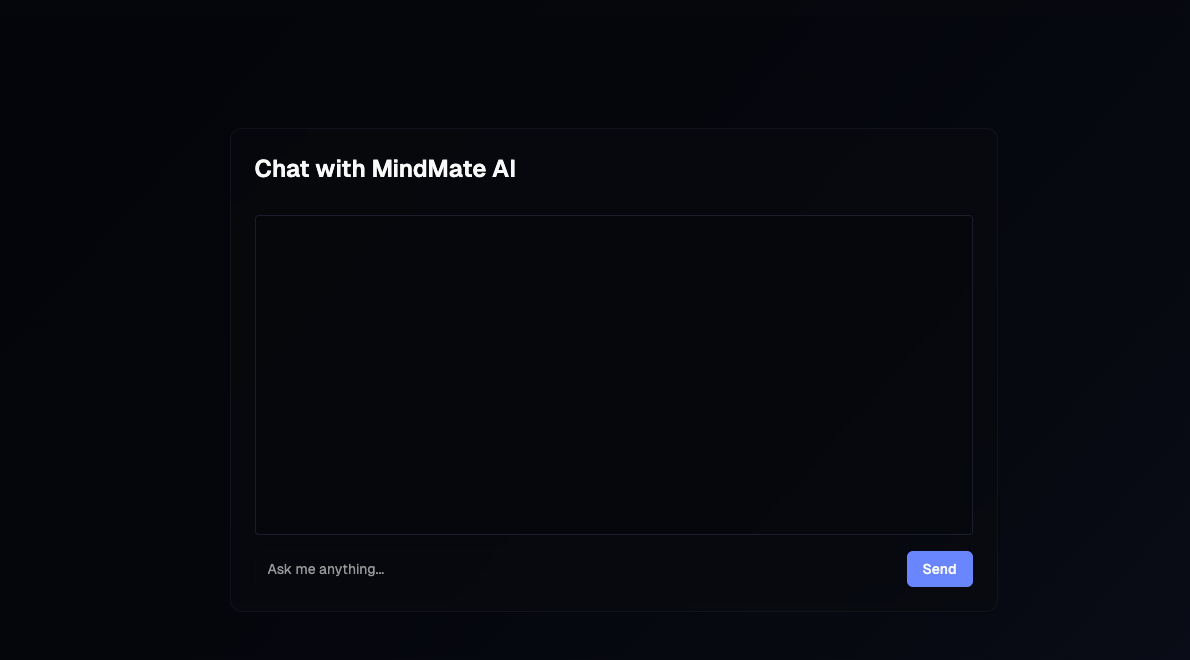
About the app section
-
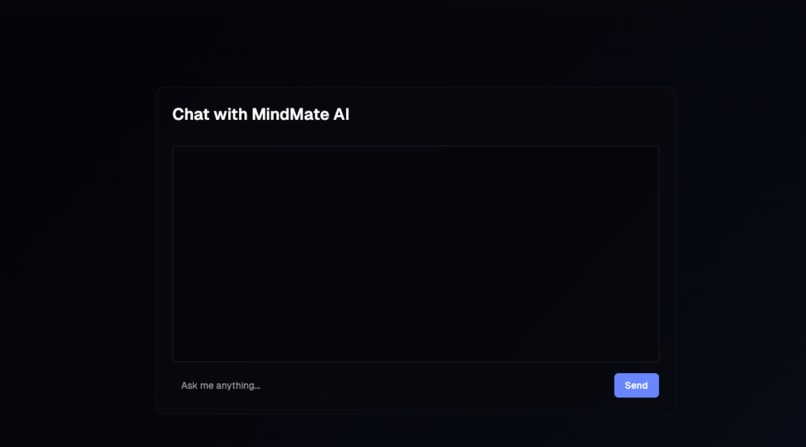
Chat with our deployed chatbot for more answer's to your questions
-
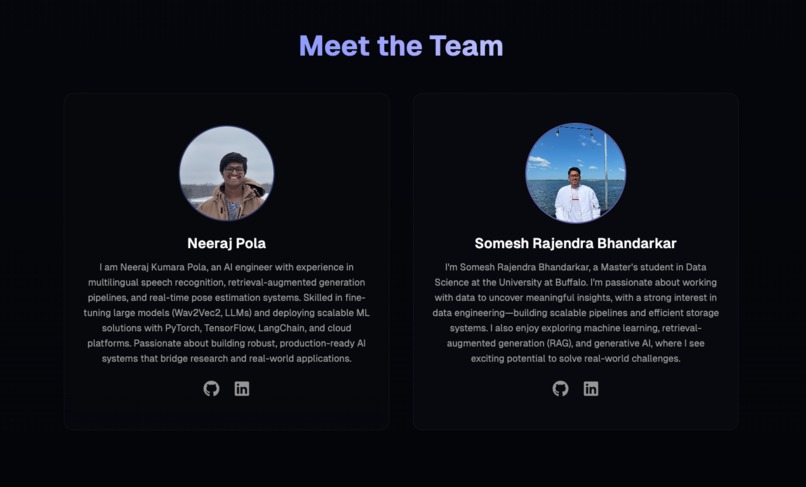
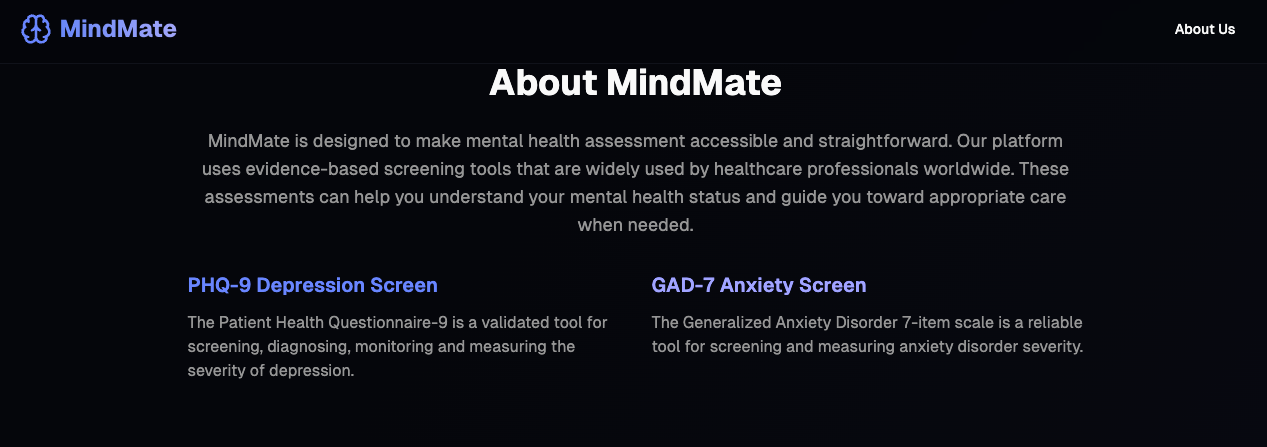
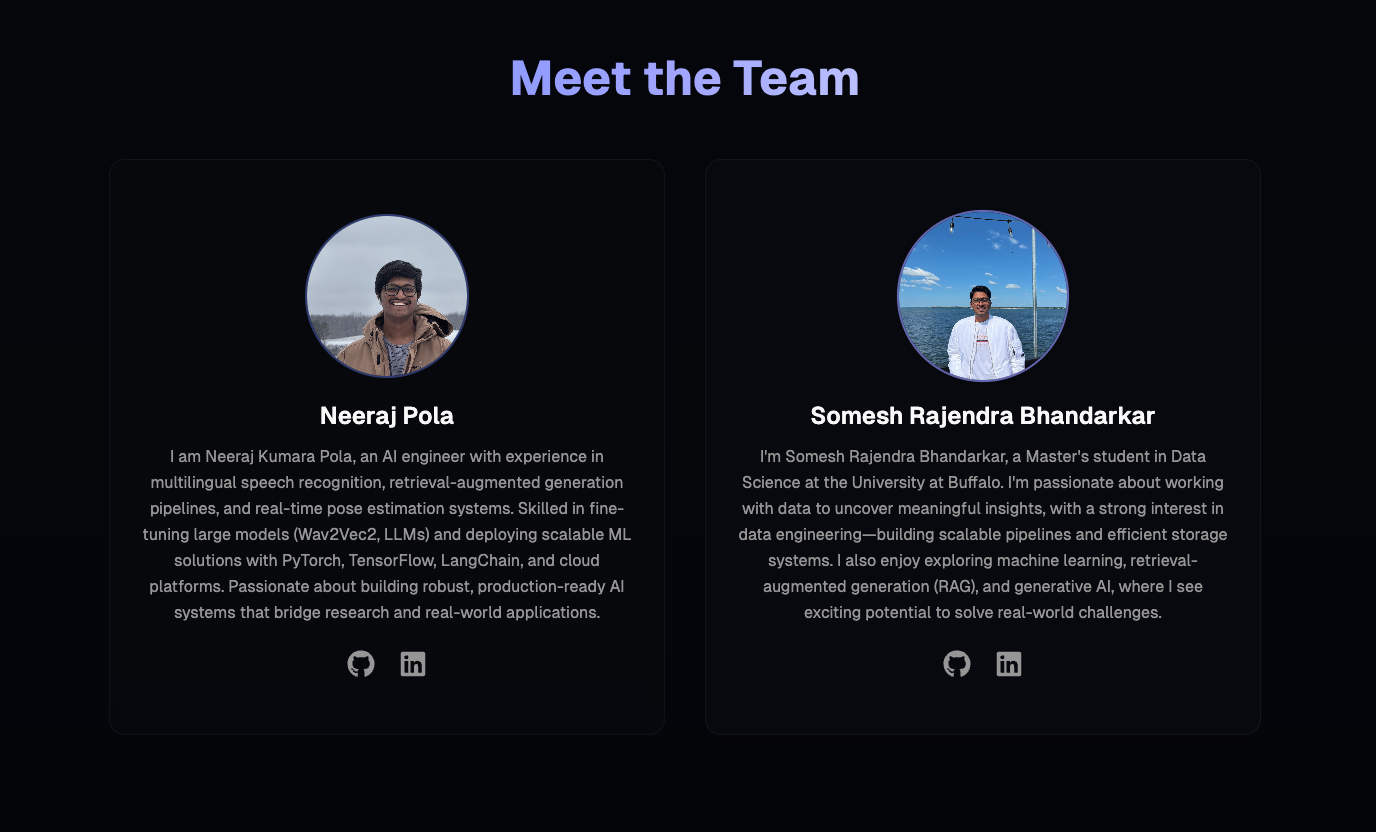
About us section
-
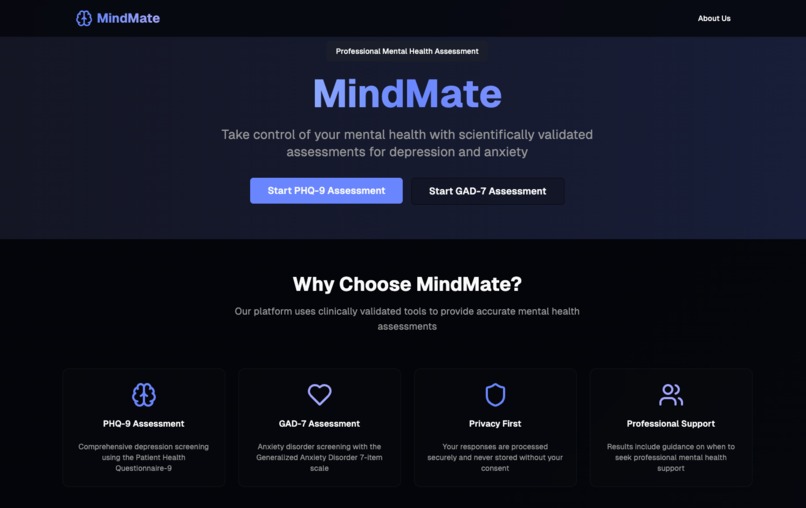
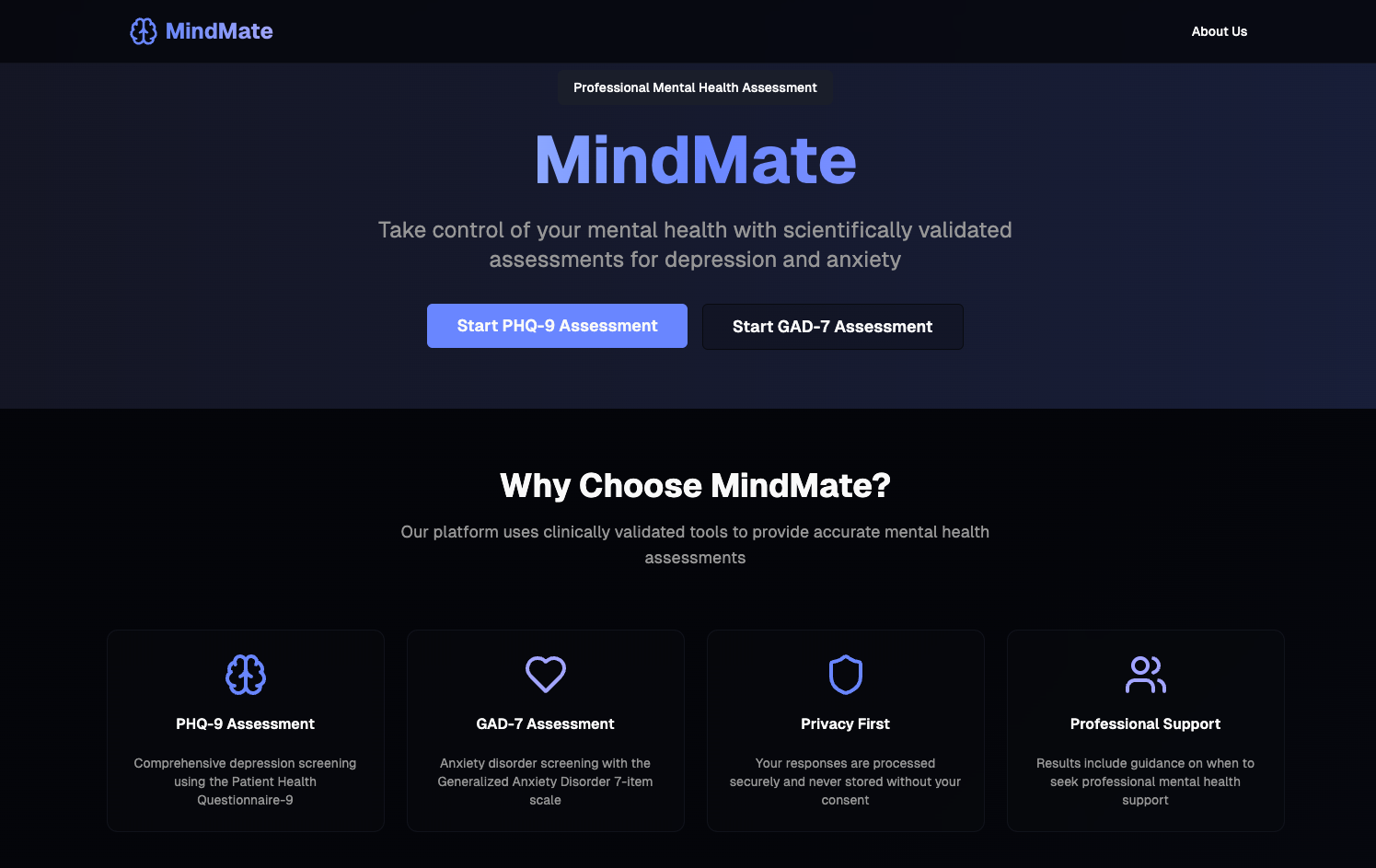
Starting Page with screening test section
Inspiration ->
Mental health issues are very widespread, but screening and assistance are not readily available. Most individuals are reluctant to get in touch because of stigma, absence of resources, or inability to know their symptoms. Our vision was to develop a convenient, AI-based app, which enables the user to self-evaluate, get instant advice, and get connected to the relevant care.
What it does ->
MindMate is a mental health screening and support application that uses AI.
- Evidence-based questionnaires, such as PHQ-9 (depression) and GAD-7 (anxiety), can be taken by the users.
- Their answers are immediately assessed by the app and structured feedback is given.
- An included chatbot is an LLM-based system that one may use to ask questions and get sympathetic advice as well as know more about coping mechanisms.
- Assessment logic is securely implemented by the backend and the frontend is comprised of a clean interface.
How we built it ->
- Frontend: Built with Next.js + TailwindCSS for a responsive and modern user interface.
- Backend: A FastAPI server powers the RAG pipeline, managing embeddings, search, and AI calls.
- Database: Used TiDB with vector search support to store embeddings of educational resources and mental health knowledge.
- AI Models: Integrated OpenAI GPT-4o-mini for conversation and text-embedding-3-small for vector search.
- Deployment: Frontend deployed on Vercel, backend + database hosted via Render & TiDB Cloud.
Challenges we ran into ->
- Setting up vector search in TiDB and migrating from storing embeddings as raw blobs to using proper VECTOR columns.
- Handling API rate limits and ensuring consistent responses from the RAG pipeline.
- Maintaining a balance between empathy and accuracy in AI-generated responses.
- Deployment hurdles, especially ensuring that the frontend and backend communicated correctly across services (CORS, environment variables, ports).
Accomplishments that we're proud of ->
- Successfully building a full-stack AI app in a short time.
- Implementing retrieval-augmented AI so that responses are not only fluent but also grounded in reliable mental health resources.
- Creating an engaging chat interface that feels approachable and user-friendly.
- Overcoming backend scaling and database integration challenges.
What we learned ->
- How to implement AI + database integration using embeddings and vector indexes.
- The importance of system design when deploying full-stack AI apps (API handling, DB connections, caching).
- How to make AI interactions feel more empathetic and user-centric, rather than just technical.
- That deployment and infra are just as challenging (and rewarding) as building the core ML pipeline.
What's next for MindMate: AI-Powered Mental Health Screening & Support App ->
- Include additional tests (e.g. PTSD, bipolar, stress scales).
- Connect with telehealth to have a direct connection with therapists.
- Include multilingual service to cover more people.
- Enhance chatbot functionality through retrieval-augmented generation (RAG) on curated mental health resources.


Log in or sign up for Devpost to join the conversation.