Inspiration
Study does not have to be solely memorizing and unstructured. As a tutor myself, a lot of students miss the potential benefit of learning efficiently and the right way. This is why I built Mindmappr. Mindmappr turns a study topic, available time, learner level, and goal into a practical study plan and a small prerequisite map. Learners can explain a concept in their own words, receive concise formative feedback, choose their own recall rating, and return when that concept is due for review. The logic behind is based on FSRS (Free Spaced Repetition Scheduler). It is a modern algorithm for spaced repetition technique that dramatically improves flashcard study efficiency.
Mindmappr turn that uncertainty into a clear, personal learning path. Instead of giving students another generic set of flashcards, it helps them move from a study goal to a plan, a concept map, and a review routine they can actually follow.
What it does
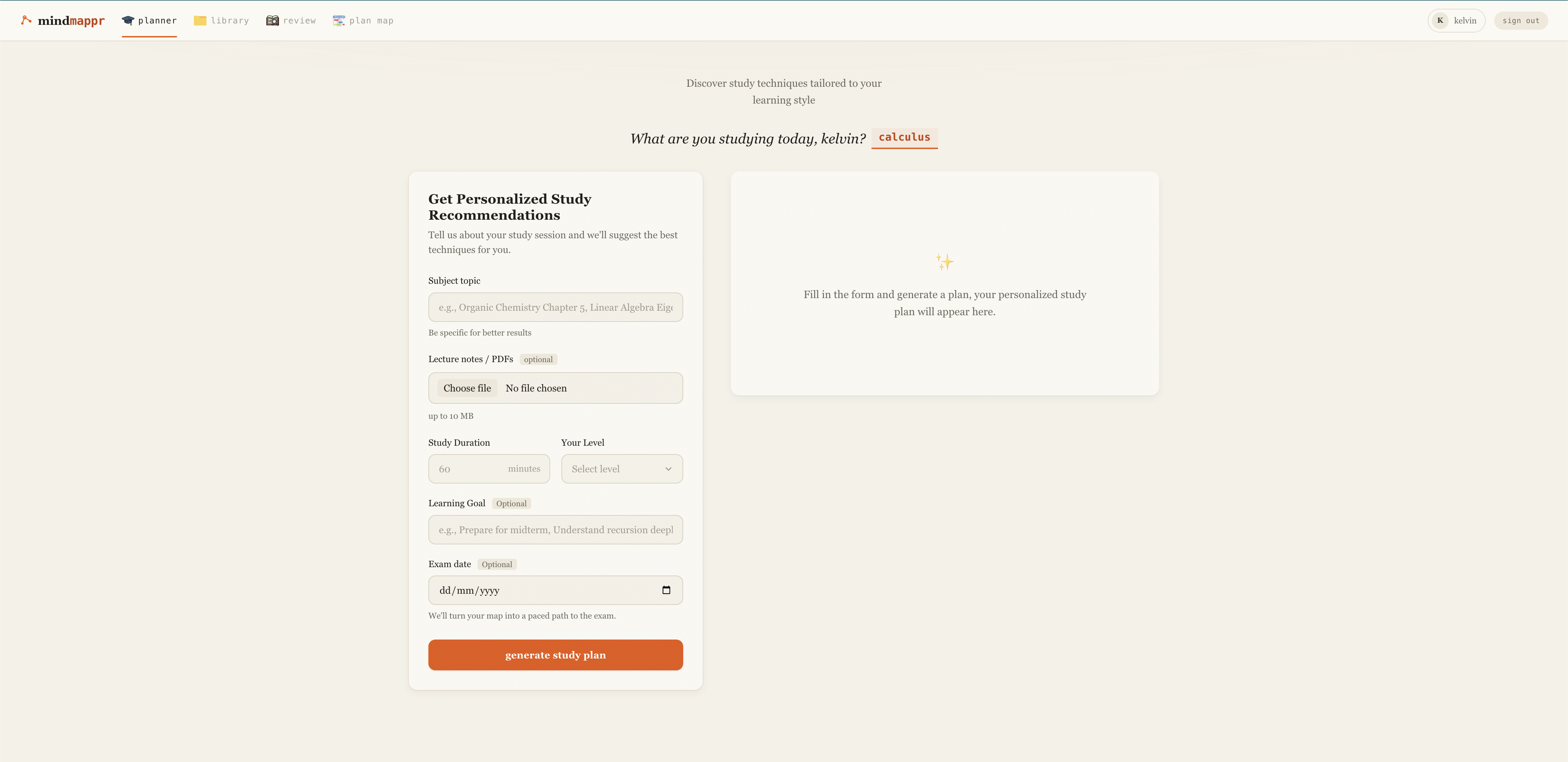
Mindmappr turns a learner’s subject, available study time, level, goal, and optional exam date into:
- a personalized study plan with timed learning techniques and practical tips;
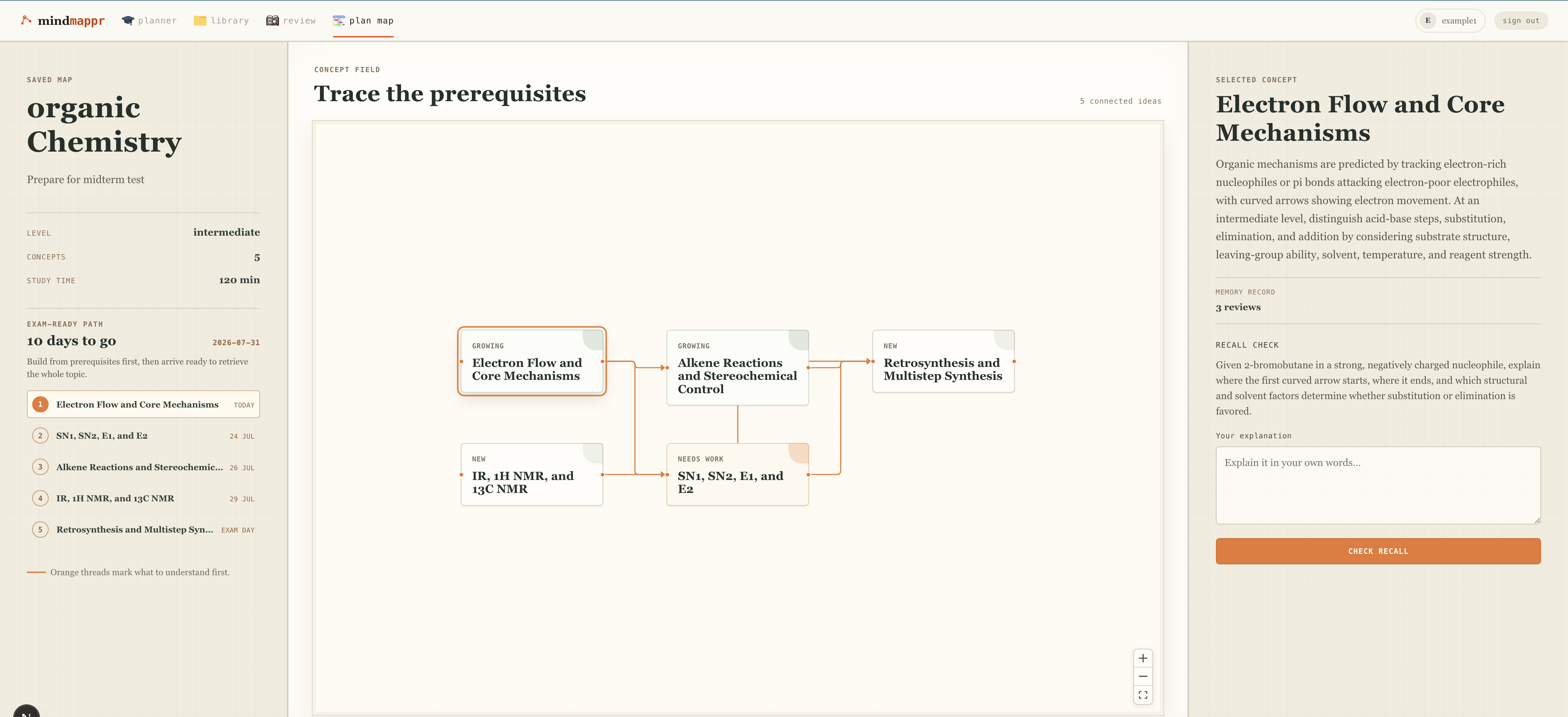
- a visual prerequisite map that breaks a topic into connected concepts;
- retrieval-practice prompts that ask learners to explain ideas in their own words;
- concise formative feedback before the learner chooses their own recall rating;
- a review schedule based on FSRS-inspired stability and difficulty states;
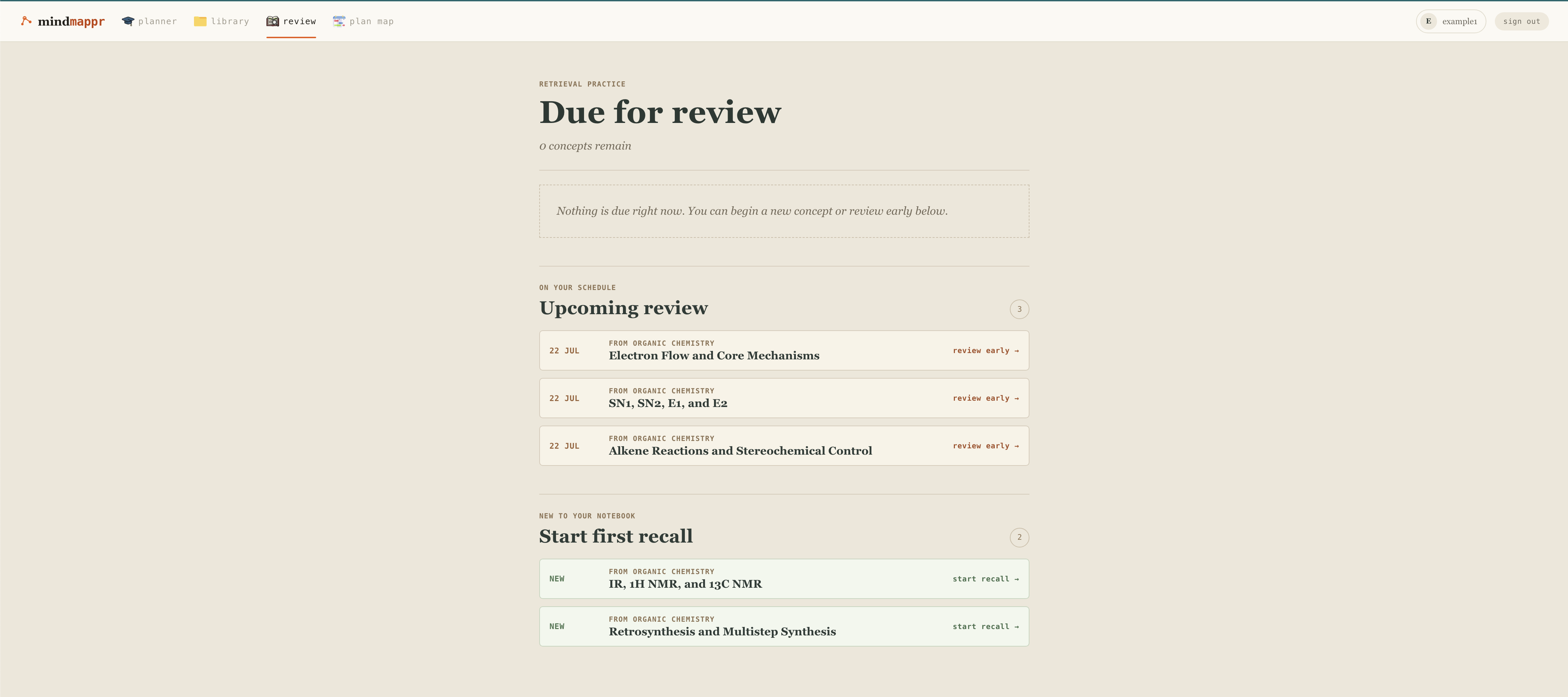
- a library for saved learning maps and a review page for due and upcoming practice.
Visitors can explore the planner before signing in. Signed-in learners can save maps, return to concepts later, and build a more intentional study routine over time.
-> Since sign up and sign in currently does not require real email auth, feel free to use a dumb email and password when sign up!
How I built it
I built the frontend with Next.js and React, and the API with FastAPI and SQLAlchemy. Supabase handles authentication and Postgres-backed saved study data.
The OpenAI Responses API powers the learning experience. GPT-5.6 Luna receives a learner’s study context and returns structured outputs validated with Pydantic: a study plan, a small concept map with prerequisite relationships, and bounded retrieval-practice feedback. Keeping the output structured makes it possible to turn generation into a usable product flow instead of displaying an unstructured block of AI text.
I used Codex throughout the build to accelerate the interface, FastAPI routes, database migrations, automated tests, documentation, and security review. Codex features of adding comments in changes and scheduled task helped me structure my plan easily. The project includes Playwright coverage for key browser journeys and pytest coverage for the API, generation logic, review scheduling, and ownership checks.
Challenges I ran into
The hardest part was connecting generative AI to a learning flow that feels reliable. A study plan needs to be useful, but it also needs predictable structure so it can become a map, a set of review prompts, and saved progress.
UI sometimes feel generic and slop, and forget to formally test with playwright. This is where I guide Gpt-5.6 Terra with example UI and plug in frontend design to improve the output.
Other challenges included connecting browser authentication to backend ownership checks, handling local development CORS correctly, building a review experience that distinguishes due work from upcoming work, and making permanent deletion of saved maps deliberate rather than accidental.
Accomplishments that I'm proud of
I’m proud that Mindmappr is more than a plan generator. It creates a connected workflow: plan, map, retrieve, reflect, and review.
The product details that make the experience feel usable and better than Anki (a flashcard app I am also using but finds it not helpful enough):
- concept-level review rather than a single generic reminder;
- a visual map that helps learners see prerequisite relationships;
- guest access so students can understand the value before committing;
- personalized navigation and saved-map management;
- accessible, compact mobile navigation;
- an inline confirmation before permanently removing a learning map;
- automated tests around core learning and ownership flows.
What I learned
I learned that the strongest AI features need clear product boundaries. Structured outputs, validation, and constrained prompts are as important as the model call itself when AI results must drive real interface states.
I also learned that learning products need to respect the student’s judgment. AI feedback can make reflection easier, but it should not quietly make decisions about a learner’s memory or progress.
Finally, building with Codex showed me how much faster iteration can be when an agent helps turn a product idea into tested routes, polished UI details, and a more complete end-to-end experience.
What's next for Mindmappr
Next, I want to make Mindmappr more useful for classrooms: teacher-created learning paths, shared course objectives and ways to spot concepts a class is struggling with.
For students, I want to expand support for exam-readiness paths, richer map editing, practice that does not disrupt a scheduled review, and more accessible ways to study across different subjects and learning contexts.
Built With
- codex
- fastapi
- pydantic
- python
- react
- supabase
- typescript
- vercel

Log in or sign up for Devpost to join the conversation.