-
-
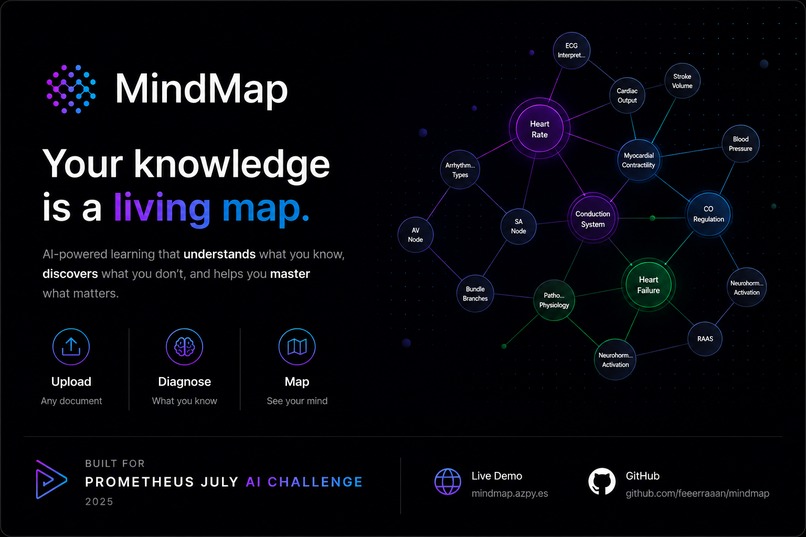
Portrait
-
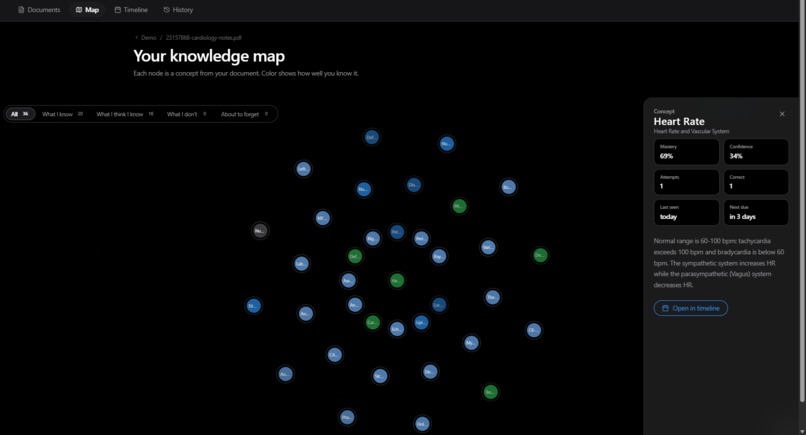
Map
-
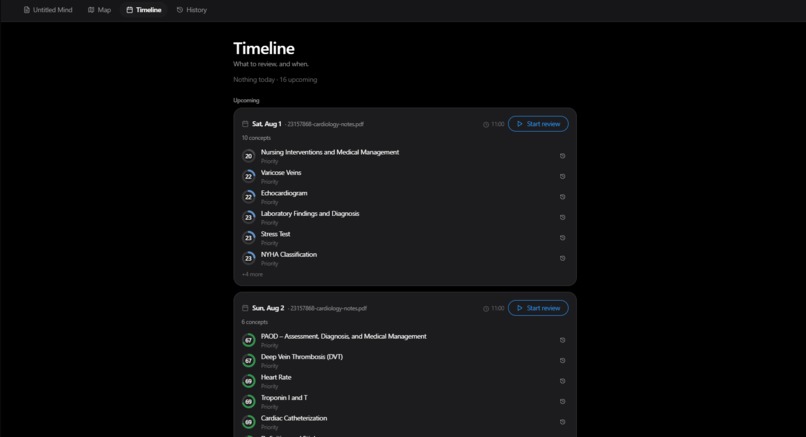
Timeline
-
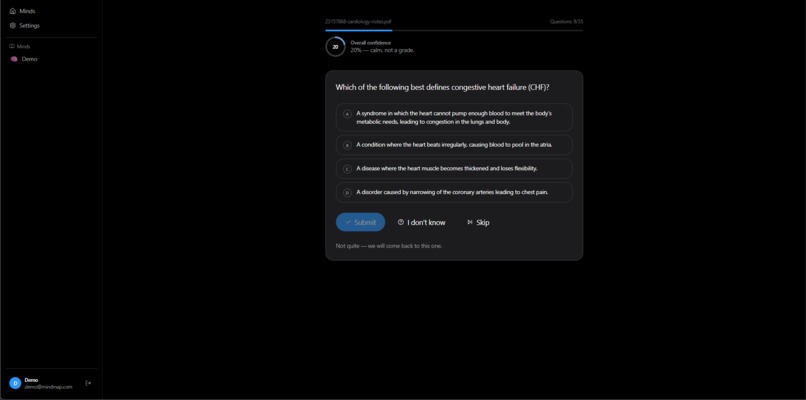
Question
-

History
-
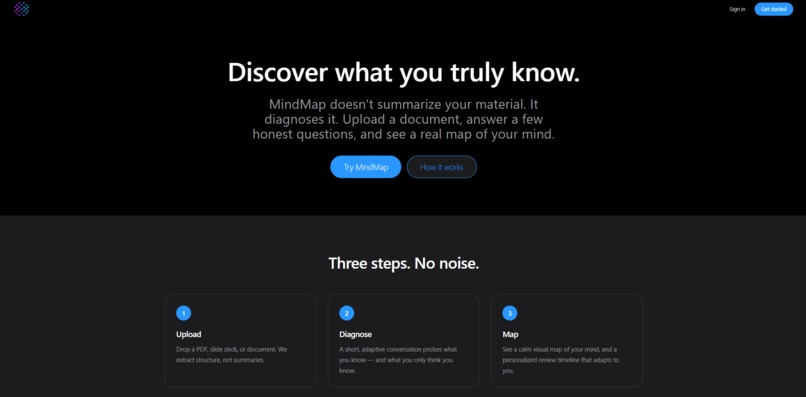
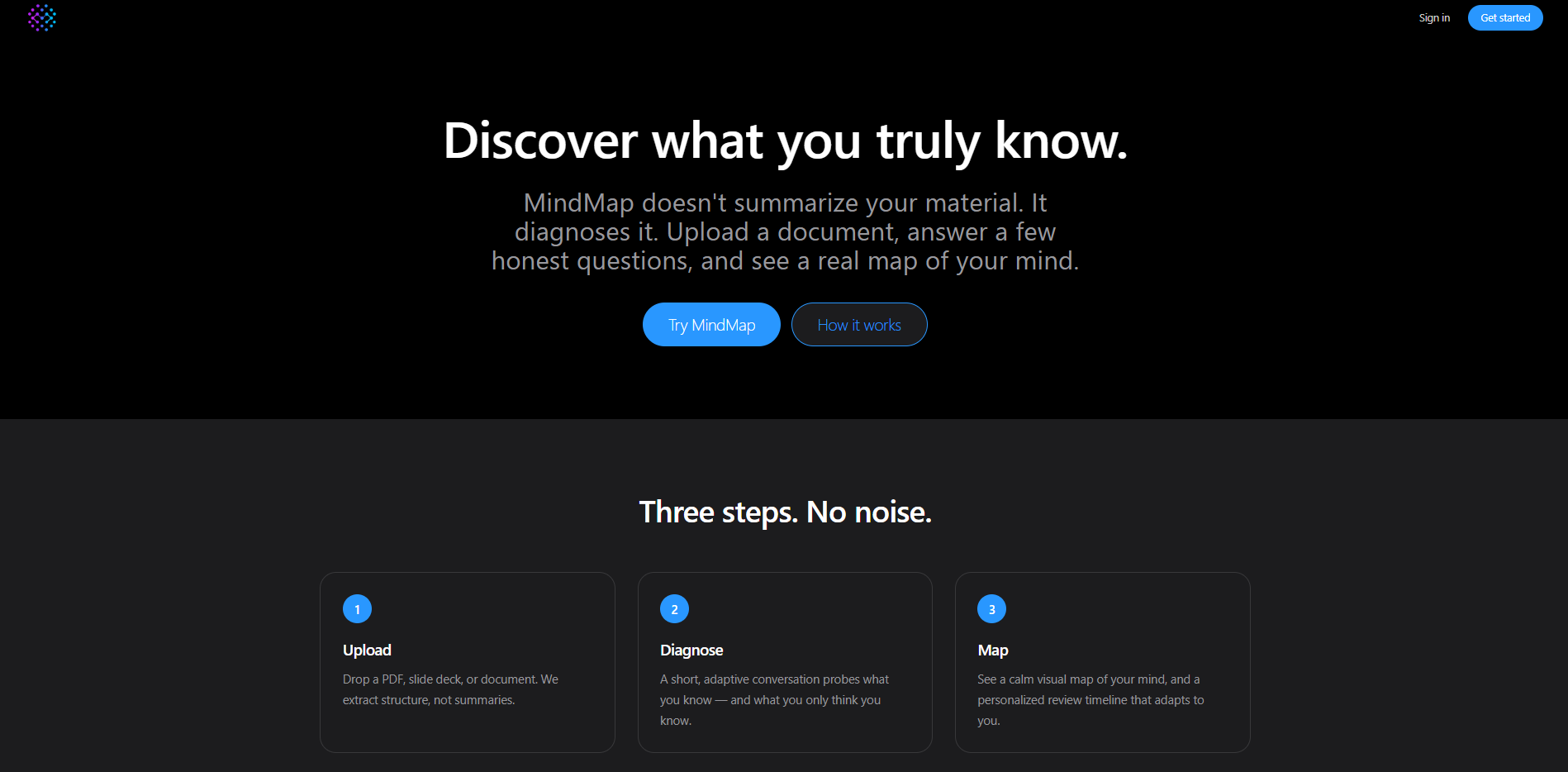
Landing
-
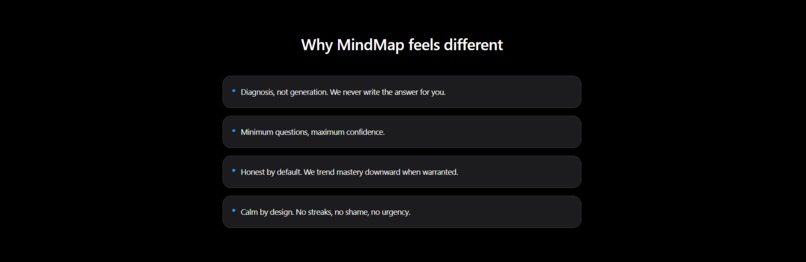
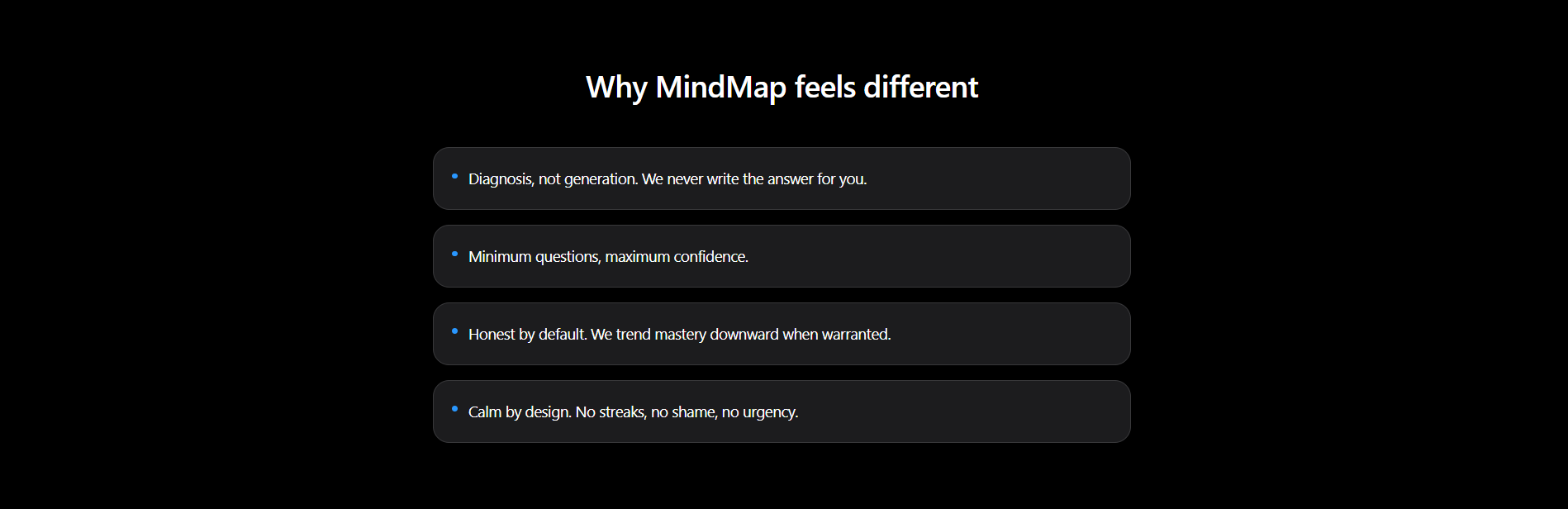
Landing 2
-
Sign in
-
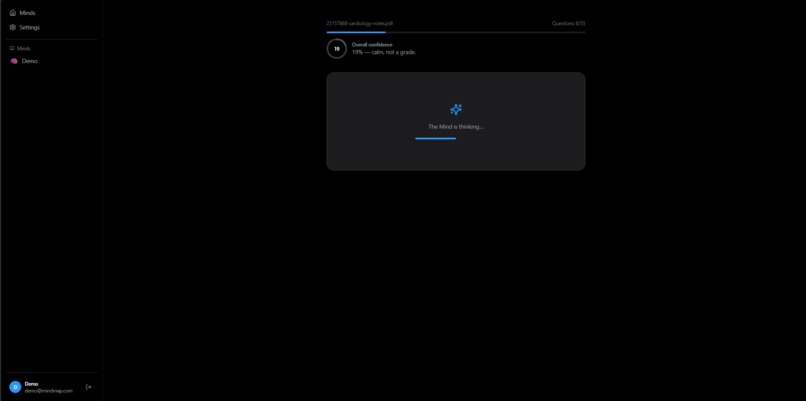
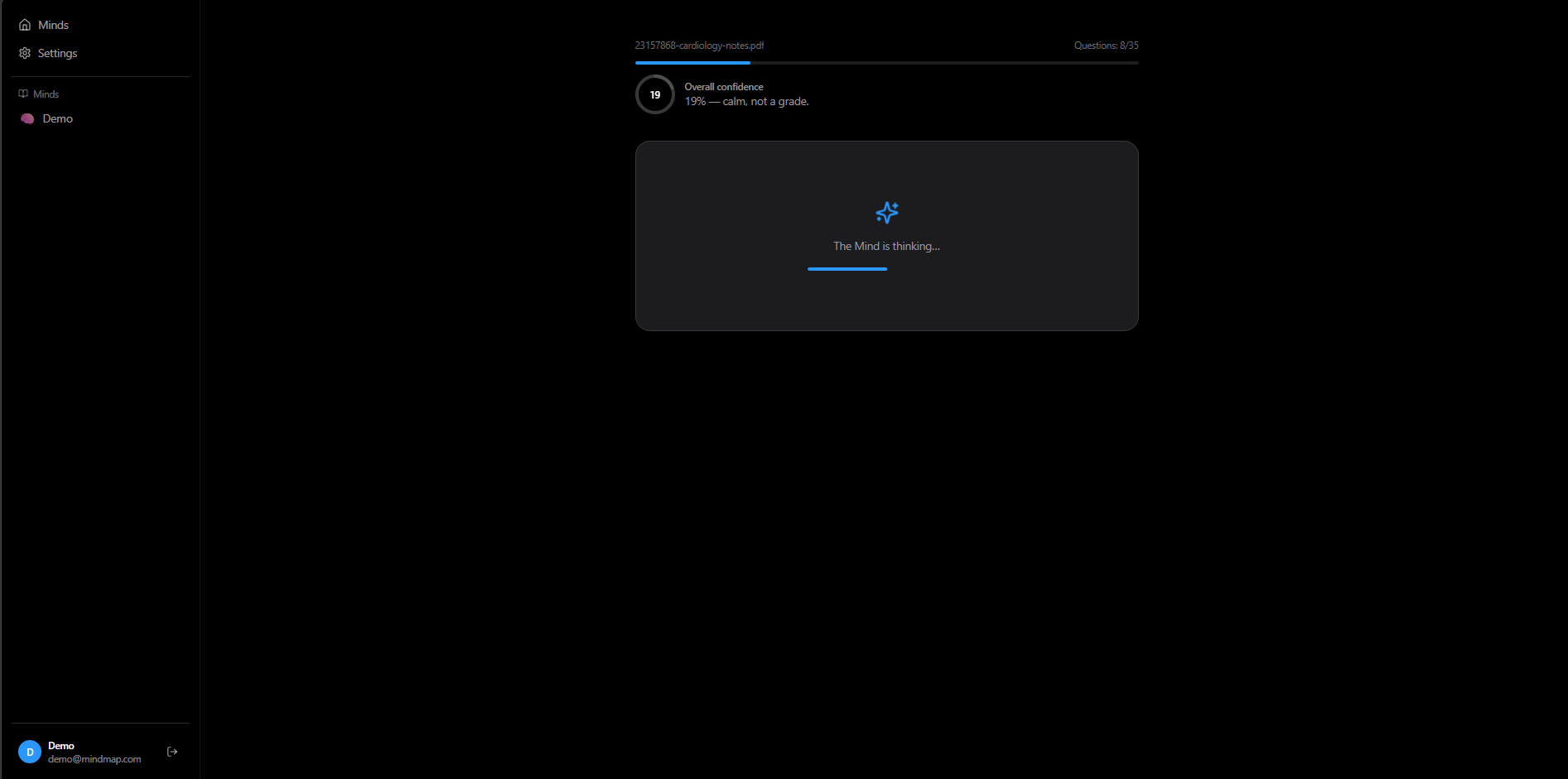
Thinking

Inspiration
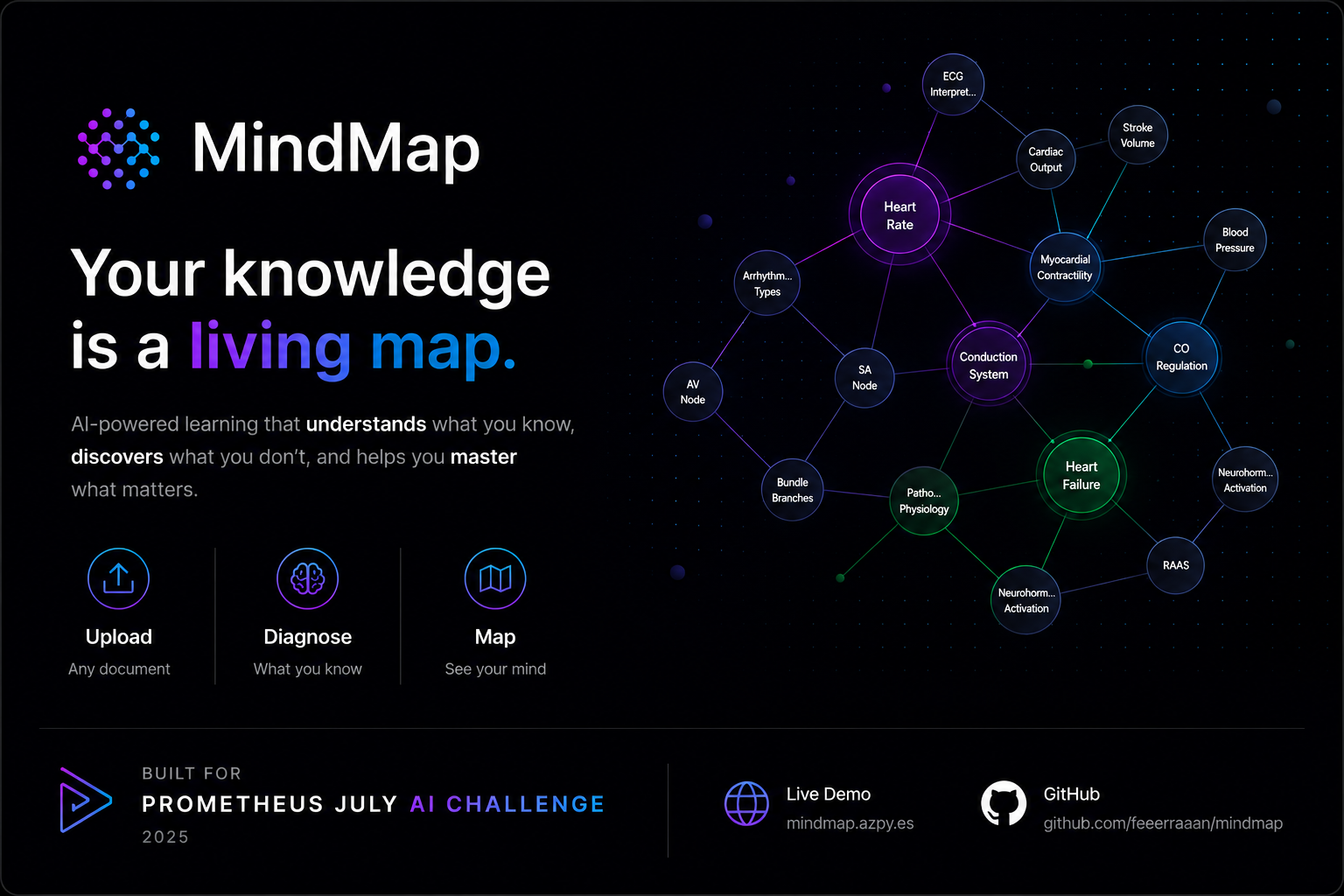
Most study tools optimize for producing - more flashcards, more summaries, more quizzes. But the real bottleneck in self-study isn't production volume; it's the illusion of competence - the gap between what you recognize and what you truly understand. We wanted to build the opposite: a tool that optimizes for understanding, that manufactures the uncomfortable moment where you realize you didn't actually know what you thought you knew. An MRI scan for knowledge, not another summarizer.
What it does
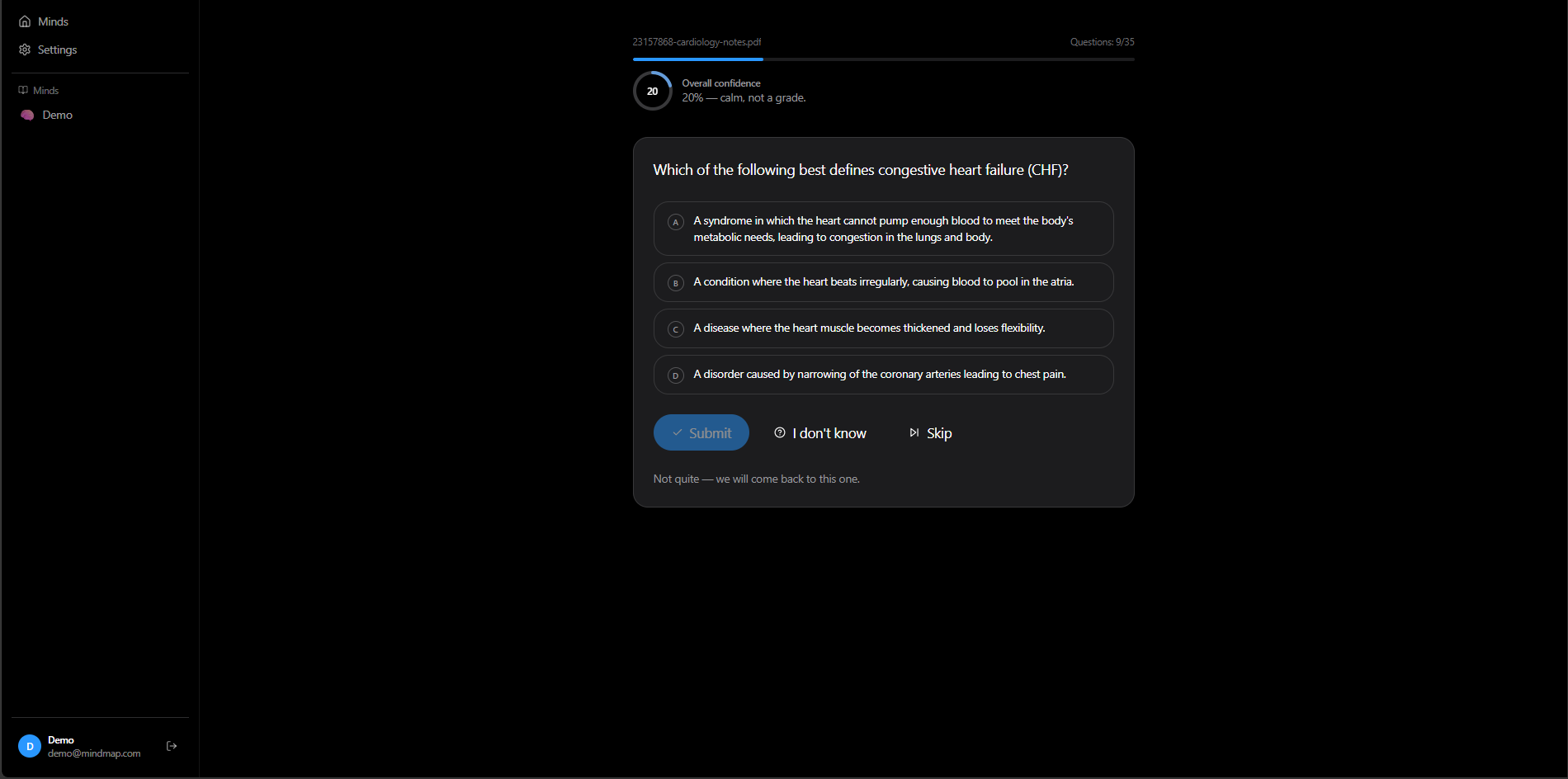
MindMap builds a Knowledge Graph from any PDF, DOCX, or PPTX you upload, then runs an adaptive diagnosis - a calm Socratic interview that asks the minimum number of questions that maximally reveal your knowledge state, using Item Response Theory and Bayesian estimation.
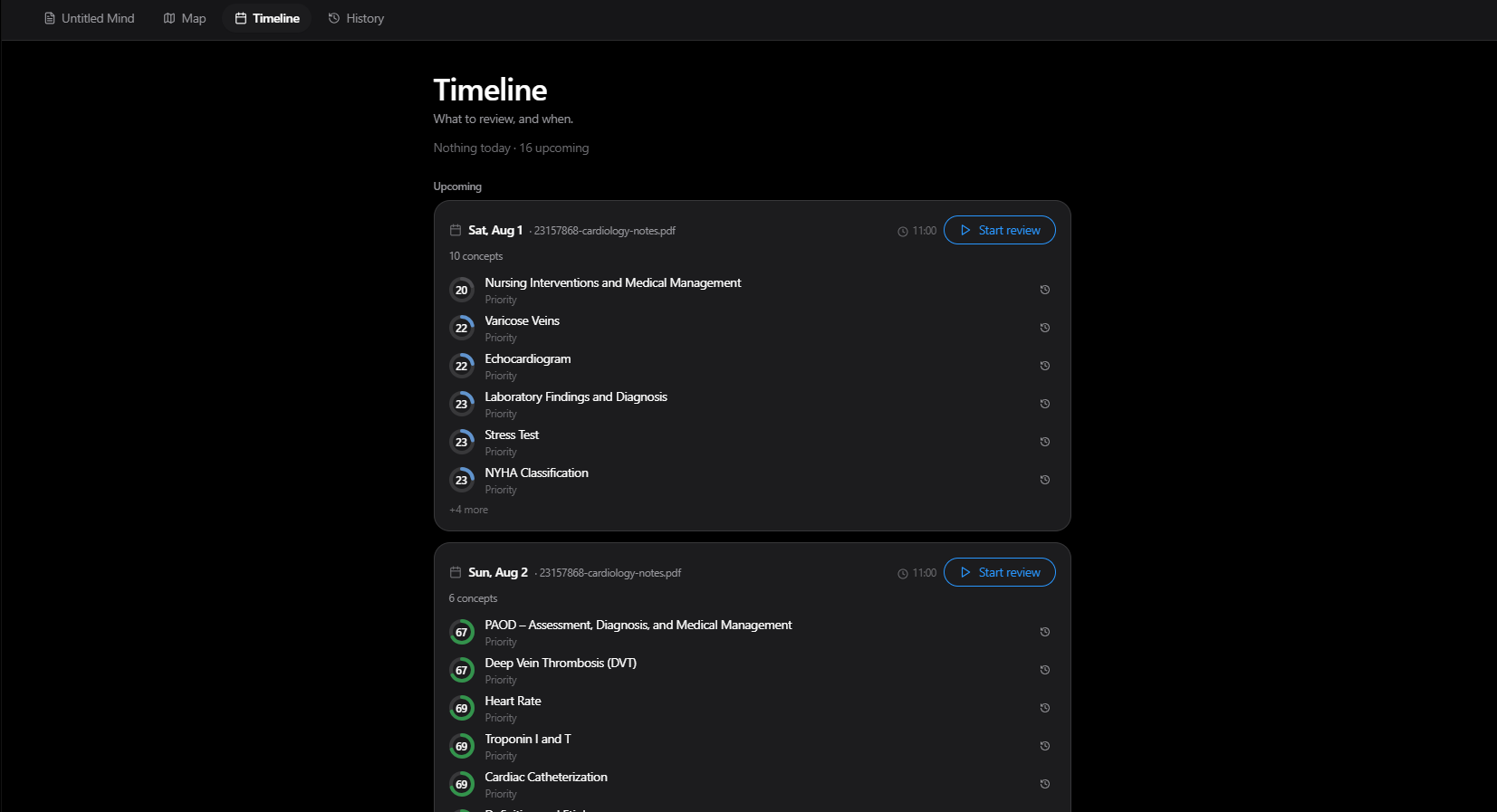
The diagnosis runs as a 4-phase cycle: DIAGNOSE → LEARN → PRACTICE → VERIFY. It generates questions just-in-time via LLM, evaluates open-ended answers semantically, surfaces weak concepts through the dependency graph, and teaches you what you missed. At the end, a pure-math Timeline Engine schedules spaced reviews adapted to your measured (mastery, confidence) - no fixed forgetting curve, no manual card authoring.
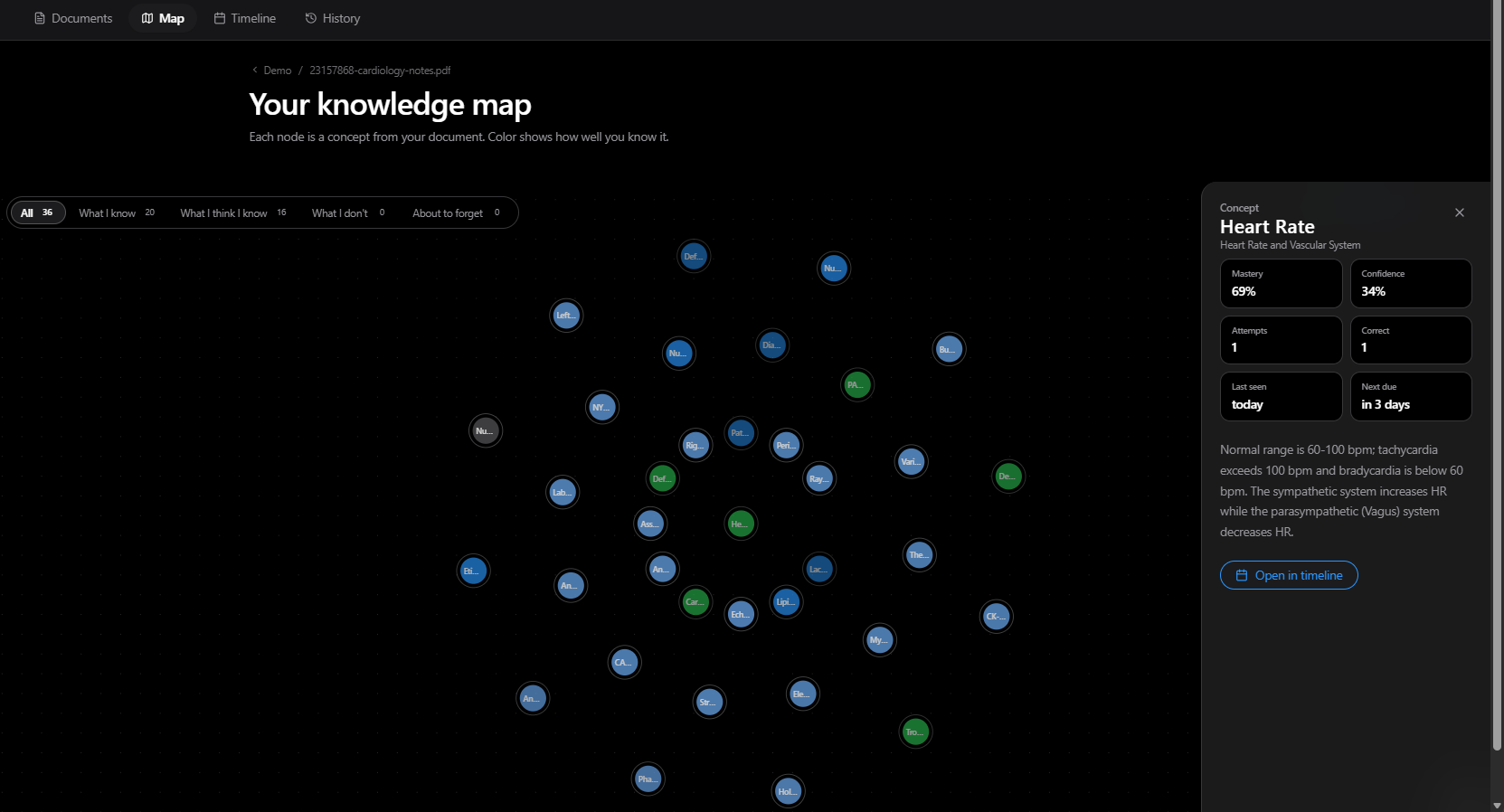
The output is a visual Knowledge Map that fills with color as your mastery emerges: the product's hero moment.
How we built it
- 12-package pnpm monorepo with enforced import boundaries (ESLint
no-restricted-paths). Thepackages/brainpackage is the only place that calls an LLM - every other package sees a typedBrainobject. - Next.js 16 App Router with Server Components, Server Actions, and SSE streaming for the diagnosis conversation (with a polling fallback for spotty connections).
- Prisma + Neon Postgres for persistence; a VPS worker with atomic
QUEUED → RUNNINGclaims handles long-running PDF parsing and graph generation outside Vercel's serverless limits. - AI layer on
@ai-sdk/openai-compatiblewith a provider-independent router, task-based model selection (cheap for extraction, reasoning for evaluation), token-bucket cost guards, and versioned.mdprompt templates with schema-repair retries. - All LLM outputs are Zod-validated; on failure we retry with repair prompts (max 2), then mark the concept
failedand continue - partial graphs over total failure.
Challenges we ran into
Keeping the AI boundary airtight. The rule "only packages/brain imports an AI SDK" is enforced in flat ESLint config. As features shipped fast during the hackathon, the rule caught violations that would have leaked API keys to the client - exactly what it was designed to prevent.
Schema-repair without token blowup. LLMs return prose-wrapped or invalid JSON, especially from cheaper models. Our extractJson helper strips fences, Zod validates, and a repair prompt re-asks with the validation error - capped at 2 retries.
Acyclic graphs from an LLM. Extracted dependency edges sometimes contain cycles. A Tarjan SCC pass rejects them and drops offending edges rather than failing the whole graph build.
IRT math that rewards honesty. "I don't know" and "Skip" produce the same correctness = 0 but different confidence updates. "I don't know" raises confidence (honest signal) while "Skip" lowers it. Getting the Bayesian posteriors right required hand-computed unit tests to verify the density didn't silently inflate mastery.
SSE that survives demo WiFi. The diagnosis uses SSE with a one-shot reconnect and a React Query polling fallback, so a dropped connection resumes from the persisted DiagnosisSession state.
Multi-phase session lifecycle. The 4-phase cycle (DIAGNOSE → LEARN → PRACTICE → VERIFY) shares one DiagnosisSession row. We learned the hard way that marking the session COMPLETED at the first shouldStop (end of DIAGNOSE) silently killed the LEARN, PRACTICE, and VERIFY phases - a one-line fix with outsized impact on timeline and history population.
What we learned
- Bayesian mastery estimation on a 2D grid. Our IRT engine uses a 1PL logistic model with Fisher information for question selection and a discretized 2D
(mastery, confidence)posterior, updated via grid-based Bayesian inference:
$$P(\theta \mid r) \propto P(r \mid \theta) \cdot P(\theta)$$
where the likelihood $P(r \mid \theta, b)$ is the standard 1PL IRT form:
$$P(r = 1 \mid \theta, b) = \frac{1}{1 + e^{-(\theta - b)}}$$
Pure-math scheduling outperforms fixed curves. Scheduling review intervals from measured
(mastery, confidence)pairs - where intervals soften on failure instead of punitively doubling - produced review plans that felt more natural than any fixed-curve approach.Streaming isn't optional for Socratic dialogue. A streamed follow-up clarification when an answer is ambiguous turns a dead-end into a conversation. That's only possible with SSE and a language model behind it.
What's next for MindMap
- Performance: reduce worker latency and cold starts so the platform feels faster end-to-end.
- OCR for scanned/image-only PDFs (currently surfaced gracefully).
- Multi-document workspaces - merge a learner's whole corpus into one unified knowledge graph.
- Collaborative maps - share a diagnostic snapshot, let a mentor review a student's gaps.
- API for educators - "diagnose my cohort on this material."
- React Native app (PWA-first until retention is proven).
Built With
- better-auth
- docker
- framer-motion
- i18n
- next.js
- opencode
- playwright
- pm2
- pnpm
- postgresql
- prisma
- pwa
- react
- react-query
- server-sent
- shadcn/ui
- sse
- tailwind-css
- turborepo
- typescript
- vercel
- vitest
- zod

