Inspiration
Learning should be an adventure, not a chore. We've all experienced the frustration of trying to understand complex topics by jumping between your screens, losing our train of thought, and struggling to see how concepts connect. Wanted to create a tool that transforms knowledge exploration into an immersive and visual journey that shows you the web of concepts unfold in 3D space. My inspiration came from the realization that human brains naturally think in networks and associations, so why shouldn't learning tools reflect that?
What it does
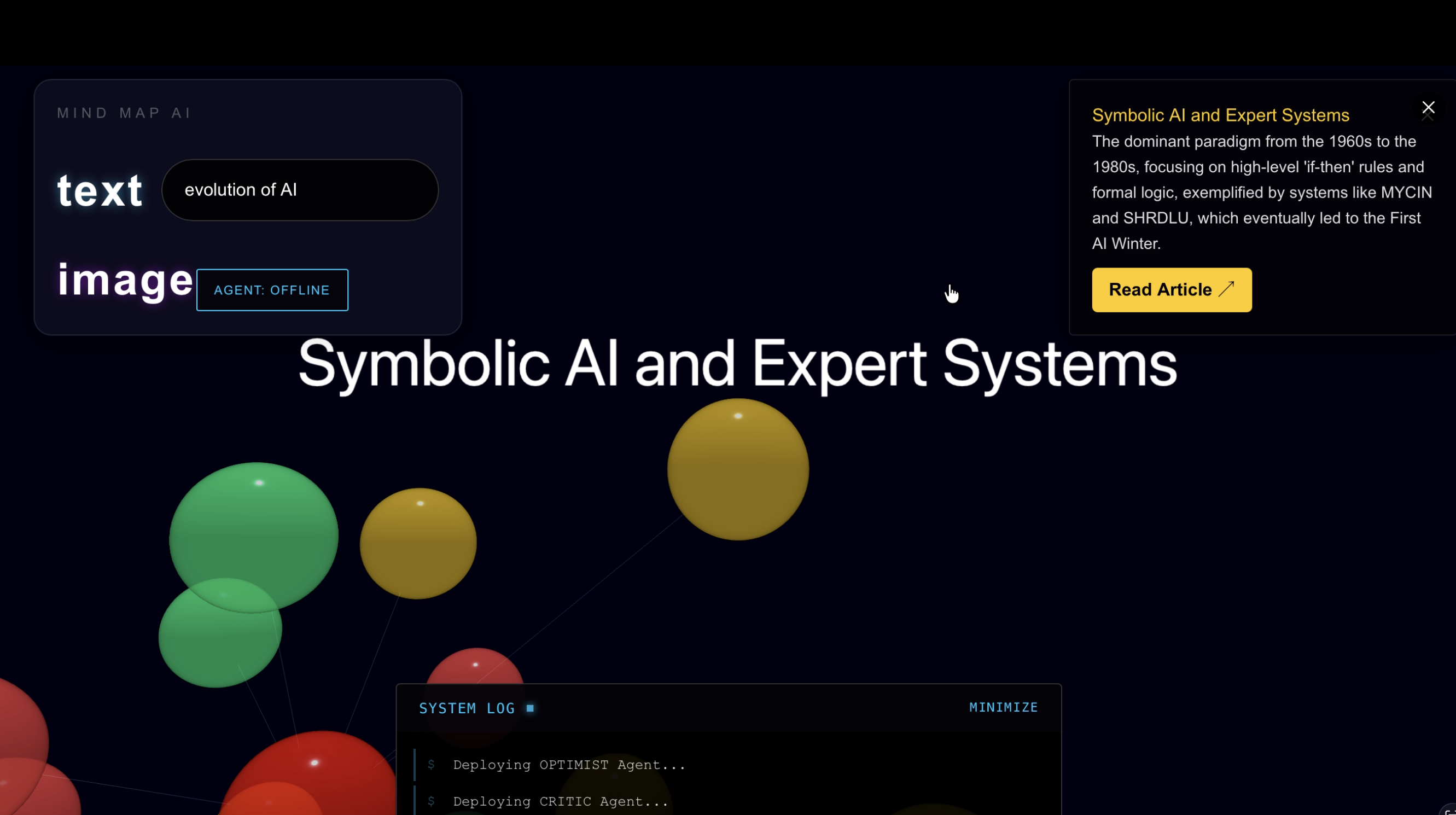
MindMap AI is an AI-powered 3D knowledge graph visualization platform that transforms how people explore and understand information. Users simply type a query or upload an image, and MindMap AI creates a beautiful 3D network of related concepts they can explore by clicking, rotating, and diving deeper into each node.
How we built it
Frontend (Next.js+React.js)
- Three.js and react-force-graph-3d for stunning 3D visualizations
- Modern glass-morphism UI with smooth animations
- Server-side rendering for optimal performance
AI Backend (Python + FastAPI)
- Google Gemini 3.0 Flash Preview for multi-agent AI research
- Google Gemini Multi Modal model for computer vision in understanding image uploads and extracting key related information from the web.
- Sentence Transformers (all-MiniLM-L6-v2) for semantic embeddings
- Three distinct AI agent personas running in parallel
- Wikipedia API integration for metadata enrichment
Vector Engine (C++)
- Custom-built high-performance vector similarity search
- Optimized dot product calculations for 384-dimensional embeddings
- Binary storage format for 2000+ pre-computed vectors
- HTTP server using cpp-httplib for sub-millisecond responses
Infrastructure
- Docker containerization for all services
- Microservices architecture with inter-service HTTP communication
- Deployed on Render with environment-based configuration
- Automated CI/CD pipeline
Challenges we ran into
Host Platform Issues: Because of the multiple systems this project entails (c++ engine, python backend, and react frontend), finding a host compatible for all three and one that could accommodate the vast amount of data being extracted was a challenge. I juggled through many different hosting platforms (Render, Vercel, Railway, AWS), and finally settled on using railway to host MindMap AI.
***Cross-Language Integration*: Getting C++, Python, and JavaScript services to communicate seamlessly was tricky. We had to carefully design our API contracts and handle serialization/deserialization across languages.
Performance Optimization: Rendering 100+ nodes in 3D with smooth physics simulations while maintaining 60fps was challenging. We implemented aggressive optimizations and careful state management.
Accomplishments that we're proud of
- Full-Stack Innovation: Successfully integrated C++, Python, and modern React into a cohesive, production-ready application
- AI Multi-Agent System: Created three distinct AI personalities that provide genuinely different perspectives, making research more comprehensive
- Performance Excellence: Achieved sub-millisecond vector search times and smooth 60fps 3D rendering with physics simulations
- Beautiful UX: Crafted a polished, glass-morphism interface that makes complex technology feel approachable and fun
- End-to-End Deployment: Successfully deployed a multi-language microservices application to production with proper orchestration
- Image Analysis: Integrated vision AI to extract concepts from images—something we implemented on a whim that turned out amazing
- Complete Documentation: Created comprehensive architecture docs, deployment guides, and API documentation
What we learned
Technical Skills
- Vector embeddings and semantic search algorithms
- 3D graphics programming with Three.js and WebGL
- High-performance C++ for production systems
- Microservices architecture and inter-service communication
- Async/streaming in Python with FastAPI
- Modern React patterns with Next.js 16 and React 19
- Docker containerization and orchestration
Engineering Practices
- Designing APIs for cross-language compatibility
- Balancing performance vs. maintainability
- Progressive enhancement and graceful degradation
- Real-time streaming architectures
- Managing complexity in distributed systems
Deployment & DevOps
- Multi-service deployment strategies
- Environment-based configuration management
- Debugging production issues across services
- Cost optimization for free-tier hosting
What's next for MindMap AI
- Add more AI agent personas (Scientist, Philosopher, Entrepreneur)
- Implement "deep dive" mode where agents can recursively explore topics
- Add chat interface to ask questions about the knowledge graph
- Fine-tune our own embedding model for better domain-specific results
- Save and share custom knowledge graphs
- Export functionality (PDF, image, interactive HTML)
- Mobile app for on-the-go learning
- Browser extension for instant visualization from any webpage
- API for developers to integrate knowledge graph generation into their apps
Built With
- c++
- gemini3
- javascript
- next.js
- python
- react
- three.js


Log in or sign up for Devpost to join the conversation.