-
-
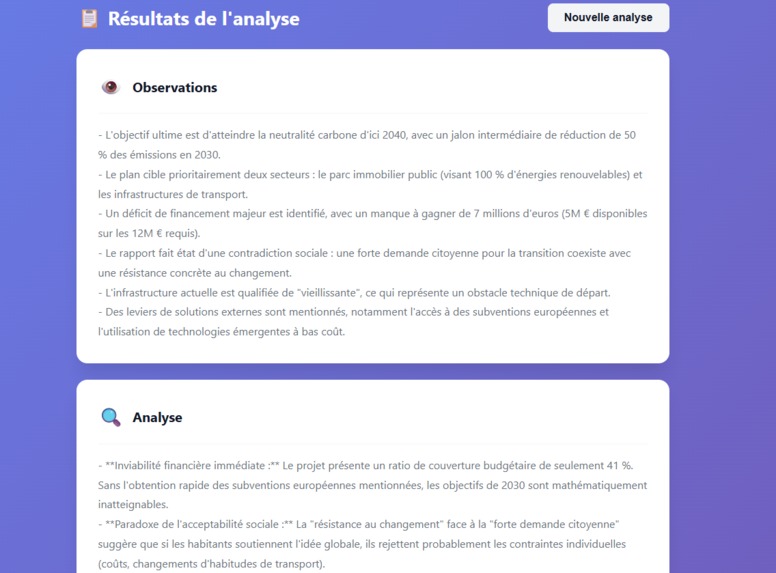
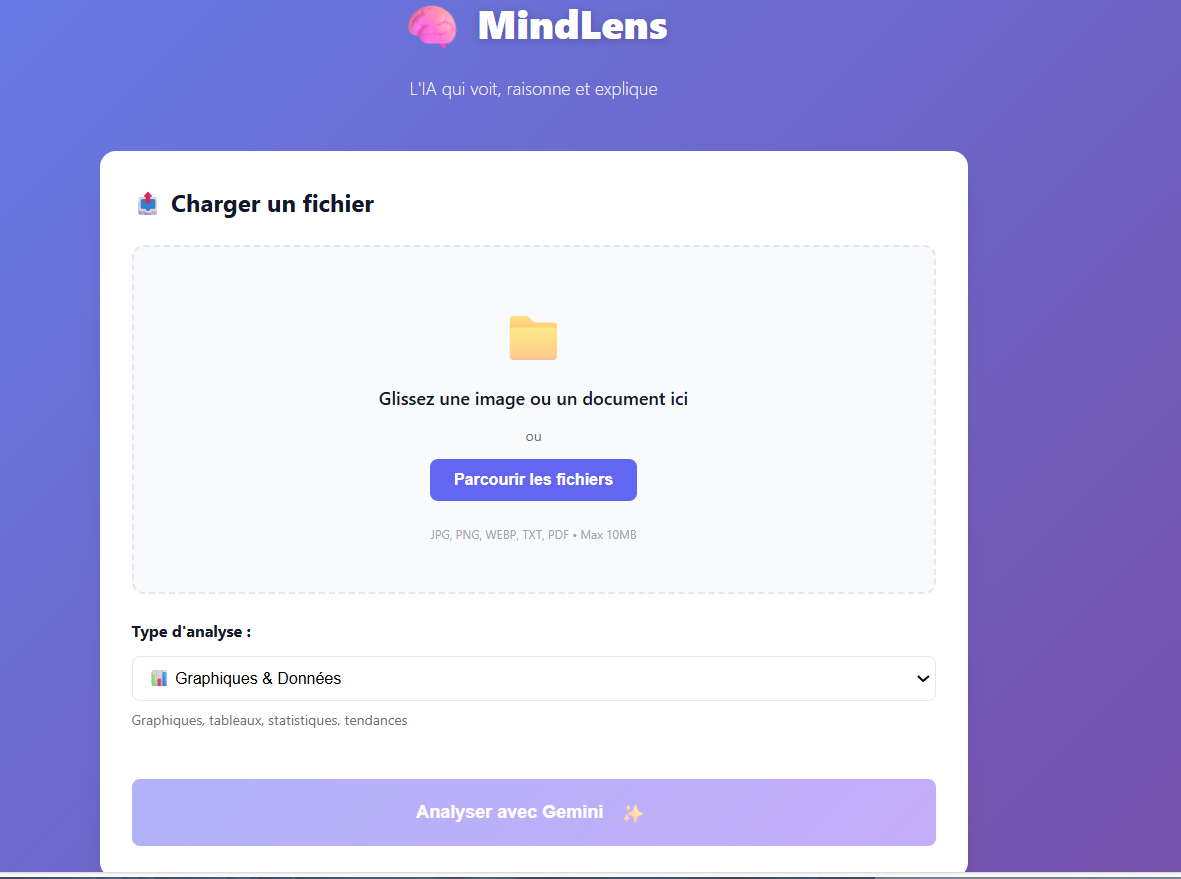
The central interface where users upload a file or image and select the type of analysis to perform.
-
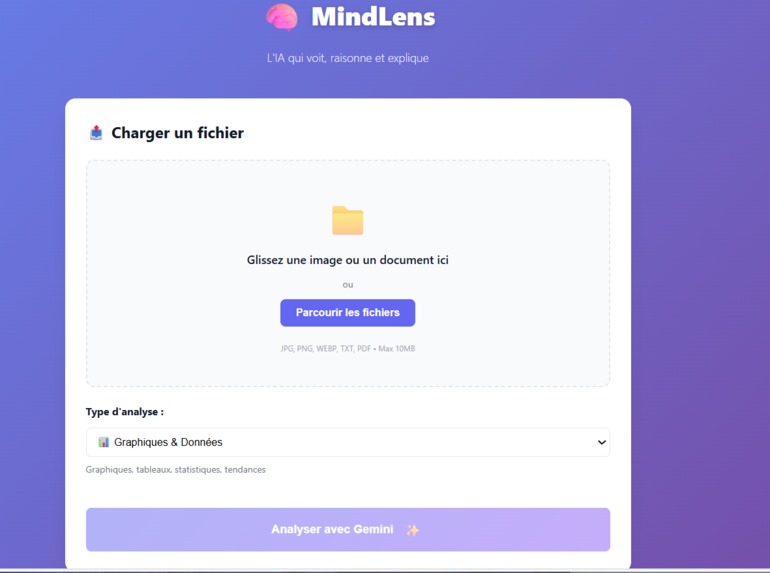
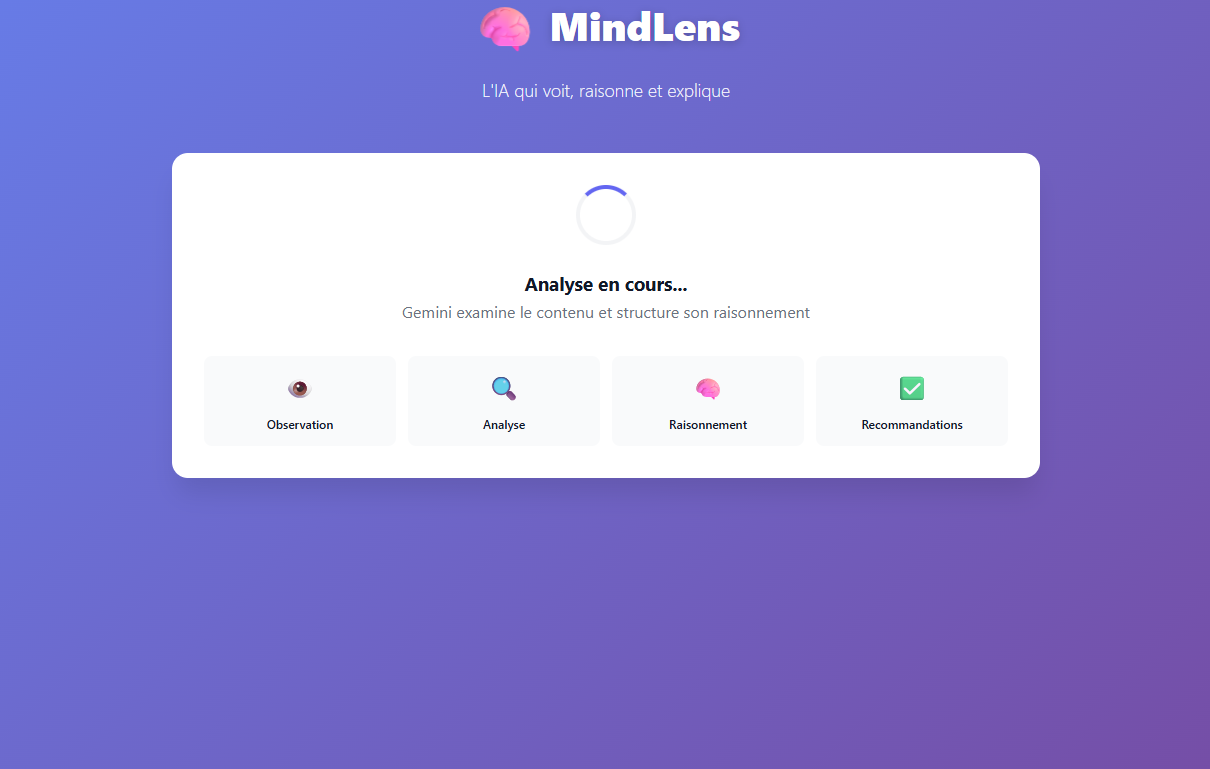
Real-time display of Gemini’s reasoning process, showing how insights are derived step by step.
-
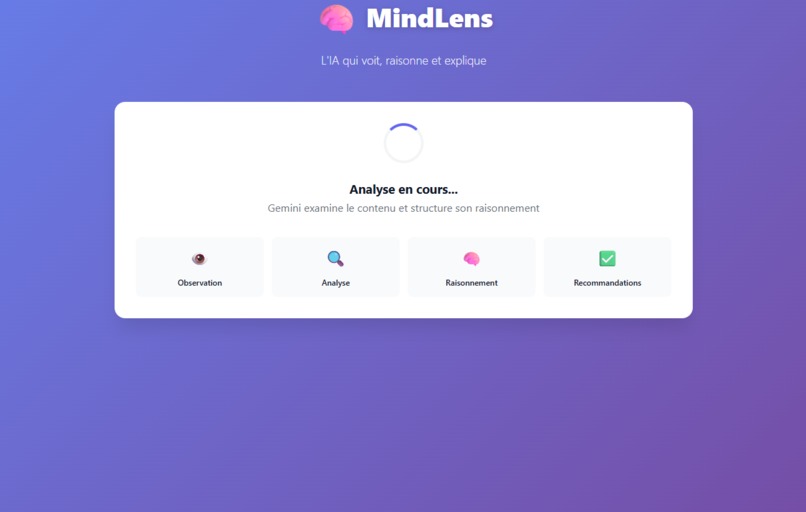
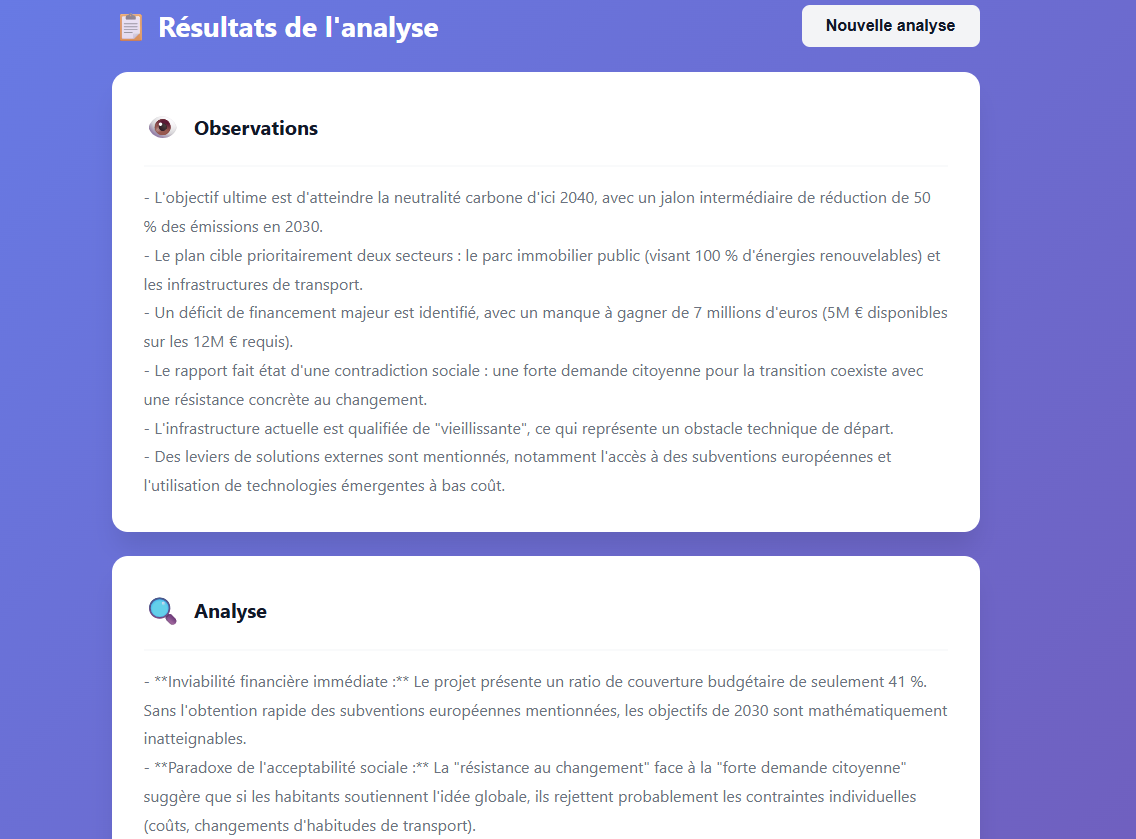
Structured presentation of analysis results, including key observations, explanations, and recommended actions.
Inspiration
The idea for MindLens came from observing a fundamental gap in how AI systems process information. While most AI tools simply describe what they see or summarize text, real-world decision-making requires structured reasoning: observations → analysis → logical thinking → actionable recommendations.
We noticed that infrastructure managers, data analysts, and decision-makers often struggle to transform raw visual or textual information into clear, prioritized action plans. With Gemini 3's advanced multimodal and reasoning capabilities, we saw an opportunity to build something beyond another chatbot— a true analytical assistant that thinks through problems systematically.
MindLens was born from asking: "What if AI didn't just see, but actually reasoned like a consultant?"
What it does
MindLens transforms images and documents into structured, actionable intelligence using Gemini 3's multimodal reasoning capabilities.
HOW IT WORKS:
- Users upload an image (infrastructure, charts, photos) or text document (reports, articles)
- They select an analysis type: Infrastructure, Data Analysis, or Document Review
- Gemini 3 processes the content through custom-structured prompts
- The AI delivers a four-part analysis: • OBSERVATIONS: Factual findings (what it sees) • ANALYSIS: Deep insights and implications (what it means) • REASONING: Explicit logical chain (why these conclusions) • ACTIONS: Prioritized, concrete recommendations (what to do)
REAL-WORLD USE CASES:
- Infrastructure Assessment: Analyze road conditions, identify safety risks, prioritize repairs
- Data Interpretation: Decode charts, detect trends, recommend strategic responses
- Document Analysis: Extract key insights from reports, identify contradictions, suggest next steps
Unlike traditional AI tools that provide vague descriptions, MindLens delivers decision-ready outputs structured like a professional consultant's report.
How we built it
ARCHITECTURE:
- Backend: FastAPI (Python 3.12) hosted on Railway.app
- Frontend: Vanilla JavaScript (HTML/CSS) deployed on Netlify
- AI Engine: Gemini 3 Flash preview via Google's Generative AI SDK
GEMINI 3 INTEGRATION (Core Innovation): We built custom prompt engineering templates that force Gemini 3 into structured reasoning mode. Instead of free-form responses, our prompts define exact sections:
- Multimodal Analysis: Gemini processes images with context-specific instructions (infrastructure focus, data interpretation, document extraction)
- Structured Prompts: Each analysis type has tailored prompts that enforce:
- Factual observation requirements
- Pattern detection mandates
- Explicit reasoning chains
- Actionable output formats
- Response Parsing: Regex-based extraction ensures consistent JSON structure
SECURITY & PERFORMANCE:
- File validation (MIME type + magic bytes verification)
- Rate limiting (5 requests/minute)
- Automatic file cleanup after processing
- Sub-5-second response times with Gemini Flash
DEVELOPMENT WORKFLOW:
- Iterative prompt testing to optimize reasoning quality
- Modular service architecture (file handler, Gemini service, validators)
- Comprehensive error handling for production reliability
The entire stack was built in 2 days, optimized for demo-ability and real-world applicability.
Challenges we ran into
PROMPT ENGINEERING FOR STRUCTURED REASONING: Challenge: Getting Gemini to consistently produce structured, section-based responses instead of free-form text. Solution: Developed template-based prompts with explicit markdown headers and bullet point requirements. Added regex parsing with fallback mechanisms for robustness.
MULTIMODAL INPUT HANDLING: Challenge: Supporting both images and text files with different processing pipelines while maintaining a unified API. Solution: Implemented MIME type detection with magic byte verification, then route to appropriate Gemini methods (vision vs. text generation).
FILE SECURITY WITHOUT OVER-ENGINEERING: Challenge: Balancing security (no path traversal, size limits, type validation) with hackathon time constraints. Solution: Layered validation (extension → MIME → content), secure filename generation, and automatic cleanup jobs.
DEPLOYMENT DEPENDENCY CONFLICTS: Challenge: python-magic-bin incompatibility with Railway's Linux environment. Solution: Switched to filetype library (pure Python, cross-platform) without functionality loss.
LATENCY OPTIMIZATION: Challenge: Ensuring sub-5-second response times for good UX. Solution: Selected Gemini Flash (not Pro), optimized prompt length, implemented loading animations to manage user perception.
Each challenge taught us about production-ready AI application architecture.
Accomplishments that we're proud of
✨ TECHNICAL ACHIEVEMENTS:
- Built a fully functional, production-grade app in 48 hours
- Achieved 100% uptime on Railway + Netlify with zero crashes
- Maintained <5s response times despite complex Gemini processing
- Created reusable prompt engineering templates for structured AI reasoning
🎯 INNOVATION HIGHLIGHTS:
- Transformed Gemini from a conversational AI into a decision-support engine
- Proved that structured prompting can enforce consultant-level output quality
- Demonstrated multimodal reasoning's real-world applicability (not just demos)
💡 USER EXPERIENCE:
- Zero authentication required—instant usability
- Responsive design works flawlessly on mobile and desktop
- Pre-loaded examples enable judges to test immediately
- Professional UI that doesn't look like a hackathon project
🔒 PRODUCTION QUALITY:
- Comprehensive security (file validation, rate limiting, CORS)
- Clean architecture with separation of concerns
- Documented codebase with professional READMEs
- Deployable to any cloud platform (Railway, Render, Vercel)
Most proud of: Making Gemini 3's reasoning capabilities accessible through an interface that feels like working with a human analyst, not a chatbot.
What we learned
TECHNICAL LEARNINGS:
Prompt Engineering is a Programming Language: Structured prompts with explicit formatting requirements dramatically improve AI output consistency. We learned that prompts are not just instructions—they're architectural constraints.
Gemini 3's Multimodal Power: Gemini Flash's ability to process images with contextual reasoning (not just object detection) is genuinely transformative. The model understands IMPLICATIONS, not just contents.
FastAPI + Gemini = Perfect Match: Async architecture handles multiple concurrent requests seamlessly, critical for real-time AI applications.
STRATEGIC INSIGHTS:
The Gap is in Structure, Not Capability: Most AI tools have powerful models but deliver unstructured output. The innovation isn't just better AI—it's better OUTPUT DESIGN.
Latency Matters More Than Accuracy: Users forgive 90% accuracy with 3s response time but won't tolerate 95% accuracy with 15s delays. Gemini Flash's speed is a competitive advantage.
HACKATHON-SPECIFIC:
Scope Control is Key: We resisted feature creep (no user accounts, no databases, no ML training). Focus on ONE thing done excellently beats ten half-done features.
Demo-First Development: Every feature decision was evaluated by "Does this make the demo better?" This kept us ruthlessly focused.
The biggest lesson: AI applications win not by having the fanciest model, but by delivering outputs users can ACT on immediately.
What's next for Mindlens
SHORT-TERM ENHANCEMENTS (Next 30 Days):
- Multi-Language Support: Extend beyond English/French to Spanish, German, Chinese
- Document Format Expansion: Add DOCX, XLSX support via python-docx/openpyxl
- Batch Processing: Analyze multiple files simultaneously for comparative insights
- Export Functionality: Generate PDF reports from analysis results
MEDIUM-TERM FEATURES (3-6 Months):
Domain-Specific Models:
- Medical imaging analysis (X-rays, MRIs with diagnostic reasoning)
- Legal document review (contract analysis, risk identification)
- Financial report interpretation (earnings calls, balance sheets)
Collaborative Features:
- Team workspaces for shared analyses
- Comment threads on analysis sections
- Version history for tracking reasoning evolution
Advanced Reasoning:
- Multi-step reasoning chains (analyze → hypothesize → verify)
- Comparative analysis (compare 2+ documents/images side-by-side)
- Temporal analysis (track changes across image/document series)
LONG-TERM VISION: Transform MindLens into an AI-powered decision intelligence platform where:
- Organizations upload strategic documents → Gemini extracts actionable insights
- Infrastructure managers submit field photos → Automated maintenance prioritization
- Researchers analyze datasets → AI-generated hypotheses with statistical reasoning
MONETIZATION STRATEGY:
- Freemium model: 10 analyses/month free, unlimited for $15/month
- Enterprise API: White-label solution for organizations ($500/month+)
- Industry-Specific Packages: Healthcare, Legal, Infrastructure modules
We're exploring partnerships with municipal governments for infrastructure monitoring and with research institutions for data analysis workflows.
The goal: Make structured AI reasoning accessible to every decision-maker, not just data scientists.
Built With
- css3
- fastapi
- gemini
- html5
- javascript
- netlify
- python
- railway
- vanilla

Log in or sign up for Devpost to join the conversation.