-
-
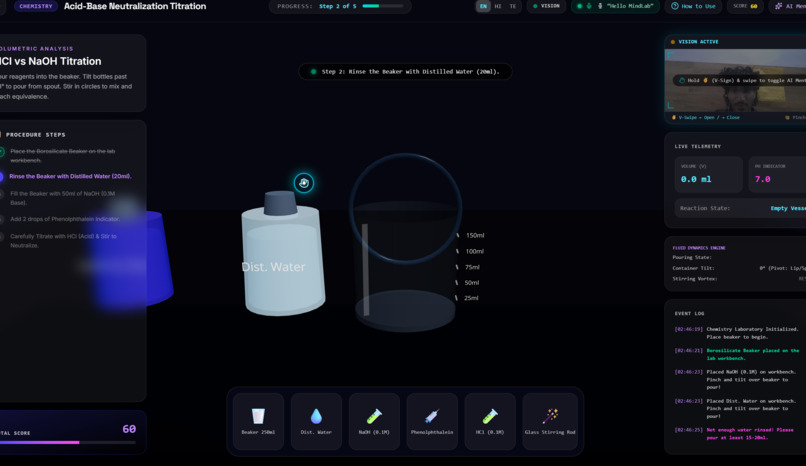
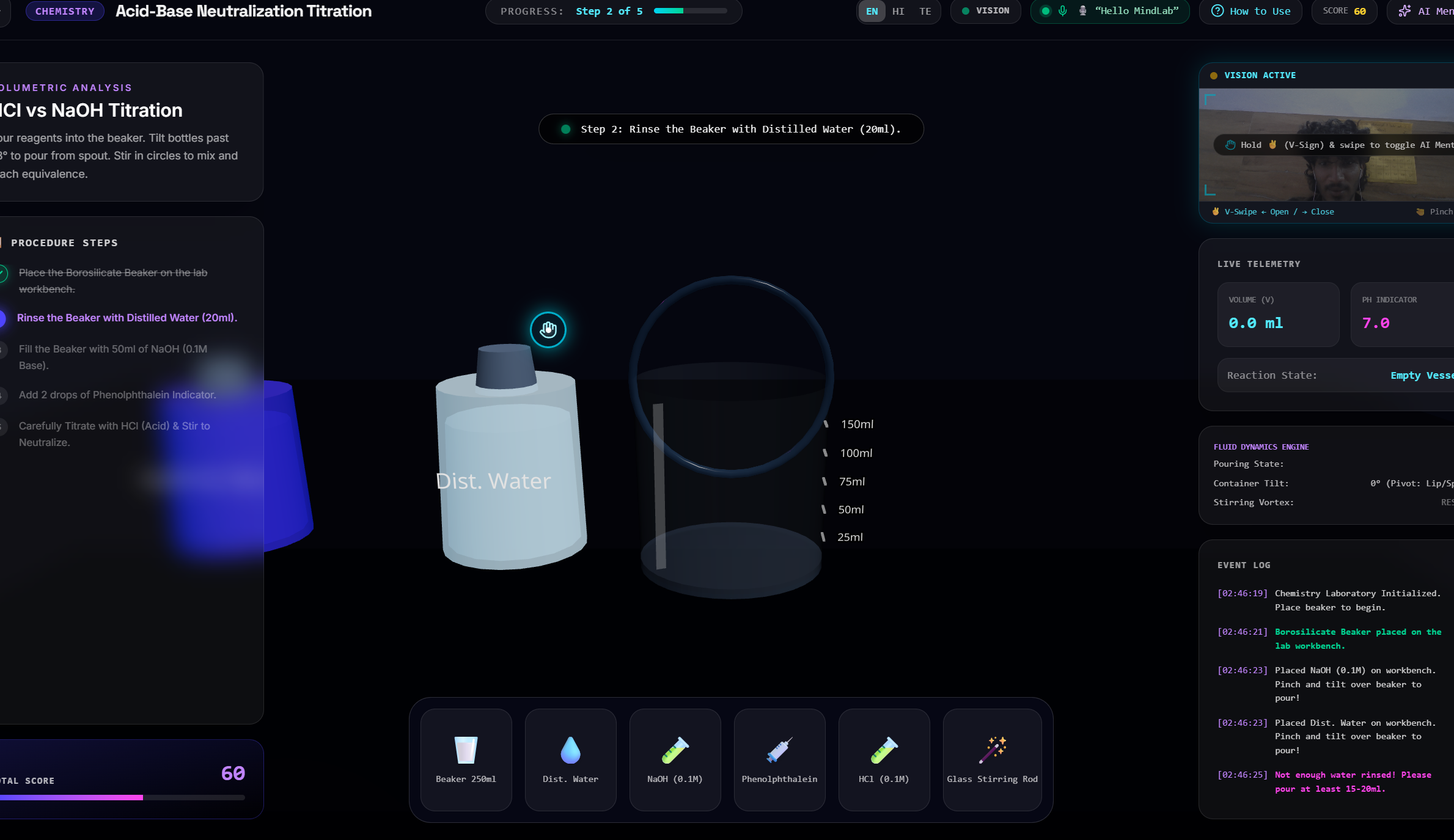
chemistry Lab in action
-
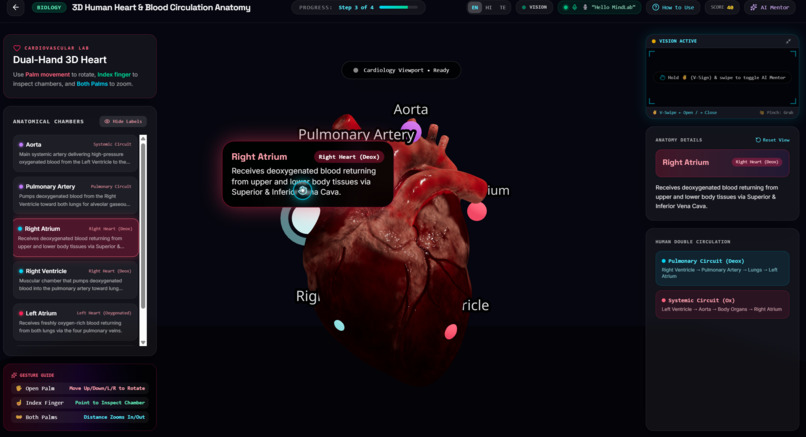
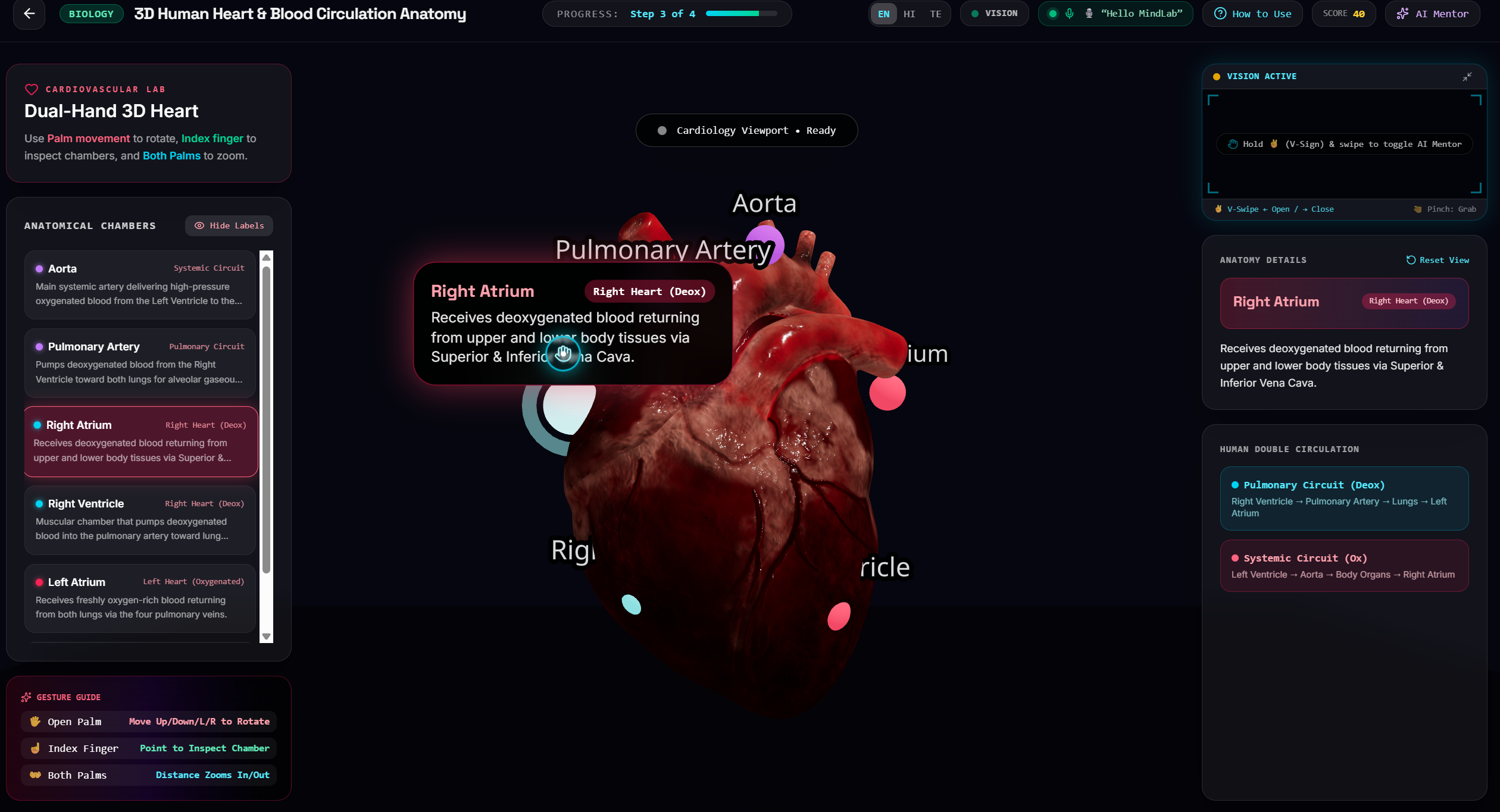
Heart_anatomy
Inspiration
The idea for MindLabs came to me when I visited a government school and saw how difficult it was for students to access something as basic as a science laboratory. Students were learning about experiments through textbooks, but many never got the opportunity to actually perform them. It made me wonder, what if we could bring an entire laboratory to students without it physically being there? What if all they needed was a laptop or a phone to experience science the way it was meant to be taught? That simple thought eventually became MindLabs. I wanted to build something that could make practical science education accessible to every student, regardless of where they study or what facilities their school has.
What it does
MindLabs is a combination of advanced CV architecture and gesture controlled system that enables students to actually perform experiments, look at parts of human body, in a one of a kind interactive environment. Students can actually pick up test tubes, Mix elements, see reactions happen, Talk to the AI in their own local language and it will talk back like a friend and answer their queries. An experiment can be performed million times over without worrying about wastage of chemicals and hazards of real apparatus
How we built it
MindLabs is built using Google's MediaPipe for real-time hand tracking, React and Vite for the web application, and Three.js for interactive 3D environments. We integrated Groq-powered AI and ElevenLabs for voice interactions. The web-based architecture makes it accessible across laptops, tablets, and phones without requiring expensive equipment.
Accomplishments that we're proud of
What makes me happiest about MindLabs is that we managed to turn an idea that initially sounded quite ambitious into something students can actually interact with. Being able to control a virtual laboratory with nothing more than your hands and a regular camera is something we're genuinely proud of. I also worked on making the interactions smoother and ensuring that the experiments follow the NCERT and CBSE curriculum. Another important accomplishment was bringing together gesture controls, interactive 3D models, and an AI assistant into one learning environment. Rather than building technology just for the sake of showing something impressive, we wanted every feature to serve a purpose and make learning science a little easier and more interesting.
What we learned
I am proud of being able to make it smoother, ensuring the entire laboratory actually Follows Government instructed curriculum, so no student is left behind.
What's next for MindLabs
Our vision for MindLabs is to make practical science education accessible to every student. We plan to introduce more experiments, support regional languages, and explore offline functionality for schools with limited internet access. We also hope to work with schools to bring MindLabs into real classrooms. Hack47 is one of our first opportunities to showcase what we've built, and we believe the best way to understand MindLabs is to experience it. After all, science was never meant to be just read about. It was meant to be explored.
Built With
- computervision
- llm
- mediapipe
- react.js
- three.js

Log in or sign up for Devpost to join the conversation.