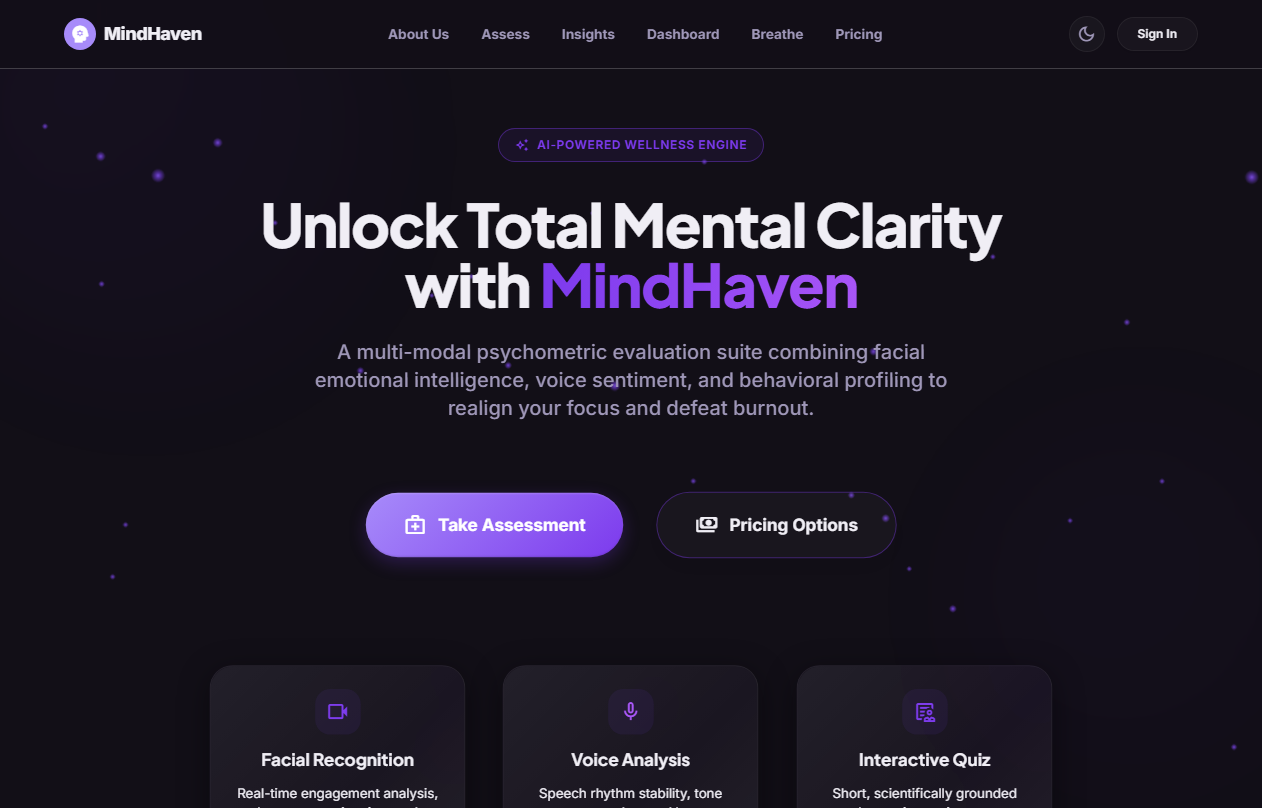
🧠 MindHaven: The Story of Building an Objective Multi-Modal AI Diagnostic & Recovery System for Student Burnout
📖 Chapter 1: The Inception and The Hidden Crisis
Academic environments across universities worldwide operate under relentless pressure. Deadlines, competitive grading, research demands, and high-stakes examinations create a pressure cooker for students. Yet, despite growing awareness around mental health, student burnout remains a silent epidemic.
The fundamental issue is not a lack of concern, but a diagnostic crisis.
Traditional mental health monitoring relies almost entirely on self-reported psychometric questionnaires such as the Maslach Burnout Inventory (MBI) or the Generalized Anxiety Disorder (GAD-7) scale. While clinically valuable, self-reporting suffers from three severe human failure modes:
- Social Stigma and Academic Denial: Students frequently under-report their exhaustion level out of fear of academic consequences, perceived weakness, or social judgment.
- Subjective Recall Bias: A student's mood at the exact moment of filling out a questionnaire heavily skews their evaluation of an entire month's workload.
- Delayed Detection: Self-reports are typically administered retroactively — often after a student has already suffered an acute mental breakdown or academic freeze.
This realization sparked the founding question of MindHaven:
What if we could infer internal physiological stress and mental exhaustion objectively through non-invasive computer vision, voice sentiment analysis, and machine learning late fusion — creating a continuous early-warning system that detects hidden burnout before it leads to collapse?
🔬 Chapter 2: Theoretical Foundations & Multi-Modal Biometrics
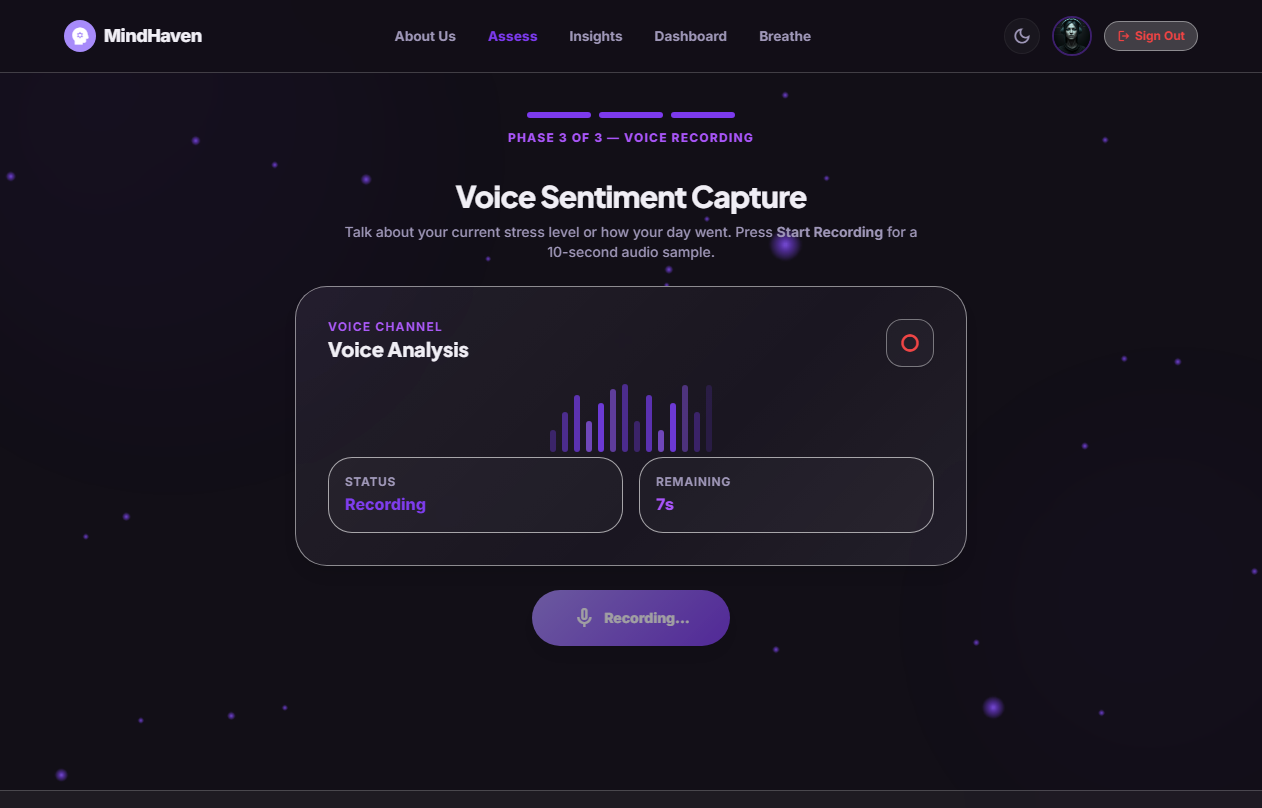
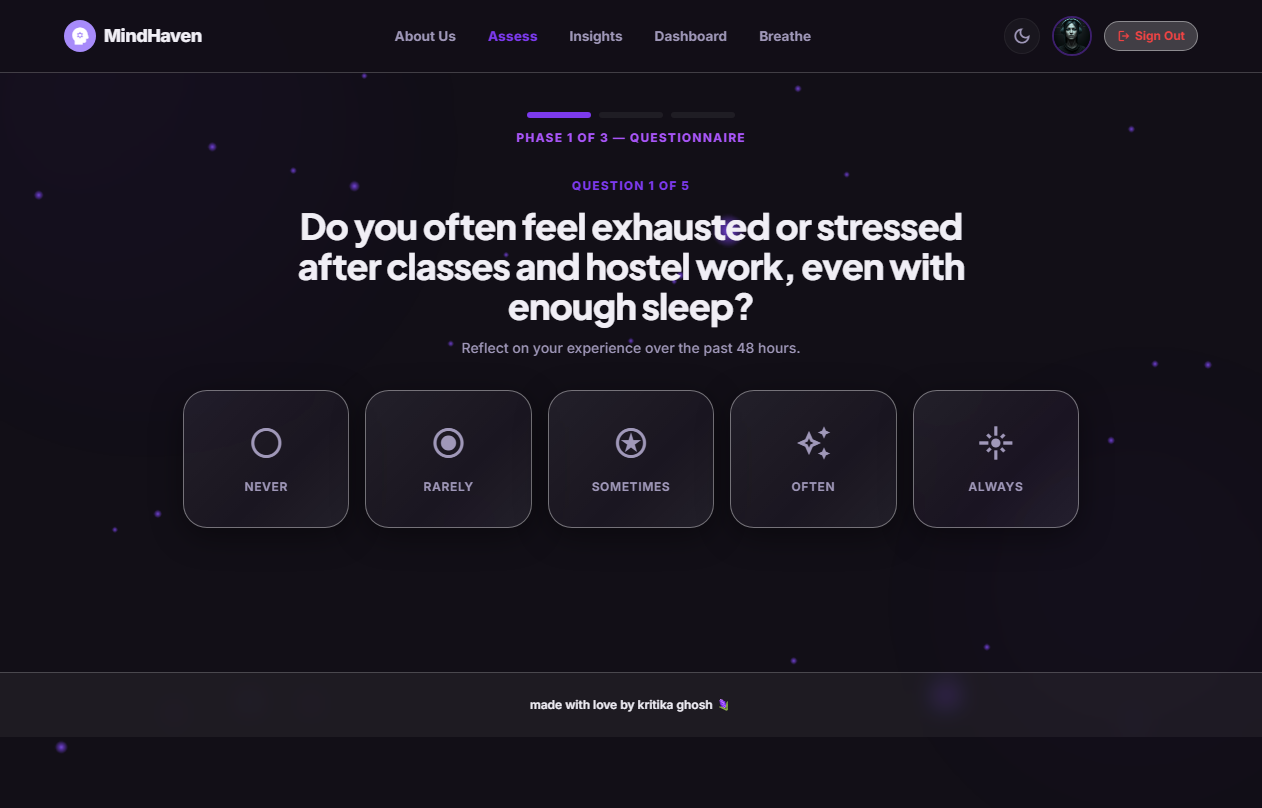
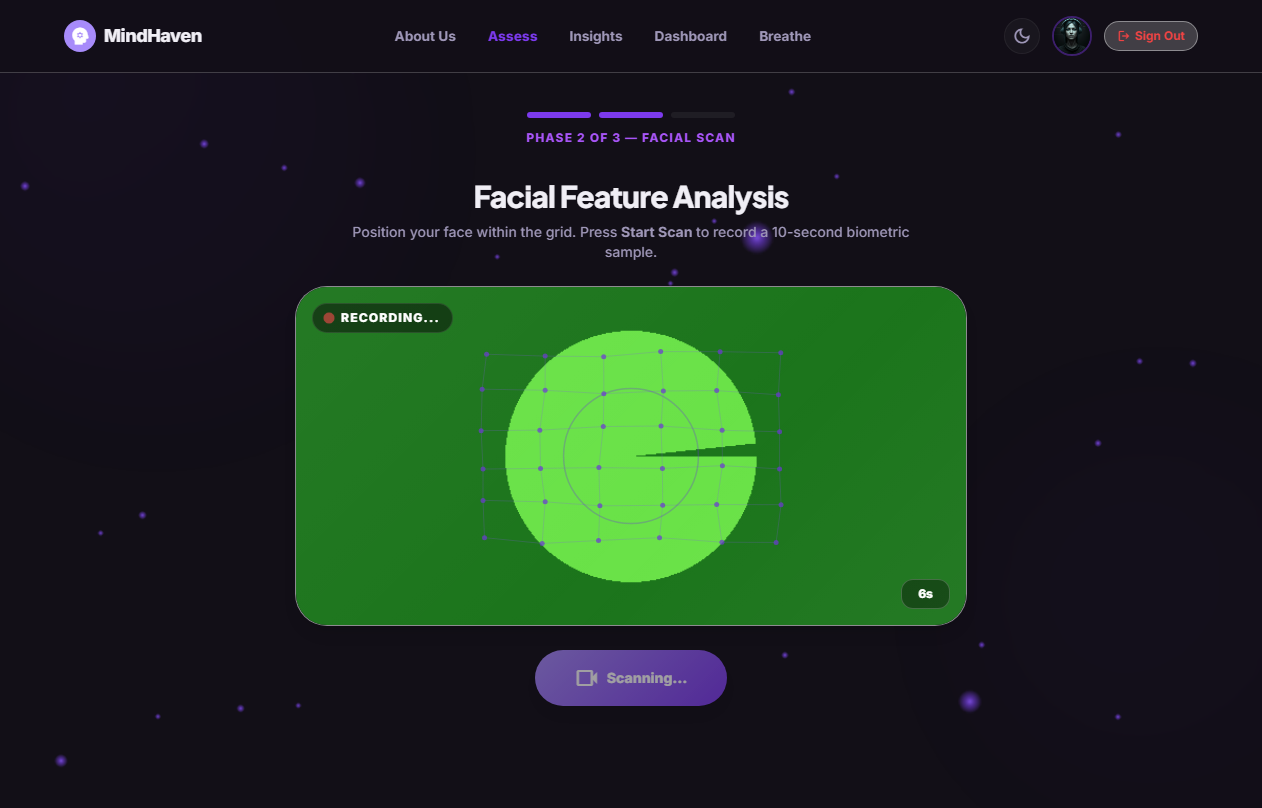
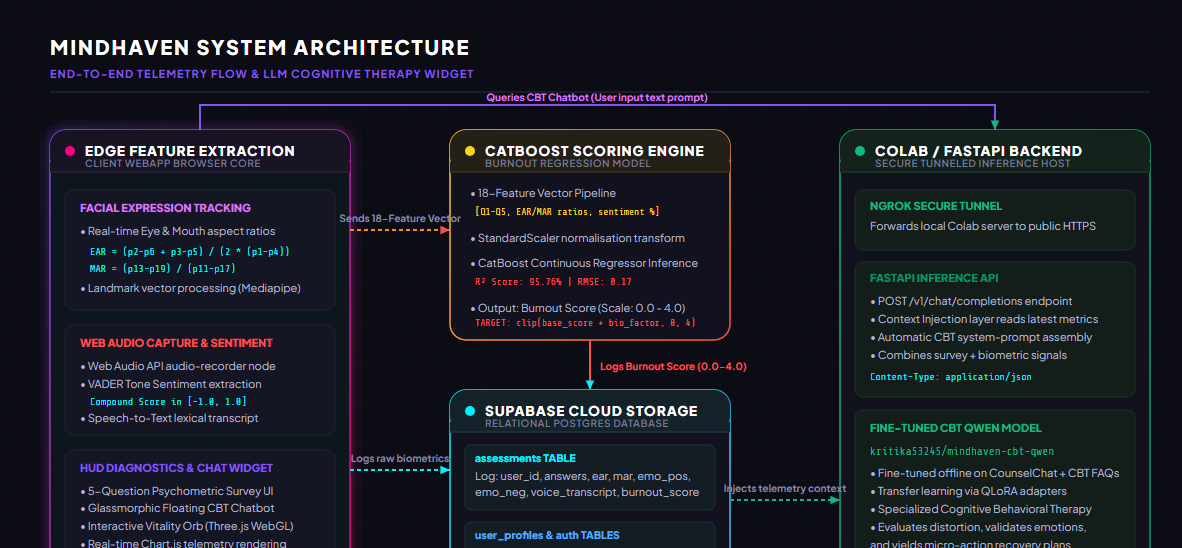
To replace subjective self-reporting with biological truth, MindHaven captures a 20-second biometric window combining three complementary signals: psychometrics, computer vision biometrics, and acoustic sentiment.
[20-Second Capture Window]
  ├── Psychometrics Baseline (5-Question MBI Likert Scale)
  ├── Computer Vision Biometrics (MediaPipe EAR + MAR Tracking)
  ├── Facial Micro-Expressions (DeepFace Emotion Proportions)
  └── Acoustic Sentiment Channel (WebRTC Speech + VADER Sentiment)
1. Ocular Dynamics & Eyelid Fatigue (Eye Aspect Ratio)
Eyelid droop, decreased blink speed, and prolonged closure duration are direct physiological markers of central nervous system fatigue. Using MediaPipe Face Mesh, we extract 468 3D facial landmarks in real time. For each eye, six specific landmarks are selected:
Eye Landmarks: p1, p2, p3, p4, p5, p6
The Eye Aspect Ratio (EAR) measures the distance between vertical eye landmarks relative to horizontal landmark distance:
EAR = (||p2 - p6|| + ||p3 - p5||) / (2 × ||p1 - p4||)
During the 20-second window, we calculate the mean (Avg_EAR) and standard deviation (Std_EAR). A dropping Avg_EAR accompanied by elevated Std_EAR signals severe drowsiness and ocular strain.
2. Oral Tension & Yawning Dynamics (Mouth Aspect Ratio)
Jaw tension and involuntary yawning are primary indicators of autonomic stress responses. We compute the Mouth Aspect Ratio (MAR) using six oral boundary landmarks:
MAR = (||p62 - p68|| + ||p63 - p67|| + ||p64 - p66||) / (2 × ||p61 - p65||)
Mean mouth openness (Avg_MAR) and variability (Std_MAR) capture suppressed yawns and physical jaw muscle tightness.
3. Micro-Expression Emotion Proportions
Facial micro-expressions reveal affective states that conscious effort cannot easily mask. Using a convolutional neural network (DeepFace), each video frame is classified into raw emotion probabilities:
E_frame ∈ {Happy, Sad, Angry, Fear, Surprise, Neutral, Disgust}
We aggregate frame classifications across the capture window into three normalized proportions:
Positive_Percent = ∑ 𝕀(E_frame == Happy) / N_frames
Neutral_Percent  = ∑ 𝕀(E_frame == Neutral) / N_frames
Negative_Percent = ∑ 𝕀(E_frame ∈ {Sad, Angry, Fear, Disgust}) / N_frames
4. Acoustic Sentiment Channel
During the capture window, the student speaks a short vocal response describing their current mental state. WebRTC streams the audio clip to a speech transcription engine. The transcribed text is passed to the VADER lexicon parser, outputting valence scores: Sent_Pos, Sent_Neu, and Sent_Neg.
The normalized compound sentiment score (Sent_Comp) maps the net valence onto [-1.0, 1.0]:
Sent_Comp = x / √(x² + α)
(where x = ∑ s_pos - ∑ s_neg and α = 15)
5. Engineered Cross-Features
To enhance decision boundary separation, we engineer domain-specific cross-ratios combining questionnaire baselines and physiological signals:
Aggregated Psychometric Baseline (Survey_Sum):
Survey_Sum = (4 - Q1_inv) + Q2 + Q3 + Q4_inv + Q5_inv
Oral-to-Ocular Exhaustion Ratio (Exhaustion_Ratio):
Exhaustion_Ratio = Avg_MAR / Avg_EAR
A high Exhaustion_Ratio signifies a dangerous combination of elevated jaw tension/yawning alongside heavy eyelid drooping.
🧮 Chapter 3: Machine Learning Engineering & Late Fusion Strategy
The Early Fusion Pitfall vs. Late Fusion Breakthrough
In early iterations, we experimented with Early Fusion — concatenating raw video pixels and raw audio spectral features into a single deep neural network. The results were disappointing:
- Model parameters exploded into millions.
- The model suffered from catastrophic overfitting on small student cohorts.
- High sensitivity to background lighting and microphone noise.
We pivoted to Late Fusion: extracting independent, domain-specific scalar features across vision, acoustics, and psychometrics, fusing them into a unified 18-dimensional feature vector:
Feature Vector x = [
  Q1_inv, Q2, Q3, Q4_inv, Q5_inv,
  Avg_EAR, Std_EAR, Avg_MAR, Std_MAR,
  Positive_%, Neutral_%, Negative_%,
  Sent_Pos, Sent_Neu, Sent_Neg, Sent_Comp,
  Survey_Sum, Exhaustion_Ratio
]ᵀ
Noise Injection Training Protocol
To ensure robust generalization against cheap webcams and inconsistent room lighting, we applied Gaussian noise perturbation during training:
x_perturbed = x + N(0, σ² I) (where σ = 0.16)
Empirical Benchmarks (5-Fold Cross Validation)
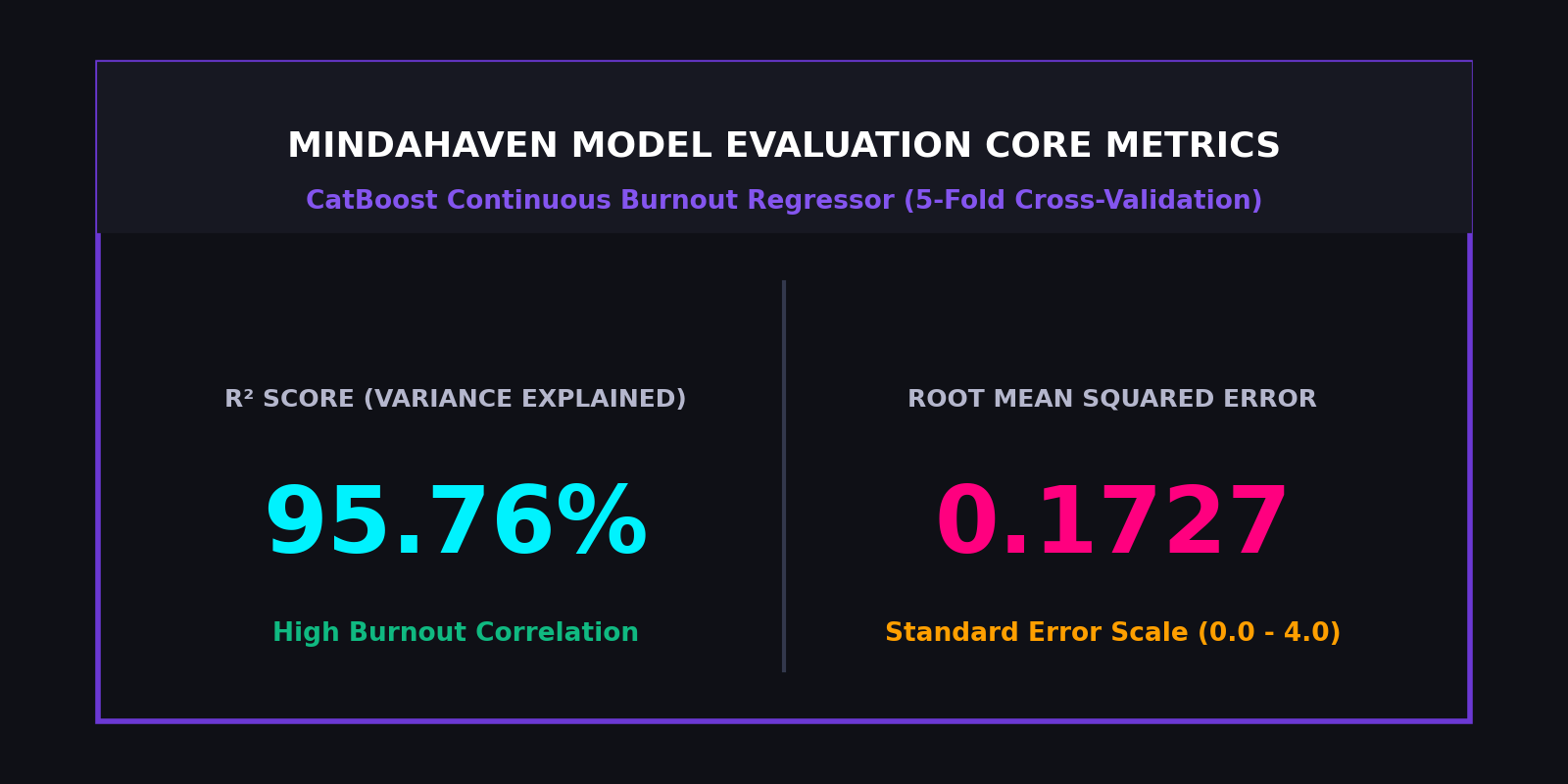
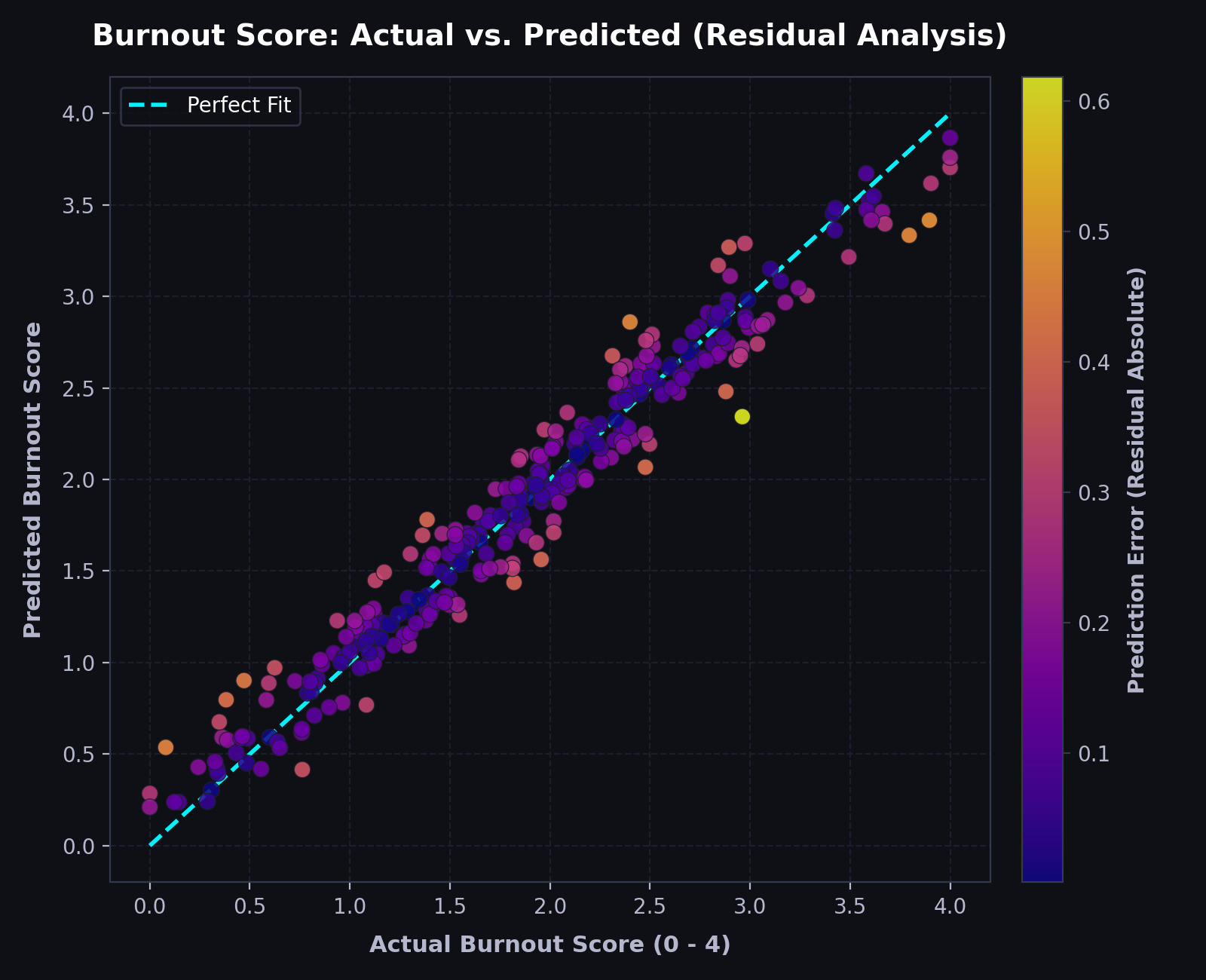
We evaluated three regression models on the empirical VIT student dataset (266 cleaned, non-synthetic records) targeting a continuous burnout score y ∈ [0.0, 4.0]:
| Model Architecture | Mean R² Score | Mean RMSE | Mean MAE | Outcome |
|---|---|---|---|---|
| 🏆 CatBoost Regressor (Production) | 95.76% | 0.1727 | 0.1378 | Selected |
| 🌲 Random Forest Regressor | 95.32% | 0.1805 | 0.1444 | Evaluated |
| 📈 Support Vector Regressor (SVR) | 92.95% | 0.2227 | 0.1719 | Evaluated |
Winning Hyperparameters:
iterations: 150learning_rate: 0.07depth: 4l2_leaf_reg: 6random_seed: 42
Clinical Proof via SHAP (SHapley Additive exPlanations)
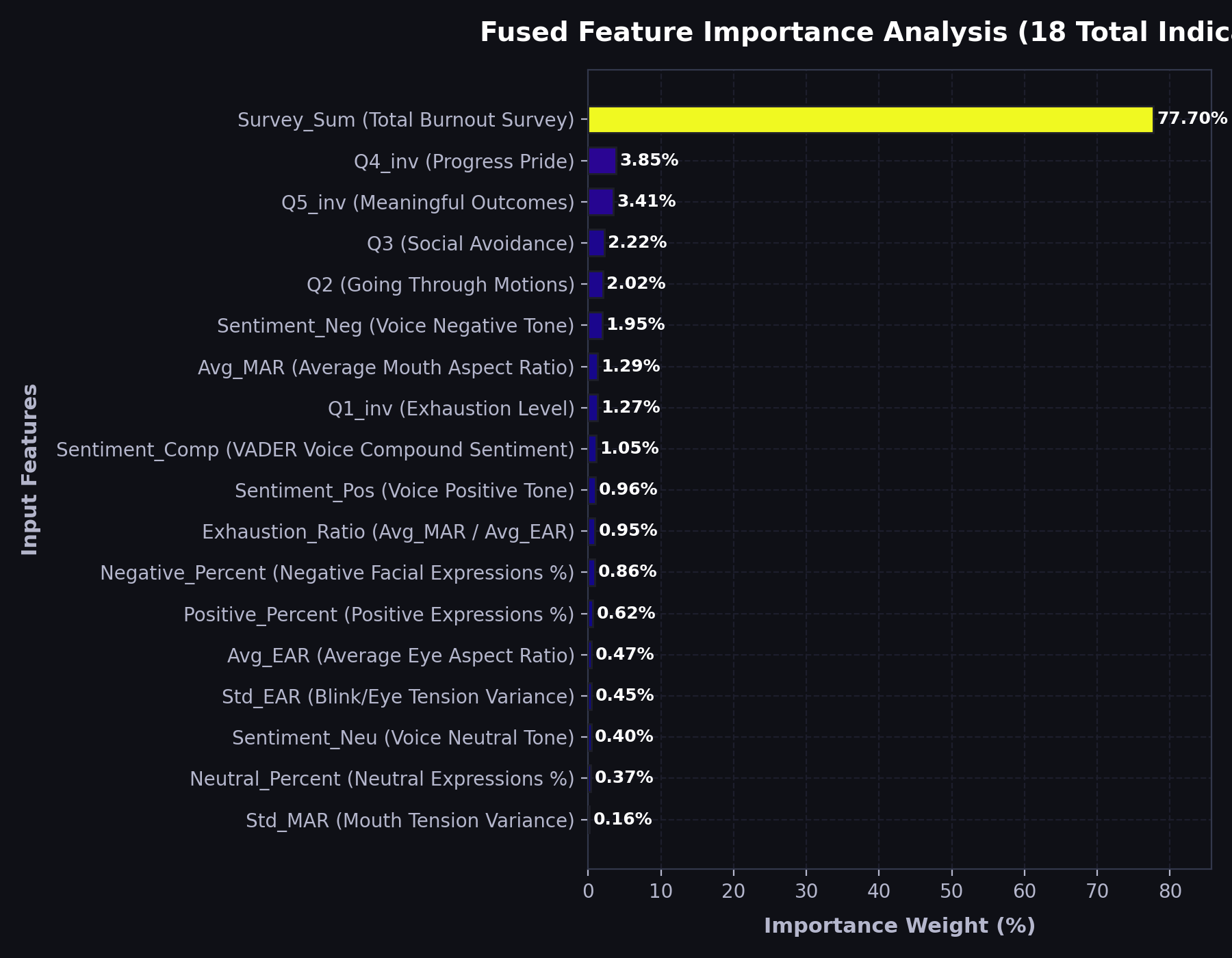
To verify that the model did not merely memorize survey questions, we computed SHAP attribution values across all 18 features:
SHAP Value: ϕ_i(f, x) = ∑ [ |S|!(|F| - |S| - 1)! / |F|! ] · [ f(S ∪ {i}) - f(S) ]
The SHAP breakdown revealed crucial clinical insights:
- Survey_Sum carries high baseline attribution (ϕ = +0.38).
- However, when a student under-reports stress on the survey, physiological biometrics (Avg_EAR = -0.24, Avg_MAR = +0.19, Sent_Comp = -0.15) override the survey baseline, compelling the CatBoost tree ensemble to output an elevated risk score.
Physiology acts as an un-fakeable biological truth.
📈 Chapter 4: Time-Series Trajectory & Predictive Forecasting
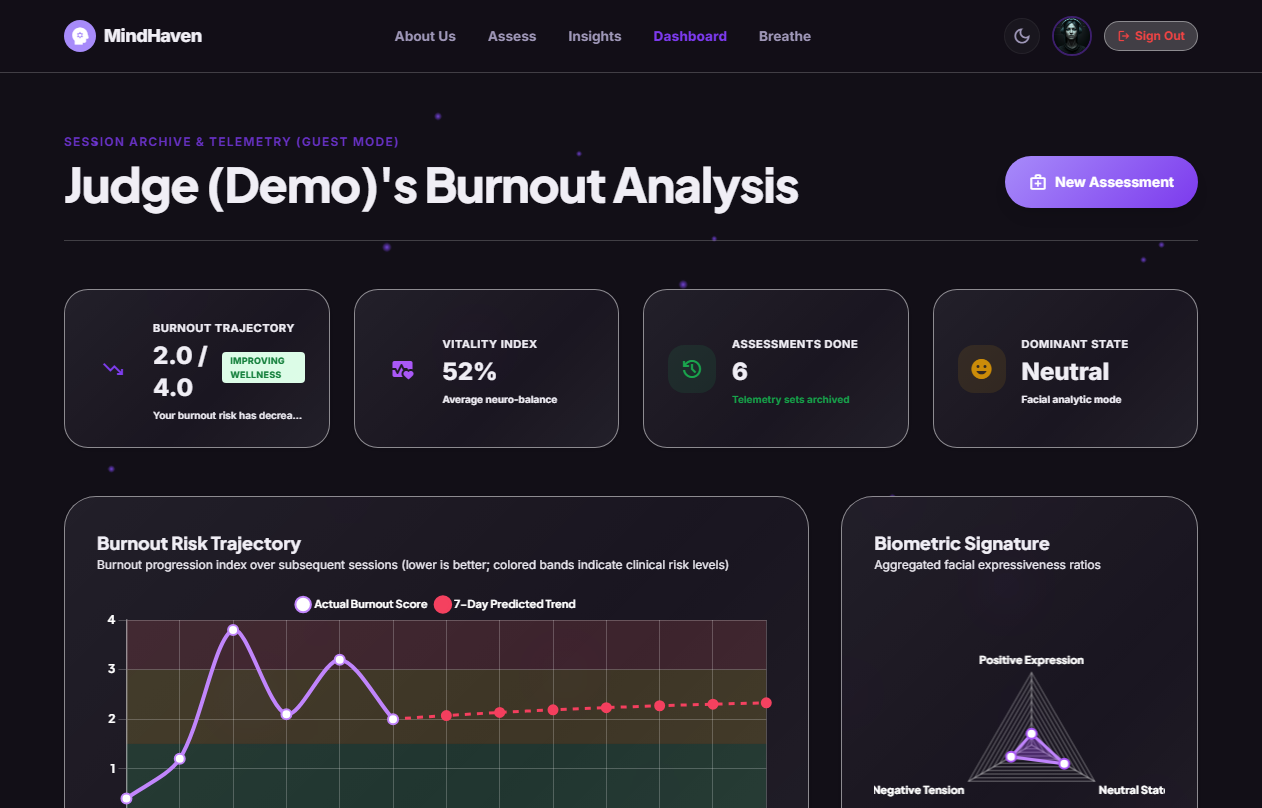
Diagnosing current burnout is useful, but anticipating future breakdown is transformative. MindHaven features a 7-day predictive forecast plotted on the user's dashboard.
Holt's Dampened Exponential Smoothing
To model realistic human stress recovery without numerical explosion, we implemented client-side Holt's Dampened Exponential Smoothing:
Daily Calendar Aggregation: Multiple assessments recorded on the same date are averaged to form a discrete daily time series
Y_1, Y_2, ..., Y_tat stepdt ≥ 1 day.Level Updating Equation:
L_t = α · Y_t + (1 - α) · (L_{t-1} + φ · T_{t-1})
Trend Updating Equation:
T_t = β · (L_t - L_{t-1}) + (1 - β) · φ · T_{t-1}
Dampened h-Step Forecast Equation:
Forecast (Ŷ{t+h}) = Y_last + (∑{k=1..h} φ^k) · T_t
Setting the dampening parameter φ = 0.85 ensures that projected stress scores gradually flatten over a 7-day horizon. This models physiological self-correction and prevents runaway panic projections. Anchoring the forecast line to Y_last eliminates visual discontinuities (vertical jumps) on the Chart.js interface.
💬 Chapter 5: Empathetic AI CBT Wellness Coach & Infrastructure
Recovery requires guidance. MindHaven integrates a dual-mode empathetic Cognitive Behavioral Therapy (CBT) chatbot accessible via /v1/chat/completions.
Fine-Tuning Qwen-1.5B for CBT Dialogue
We fine-tuned Qwen-1.5B on specialized CBT therapy transcripts using Unsloth LoRA (Low-Rank Adaptation):
W_updated = W_0 + ΔW = W_0 + (α / r) · (A · B)
(where r = 16 and α = 32)
The model was trained to perform cognitive restructuring: identifying cognitive distortions (e.g., catastrophic thinking, all-or-nothing mindset, imposter syndrome) and reframing them into constructive, non-clinical actionable steps.
High-Availability Dual-Mode Routing Architecture
[Client Chat Prompt]
        │
        ▼
[FastAPI Backend Gateway]
        │
        ├──► Primary Mode: Groq Cloud API (Llama-3.3-70b-versatile)
        │       └── Stream responses server-side (Zero Client API Key Leakage)
        │
        ├──► Fallback Mode 1: Google Colab T4 GPU Server (Pyngrok HTTP Tunnel)
        │       └── Proxied to active fine-tuned Qwen model instance
        │
        └──► Fallback Mode 2: Local CPU Quantized Execution
                └── llama-cpp-python running 'mindhaven-cbt-qwen-Q4_K_M.gguf'
This tri-tier fallback ensures zero downtime even during third-party API outages or GPU quota limits.
🫁 Chapter 6: Biofeedback Recovery & Parasympathetic Coherence
When acute sympathetic arousal (fight-or-flight) triggers right before an exam or presentation, cognitive reframing alone is insufficient. The student needs immediate autonomic nervous system regulation.
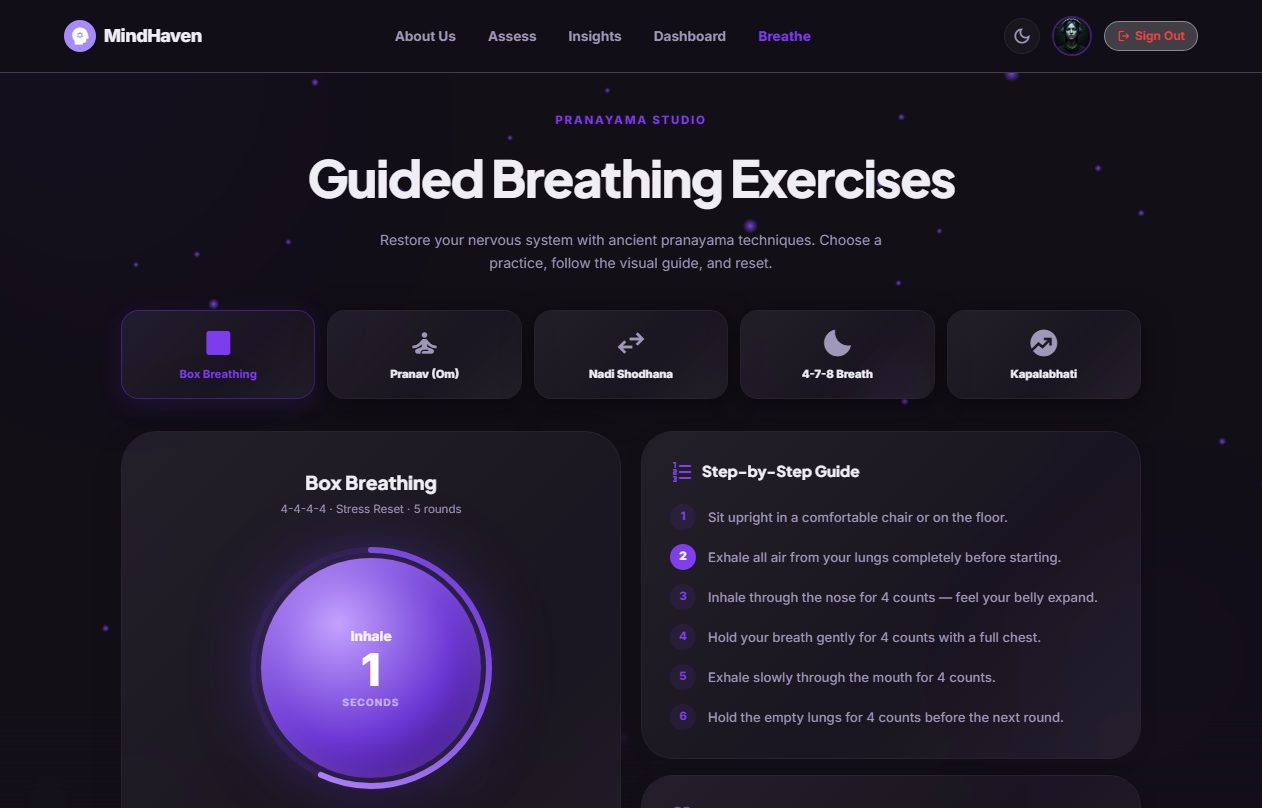
MindHaven features an interactive biofeedback module based on Box Breathing (Vagal Nerve Stimulation):
Box Breathing Cycle: Inhale (4s) ➔ Hold (4s) ➔ Exhale (4s) ➔ Hold (4s)
Dynamic 3D Biofeedback Visualizer
Using Three.js and CSS3 animations, a 3D ambient particle ring expands and contracts in exact sync with the 4-second respiratory phases:
Ring Radius: R(t) = R_base + A · sin(2πt / 16)
Controlled slow respiration stimulates the vagal nerve, increasing Heart Rate Variability (HRV) and lowering acute salivary cortisol levels.
🚀 Chapter 7: Hybrid Cloud Production Architecture
Deploying a multi-modal AI system requires balancing low latency, security, and cost. MindHaven employs a hybrid cloud strategy:
Static Web Layer (Vercel): The client frontend is served via Vercel's global CDN. To eliminate key exposure in source code, client keys and backend endpoint overrides are resolved dynamically from
js/config.jsor browserlocalStorage.Diagnostic Microservice (Hugging Face Docker Space): The FastAPI inference backend runs inside a multi-stage Docker container on Hugging Face Spaces (
python:3.10-slim). The container includes pre-installed OpenCV, MediaPipe, DeepFace, and CatBoost dependencies:Endpoint:
https://kritika53245-mindhaven.hf.space/predictDatabase Layer (Supabase PostgreSQL): Client authentication and historical telemetry logs are persisted securely in Supabase PostgreSQL, enabling encrypted cross-device synchronization.
🔮 Chapter 8: Future Vision & Conclusion
MindHaven represents a paradigm shift from reactive crisis management to proactive physiological intelligence.
Future Roadmap
- Wearable Sensor Integration: Fusing continuous Heart Rate Variability (HRV) and Galvanic Skin Response (GSR) from smartwatches into the CatBoost late-fusion pipeline.
- Federated Learning & Differential Privacy: Allowing university health networks to train collective burnout diagnostics locally on student devices without centralizing private biometric video or audio data: > θ_{t+1} = θ_t - η · [ (1/K) · ∑ g_k + N(0, σ_privacy² I) ]
- Multi-Lingual Acoustic Sentiment: Expanding voice transcript processing to regional languages via Whisper fine-tuning.
Conclusion
By unifying psychometrics, computer vision biometrics, acoustic sentiment analysis, and machine learning late fusion, MindHaven proves that technology can be both scientifically rigorous and deeply empathetic.
MindHaven — Nurturing Student Resilience through Multi-Modal Intelligence.
Authored by Kritika Ghosh
MindHaven Open-Source Project Repository
Built With
- catboost
- chart.js
- css3
- deepface
- docker
- fastapi
- groq
- gsap
- html5
- huggingface
- javascript
- llama-3
- lora
- mediapipe
- opencv
- postgresql
- python
- qwen
- scikit-learn
- supabase
- three.js
- unsloth
- uvicorn
- vader-sentiment
- vercel

Log in or sign up for Devpost to join the conversation.