Inspiration
Stress and burnout often build gradually through changes in sleep, energy, concentration, workload, and daily routines. We wanted to create a tool that could help people recognize these patterns earlier instead of waiting until they become overwhelming.
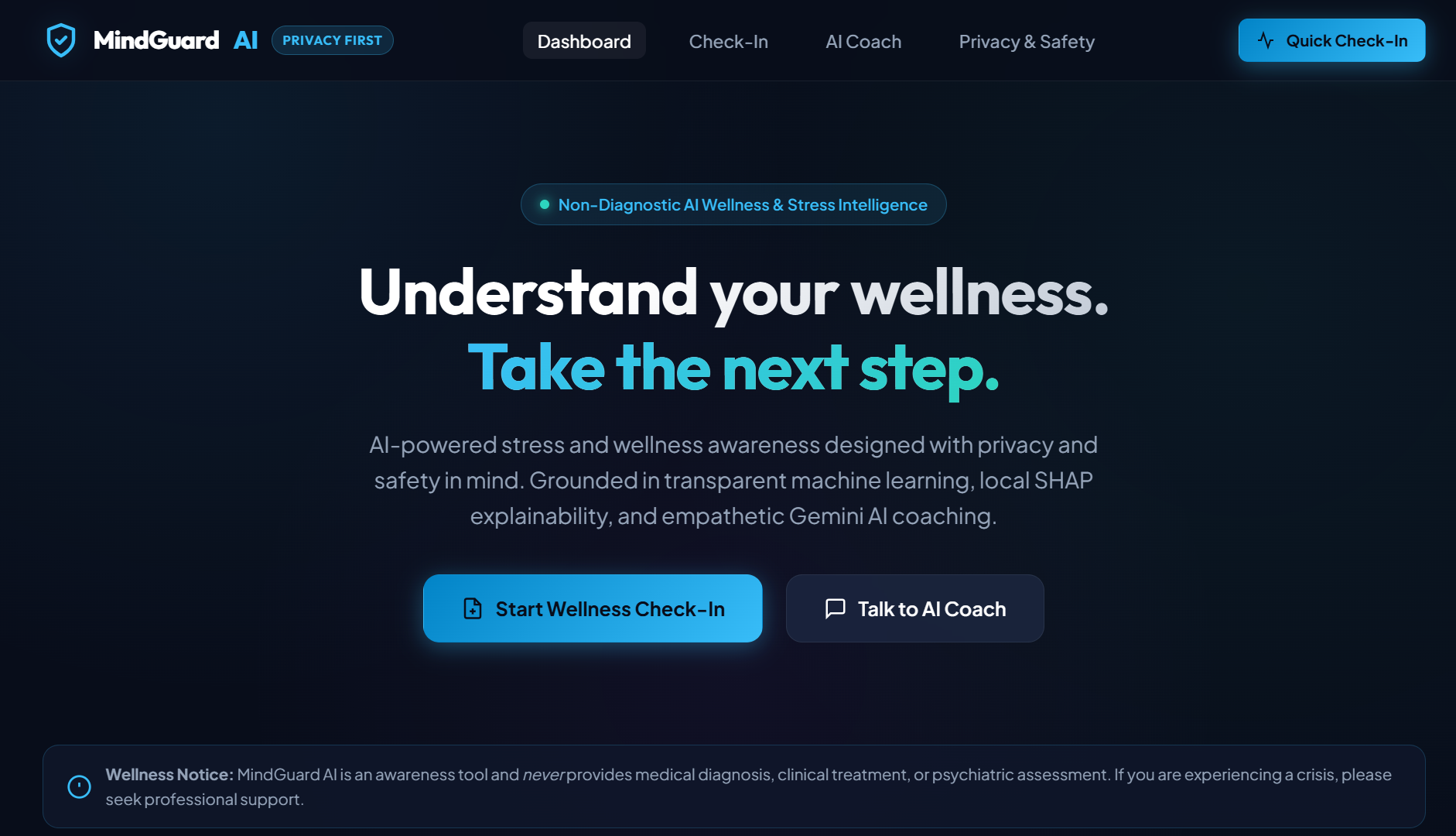
This inspired MindGuard AI, a privacy-first wellness assistant that combines machine learning, explainable AI, and generative AI to help users understand their wellness patterns and take practical next steps.
MindGuard is designed for wellness awareness, not medical diagnosis.
What it does
MindGuard AI provides a simple, personalized wellness experience:
- 📝 Wellness Check-In — Users answer questions about factors affecting their well-being.
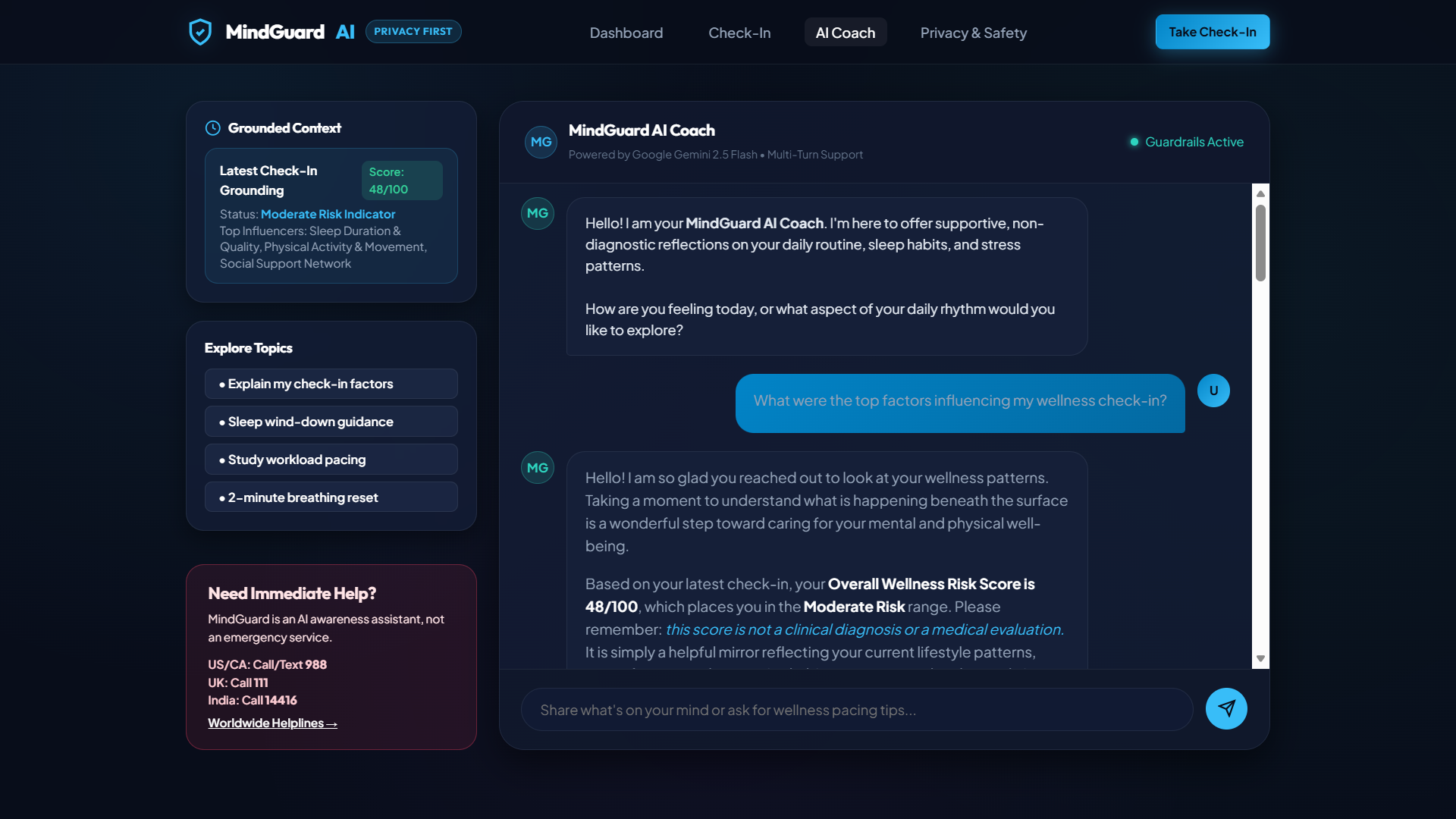
- 📊 ML Wellness Risk Indicator — A machine learning model analyzes the responses and provides a wellness/stress risk indicator.
- 🔍 Explainable Insights — SHAP helps identify the factors that contributed most to the model's result.
- 🤖 AI Wellness Coach — Gemini Flash provides supportive, personalized conversations based on the user's results and context.
- 📈 Wellness Trends — Users can track changes in their check-in results over time.
- 🔐 Responsible AI — The system includes privacy protections, safety boundaries, and clear non-diagnostic limitations.
Instead of allowing the LLM to make the core prediction, MindGuard separates the responsibilities:
ML → Prediction | SHAP → Explanation | Gemini → Conversation & Guidance
How we built it
MindGuard AI was built as a lightweight full-stack AI/ML application.
The machine learning pipeline uses Python, Pandas, Scikit-learn and XGBoost, with SHAP for explainability. We trained the model using the Student Mental Health and Burnout Dataset obtained from Kaggle.
The application backend is built with Flask, exposing APIs for ML predictions and AI conversations.
The frontend was developed from scratch using HTML, CSS and vanilla JavaScript to create a responsive and interactive health-tech interface.
For generative AI, we integrated Google Gemini Flash through the official Google GenAI SDK. Gemini is used to explain results, provide supportive guidance, and power the conversational AI coach.
The application is designed to run on Render's free tier, with the Gemini API key securely managed through environment variables.
The overall architecture is:
User
  ↓
Wellness Check-In
  ↓
Data Preprocessing
  ↓
ML Model
  ↓
Wellness Risk Indicator
  ↓
SHAP Explainability
  ↓
Safety Layer
  ↓
Gemini AI
  ↓
Personalized Guidance

Log in or sign up for Devpost to join the conversation.