Inspiration
What it does
How we built it# MindGuard AI
The Problem
Mental wellbeing is often something people only think about when they are already struggling. Many people experience changes in mood, stress, sleep, energy, or focus without noticing how these factors are connected over time.
I wanted to build something simple that could help people pause for a moment each day, understand how they are doing, and notice meaningful changes before they become overwhelming.
That idea became MindGuard AI.
What Inspired Me
The inspiration behind MindGuard AI came from a simple question:
What if checking in with yourself every day was as easy as checking a notification?
I wanted to create a tool that doesn't overwhelm users with complicated forms or clinical terminology. Instead, MindGuard focuses on a few simple daily questions and uses AI to turn those answers into supportive, understandable insights.
The goal is not to diagnose anyone or replace professional care. MindGuard is designed as a daily wellbeing companion for self-awareness and early pattern recognition.
How It Works
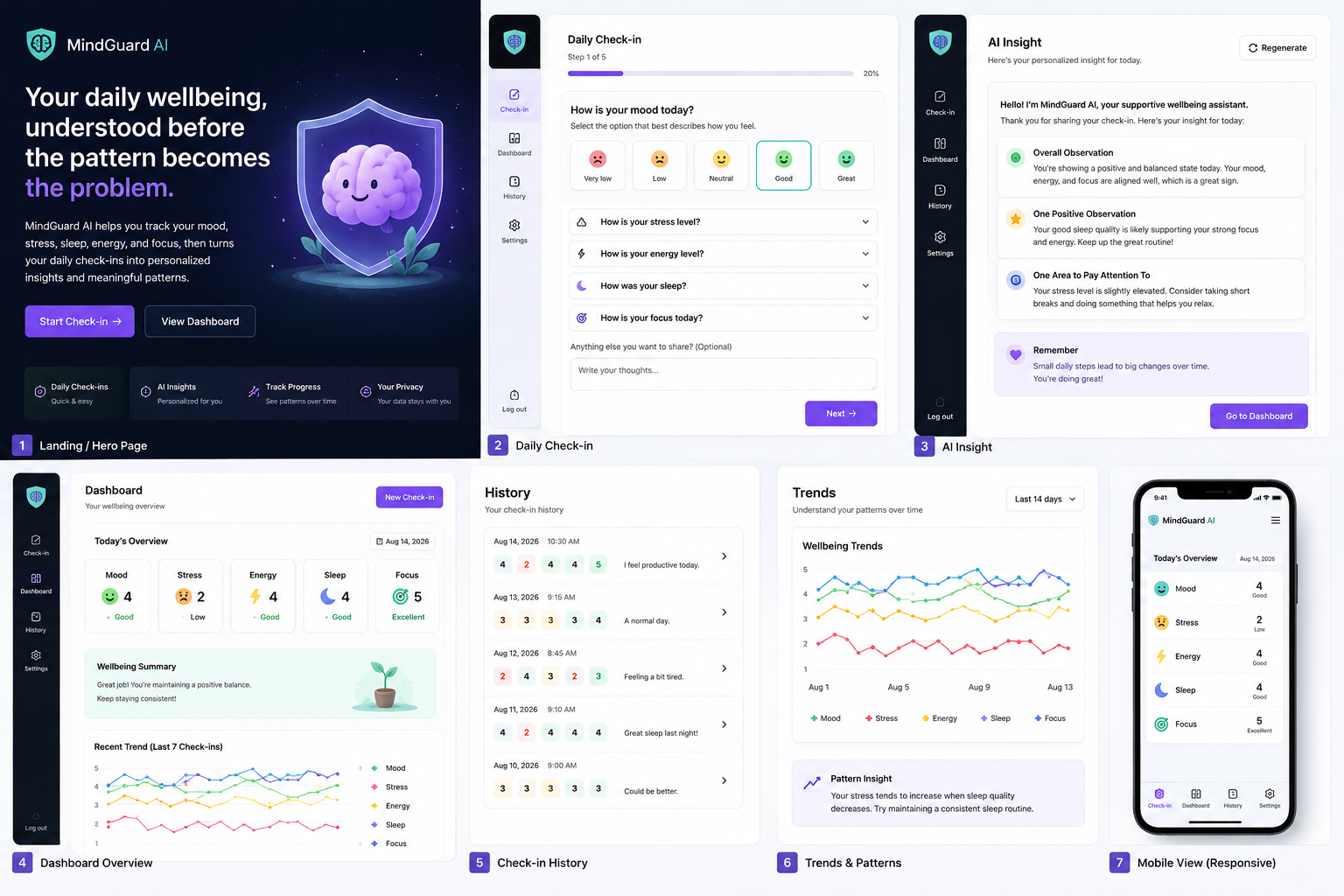
The experience is intentionally simple:
- The user completes a short daily check-in.
- They answer questions about areas such as mood, stress, energy, sleep, and focus.
- They can optionally add a personal note.
- MindGuard AI analyzes the check-in.
- The dashboard presents the user's wellbeing information in an easy-to-understand format.
- Previous check-ins can be reviewed through the history experience.
Instead of turning the experience into a complicated assessment, MindGuard tries to make self-reflection feel like a small daily habit.
Key Features
- Daily Check-ins — Quick questions designed to encourage consistent self-reflection.
- AI-Powered Insights — Personalized observations generated from the user's responses.
- Wellbeing Dashboard — A central place to understand the latest check-in.
- Check-in History — Allows users to look back at previous entries.
- Multiple Wellbeing Signals — Mood, stress, energy, sleep, and focus can all be considered together.
- Simple User Experience — Designed to be approachable for people without technical or mental-health expertise.
How I Built It
MindGuard AI was built as a modern web application using:
- Next.js
- TypeScript
- React
- Tailwind CSS
- Lucide React
- Google Gemini / Google GenAI
- Local browser storage for the current prototype
- Git/GitHub workflow for version control
The application uses a Next.js API route to process check-in information and generate an AI-powered wellbeing insight. The frontend then presents that information through dedicated pages for check-ins, the dashboard, and history.
Challenges
One of the biggest challenges was making the application feel reliable while moving quickly during a hackathon.
I encountered several TypeScript and JSX issues while building the dashboard and check-in experience, including component errors, missing dependencies, incorrect JSX structure, and runtime issues. Instead of treating those problems as blockers, I used them as opportunities to improve the structure of the application.
Another challenge was deciding how AI should be used responsibly.
It would be easy to make an AI application that produces impressive-sounding responses, but wellbeing is a sensitive area. I wanted MindGuard to remain supportive without pretending to provide medical diagnosis or professional treatment.
That shaped the product's direction: MindGuard observes, summarizes, and encourages reflection rather than diagnosing.
What I Learned
Building MindGuard taught me that a good hackathon project is not just about adding more technology.
The most important part is connecting technology to a problem that people actually experience.
I also learned a lot about building with AI. The useful part isn't simply asking an AI model to generate text. The real challenge is designing the right user experience around the AI so that its output is understandable, useful, and appropriate for the context.
Most importantly, I learned how much iteration is required to turn an idea into something people can actually use. Features that seem simple on paper often require significant debugging, testing, and refinement.
Why It Matters
MindGuard AI is built around a small idea with a potentially meaningful impact:
help people pay attention to themselves before they stop paying attention to themselves.
By making daily wellbeing reflection quick and accessible, MindGuard can help users become more aware of their own patterns and make small, proactive changes to their routines.
It is not intended to replace mental health professionals. Instead, it aims to provide a simple first step toward greater self-awareness.
What's Next
The current version is a foundation for a larger vision.
Future versions could include:
- Long-term wellbeing trends
- More advanced pattern detection
- Personalized recommendations
- Smarter insights based on historical data
- Privacy-focused data storage
- Optional reminders
- Better accessibility
- More sophisticated AI safety and wellbeing guardrails
The ultimate goal is to make MindGuard something people can use in a few minutes each day to better understand their wellbeing over time.
MindGuard AI turns a few seconds of daily reflection into a clearer picture of how you're doing.
Challenges we ran into
Accomplishments that we're proud of
What we learned
What's next for MindGuard AI
Built With
- ai
- analytics
- api
- css
- gemini
- genai
- generative
- git
- github
- good
- health
- healthtech
- javascript
- localstorage
- mental
- next.js
- personal
- react
- rest
- social
- tailwind
- typescript
- wellbeing

Log in or sign up for Devpost to join the conversation.