-
-
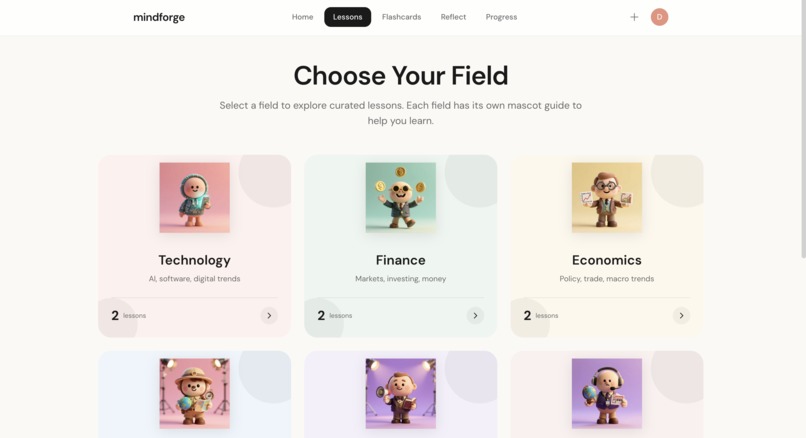
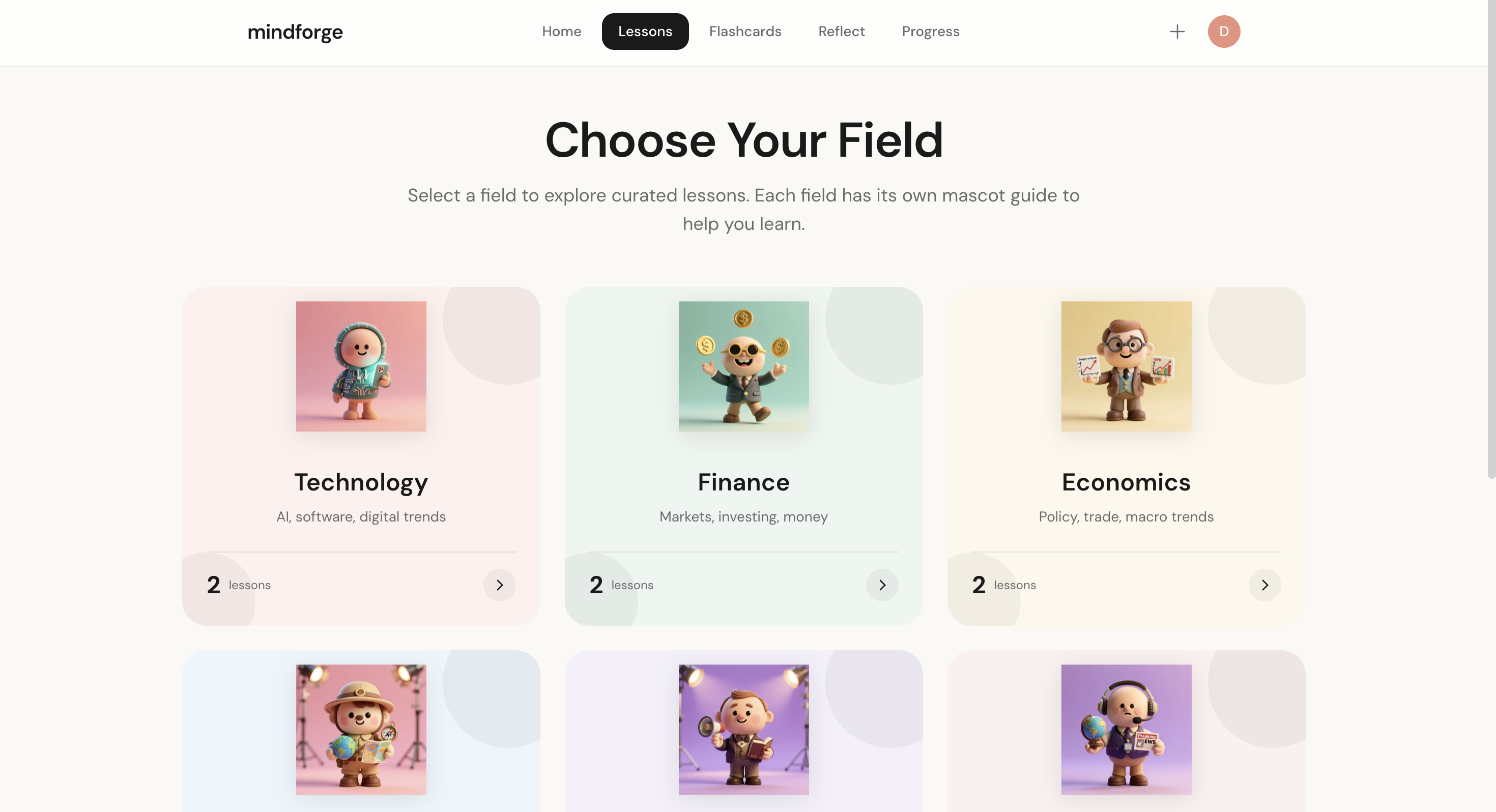
Learning fields
MindForge
AI-powered microlearning platform that transforms how we learn by meeting people where they already are: scrolling through feeds, watching short videos, and seeking instant gratification.
Inspiration
In today's world, we're drowning in information but starving for knowledge. People scroll through social media and short videos for hours, absorbing entertainment. Meanwhile, traditional education platforms feel like homework—boring, time-consuming, and disconnected from how we actually consume content today.
The question: What if learning could be as addictive as social media? What if instead of scattered sources and bookmarks we can learn from only one platform?
That's when MindForge was born—a platform that synthesizes content from multiple real-world sources into personalized, bite-sized lessons with quizzes, flashcards, and AI-generated videos.
Features
Multi-Modal Learning
- Swipe Cards: TikTok-style bite-sized lessons you swipe through
- Deep Read: Long-form articles for focused learning
- Video Learning: Mobile-optimized 9:16 portrait videos with AI narration
- Review Mode: Spaced repetition flashcards for retention
- Reflection: Self reflect to further consolidate the lesson
- Self Generated Lesson: Learn by having agents generate lessons on your own interest
AI-Powered Content Generation
- Curated lessons across 6 fields: Technology, Finance, Economics, Culture, Influence, Global Events
- Synthesizes sources from 16+ external APIs (arXiv, Reddit, HackerNews, NASA, Wikipedia, YouTube, RSS feeds, Financial APIs, and more)
- Generates contextual quizzes with intelligent fallback systems
- Creates mobile-optimized images using Hugging Face FLUX.1-schnell, SDXL, Ollama Cloud, and Pollinations
- Plans and structures video content with AI agents
- Text-to-speech narration using Coqui TTS and eSpeak
Intelligent Progress Tracking
- Real-time stats: topics learned, study time, daily streaks
- Lessons only count as "complete" when users pass quizzes (60%+ score)
- Gamification: points, achievements, leaderboards
- Daily challenges to build consistent learning habits
Personalized Learning Paths
- Self generated lesson feature where user can generate any lessons from any topic they are curious about
- Reflection system for metacognitive learning, where AI can learn from user feedback and generate better lessons catering to it as well as adaptive lessons difficulty based on performance
- Intelligent API selection powered by LLM agents
Architecture
Tech Stack
Frontend
- React 18 + TypeScript + Vite
- React Native (Expo) for mobile
- TailwindCSS for styling
- LottieFiles & MagicUI for animations
- Axios for API communication
Backend
- FastAPI (async Python 3.11+)
- Supabase (PostgreSQL + Bucket Storage)
- RESTful API design
AI/ML
- LLMs: Groq (llama-3.3-70b-versatile), OpenAI (gpt-4o-mini fallback)
- Text-to-Image: HuggingFace (FLUX.1-schnell, SDXL), Ollama Cloud, Pollinations
- Text-to-Speech: Coqui TTS, eSpeak (fallback)
- Agent-based architecture with 7 specialized agents
Content APIs
- Knowledge: Google Books, arXiv, YouTube, Wikipedia
- News: BBC News (NewsAPI), RSS feeds, HackerNews
- Data: FRED (Economics), NASA, Yahoo Finance
- Social: Reddit
- And many more
AI Agents
- LessonSynthesis Agent - Combines multi-source data into coherent lessons
- QuizGeneration Agent - Creates contextual assessments
- ReflectionAnalysis Agent - Analyzes learning patterns
- Recommendation Agent - Suggests next topics
- APISelector Agent - Chooses optimal data sources
- ContentSmart Agent - Content quality control
- VideoPlanning Agent - Structures video lessons
Some of Many Challenges We Faced
1. The Quiz Generation Nightmare
Spent hours debugging why quizzes showed generic questions. Root cause: environment variables not loading properly. Learned the importance of explicit load_dotenv() calls and robust error handling.
2. JSON Truncation Hell
LLMs generated incomplete JSON when creating 15-question quizzes. Solution: Generate in batches of 3, implement JSON repair logic, and reduce total questions to 5.
3. Mobile Image Optimization
Initial images were landscape and didn't fit mobile screens. Had to:
- Research optimal mobile aspect ratios (9:16)
- Engineer prompts for vertical composition
- Add safe zones for UI overlays
- Test across multiple image generation providers
4. API Rate Limits & Costs
Free tier APIs have strict limits. Built intelligent caching, request batching, and fallback chains to stay within limits while maintaining quality.
What We Learned
Technical Lessons
- Resilience is Key: Always have fallbacks. Groq → OpenAI → Fallback quiz saved the project.
- Prompt Engineering is an Art: Spent as much time on prompts as code. Small changes dramatically affect output quality.
- Mobile-First Matters: Designing for mobile from the start is easier than retrofitting. 9:16 aspect ratio became our north star.
- Validation > Completion: Measuring learning through assessment is more meaningful than tracking consumption.
- User Psychology: Gamification works. Streaks, points, and progress bars drive engagement.
Product Lessons
- Learning Modalities Matter: Different people learn differently. Multi-modal approach increases accessibility.
- Instant Gratification: 5-minute lessons work better than 30-minute courses.
- Social Proof: Leaderboards and achievements tap into competitive motivation.
- Content Quality: Multi-source synthesis produces better lessons than single-source generation.
License
This project is open source and available under the MIT License.
Built with care to make learning as addictive as social media
Built With
- fastapi
- groq
- huggingface
- ollamacloud
- openai
- pollinations
- python
- react
- typescript

Log in or sign up for Devpost to join the conversation.