Inspiration
Mental health struggles often stay hidden because people are afraid to speak up, do not know where to start, or feel judged when asking for help. We wanted to build something that lowers that barrier. MindCheck was inspired by the belief that mental wellness support should be accessible, private, and easy to understand. Instead of creating another black-box AI tool, we wanted to build an ethical system that helps people reflect on their mental state and encourages early action.
What it does
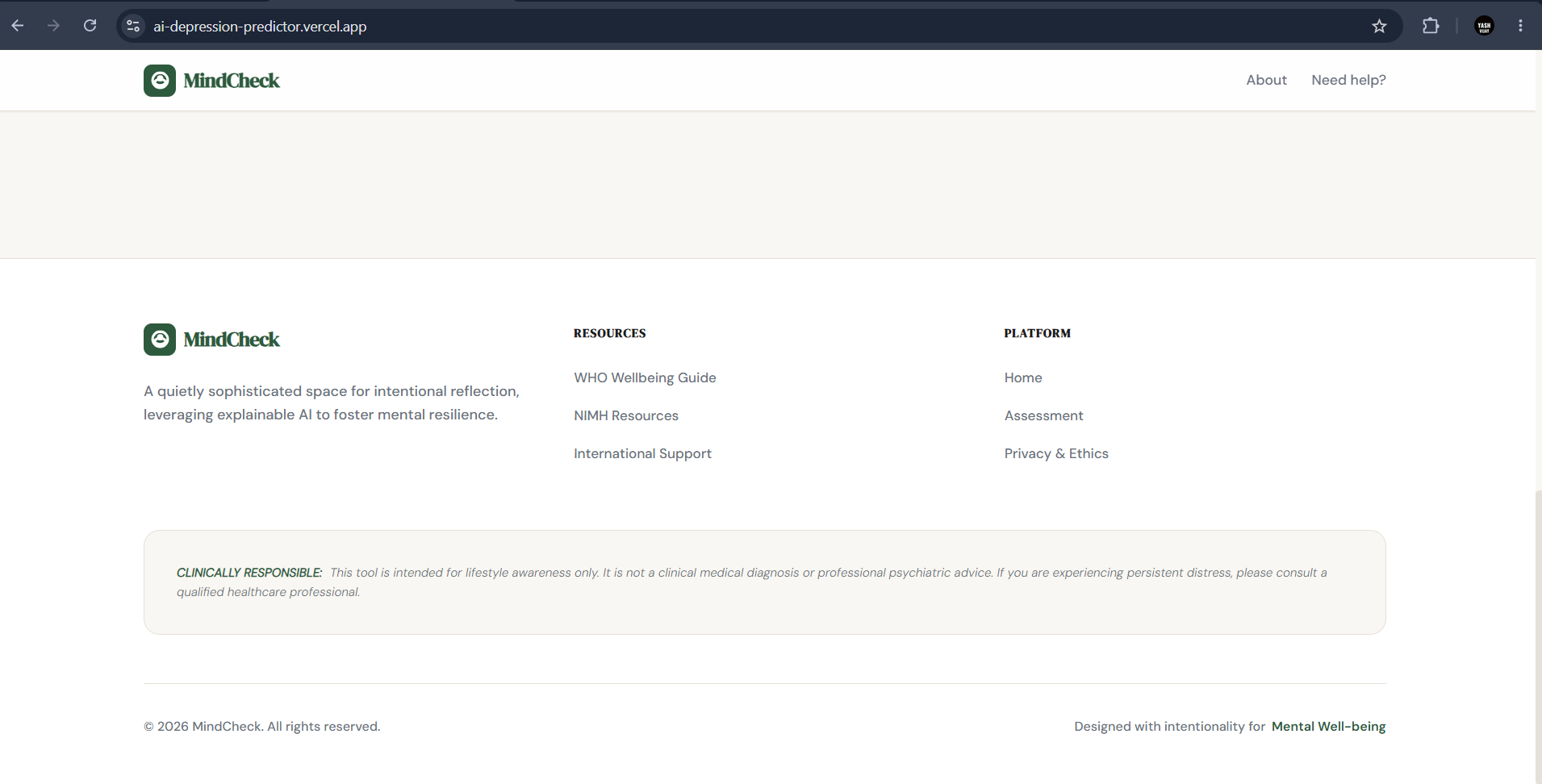
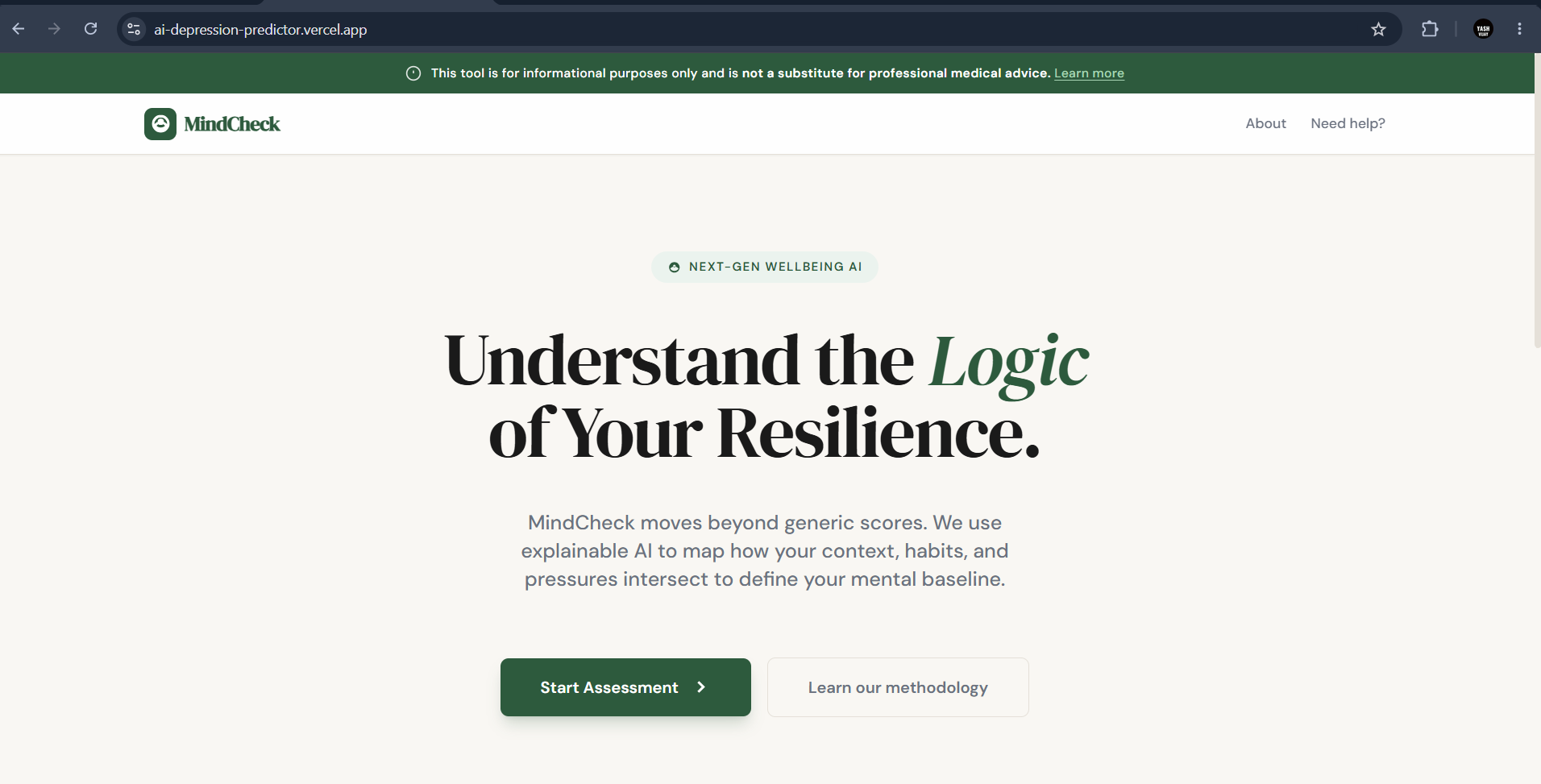
MindCheck is an AI-powered mental wellness screening web app that analyzes lifestyle and stress-related patterns to estimate mental health risk in a transparent way. It does not replace doctors or therapists. Instead, it provides an early check-in experience with explainable AI insights, safety-aware messaging, and support guidance when needed. Users get a simple, conversational interface, a prediction powered by machine learning, and SHAP-based explanations that show why the model gave that result.
How we built it
I built MindCheck entirely as a solo developer using a Python-first stack. The backend is powered by Flask, with Scikit-Learn for machine learning, SMOTE for imbalance handling, SHAP for explainability, and Pydantic for validation. I also used PyTest to test the system and Docker + Docker Compose to make it production-ready and easy to deploy.
The frontend was built with React 18, Tailwind CSS, Framer Motion, and Lucide Icons to create a clean, modern, and responsive experience. The whole app is structured as a full-stack ethical AI product, not just a model demo.
Challenges we ran into
The biggest challenge was building something useful in a sensitive domain without making harmful or irresponsible claims. Mental health is not a normal prediction problem, so every part of the product had to be designed carefully.
Another challenge was explainability. A prediction is not enough in mental health — users need to understand the reasoning behind it. Making SHAP explanations simple enough for non-technical users took a lot of thought.
We also had to handle class imbalance, validation, deployment, and ethical messaging while keeping the product fast, clean, and stable.
Accomplishments that we're proud of
I am proud that I built MindCheck completely on my own from concept to deployment. I am especially proud of combining machine learning, explainable AI, responsible design, and full-stack deployment into one product.
The biggest achievement is that the app is not just technically strong — it is also thoughtful. It respects privacy, avoids diagnosis claims, explains predictions, and encourages support-seeking behavior. That balance between innovation and responsibility is what makes the project special.
What we learned
This project taught me that building AI for real-world problems is not only about accuracy. It is also about trust, clarity, ethics, and user experience.
I learned how to:
build a full ML pipeline in Python, handle imbalance with SMOTE, explain model decisions with SHAP, validate inputs properly with Pydantic, package an app with Docker, and design an AI product responsibly for sensitive use cases.
Most importantly, I learned how powerful Python can be when used to solve meaningful problems.
What's next for MindCheck
The next version of MindCheck will focus on making the experience even more helpful, safe, and personalized.
Planned improvements include:
clinically reviewed screening flows, multilingual support, better fairness and bias evaluation, secure user histories for long-term tracking, smarter recommendation flows for support resources, and deeper collaboration with mental health professionals.
The long-term vision is to turn MindCheck into a trusted, ethical, and explainable mental wellness assistant that helps people take the first step toward support earlier.

Log in or sign up for Devpost to join the conversation.