-
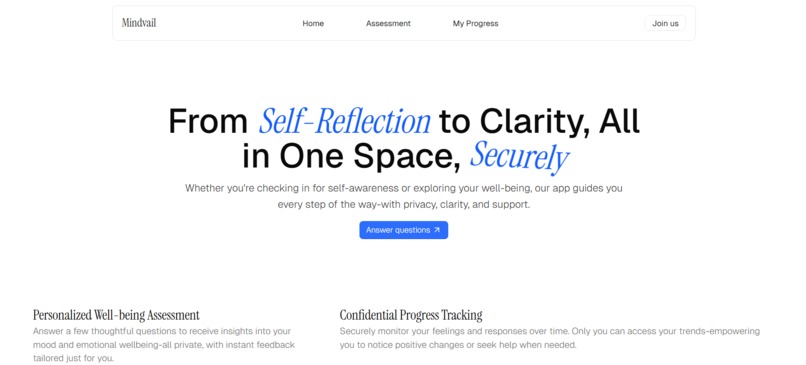
Home Page
-
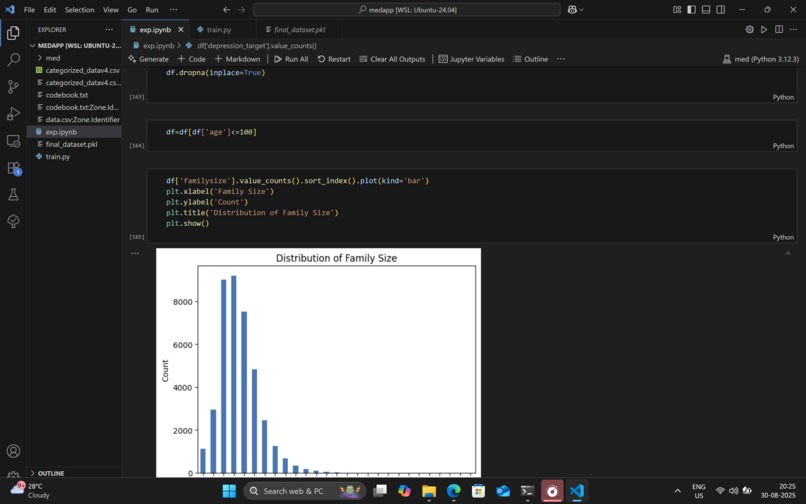
Data Cleaning
-
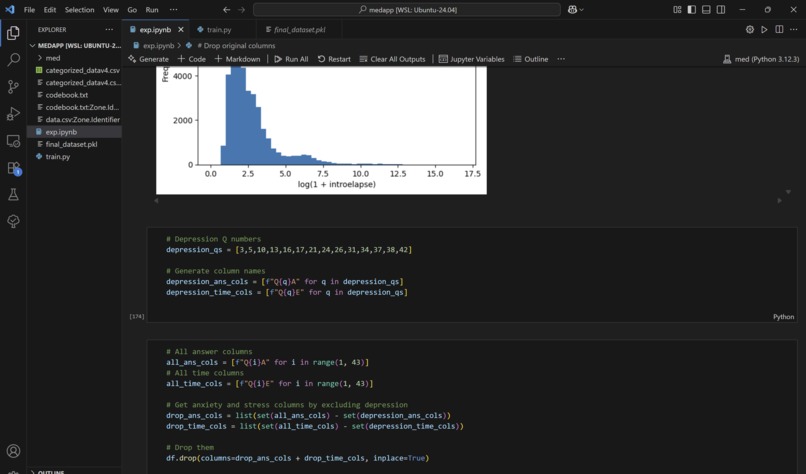
Feature Engineering
-
Installing SEAL


MindVail – Project Story
Inspiration
The idea for MindVail came from real-life experiences. During my time in college, I saw many friends and peers silently struggling with stress, anxiety, and depression, yet most of them avoided seeking help. Some feared being judged, others worried about their privacy, and many simply didn’t know where to turn. Watching people I care about go through this made me realize how big the gap is between those who need help and the systems meant to provide it.
I wanted to create something that could bridge this gap — a tool that feels safe, private, and stigma-free, where someone can check in on their mental health without fear of exposure or data misuse. That’s what inspired me to build MindVail: not just as a project, but as a step toward making mental health support more accessible and human.
What it does
MindVail is a web-based mental health screening platform that allows users to complete a structured questionnaire and get predictions about their mental health status. Using the DASS-42 dataset, we trained a multinomial regression model to classify responses into categories related to stress, anxiety, and depression.
The key feature is privacy-first design: all user data is processed under homomorphic encryption (Microsoft SEAL), so not even the system sees raw inputs. The platform then provides personalized recommendations such as mindfulness tips, lifestyle changes, or professional guidance.
How we built it
- Dataset & Model: We used the DASS-42 dataset and trained a multinomial regression classifier for prediction.
- Privacy Layer: Integrated homomorphic encryption using Microsoft SEAL so that all computations happen securely on encrypted data.
- Web Interface: Built a simple and accessible interface where users can fill out the survey and get results.
- Agentic AI Workflow: Integrated IBM’s Granite models with ADK for automated secure workflows.
Challenges we ran into
- Encryption Integration: Getting homomorphic encryption to work with machine learning inference was tricky and required fine-tuning.
- Performance Bottlenecks: Encrypted computations were slower, so optimizing runtime was a challenge.
- Curse of Dimensionality: The DASS-42 dataset has many features. To reduce the risk of overfitting and high-dimensional noise, we carefully selected and engineered features to make the model more robust while keeping it computationally efficient.
- Balancing Accuracy & Privacy: Adding encryption made computation heavier, so we had to balance security with usability.
Accomplishments that we're proud of
- Successfully integrated homomorphic encryption with a real predictive model.
- Built a platform that feels safe and private, addressing stigma around mental health.
- Reduced dimensionality issues while maintaining solid predictive accuracy.
What we learned
- Learned how to apply privacy-preserving machine learning in practice.
- Gained hands-on experience with Microsoft SEAL, IBM Granite ADK, and secure workflows.
- Understood the trade-offs between model performance, privacy, and usability in real-world applications.
What's next for MindCare AI
- Intel SGX Integration: Encrypt not just the basic models, but even agentic models, ensuring end-to-end confidentiality.
- Rust for Security: Use Rust for critical components to improve both performance and security.
- Quantum-Resistant Encryption: Extend encryption methods to stay secure even against future quantum computers.
- Expanded Guidance: Broaden the scope of personalized recommendations with more mental health resources.

Log in or sign up for Devpost to join the conversation.