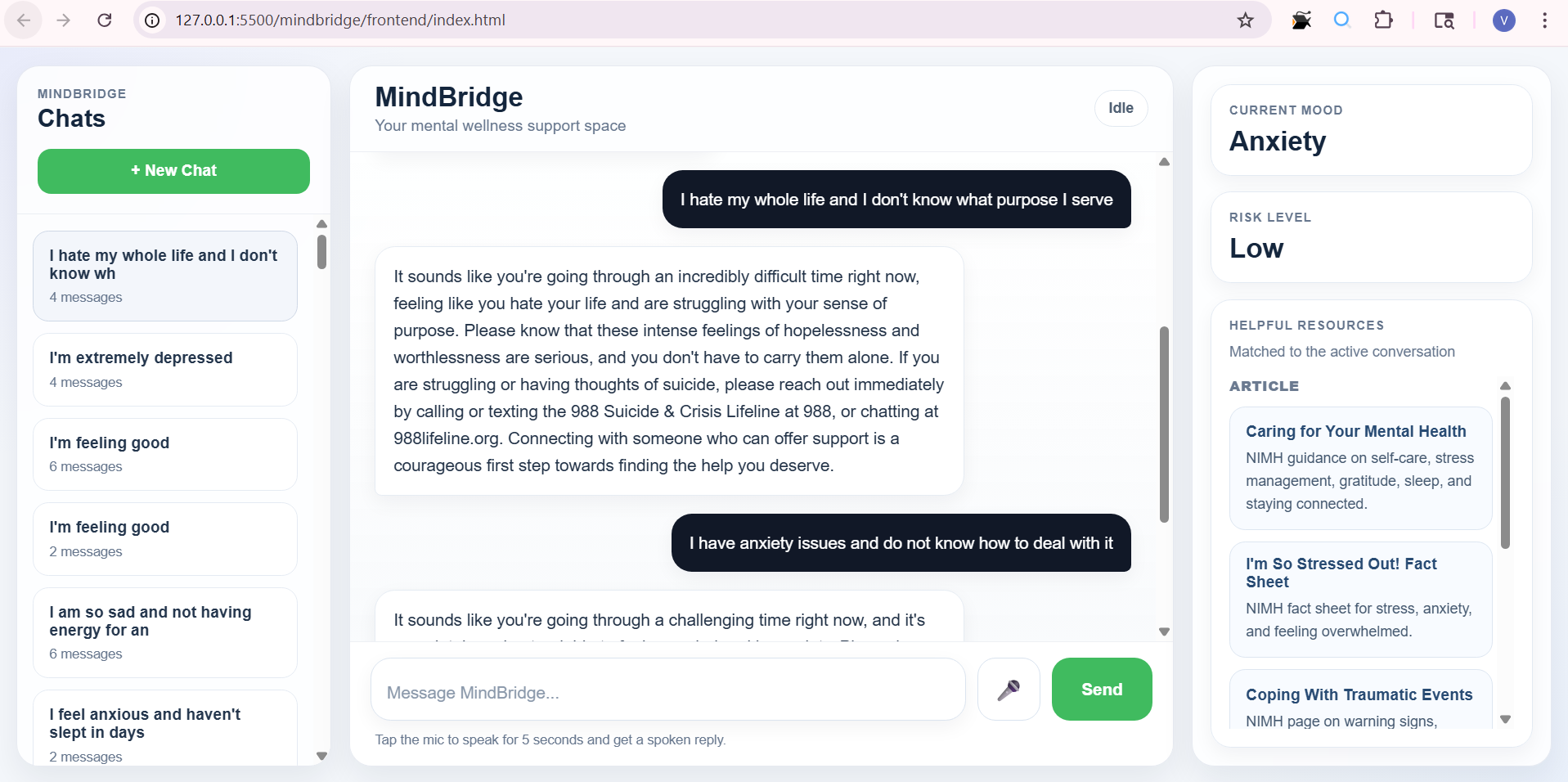
Mental health struggles often go unnoticed—not because help doesn’t exist, but because reaching out feels difficult, delayed, or even intimidating. Many people experience stress, anxiety, or loneliness in silence, especially during late hours or moments when immediate human support isn’t available.
We built MindBridge to bridge this gap.
MindBridge is an AI-powered mental wellness companion designed to provide real-time emotional support through conversation. The idea started with a simple question: “What if talking to an app could feel like talking to someone who truly understands you?”
To answer this, we designed a system that doesn’t just respond—but listens, analyzes, and adapts.
When a user shares how they feel, MindBridge:
Uses AI to detect emotional state and intensity Assesses risk levels to identify distress or crisis situations Generates empathetic, human-like responses Provides personalized mental health resources Supports voice-based interaction for a more natural experience
Unlike traditional chatbots, MindBridge focuses on emotional intelligence, not just conversation. It combines natural language processing, real-time analysis, and voice synthesis to create a safe and supportive environment.
During development, we focused on:
Making responses feel genuine, not robotic Ensuring low latency for real-time interaction Designing a clean, distraction-free chat interface Building a scalable backend using modern AI APIs and cloud-ready architecture
In just a short hackathon timeframe, we transformed an idea into a working prototype that demonstrates how AI can be used not just for automation—but for human-centered support.
MindBridge is not a replacement for professional help—but a first step toward it. A space where users can express themselves, feel heard, and be guided toward better mental well-being.
Built With
- css
- elevenlabs
- fastapi
- geminiapi
- html
- javascript
- mongodb
- python

Log in or sign up for Devpost to join the conversation.