-
-
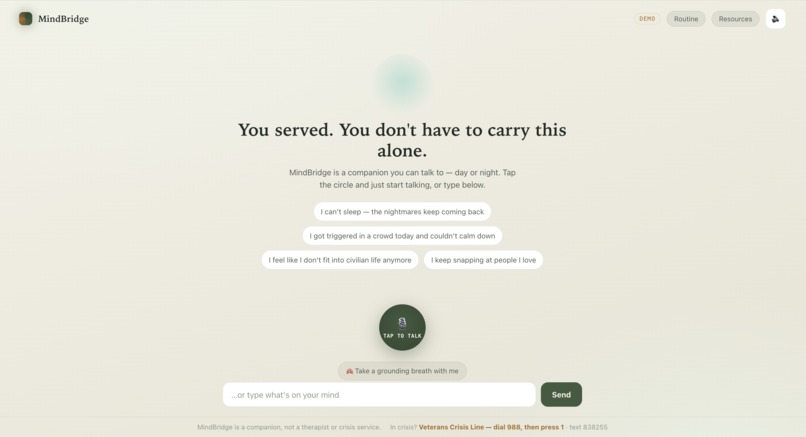
MindBridge Website
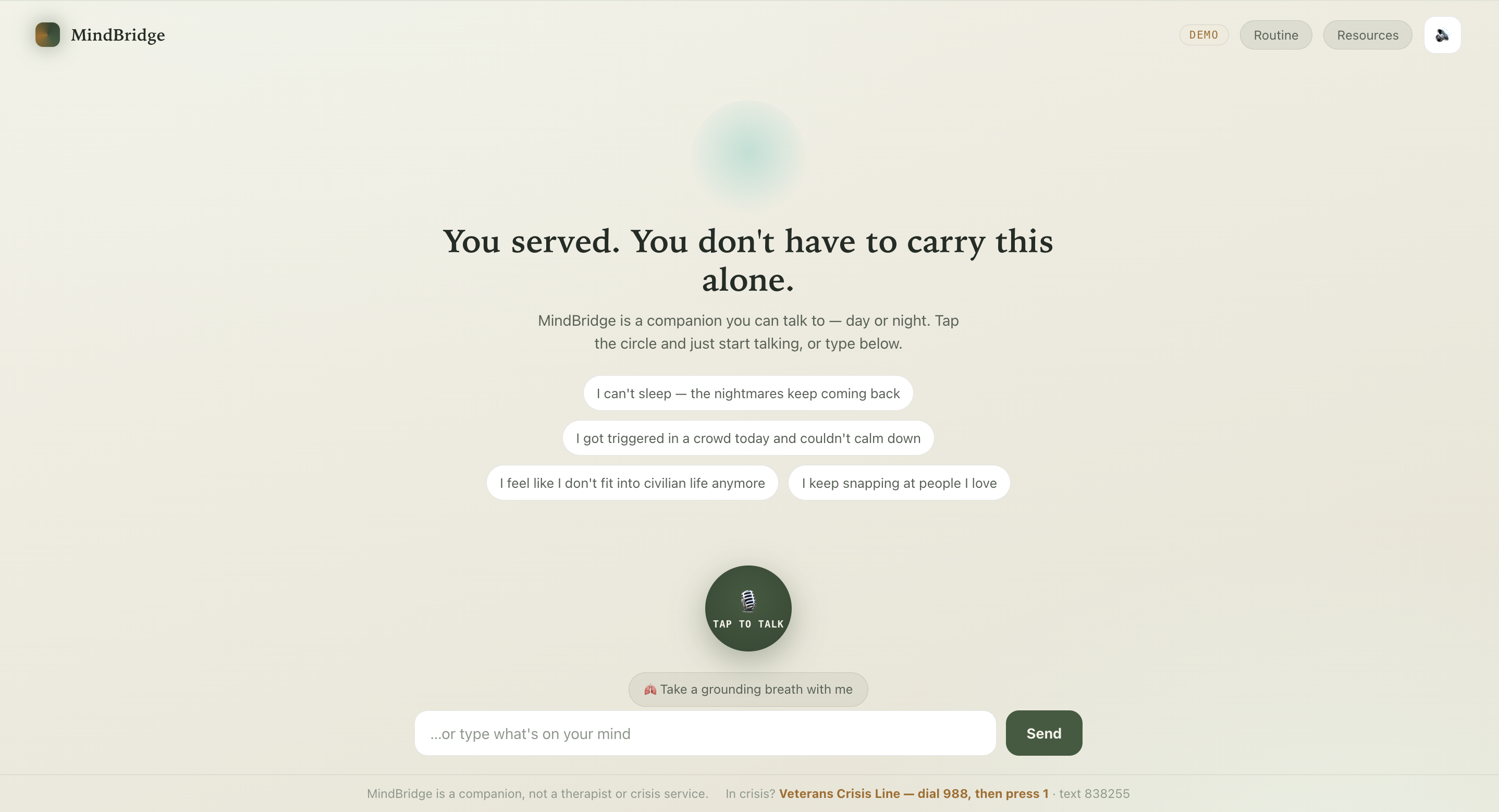
Mind Bridge
Inspiration
The Mission Imbalance
Service members leaving active duty encounter a sudden, jarring reality: they wake up to a civilian world completely devoid of baseline operational structure.
In the military, personnel live within an ecosystem optimized for high-level tactical efficiency. Every segment of the day is deliberately scheduled, accountability is an unyielding team dynamic, and personal identity is bound to the success of the unit. Returning to civilian life shatters this framework instantly. Forcing an immediate leap from total environmental predictability to unguided self-direction frequently paralyzes veterans under intense decision fatigue, systemic executive dysfunction, and severe isolation.
Traditional veteran transition resources completely miss this psychological bottleneck. By treating reintegration as an administrative checklist or a flat directory of links, they focus strictly on the end state—like finding a job or housing—while completely ignoring the daily behavioral architecture needed to survive the shift. They fail to replicate the daily schedule, the protective unit accountability, and the mission-oriented clarity that keeps service members grounded.
So, we asked ourselves: How do we build an adaptive bridge out of military discipline that systematically trains veterans for civilian self-reliance?
Our empirical approach is validated by clinical data, including a 2020 behavioral activation study demonstrating an exceptional effect in reducing severe PTSD symptoms through structured scheduling, and that team-based community service slashes veteran depression rates from 23.5% down to just 15%.
What it does
Mind Bridge operates as an adaptive daily routine engine and digital stabilization platform. It reconstructs the familiar mechanics of a military training calendar while map-matching municipal San Francisco resources directly onto the user's day to alleviate cognitive overload.
The platform is driven by an automated, telemetry-backed system built on Gradient AI. Rather than leaving veterans to navigate civilian ambiguity unsupported, the system establishes a baseline routine and pulls back rigid parameters over several months. As behavioral data confirms a veteran is stabilizing, the interface introduces open time blocks and greater self-directed freedom.
The system organizes its daily execution around 3 specialized tracks:
- Track Alpha (Full-Time Student): Created to provide structure within the highly flexible environments of higher education, mapping out accessible public library workspaces and campus resource checkpoints.
- Track Bravo (Tech Sector Job Hunting): Tailored for veterans breaking into the corporate ecosystem, organizing daily routines around resume building, skill development, mock interviews, and local technical networking windows.
- Track Charlie (Holistic Mental & Physical Recovery): Dedicated to intensive wellness, directly integrating clinic appointments, local peer support circles, and nature-based therapeutic recovery schedules.
Additionally, to bridge the critical gap between experiencing hidden psychological stress and actively calling for help, we built MindBridge—a low-friction, judgment-free peer-support voice companion embedded directly into the platform. Roughly one in eleven U.S. veterans will live with PTSD in their lifetime, yet the individuals trained to run toward danger are often the last to ask for help. Stigma, fierce self-reliance, and long waits at the VA leave too many carrying this weight alone—especially at night when clinics are closed and the people who understand are asleep.
MindBridge is engineered as a voice-first conversational endpoint that veterans talk to out loud like a phone call. It actively listens and reflects their feelings without judgment in warm, plain, spoken-length language, while deploying evidence-informed grounding techniques (such as 5-4-3-2-1 sensory matching or box breathing) drawn strictly from a curated knowledge base rather than being invented on the fly. Furthermore, it integrates with our data pipeline to connect veterans to real, verified local resources by exact name and location, while remaining hard-coded to stop everything and hand off to the Veterans Crisis Line (Dial 988, then Press 1) the exact moment a conversation signals an acute safety crisis.
MVP Core Features
- The Operations Order (OPORD) Schedule Builder: Generates a deterministic daily timeline built out with explicit operational blocks: "Morning Formations" (mandatory routine check-ins), "Focused Sorties" (deep-work execution windows), and "Stand-Downs" (rest and nutrition). To mitigate routine drift, we lock all subsequent objectives until the user confirms they have completed the current task. If a task is missed or delayed, the system intervenes with a conversational verbal adjustment instead of allowing the day's routine to unravel.
- Algorithmic "Phase-Down" Engine: Modulates the user experience across 4 distinct developmental phases.
- Phase 1 (Garrison) utilizes strict military formatting, forced timelines, and 24-hour notation.
- Phase 2 & 3 (Active Transition) introduce "Asymmetric Blocks"—1- to 2-hour windows of unallocated time. To insulate the veteran from choice paralysis, the interface reveals a hyper-curated 3-option menu of local resources that transition from individual habits into team-centric, civic volunteering opportunities.
- Phase 4 (Stand-Down) cleanly phases military terminology out of the UI altogether, seamlessly morphing the application into a flexible, standard civilian calendar.
Voice AI Companion
- Authentic Spoken Mirroring: Listens and reflects back the veteran's operational language without judgment, utilizing warm, plain, spoken-length dialogue. It deliberately avoids clinical jargon or overly robotic text-assistant phrasing.
- Evidence-Informed Somatic Grounding: Deploys simple, structured grounding techniques (e.g., 5-4-3-2-1 sensory matching, box breathing, and spatial orienting) drawn from a curated clinical knowledge base—never invented on the fly by the model.
- Contextual RAG Routing & DataSF Mapping: Uses a custom Retrieval-Augmented Generation (RAG) pipeline to ingest local San Francisco resource vector stores. If a veteran mentions anxiety about a commute, administrative stress, or weekend isolation, the AI instantly restructures their upcoming calendar blocks and surfaces specific local destinations—such as free library workspaces, peer networks, or outdoor active recovery trailheads—by exact name and location.
- Hard-Coded Crisis Handoff: The engine strictly knows its operational limits. The exact millisecond a conversation signals an acute psychological crisis or safety threshold, it halts all scheduled routing workflows and immediately hands off to the Veterans Crisis Line (Dial 988, then Press 1).
How we built it
The technical architecture of Mind Bridge maps real-time behavior metrics against municipal data environments via a dedicated analytics pipeline.
The Core Telemetry Pipeline
- Log User Telemetry: The front-end application monitors real-time user behavior, tracking block validation rates, punctuality differentials, and conversational audio streams.
- Analyze Semantic Signals: An asynchronous language pipeline driven by Gradient AI processes the raw text transcriptions from the daily voice SitReps to isolate emotional baseline vectors and linguistic markers of independence.
- Evaluate The Freedom Gauge: The analytical core compiles these telemetry layers into a unified Autonomy Metric, calculated across three performance indices: Routine Consistency, Adaptive Tolerance, and Semantic Sentiment.
- Adapt the Interface: When user stability metrics consistently clear established performance benchmarks, the application automatically dial downs the structural constraints, smoothly graduating the veteran into the next operational phase.
Visual Language & Interface Philosophy
Our design language blends high-reliability technical interfaces with the approachability of a personal daily journal.
- Typography System: We rely on a strict three-font hierarchy: a deep serif italic reserved for reflective and user-voiced content, a crisp small-caps sans-serif for technical labels and operational statuses, and tightly tracked Helvetica Neue for data densities and timetables.
- The Freedom Gauge Metaphor: We replaced sterile medical tracking charts with a dynamic visual metaphor that mimics a deployment countdown tracker. Schedule blocks visually transform based on a user's stability: high routine execution condenses block densities, while a color-coded canvas visualizes the dominant emotional tone of the veteran's week at a glance.
- Color Framework: Emotional signals are tracked via explicit interface signifiers: $\text{Anxiety} = \textcolor{#7B5EA7}{\blacksquare}$, $\text{Stability} = \textcolor{#5A9E7C}{\blacksquare}$, and $\text{Isolation} = \textcolor{#b45309}{\blacksquare}$. The UI uses a warm, non-clinical neutral background (#f5f2ee) to prevent the application from feeling cold or medical.
DataSF API Gateway Strategy
To deeply embed the application within the civic fabric of San Francisco, Mind Bridge connects directly to live municipal endpoints via REST:
- SF Public Library Locations & Events API: Auto-populates open blocks with localized library workspaces, learning events, and free access facilities.
- SF Recreation & Parks Department Facilities: Feeds the active recovery engine with live mappings of natural green spaces and trail systems throughout the Presidio and Golden Gate Park.
- Department of Public Health Directory: Provides an up-to-date database of neighborhood clinics and peer counseling hubs for real-time routing during high-anxiety episodes.
- Swords to Plowshares Integration Pipeline: Directly streams critical housing appointments, legal advocate meetings, and career pipelines straight into the user's OPORD calendar.
- The Presidio Habitat Restoration Dataset: Sources weekly environmental stewardship schedules, turning public land projects into team-based "Civic Missions" for veteran squads.
Challenges we ran into
Embracing Epistemic Humility
A foundational technical challenge was recognizing the limits of behavioral data. Individual daily telemetry points are noisy and provide zero clinical diagnosis on their own. Authentic behavioral stabilization can only be validated longitudinally over 6-8 week horizons. Preventing the system from making aggressive, single-day assumptions—while engineering a supportive UI that exercises caution without sounding detached—demanded meticulous fine-tuning. Interface text like "Routine Consistency Index has stabilized at 84% throughout your academic blocks" was intentionally balanced to strictly report verified user actions without diagnosing their mental health.
Hardening for Complex Edge Cases
We spent a massive amount of development focus addressing high-risk user conditions. For instance, if a veteran suffers an acute hypervigilant episode and completely drops out of their routine, the Dependency Gate cannot simply lock up and increase stress. It must gracefully adapt with gentle verbal realignments.
Similarly, if telemetry signals an abrupt drop in a veteran's Adaptive Tolerance Index, triggering an automated clinical reference at the wrong moment without an immediate human fallback could exacerbate feelings of alienation. There is also the challenge of users developing an unhealthy dependence on the system's absolute rigidity, causing anxiety when the engine attempts to phase out military formatting. Addressing these real-world edge cases is what separates an abstract tech mockup from an asset a veteran can actually trust.
Overcoming the "Day One" Bottleneck
The system's real therapeutic power requires multiple weeks of baseline behavioral telemetry. This creates a severe user experience bottleneck on the very first morning a veteran logs into the app after discharge—the exact point where they are most exposed to the structural void. We solved this by designing a dedicated first-morning interface: it actively avoids generating premature insights, but instantly anchors the user with an immediate "Morning Formation" check-in to provide a palpable sense of structure from day one.
Accomplishments that we're proud of
We are incredibly proud to have engineered an application whose core features are entirely supported by peer-reviewed clinical research across four scientific pillars:
- Behavioral Activation (BA): Validated by Etherton & Farley (2020), showing that deploying highly structured, milestone-driven daily calendars to combat avoidance behavior reduces overall PTSD symptoms with an exceptional clinical effect size of Hedges's $g = 1.484$.
- Nature-Assisted Ecotherapy: Validated by Bettmann et al. (2023), proving that structured immersion in natural, open-space environments (via our DataSF Recreation & Parks pipeline) decreases cortisol levels and hypervigilance, bypassing the traditional limitations of standard indoor talk therapy.
- Civic Purpose Realignment: Grounded in the Saint Louis University Veteran Volunteer Impact Study (2018), which tracked combat veterans in team-based volunteer programs. After 6 months of structured civic service, clinical PTSD symptoms plummeted from over 50% to 43%, and depression rates dropped from 23.5% to 15% by directly tapping into their desire to serve a purpose greater than themselves.
- Squad Cohesion Mechanics: Anchored by JAMA Network Open (PMC12000971), which confirms that 75.8% of younger veterans explicitly prioritize peer camaraderie and veteran-centric networks as the single most critical factor in preventing long-term transition failure.
What we learned
Our most profound lesson was organizational rather than technical: a military unit does far more than dictate schedule entries—it acts as a cognitive offloading engine. The military infrastructure absorbs the logistical overhead of planning, exposes members to simulated threats under highly controlled parameters, and replaces crushing individual isolation with built-in accountability.
When service members separate, they aren't just changing jobs; they lose their entire daily cognitive scaffolding. We learned that calculating our Routine Consistency Index (RCI) as a rolling geometric mean provides an incredibly accurate look at genuine behavioral habit formation, far outperforming standard, linear checkbox tracking.
The critical municipal resources and the civic capabilities of our veterans are already there. The gap was simply the absence of an adaptive infrastructure to wire them together.
What's next for Mind Bridge
Our immediate development roadmap focuses on building a secure, encrypted advocate dashboard, letting caseworkers at Swords to Plowshares visually track high-level, anonymized behavioral stability trends to detect routine drift before a clinical crisis emerges. We are also building out predictive telemetry modules within our Crisis Aversion system, specifically analyzing Friction Latency (the exact duration in seconds a veteran stalls on the interface following a disrupted schedule block) to isolate acute decision paralysis in real time. Finally, we plan to scale this API data gateway design beyond San Francisco, creating standardized templates for major cities across the nation that support large veteran populations.
Built With
- Gradient AI (Custom LLM Backend, Semantic Vector Extraction, & Text Sentiment Parsing)
- React Native & TypeScript (Cross-Platform Mobile Client & Telemetry-Driven UI Rendering)
- Python (Data Aggregation & Geometric Mean Analytics Infrastructure)
- DataSF REST APIs (SF Public Library, Recreation & Parks, and Department of Public Health Target Streams)
- Vector Stores (Semantic Indexing & RAG-Driven Municipal Resource Matching)
- WeasyPrint (Automated High-Fidelity PDF Generation for Caseworker Reporting Metrics)
Built With
- css
- digitalocean
- github.io
- html
- javascript
- python

Log in or sign up for Devpost to join the conversation.