Inspiration
Young people often face stress and uncertainty when preparing for exams or managing their well-being. We wanted to create a simple, accessible tool that offers guidance and emotional support without requiring advanced technical knowledge.
What it does
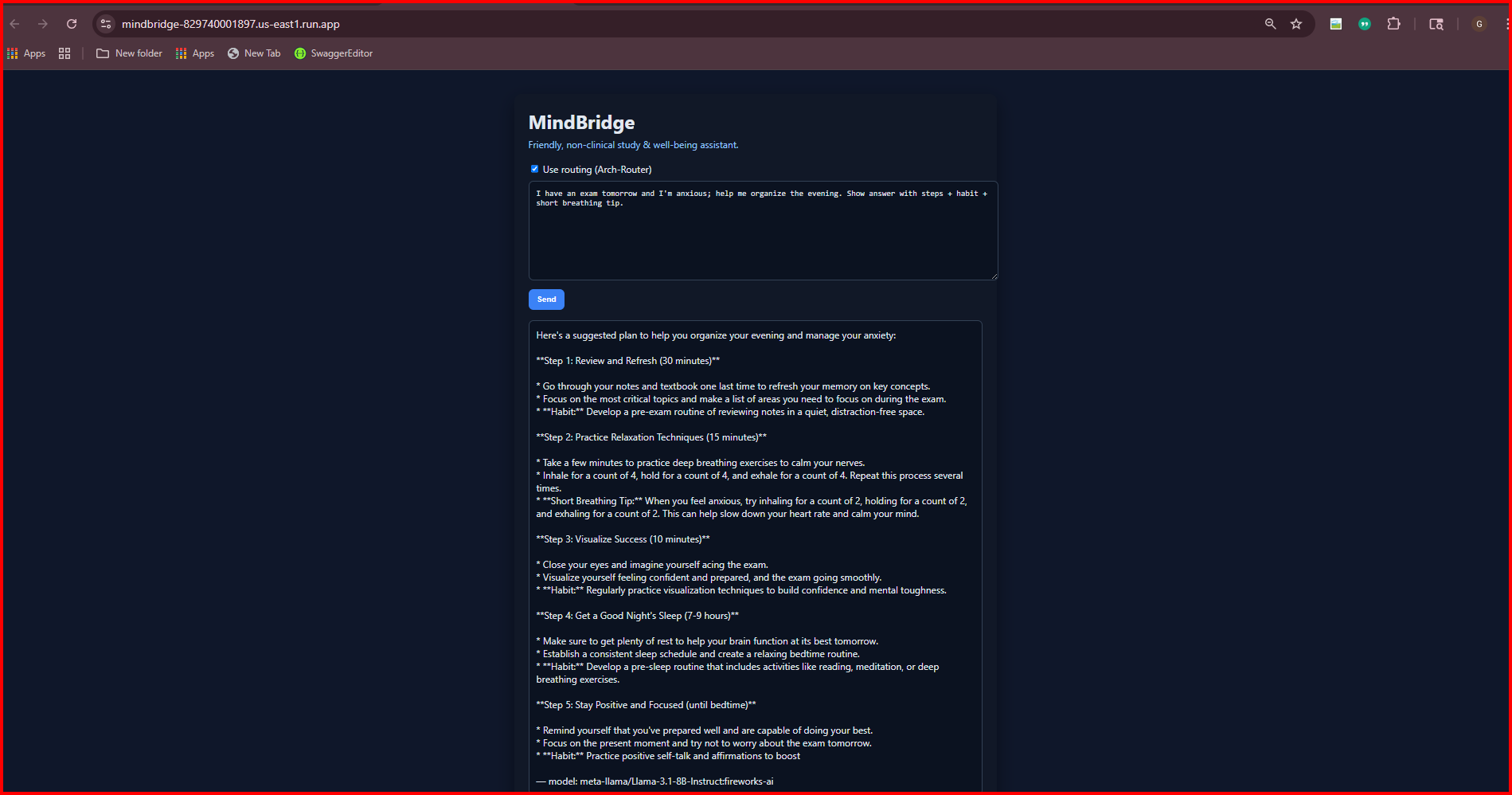
MindBridge is a friendly, non-clinical assistant that helps students organize study plans and reduce stress. Users can ask questions in natural language and receive concise, actionable tips for planning, focus, and self-care.
How we built it
We built MindBridge using Google Cloud Run for scalable deployment and integrated Hugging Face’s Inference API with the Llama 3.1 model (via Fireworks provider) for natural language understanding. The frontend and backend are served from a single Cloud Run service for simplicity and speed.
Challenges we ran into
Packaging the app into a single deployable service that includes both backend and frontend. Handling provider compatibility issues (e.g., task mismatch and model availability). Managing authentication and environment variables securely in a cloud environment.
Accomplishments that we're proud of
Successfully deployed a fully functional AI-powered app to the public in record time. Integrated advanced language models into a beginner-friendly interface. Delivered a solution that aligns with the hackathon’s theme of social good.
What we learned
How to connect and use Hugging Face’s Inference API with OpenAI-style endpoints. Best practices for deploying containerized apps on Google Cloud Run. Importance of fallback strategies for model/provider compatibility.
What's next for MindBridge
Support more advanced queries by fine-tuning models or integrating larger, more capable LLMs. Add multilingual support for global accessibility. Implement streaming responses and personalization features for a better user experience.
Built With
- 3.1
- api
- cloud
- css
- docker
- express.js
- face
- fireworks
- html
- hugging
- inference
- javascript
- llama
- node.js
- provider
- run

Log in or sign up for Devpost to join the conversation.