MindBridge — Devpost Submission
Inspiration
We’ve all been there — lying awake the night before a hard conversation, rehearsing lines in our head that never come out right in the moment. Asking for a raise. Telling a friend no. Calling someone who’s grieving when you have no idea what to say.
Emotional intelligence is widely recognized as one of the most important skills a person can develop — more predictive of life satisfaction, relationship quality, and career success than IQ. And yet it’s almost never taught. We learn it by stumbling through painful moments, often at great cost to ourselves and the people around us.
We were inspired by the way athletes and performers use deliberate practice — controlled repetition in a safe environment — to build skills that perform under pressure. MindBridge applies that same principle to human conversation.
What It Does
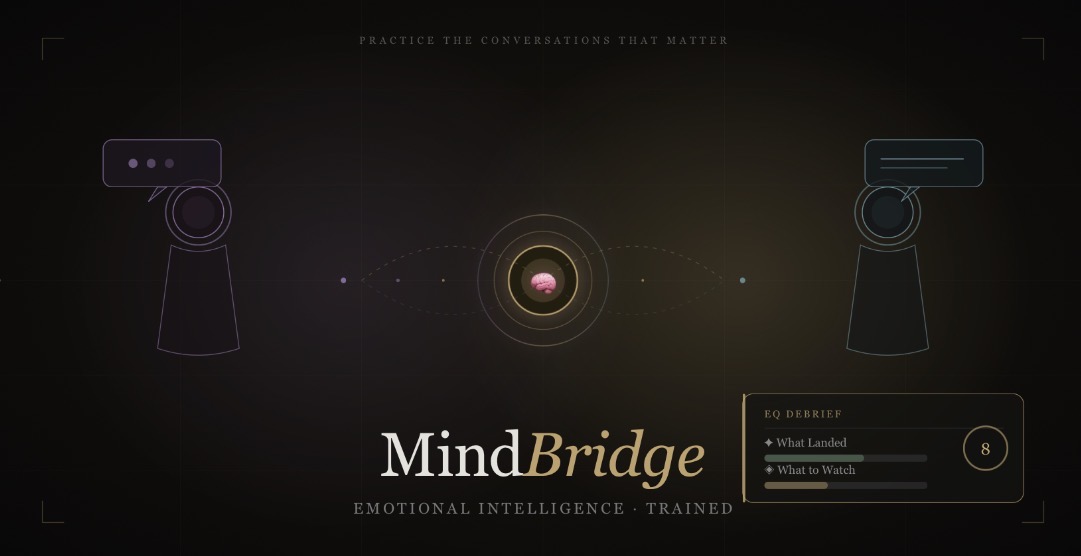
MindBridge is an AI-powered emotional intelligence trainer that puts you inside the conversations you dread most — then debriefs you like a coach.
Users choose from three real-world scenarios:
- The Raise — advocate for yourself with a defensive, dismissive manager
- The Boundary — say no to a close friend who guilt-trips and manipulates
- The Grief Call — show up for a colleague in pain without saying the wrong thing
The AI plays the other person in full character — with a distinct personality, emotional triggers, and a natural escalation arc. It doesn’t make things easy. It deflects. It pushes back. It goes quiet. It tests you.
After 5–6 exchanges, the conversation ends and MindBridge generates a personalized EQ Debrief — a structured coaching report covering what landed, what missed, your conversational pattern, one micro-skill to practice next time, and a growth score out of 10.
A lightweight progress tracker logs every session so users can see their EQ improving over time.
How We Built It
MindBridge was built entirely using MeDo — Baidu’s natural language app builder — without writing a single line of code from scratch.
We used MeDo’s multi-turn conversational generation to describe and iterate on each component:
- Scenario selector — described the card layout and character profiles in natural language; MeDo generated the full UI
- Roleplay engine — fed each character’s personality brief, emotional triggers, and escalation arc as a system prompt; MeDo built the chat interface around it
- EQ debrief engine — described the 5-section coaching structure in a single paragraph; MeDo built a transcript analyzer that identifies specific moments and generates personalized feedback
- Progress tracker — asked MeDo to add session history with scores and key takeaways
- Visual design — iterated on the dark, editorial aesthetic through conversational prompts until it felt premium and intentional
The entire build — from first prompt to deployed app — was completed through natural language conversation with MeDo.
Challenges We Ran Into
Getting the AI to stay in character without breaking. Early versions of the roleplay characters were too agreeable — they’d soften and resolve the conflict too quickly. We had to carefully craft escalation arcs and emotional triggers so the conversation felt genuinely challenging without becoming cartoonishly hostile.
Calibrating the EQ debrief tone. The debrief needed to feel like a coach, not a critic. Too harsh and users felt judged. Too gentle and it felt useless. Finding the right balance — specific, honest, and kind — required multiple prompt iterations.
Knowing when to end the conversation. Determining the natural endpoint of a roleplay (after enough turns to be meaningful, but before it drags) took careful design. We settled on 5 exchanges with an optional early-end button.
Keeping the scope focused. The temptation to add more scenarios, more features, and more complexity was real. We deliberately cut everything that wasn’t essential to the core loop: pick a scenario → roleplay → debrief → grow.
Accomplishments That We’re Proud Of
- The EQ debrief feels genuinely insightful. It reads the full conversation, identifies specific exchanges, and produces coaching feedback that users describe as surprisingly accurate.
- The character AI holds up across wildly different user approaches — aggressive, passive, articulate, stumbling — and responds authentically every time.
- The visual design feels premium and intentional — not like a hackathon project, but like a product someone would actually pay for.
- We built a complete, deployed, full-stack application entirely through natural language prompts in MeDo — which still feels a little unreal.
What We Learned
The prompt is the product. In MeDo, the quality of your thinking directly determines the quality of your output. Writing a precise character brief with specific emotional triggers produces a far richer roleplay than a vague description. The craft moved from code to language.
Constraints create focus. Limiting ourselves to three scenarios and a single core loop forced us to make each piece exceptional rather than building a sprawling app that does everything adequately.
EQ is a design problem. Building an app that helps people grow emotionally required us to think carefully about tone, pacing, feedback framing, and psychological safety — not just features and flows. That was unexpectedly rich design territory.
What’s Next for MindBridge
- More scenario archetypes — difficult family conversations, romantic conflict, workplace confrontations with peers
- Custom scenarios — let users describe their own upcoming hard conversation and practice it before it happens
- Voice mode — spoken roleplay for a more immersive, realistic experience
- Team EQ training — a version for workplaces where managers and teams practice together
- Longitudinal EQ tracking — a deeper dashboard showing EQ patterns and growth across weeks and months
- Community scenarios — user-submitted situations that others can practice too
The core insight behind MindBridge — that emotional intelligence is a trainable skill, not a fixed trait — has almost unlimited application. This is just the beginning.
Built With
- css
- ernie
- html
- javascript
- react
- tailwind

