
Inspiration
Mental health support is often hardest to access at the exact moment someone needs it. A person may be overwhelmed, stressed, isolated, or unsure whether what they are experiencing warrants professional help. Even when resources exist, finding the right one can require time, energy, and decision-making capacity that the person may not have in that moment.
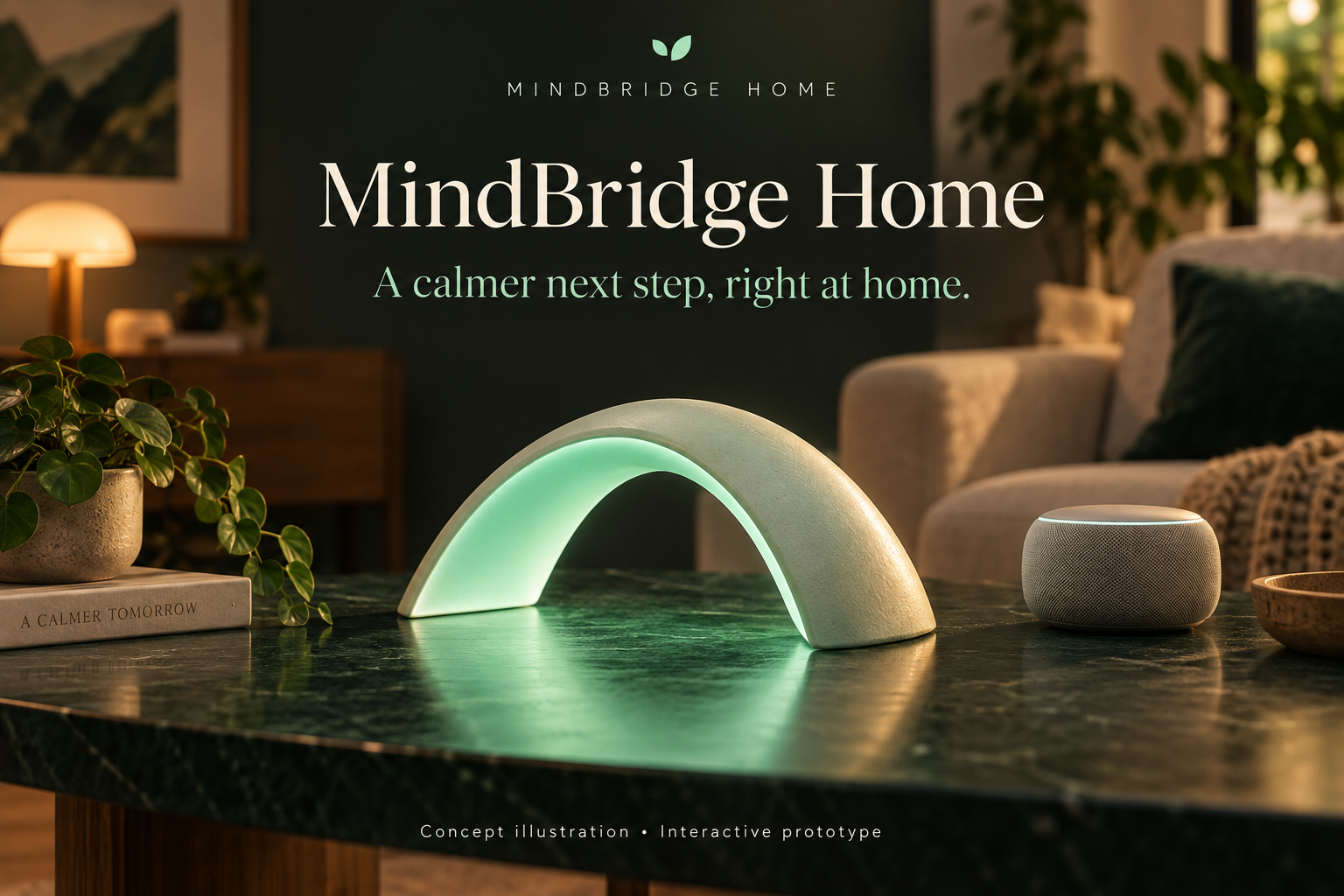
MindBridge Home was created around a simple idea: the home itself can become a more supportive environment.
Rather than trying to replace therapists, counselors, crisis professionals, or other human support systems, MindBridge Home is designed to help users take the next appropriate step. Through a conversational Alexa+ experience, users can complete brief wellness check-ins, access grounding exercises, break overwhelming problems into manageable actions, and navigate toward appropriate support resources.
The goal is not diagnosis. The goal is structured support, practical guidance, and safer navigation.
What it does
MindBridge Home is an AI-assisted wellness and support-navigation experience designed for the Alexa+ ecosystem.
A user can speak naturally about how they are feeling or what they are struggling with. MindBridge Home interprets the request and routes it to a structured tool rather than relying entirely on unrestricted AI conversation.
For example, a user might say:
“I’m overwhelmed and I don’t know what to do first.”
MindBridge Home can identify that the user is asking for practical support, invoke an action-planning tool, and help break the situation into smaller and more manageable steps.
The system is designed around several core capabilities:
- Daily wellness and stress check-ins
- Guided grounding and coping exercises
- Task decomposition and action planning
- Support-resource navigation
- Non-diagnostic wellness summaries
- Safety-oriented escalation pathways when higher levels of support may be appropriate
MindBridge Home is intentionally positioned as a wellness and navigation tool rather than an AI therapist. It does not claim to diagnose mental-health conditions or replace licensed care.
How we built it
MindBridge Home is designed around an Alexa+ conversational interface connected to a self-hosted Model Context Protocol server using Streamable HTTP.
The MCP server exposes specific tools that the conversational layer can call depending on the user’s needs. These tools include functions such as:
daily_check_in Collects structured wellness information such as current stress level, emotional state, and immediate support needs.
grounding_exercise Provides a short guided grounding or regulation activity.
create_action_plan Converts an overwhelming problem into a small sequence of manageable next steps.
find_support_resource Helps identify an appropriate category of support based on the user’s request.
wellness_summary Creates a concise, non-diagnostic summary of information collected during a check-in.
escalate_support Redirects the experience toward appropriate human or emergency resources when the interaction indicates that ordinary wellness guidance is insufficient.
Amazon Bedrock provides the generative AI layer for natural-language interpretation and response generation, while application-level rules constrain how sensitive situations are handled.
The architecture separates conversational reasoning from deterministic safety and routing logic. This helps reduce the risk of allowing the language model alone to decide how a potentially high-risk interaction should be handled.
Challenges we ran into
One of the largest design challenges was determining where generative AI should stop and deterministic application logic should begin.
Mental-health conversations are highly contextual. A purely scripted system can feel rigid and fail to understand what a user actually means. However, allowing a generative model complete freedom in sensitive situations introduces reliability and safety concerns.
MindBridge Home therefore uses a hybrid model. Natural-language AI helps understand user intent and communicate in a conversational way, while structured MCP tools handle specific actions.
Another challenge was avoiding the common tendency for wellness applications to overstate their clinical capabilities. We deliberately designed MindBridge Home so that it does not present itself as a therapist, diagnostic system, or emergency service.
Privacy was also a major consideration. A home-based wellness assistant should collect only the information necessary to complete the requested task and should avoid creating unnecessary sensitive data.
Accomplishments that we’re proud of
One of the most important accomplishments is the project’s safety-oriented architecture.
Instead of building a general-purpose mental-health chatbot, MindBridge Home uses narrowly scoped tools with defined responsibilities. This makes the system easier to understand, test, audit, and improve.
We are also proud of designing the project specifically around the strengths of a home voice interface. Mental-health and wellness support should not always require opening an app, navigating menus, or typing long explanations.
A user can simply speak.
That interaction model makes MindBridge Home particularly useful during moments of stress, fatigue, or cognitive overload, when even simple digital tasks can become difficult.
What we learned
Building MindBridge Home reinforced an important lesson about AI applications: the most useful system is not necessarily the one that gives the AI the most autonomy.
For sensitive domains, clearly defined boundaries can improve the product.
We also learned that MCP provides a strong architectural model for separating conversational intelligence from application capabilities. The AI does not need direct access to every internal function. Instead, it can invoke carefully defined tools with predictable inputs and outputs.
This makes the system more modular and creates a clearer path for testing, logging, auditing, and future development.
Another lesson was that voice-first design requires different assumptions than traditional mobile or web design. Responses must be concise enough to understand when spoken, but informative enough to help users decide what to do next.
What’s next for MindBridge Home
The next phase of MindBridge Home would focus on expanding the system while preserving its safety boundaries.
Future development could include:
- Personalized wellness routines
- Opt-in longitudinal wellness trends
- Integration with calendars and task-management services
- Location-aware resource navigation
- Multilingual support
- Accessibility features for users with visual, cognitive, or mobility limitations
- Caregiver and family-support workflows with explicit user consent
- Additional evidence-informed coping and behavioral strategies
- Improved safety evaluation and adversarial testing
- Integration with additional Amazon devices and services
A future version could also allow users to create a personalized support plan specifying preferred coping strategies, trusted contacts, routines, and resources before a stressful situation occurs.
The long-term vision for MindBridge Home is not to automate mental-health care.
It is to make the path between “I am struggling” and “I know what to do next” shorter, clearer, and easier to access.
Built With
- agentcore
- alexa+
- amazon-web-services
- amazonbedrock
- github
- mcp
- node.js
- opensource
- react
- restapis
- strandssdk
- streamablehttp
- typescript

Log in or sign up for Devpost to join the conversation.