Inspiration
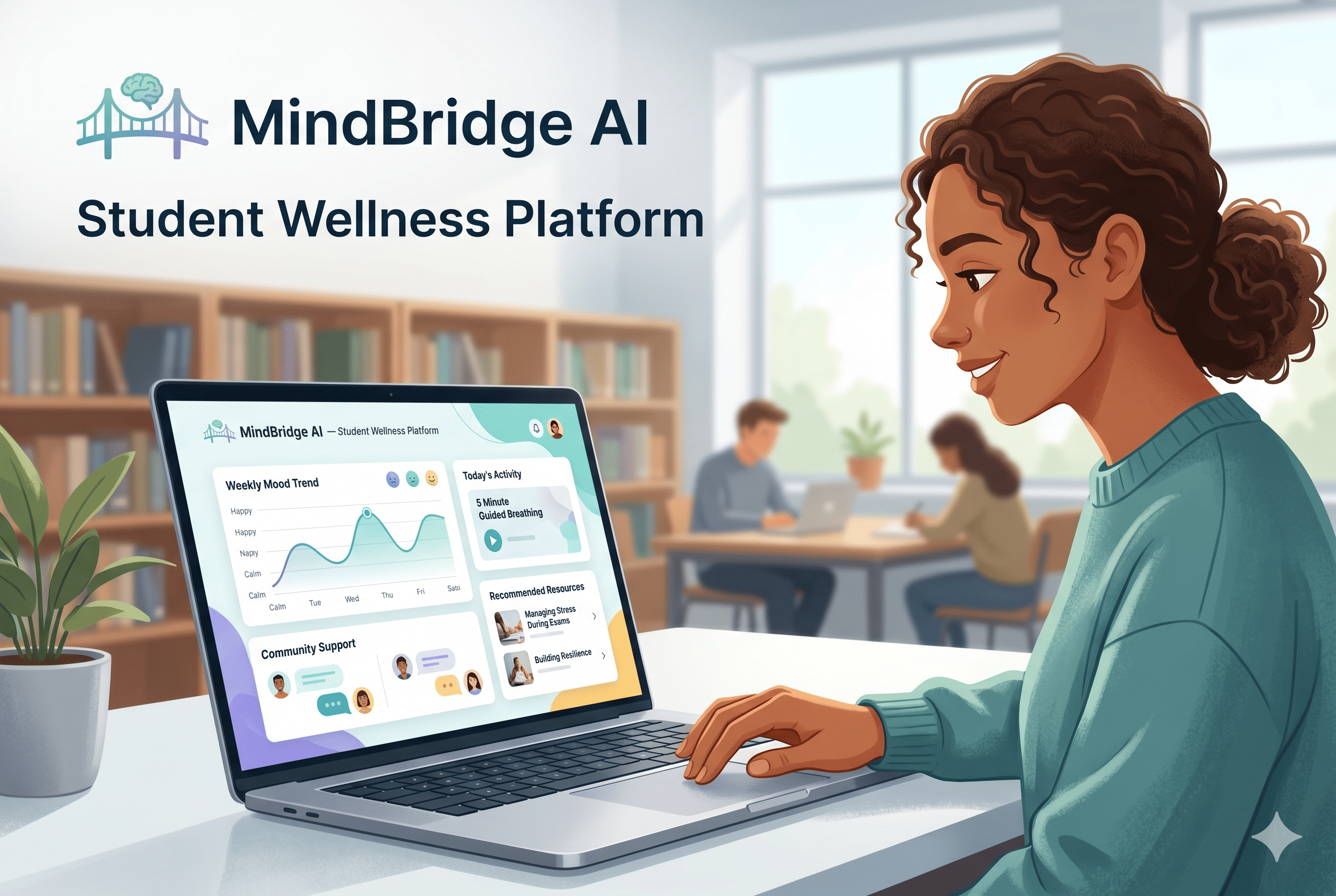
College life is rewarding, but it can also be overwhelming. Students often face academic pressure, burnout, anxiety, and a lack of accessible support systems. We wanted to build a platform that combines AI, self-reflection, peer support, and wellness resources into a single ecosystem.
According to our research, over 70\% of students report experiencing significant stress during a semester. This inspired us to create MindBridge AI — Student Wellness Hub, a proactive platform designed to help students build healthier habits before challenges become crises.
The impact we aim for can be modeled as:
$$ Wellness\ Score = 0.4(Mood) + 0.3(Habits) + 0.2(Community) + 0.1(Self\ Reflection) $$
where each factor contributes to a student's overall well-being.
What it does
MindBridge AI acts as a personalized wellness companion for students.
Key features include:
- AI Wellness Coach for personalized guidance
- Mood Tracking & Analytics
- Smart Journaling
- Stress Forecasting Dashboard
- Anonymous Community Support
- Daily Wellness Challenges
- SOS & Emergency Resources
- Gamified Progress Tracking
The platform tracks student engagement using metrics such as:
$$ XP_{total} = XP_{journal} + XP_{challenges} + XP_{community} $$
For example:
$$ XP_{total} = 120 + 80 + 50 = 250 $$
This encourages consistent wellness habits through positive reinforcement.
How we built it
MindBridge AI was developed using a modern full-stack architecture.
Frontend
- React.js
- Vite
- Tailwind CSS
- Framer Motion
- Recharts
- D3.js
- Three.js
State Management & Data
- Redux Toolkit
- React Query
- Axios
- Local Storage
Real-Time Features
- Socket.IO
Deployment
- Firebase Hosting
- GitHub
The application follows a modular architecture:
$$ System = UI + AI + Analytics + Community + Resources $$
This structure allowed us to build scalable and reusable components while maintaining performance and maintainability.
Challenges we ran into
Building for mental wellness comes with unique challenges.
Some of the major obstacles included:
- Designing an interface that feels supportive rather than clinical.
- Managing multiple wellness workflows in one application.
- Creating meaningful visualizations from emotional data.
- Ensuring anonymous community interactions remain safe and helpful.
- Balancing feature richness with simplicity.
We also needed to optimize dashboard performance as the number of tracked activities increased:
$$ Time\ Complexity \propto Users \times Activities $$
As engagement grows, efficient rendering and state management become increasingly important.
Accomplishments that we're proud of
We are proud of creating a comprehensive student wellness ecosystem rather than a single-purpose application.
Highlights
- AI-powered wellness coaching
- Personalized onboarding experience
- Interactive mood analytics
- Community-driven support
- Wellness streaks and achievements
- Stress prediction tools
- Emergency assistance resources
Some measurable outcomes include:
$$ 7\ Day\ Streak = 7 \times 10 = 70\ XP $$
$$ Challenge\ Completion\ Rate = \frac{Completed}{Assigned} \times 100 $$
Example:
$$ \frac{18}{20} \times 100 = 90\% $$
These metrics help students visualize progress and stay motivated.
What we learned
Throughout this project, we learned that mental wellness solutions require more than good technology—they require empathy.
Key lessons included:
- Designing for emotional experiences
- Building scalable React architectures
- Creating meaningful wellness analytics
- Implementing gamification responsibly
- Combining AI assistance with human-centered design
We also explored how wellness trends can be quantified:
$$ Mood\ Trend = \frac{\sum Mood\ Scores}{n} $$
For example:
$$ \frac{4 + 5 + 3 + 4 + 5}{5} = 4.2 $$
This helps users understand emotional patterns over time.
What's next for MindBridge AI — Student Wellness Hub
Our vision is to evolve MindBridge into a more intelligent and personalized student wellness platform.
Future Goals
- Advanced AI coaching powered by LLMs
- Personalized wellness recommendations
- Predictive burnout detection
- University integration systems
- Mobile applications
- Real-time crisis intervention support
- AI-generated wellness roadmaps
We plan to improve prediction capabilities using wellness indicators:
$$ Risk\ Score = 0.5(Stress) + 0.3(Sleep\ Deficit) + 0.2(Mood\ Variance) $$
For example:
$$ Risk\ Score = 0.5(8) + 0.3(6) + 0.2(4) = 6.6 $$
This could help identify students who may benefit from early support.
Our ultimate goal is simple: make mental wellness support accessible, personalized, and proactive for every student.
Built With
- apis
- axios
- d3.js
- firebase-hosting
- framer-motion
- github
- javascript
- local-storage
- react-query
- react-router-dom
- react.js
- recharts
- redux-toolkit
- rest
- socket.io
- tailwind-css
- three.js
- vite

Log in or sign up for Devpost to join the conversation.