-
-
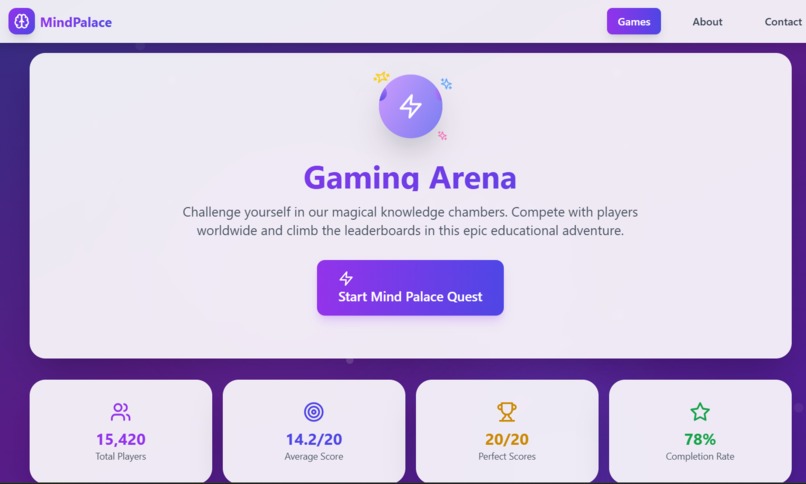
Mind Palace

🚀 Inspiration
The idea for Mind Palace came from a simple question: What if studying felt like playing a story-based game? As a student myself, I realized that traditional learning platforms can sometimes feel dry or repetitive. I wanted to build something that not only helps students revise but makes them feel like they’re on a quest. Inspired by escape rooms and memory palaces, I imagined a palace where each room unlocks with the power of knowledge.
🛠️ What I Built
I created a fully responsive web-based quiz game using React and Tailwind CSS. The app features:
- 🏰 20 unique rooms with questions from Math, History, Science, Grammar, and Tech.
- 🧙♂️ A floating animated character as a learning companion.
- 🎉 Confetti celebration at the end to make success rewarding.
- 💡 Keyboard shortcut features for accessibility.
- 📱 Clean UI inspired by modern landing page designs.
- 🧩 Game logic to progress based on correct answers only.
📚 What I Learned
- How to structure state management cleanly in React for multi-step progress.
- How to use animation libraries and SVG assets to make the user experience engaging.
- How to manage accessibility while keeping a fun design.
- How to make learning more emotionally rewarding through gamification.
⚙️ How I Built It
The project stack includes:
- React for the UI and component structure
- Tailwind CSS for styling and responsiveness
- React Confetti for animation effects
- useState and useEffect hooks for quiz logic
Each question is stored as a JSON object and loaded dynamically. Once a user selects the correct answer, the app progresses them to the next room using conditional rendering.
const handleAnswer = (selected) => {
  if (selected === questions[currentQuestion].answer) {
    setScore(score + 1);
    setCurrentQuestion(currentQuestion + 1);
  }
};
⚠️ Challenges Faced
- Keeping users engaged: It was tough to balance education and fun. I overcame this by adding a floating character and celebration effects.
- Designing mobile-first: Ensuring the experience felt natural on both desktop and mobile required a lot of tweaking with Tailwind breakpoints.
- Game logic bugs: I initially had issues with state resetting at the final level. This was resolved by isolating final screen rendering in a dedicated component.
✨ Math Integration Example
To include subjects like math, I structured question objects with LaTeX support:
{
  "question": "What is the derivative of $x^2$?",
  "options": ["2x", "x", "x^2", "1"],
  "answer": "2x"
}
This allows math expressions to be rendered cleanly using libraries like LaTeX.
🎯 Outcome
In the end, Mind Palace became more than just a quiz game — it’s a journey that helps students feel rewarded for learning. It reflects my passion for using code and design to inspire curiosity.
Built with ❤️ by Nitin Yadav during the Student Learning Hackathon.
Built With
- ai
- css3
- html5
- javascript
- react
- tailwindcss

Log in or sign up for Devpost to join the conversation.