-
-

Welcome to Mind Dojo
-
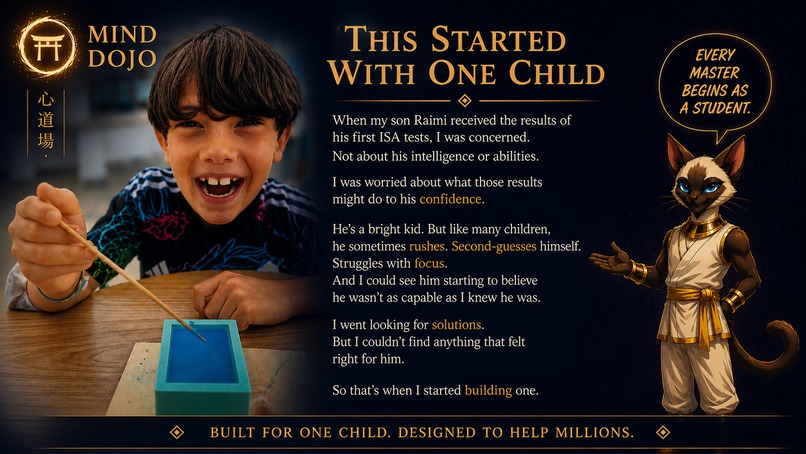
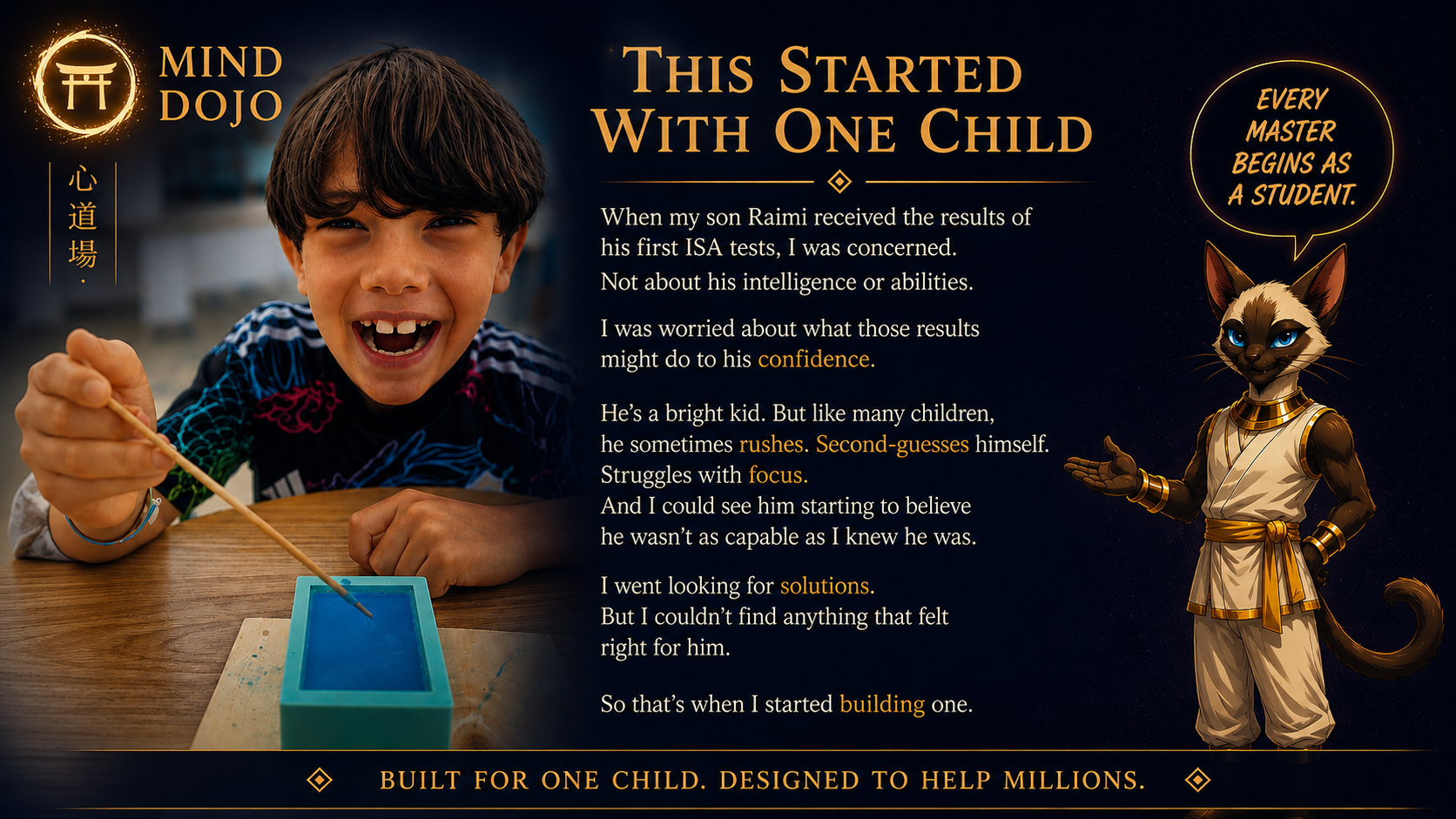
From one child to many - Dojo is the way.
-
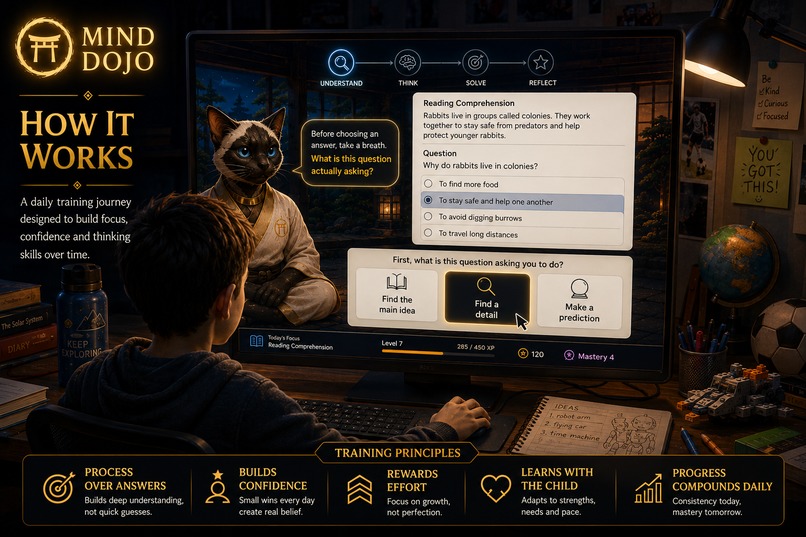
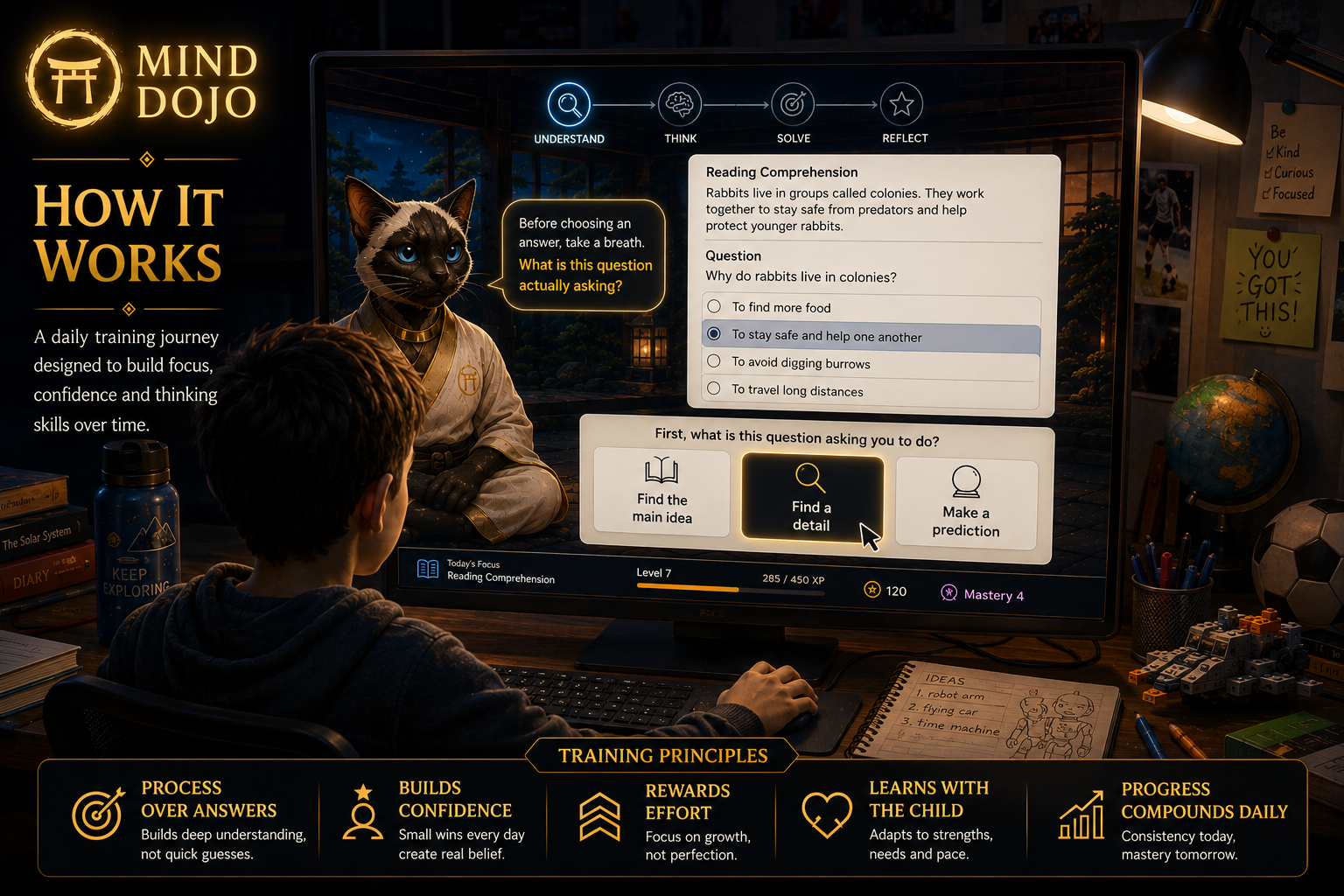
How the Dojo Work - the key is learning HOW to learn.
-
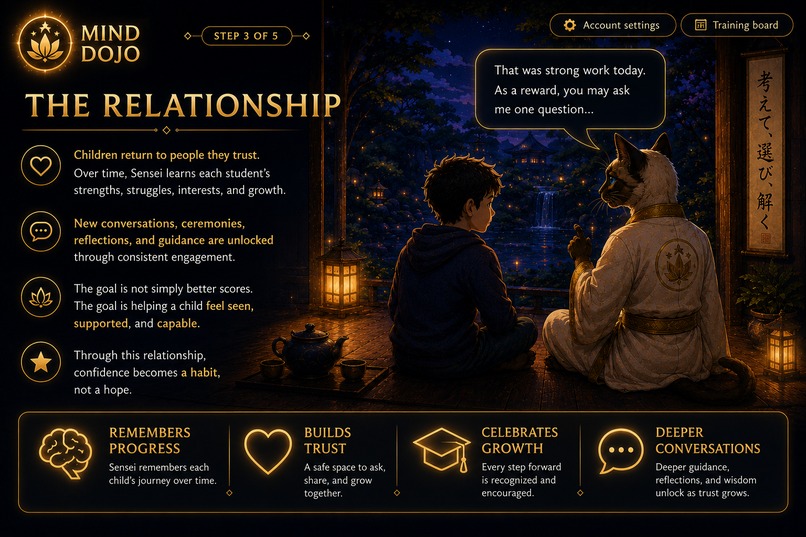
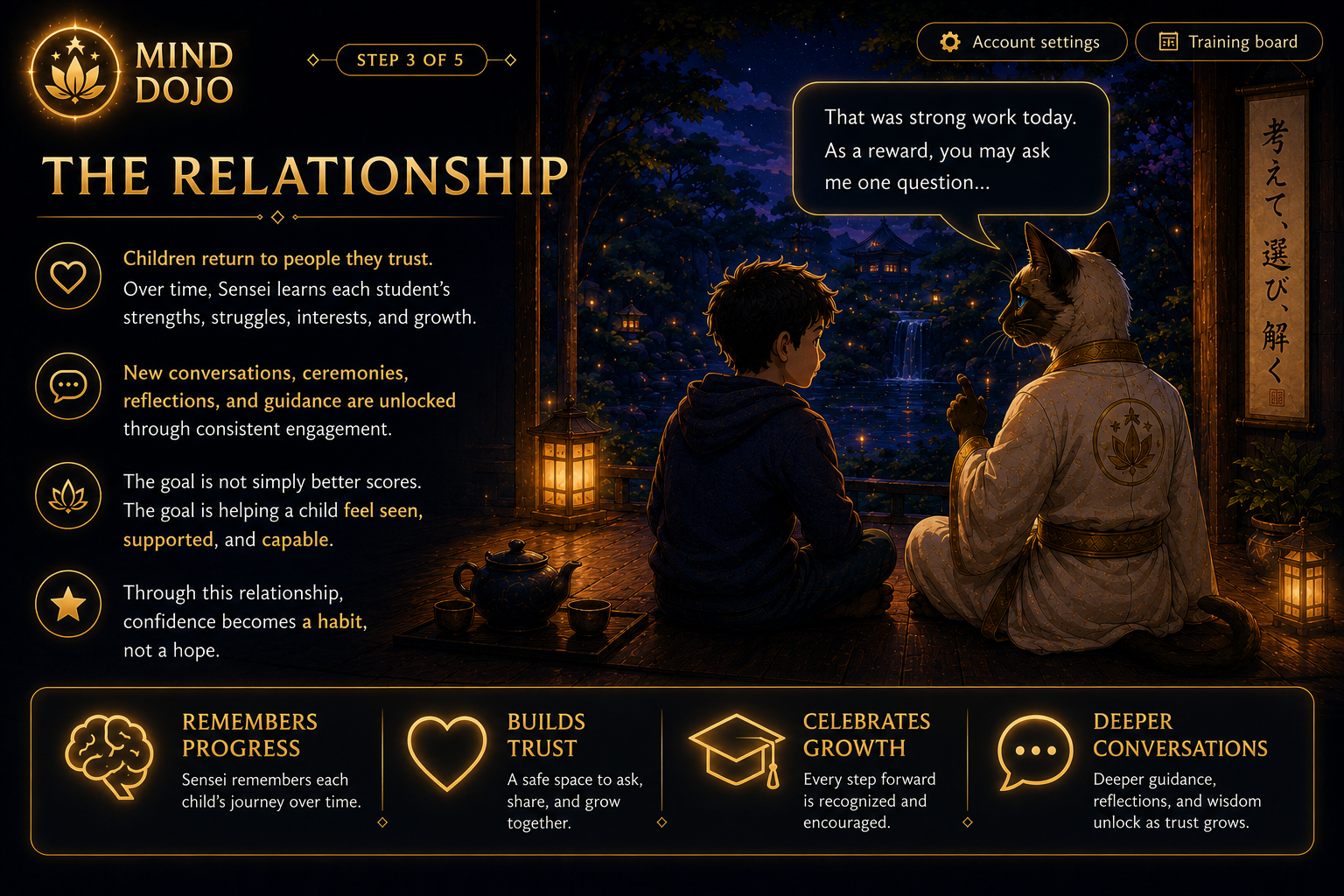
A mentor/student relationship, designed to evolve with each student.
-
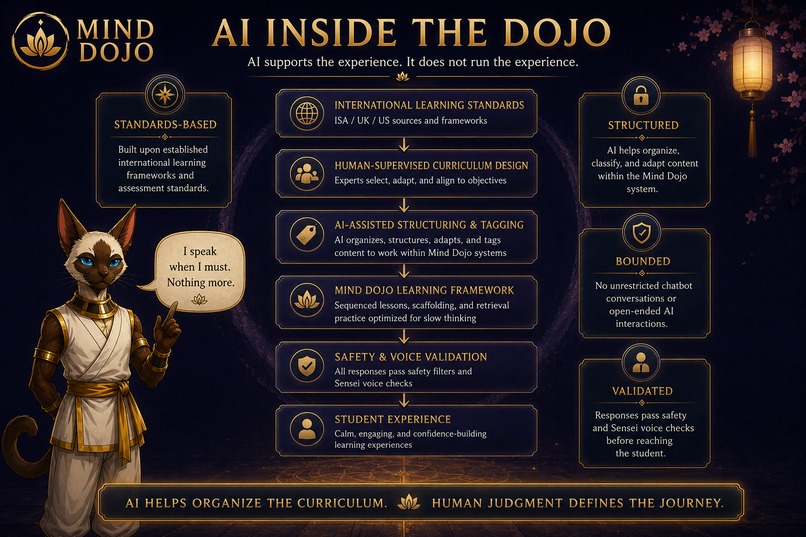
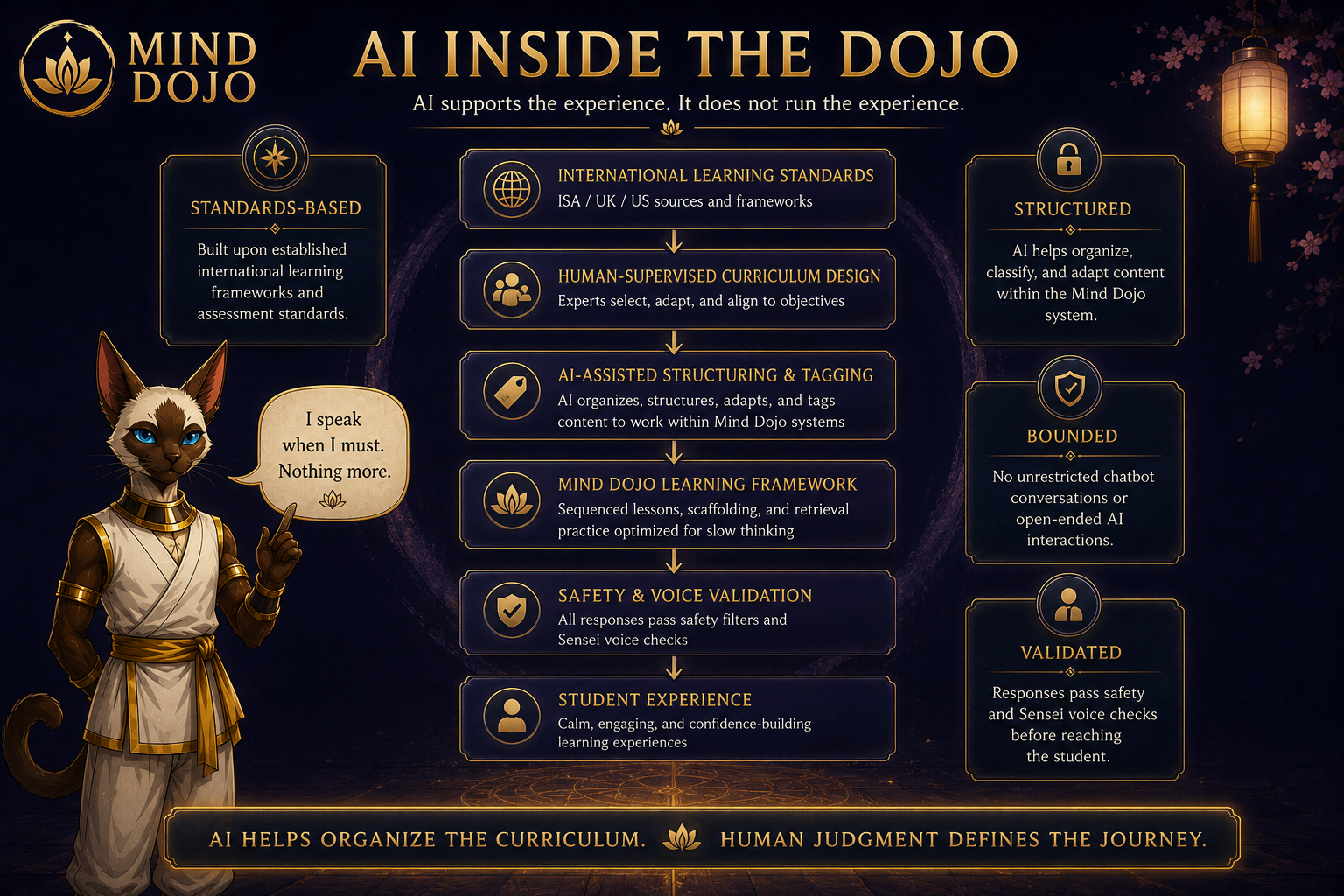
How the Dojo harnesses generative tools for its unique approach.

Inspiration
Every learning app we'd ever handed a kid asked the same flat question: is the answer right, or wrong? But that isn't how a child learns to think — and a red X has never taught anyone why. We wanted a tutor that cared how you got there.
So we built Mind Dojo: a place where a patient mentor, Cat Sensei, coaches children through the process of reasoning — understand the problem, find the clues, choose a strategy, solve it, explain it — and treats a wrong turn as a place to learn, never a failure to punish. The wager underneath it all: if you can grade a child's understanding instead of their keywords, you can coach instead of merely score.
What it does
A child works a problem through five guided stages with Cat Sensei. When they write an answer in their own words, GPT-5.6 reads it against a plain-language rubric and returns one of three verdicts — not right/wrong, but:
- Accept — they've shown real understanding.
- Coach-and-grow — they're close; Sensei gives one specific nudge and a worked example, then lets them try again.
- Missed — a gentle retry, then an easier guided step.
Because it grades meaning, a genuine paraphrase in a kid's own voice passes, while keyword-stuffing — "cracked support fail unsafe bridge" — does not. Around that core, the dojo comes alive:
- Cat Sensei's voice evolves with the relationship — the model sees a privacy-safe summary of how trust is building and speaks to this child, in this moment.
- Ask Sensei lets a child put one question to their mentor and receive a short, safe parable.
- Kids earn story — ceremony objects and lore — instead of grinding for points.
- The app quietly adapts what it serves next from anonymised performance signals.
How we built it
Codex was our engineering team — not autocomplete. We decomposed the entire product into a dependency graph of issues, then orchestrated Codex agents through a strict pipeline: each agent inspected our real codebase, wrote an implementation plan, and had a second Codex agent independently review that plan before a line was written. Only then did it build the feature test-first against a failing test, returning changes that had to survive our CI, mutation-testing, and guarded-deploy gates. Humans kept authority over product, pedagogy, content, privacy, and releases.
None of that is a claim on a slide — it's auditable in Git. One issue (#470) shows the whole loop on screen: a plan, an independent review two minutes later, an implementation with seven test files, and the merge. Fifty-seven of those plan-and-review folders are still in the repo, and on our busiest day 92 agent branches merged.
GPT-5.6 is the intelligence at runtime. Every model call routes through a single audited server gateway, and the model can only ever reply through a strict, validated tool contract:
- the free-text grader runs on the flagship
gpt-5.6, because getting a child's understanding right is exactly where that capability earns its keep; - Sensei's evolving dialogue, the Ask-Sensei parables, and the next-session steering run on the fast
gpt-5.6-luna.
The rubric we hand the model is plain English — "the answer must connect the cracked support to the danger it creates" — which is precisely why it grades so reliably. When a child reasons through a ratio problem in words alone:
"Split 36 into 3 parts (2 for Asha, 1 for Ben); each part is 12, so Asha takes 24."
the grader recognises the correct method,
$$36 \div 3 = 12, \qquad 12 \times 2 = 24,$$
even though the child never wrote a single equation. That is the whole point: it reads the reasoning, not the arithmetic.
Challenges we ran into
- Safety for children isn't a feature — it's the architecture. The API key never touches the child's device, a child's written answer is never stored, and the model can only speak through a validated tool, so it cannot say something unsafe to a kid. And if GPT-5.6 is ever slow or unavailable, the app falls back to an authored guided step and never fakes a grade — we never award mastery the model didn't confirm.
- Grading meaning, not words. Designing a rubric a model could apply consistently — accept honest paraphrases, catch keyword-foolers, and coach the "correct but bare" answer without ever calling a child wrong — took real iteration and a lot of adversarial testing.
- Orchestrating a fleet of agents without chaos. The plan → independent-review → test-first discipline is what kept dozens of parallel Codex agents from turning the codebase into mud.
Accomplishments that we're proud of
A complete, coherent product — not a proof of concept — with a genuinely novel grading model (three outcomes, meaning over keywords), a child-safe AI architecture, and a build history that shows its work. Content now spans Years 3 through 7, every answer key adversarially checked.
What we learned
- Codex is a force multiplier when you treat it as a team with process — a dependency graph, a plan, a reviewer, a failing test — not as a faster way to type.
- A plain-language rubric is model-portable and honest: it states what understanding looks like, and both the model and a human can check it.
- The pedagogy was right. Kids lean in when the tutor coaches the thinking instead of grading the answer.
What's next for Mind Dojo
More year bands, richer adaptive layering of Sensei's relationship, earned "lore comics," and an ambient, meditative score to make the dojo a place rather than an app. The goal never changes: a mentor that sees how a child got there — and helps them get further.
Built With
- ai-agents
- auth0
- bro
- codex
- docker
- github-actions
- google-cloud-tts
- gpt-5.6
- indexeddb
- koa
- nginx
- node.js
- openai
- pnpm
- postgresql
- react
- socket.io
- typescript
- vite
- vitest


Log in or sign up for Devpost to join the conversation.