-
-
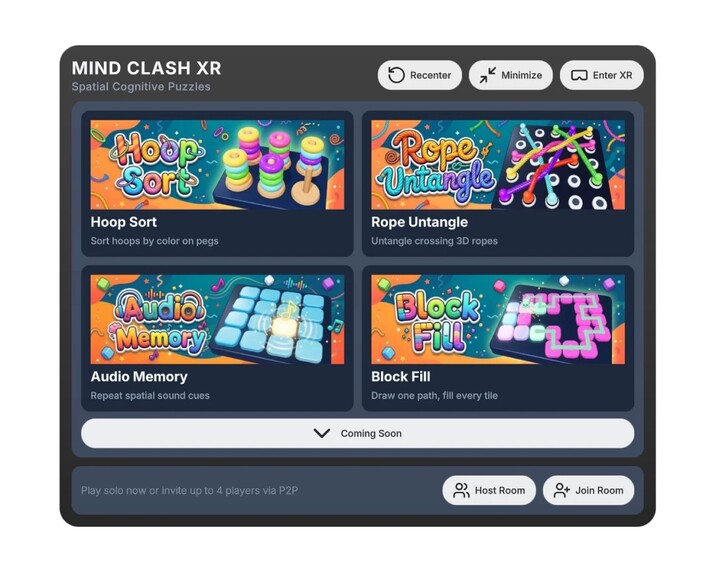
Mind Clash XR _ Main Menu
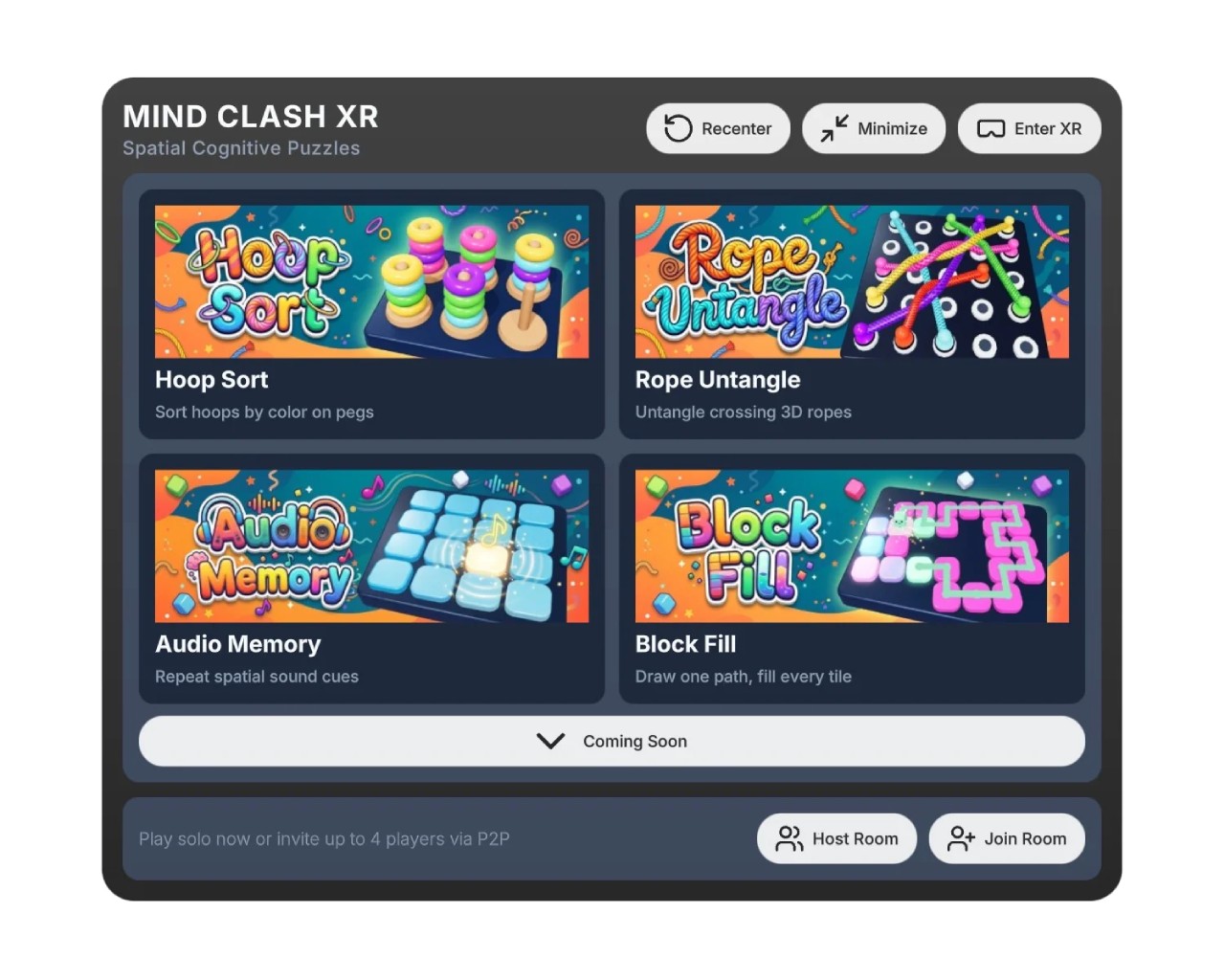
Inspiration
With the emergence of lightweight Meta VR Glasses alongside Meta Quest, spatial computing is moving from dedicated living-room gaming sessions to everyday, anywhere moments—on a couch, at a desk, or during a commute. Most VR titles still demand controllers, large play spaces, and long onboarding tutorials. I wanted to build the exact opposite: an instant-play, hands-first cognitive puzzle hub Inspired by tactile brain teasers, Mind Clash XR turns any small seated space into a fast-paced mental playground you can jump into solo or with friends in seconds.
What it does
Mind Clash XR is a seated, controller-free WebXR puzzle suite built for the Gaming track. Every interaction takes place within a comfortable two-foot radius using natural hand gestures (pinch, drag, and tap), and every game can be learned in under five seconds and completed in just a few minutes:
- Hoop Sort (Strategic Planning): Pinch, lift, and stack colorful hoops onto pegs until each peg holds a single matching color, testing multi-step logic and sequential problem-solving.
- Rope Untangle (Satisfying Mechanics): Pinch and drag glowing spatial nodes with your bare hands to uncross elastic lines until every connection resolves cleanly.
- Audio Memory (Sharpen Pattern Recall): Tap a spatial grid of light-and-sound tiles to repeat increasingly complex audio-visual sequences, training working and auditory memory.
- Block Fill (Improve Spatial Reasoning): Trace a single continuous path across a grid without lifting or trapping yourself, challenging spatial pathfinding and look-ahead planning.
- P2P Multiplayer: Share a room link and challenge up to 4 friends in real-time head-to-head cognitive matches—no dedicated backend servers or complex lobby setup required.
How we built it
- WebXR & IWSDK Foundation: Built from scratch on Meta's Immersive Web SDK (IWSDK) (with TypeScript and Three.js) for instant, zero-install browser execution across Meta Quest and Meta VR Glasses, iterating rapidly with the Immersive Web Emulator.
- 100% Hands-First Interaction Design: Engineered every puzzle, menu, and multiplayer room control to work end-to-end with bare hands (pinch-to-grab nodes, direct touch/poke for memory tiles, and continuous finger-tracing for grid paths), with seamless controller fallback.
- Seated & Compact Spatial Ergonomics: Anchored all interactive boards within an ergonomic, stationary two-foot reach zone so players never need to stand, turn around, or make wide arm gestures.
- Serverless P2P Multiplayer with Trystero: Integrated Trystero (WebRTC) to enable frictionless, room-code-based peer-to-peer multiplayer for up to 4 players with lightweight state synchronization.
- Original Core & Modular Architecture: Built all puzzle generators, rope physics, collision checks, and audio-visual feedback systems natively—structuring each mini-game as an independent module plugging into a shared multiplayer and scoring loop.
Challenges we ran into
- Hands-First Precision Without Controllers: Making pinch-and-drag rope untangling and continuous grid tracing feel effortless with bare hands required careful tuning of grab radii, depth forgiveness, and snap thresholds so interactions never feel fussy in a compact seated space.
- Synchronizing Serverless P2P Matches: Keeping puzzle boards, timers, and win states deterministic across up to 4 peers over WebRTC required compact state payloads and clean conflict resolution when players finish rounds milliseconds apart.
- Zero-Text Onboarding: Ensuring a player can jump in during a "one bus stop" session without reading instructions meant relying purely on spatial affordances, color shifts, and crisp audio-visual feedback.
Accomplishments that we're proud of
- Solo-building a complete, multi-game WebXR hub with 4-player P2P multiplayer from a blank slate during the competition window.
- Passing all three core design benchmarks: 100% controller-free hands-first play, stationary two-foot seated ergonomics ready for Meta VR Glasses, and instant browser cold-start with rewarding sub-5-minute sessions.
- Creating a modular codebase where new spatial brain games can be added rapidly without rewriting networking or input systems.
What we learned
- Designing for VR Glasses changes spatial UI rules: Constraining interactions to a compact, seated reach zone actually makes puzzles more focused, comfortable, and replayable than room-scale layouts.
- Tactile feedback bridges the controller gap: Without controller rumble, responsive visual highlights, elastic rope tension, and crisp audio cues are essential to making hand-tracking feel physical and satisfying.
What's next for Mind Clash XR
- New Hands-First Mini-Games: Expanding the hub with compact 3D spatial rotation, object stacking, and eye-hand reaction challenges.
- Mixed Reality Tabletop Anchoring: Using Passthrough and plane detection so players can snap puzzle boards directly onto a real-world desk, coffee table, or airplane tray table.
- Daily Brain-Training Streaks & Leaderboards: Adding quick daily 3-minute cognitive challenges and global rankings tailored for daily VR Glasses wearers.
Built With
- iwsdk
- three.js
- trystero
- typescript
- webrtc
- webxr
