-
-
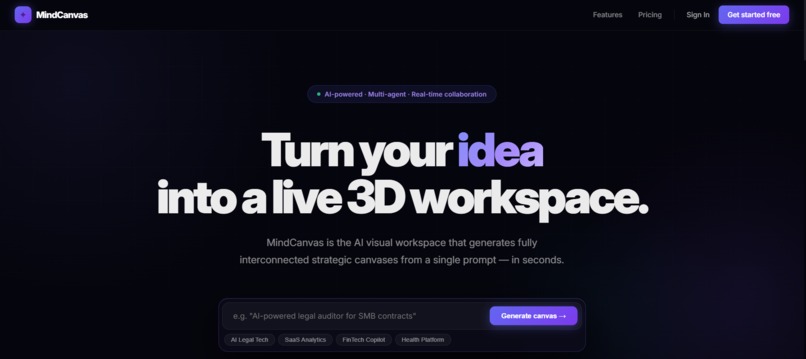
MindCanvas is an AI-powered visual workspace that transforms ideas into structured, connected strategies through an interactive canvas.
-
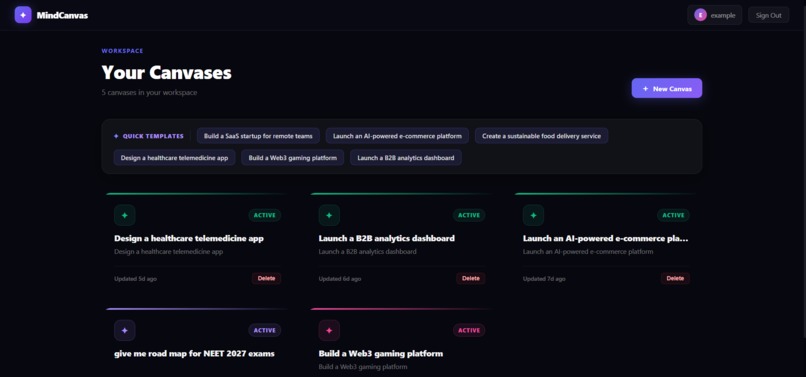
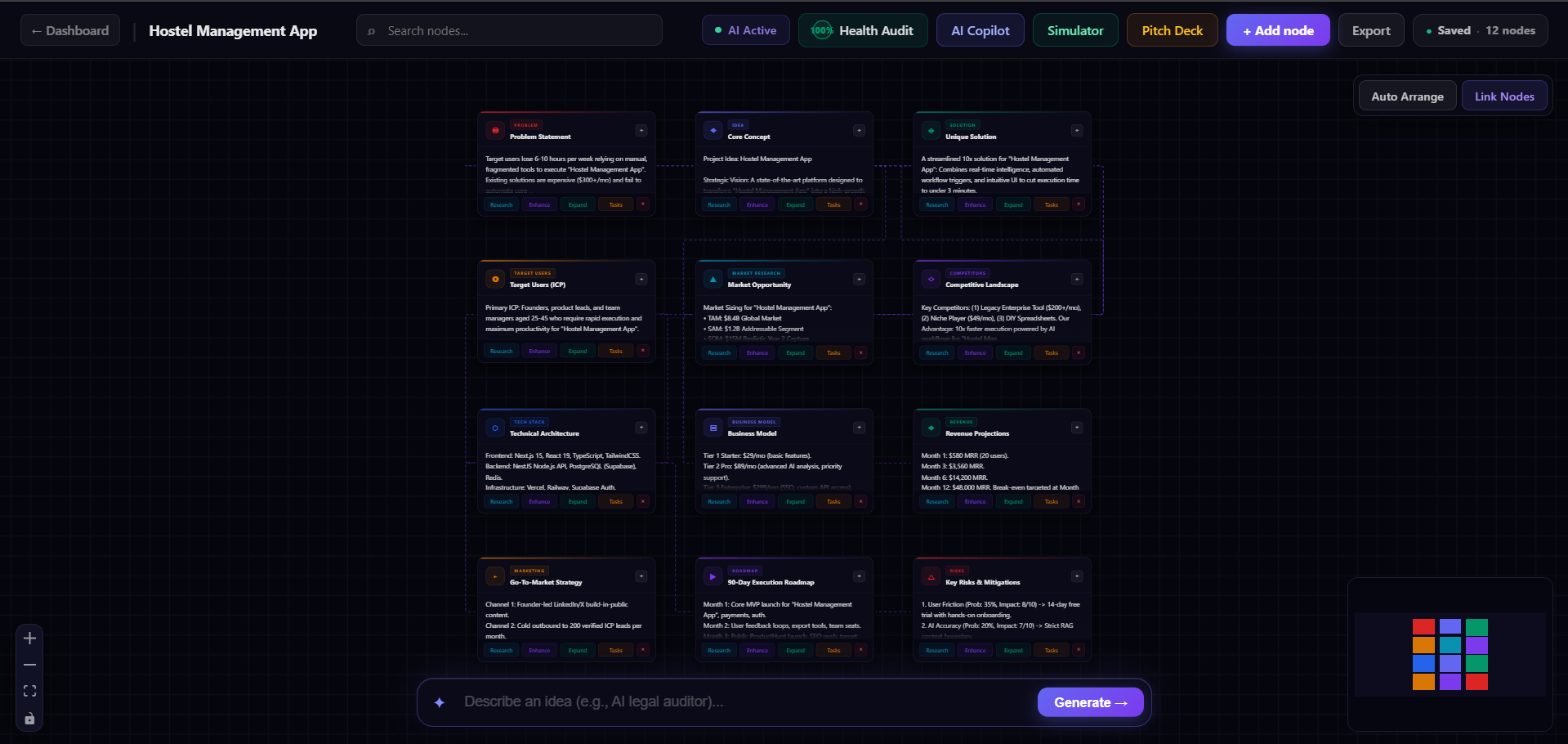
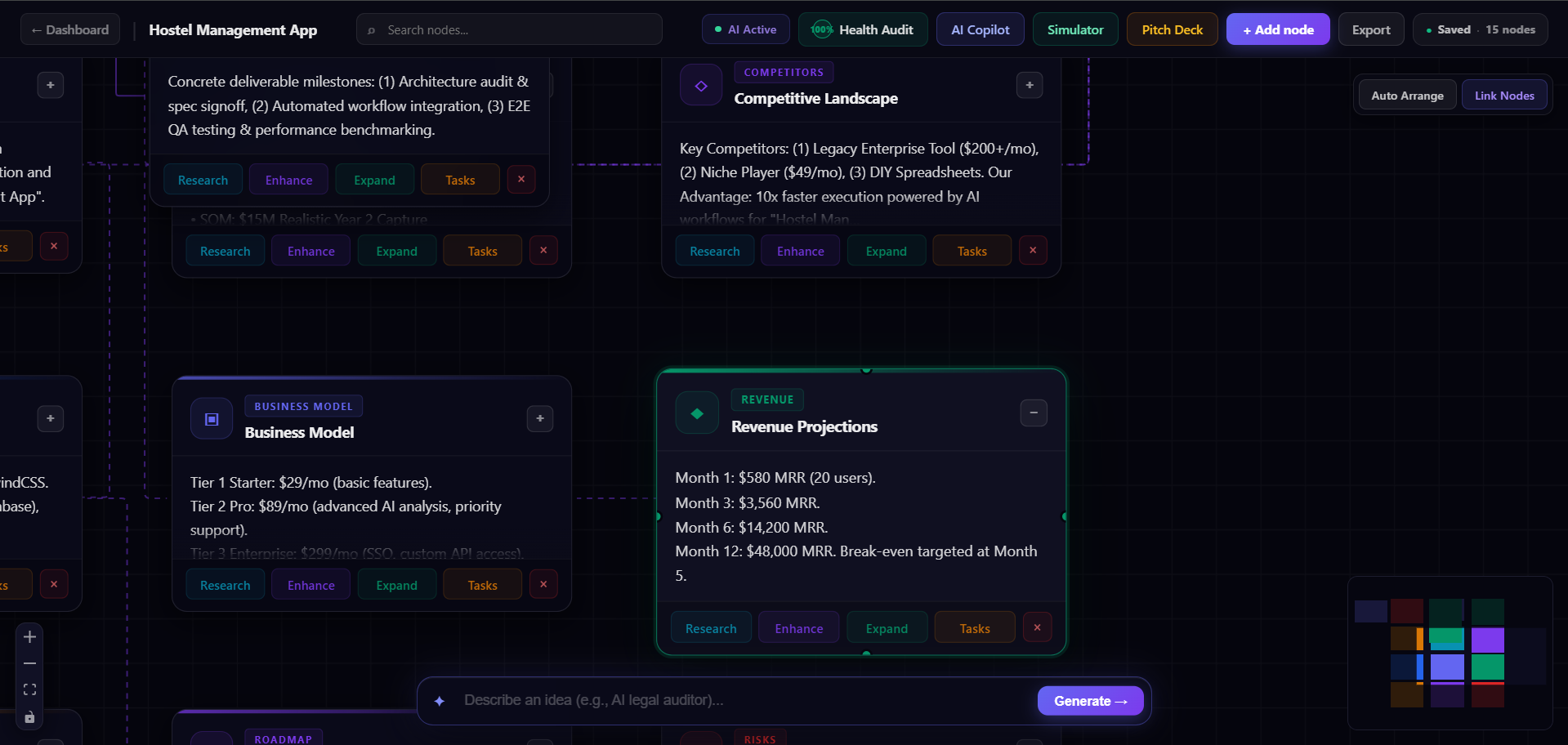
The central canvas helps users organize ideas, connect concepts, and build strategies in one flexible workspace.
-
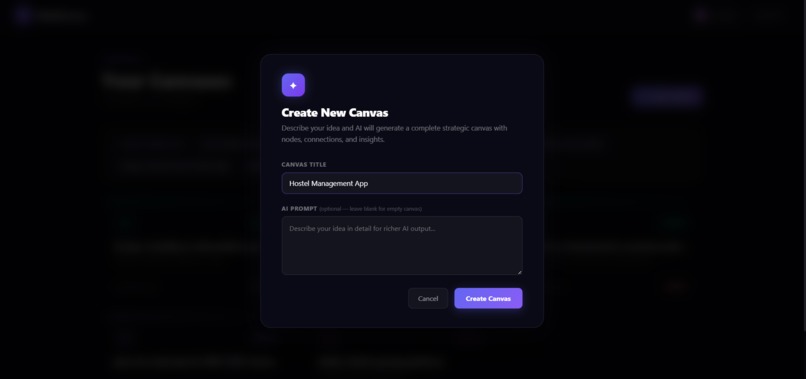
Users can start with a simple idea and let AI expand it into meaningful, structured concepts for deeper exploration.
-
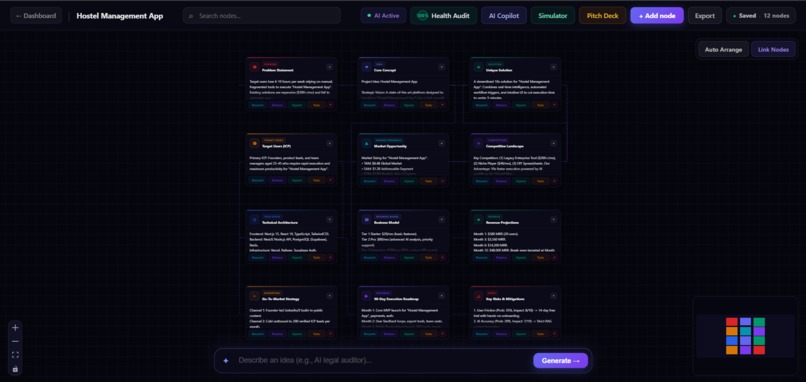
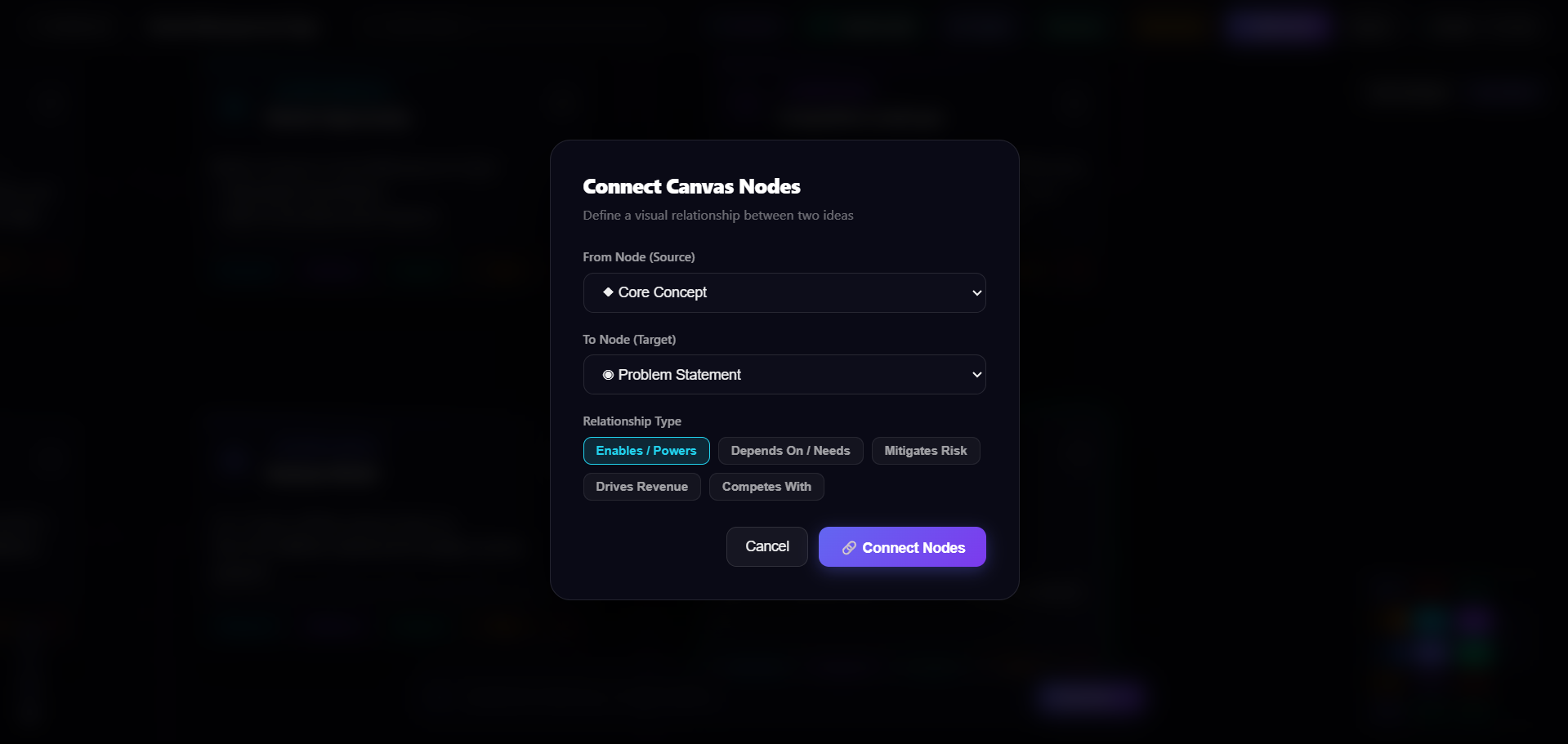
Users can connect ideas through visual nodes, making relationships easier to understand and helping them see the bigger picture.
-
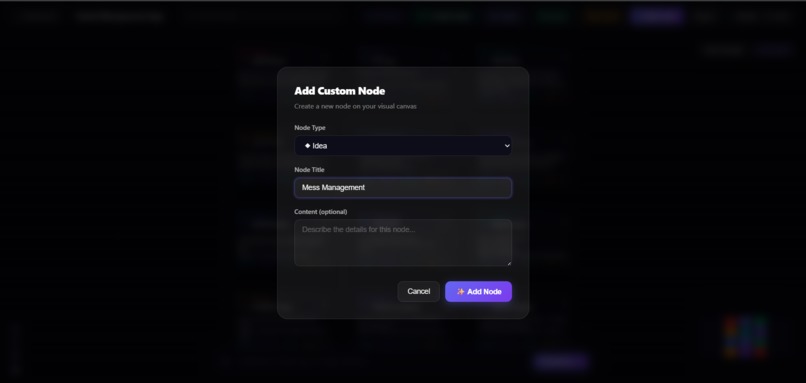
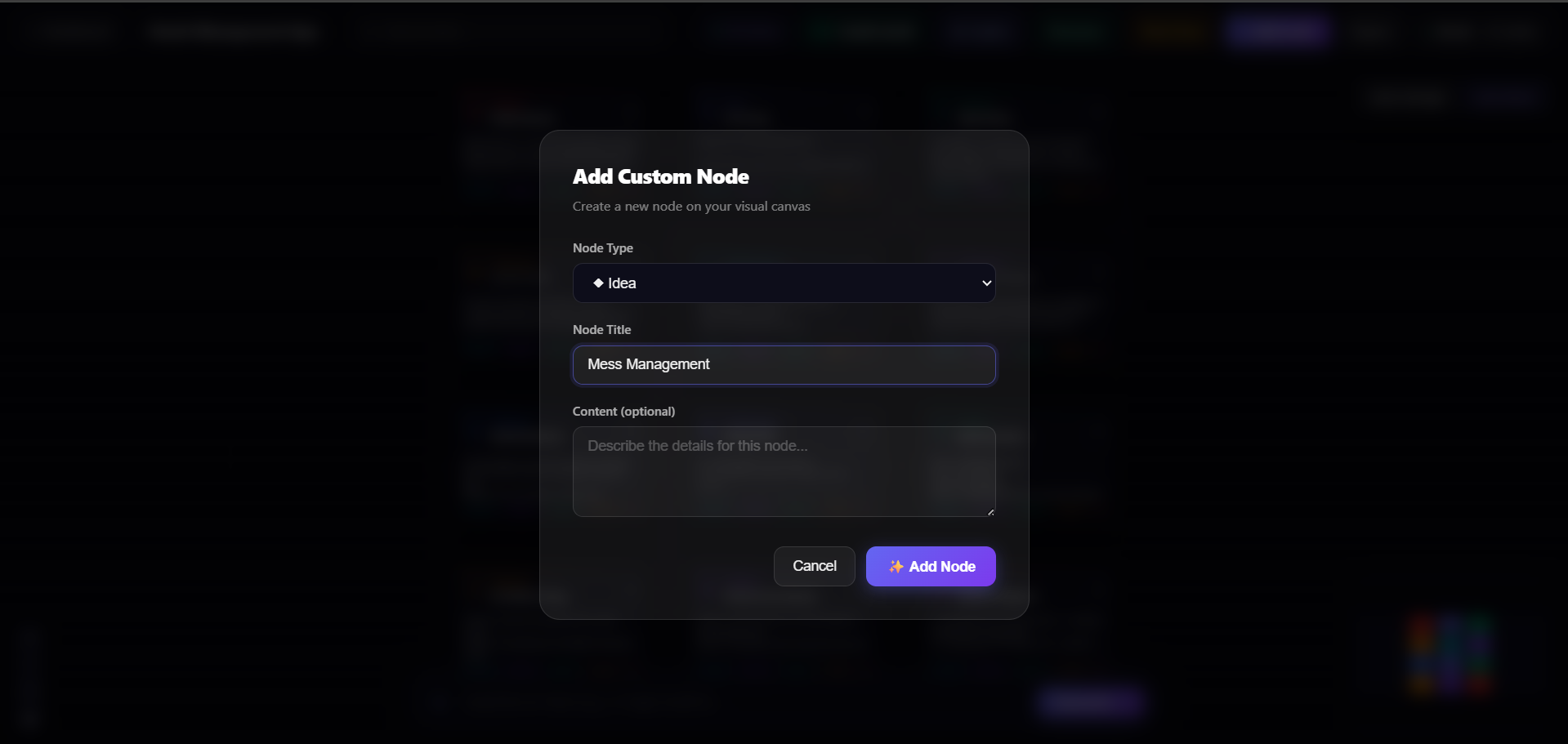
Users can create custom nodes for ideas, notes, tasks, and insights, making the canvas adaptable to any workflow.
-
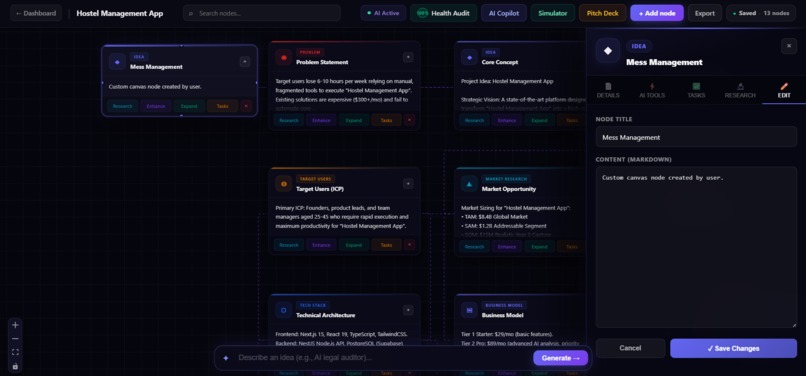
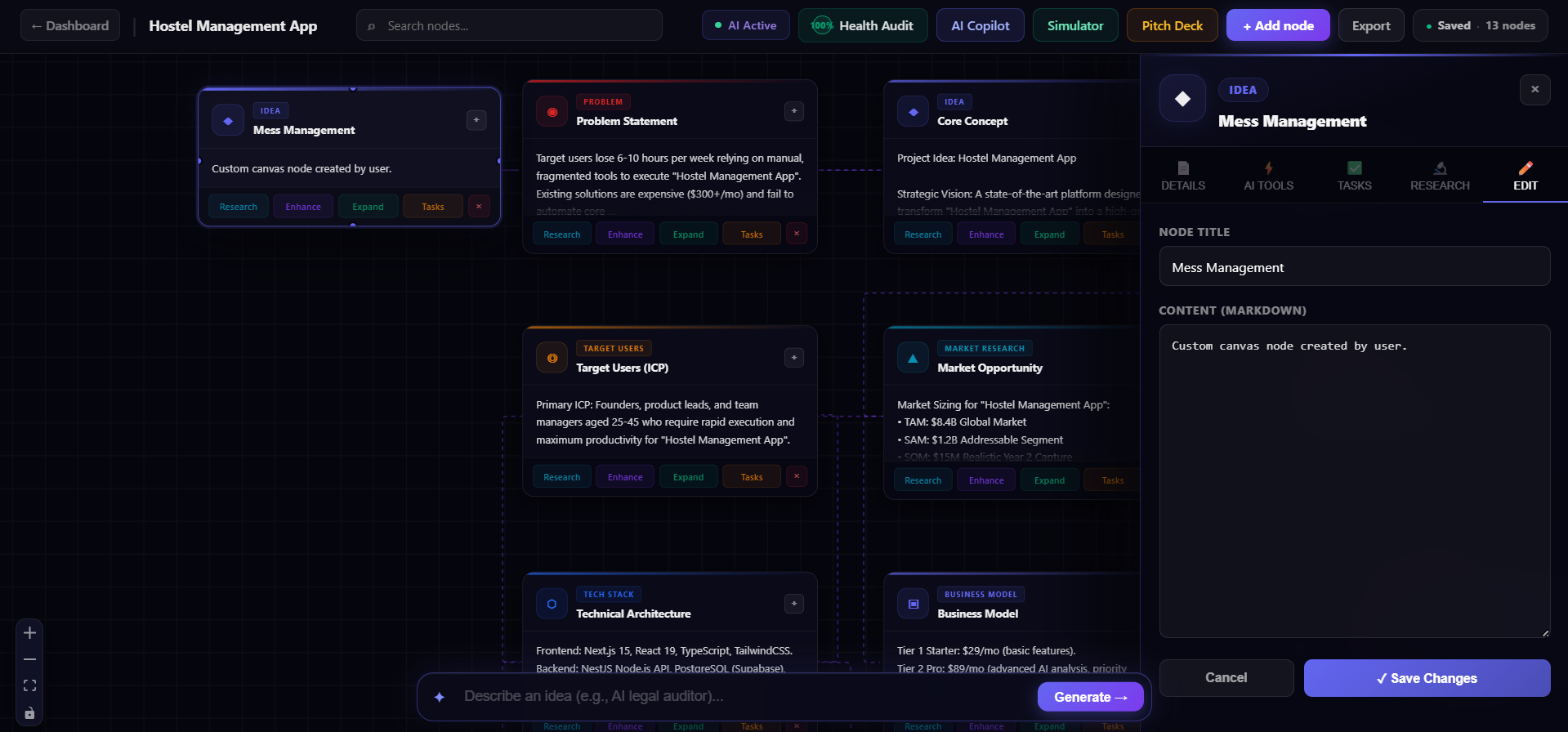
Users can edit, enhance, and expand any node with AI, allowing ideas to continuously evolve as their strategy develops.
-
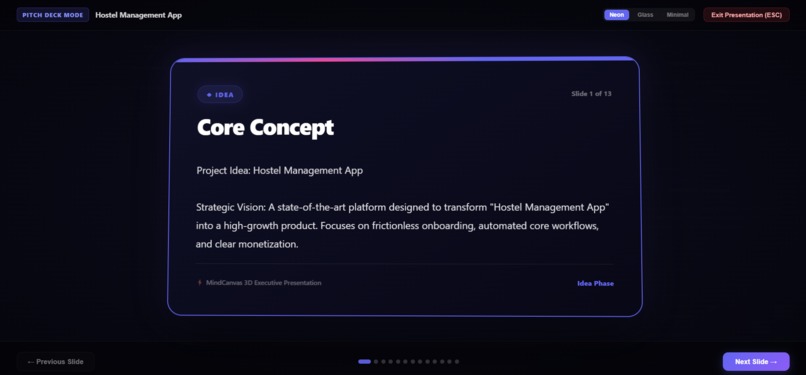
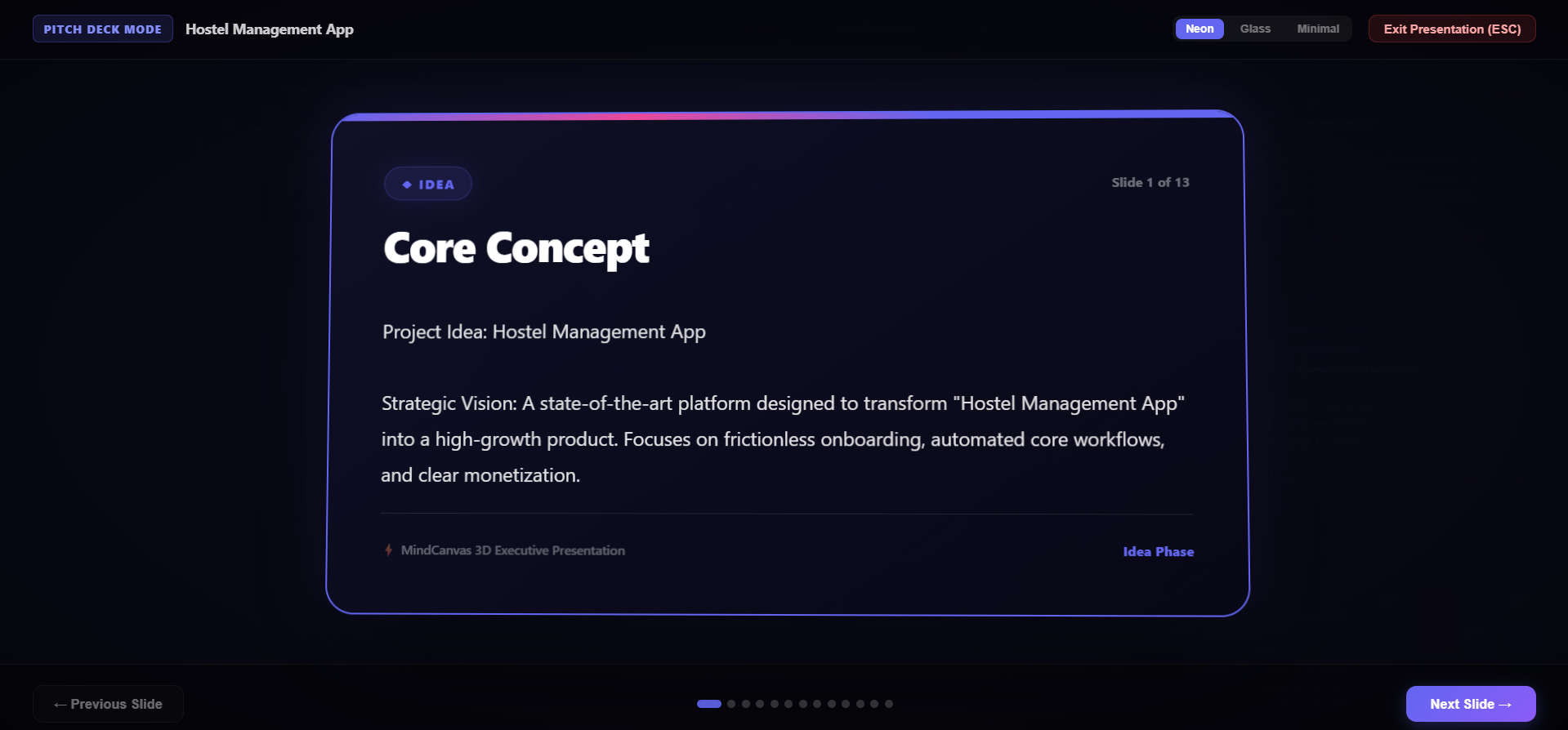
Pitch Deck Mode transforms the visual canvas into a structured presentation, making ideas, insights, and strategies easier to communicate.
-
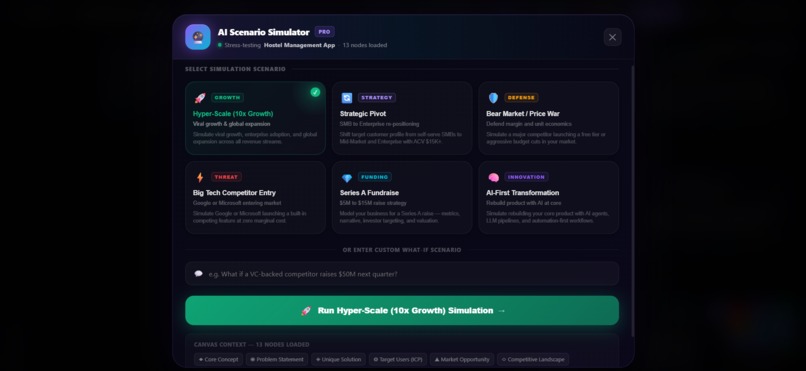
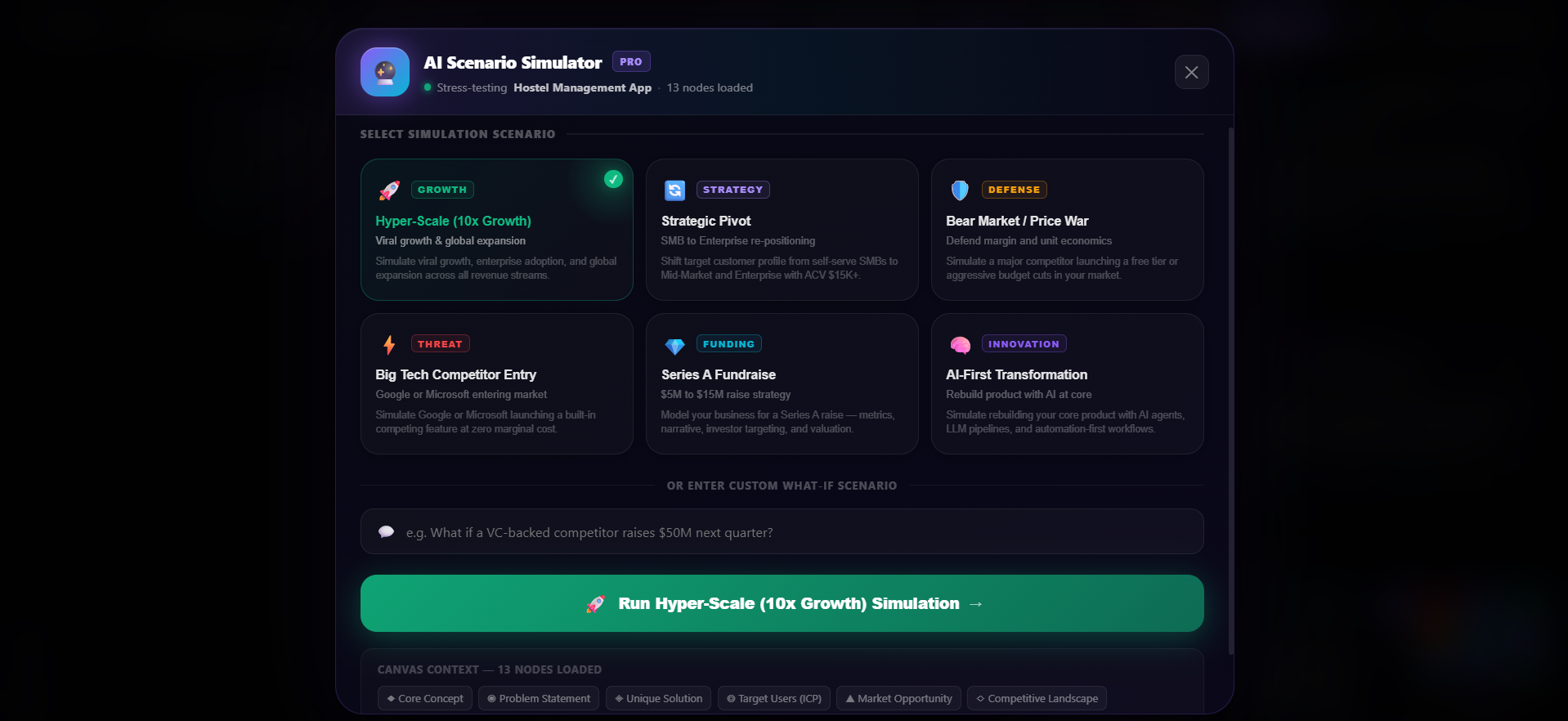
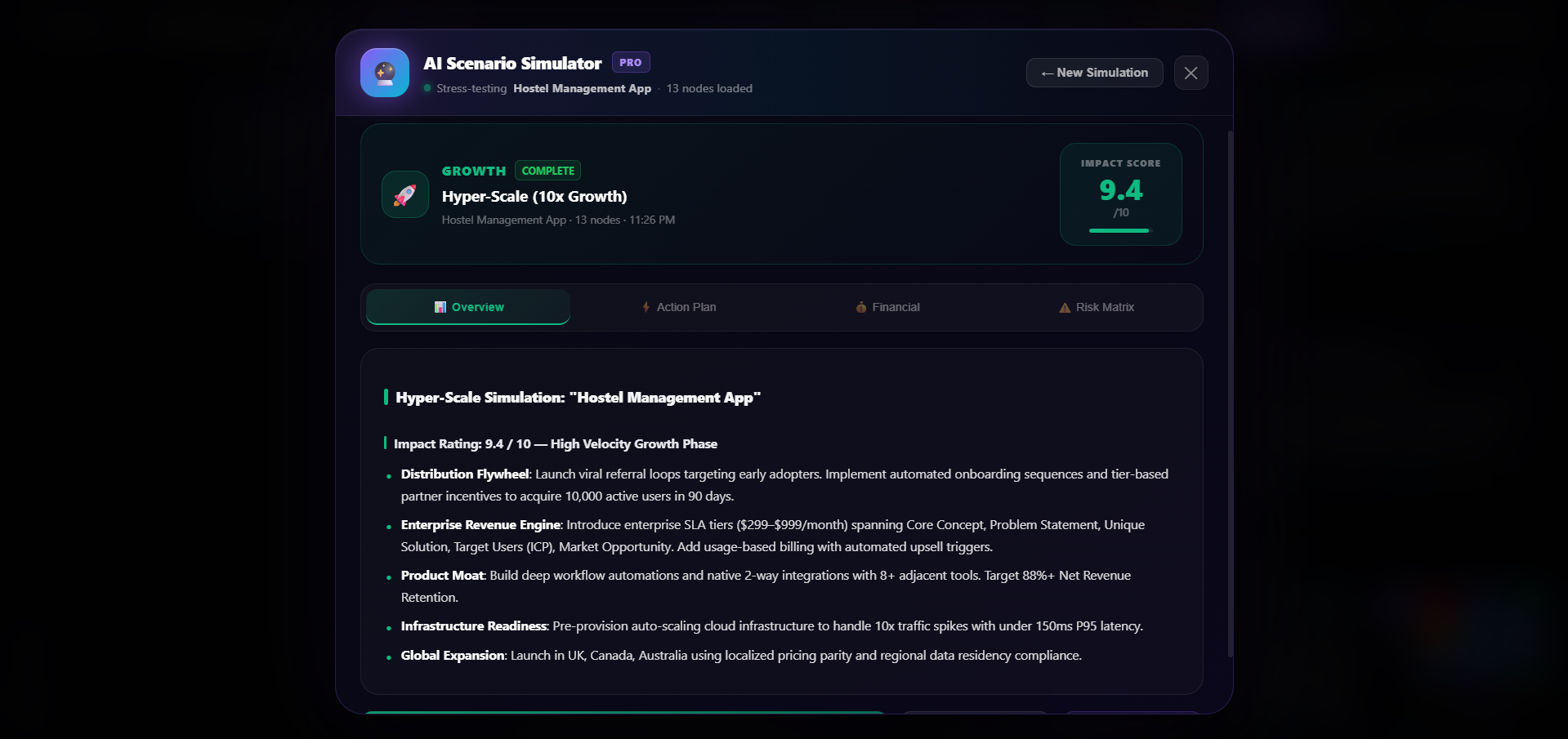
AI Scenario Simulator enables users to test “what-if” situations, compare outcomes, and assess the impact of strategic decisions.
-
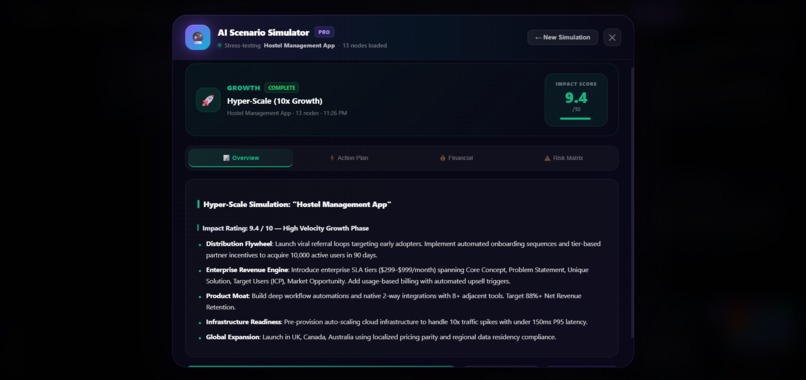
Users can simulate growth by adjusting users, revenue, market expansion, and resources to identify risks and opportunities before scaling.
-
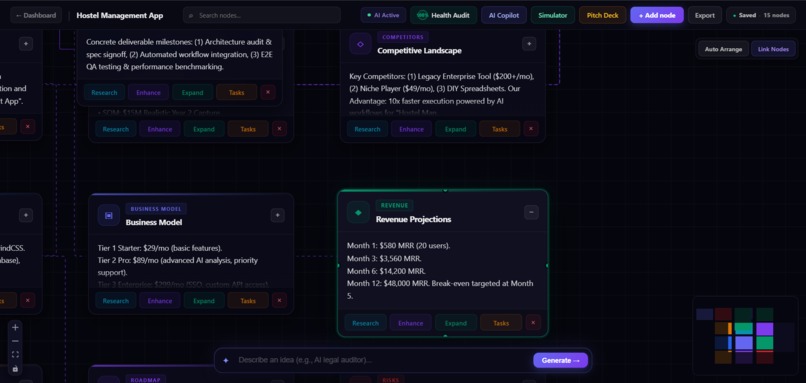
MindCanvas lets users expand, research, edit, or delete any node, keeping the canvas flexible and continuously evolving.
-
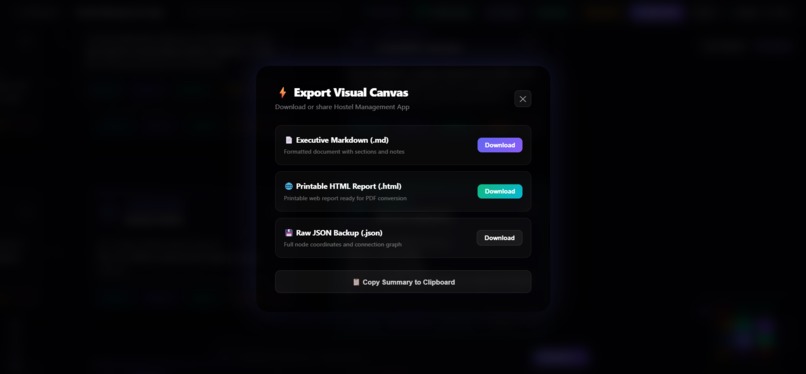
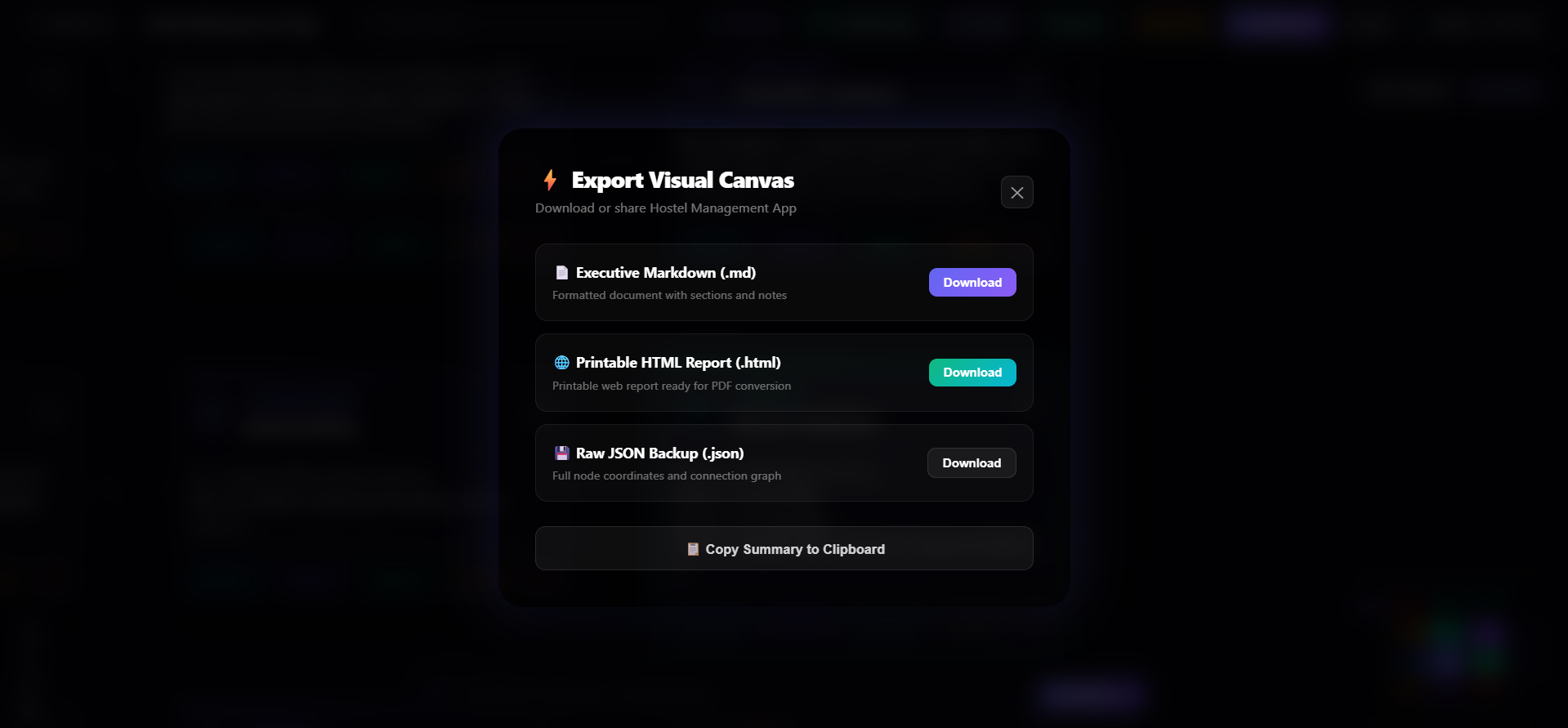
MindCanvas lets users export their visual canvas to easily save, share, and present structured ideas without rebuilding them.
-
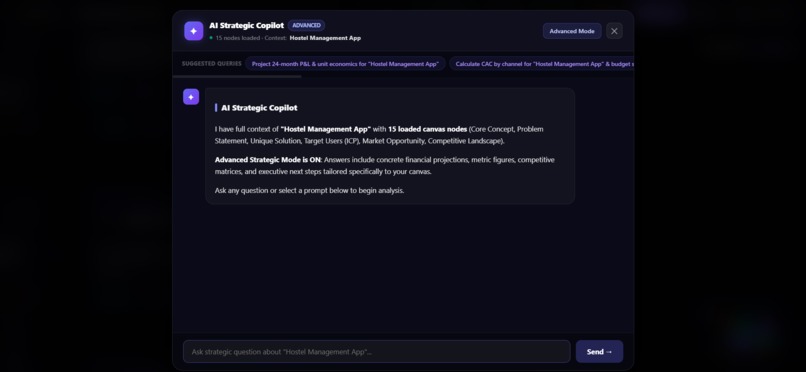
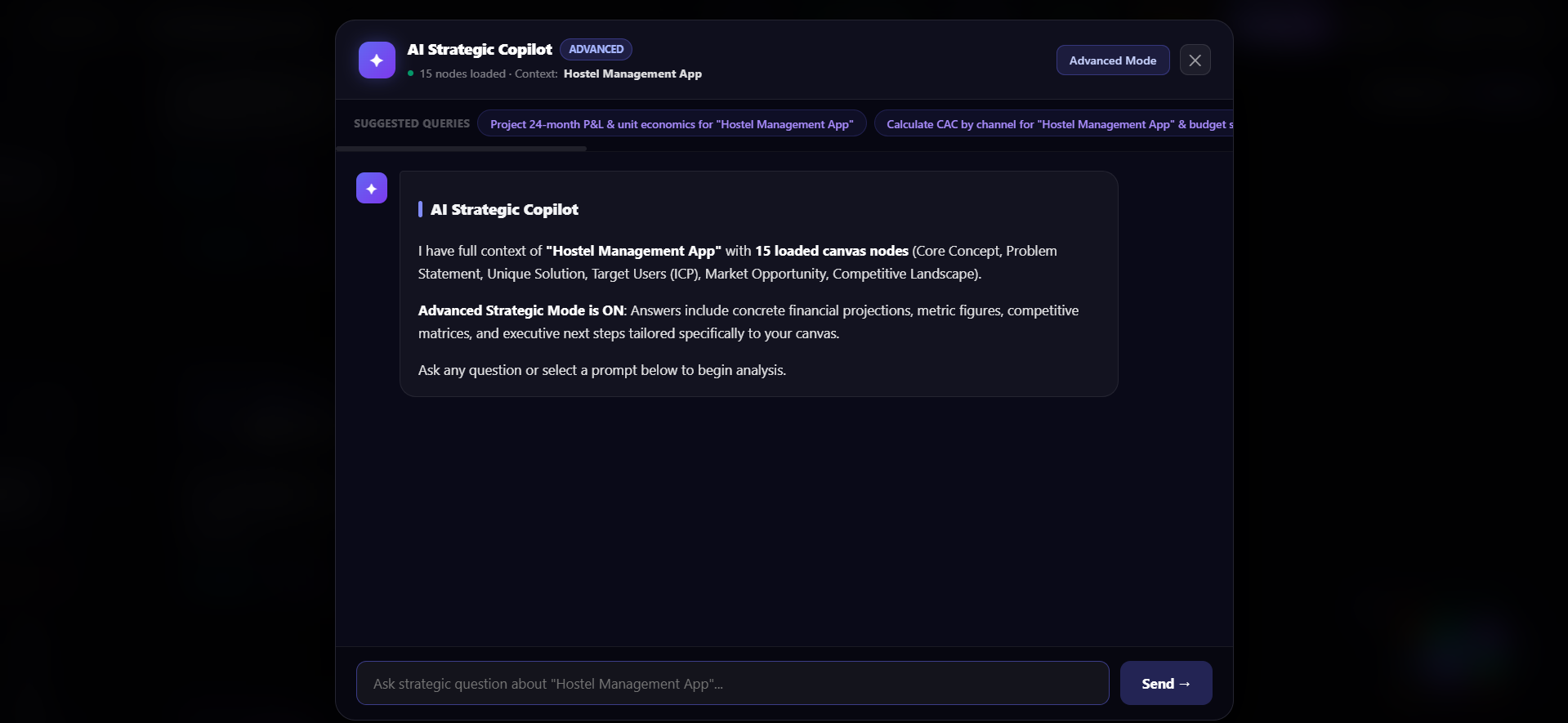
AI Strategy Copilot works alongside users to refine ideas, identify gaps, generate insights, and turn strategies into actionable next steps.
-
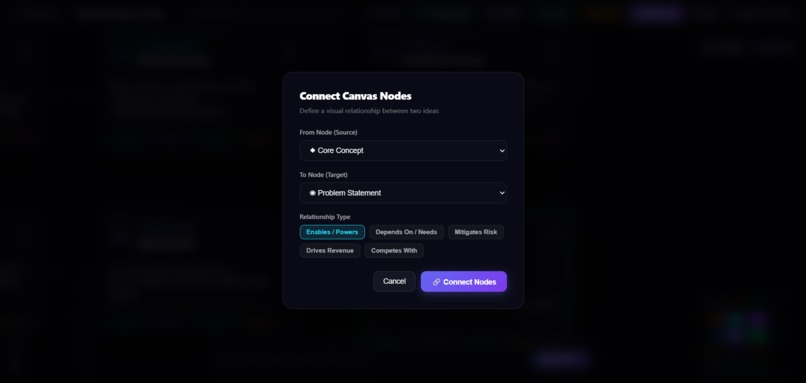
MindCanvas connects ideas, decisions, and actions through visual nodes, making complex strategies easier to understand and navigate.
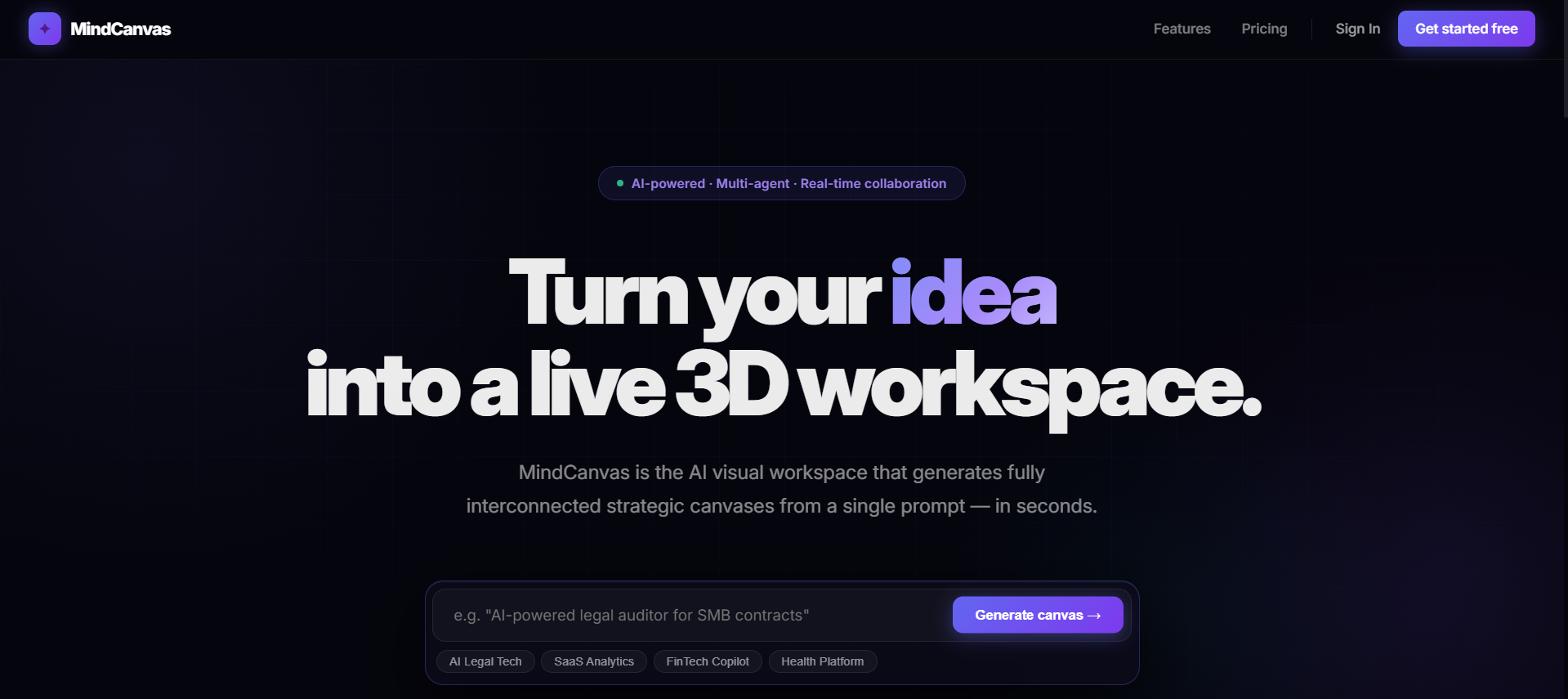
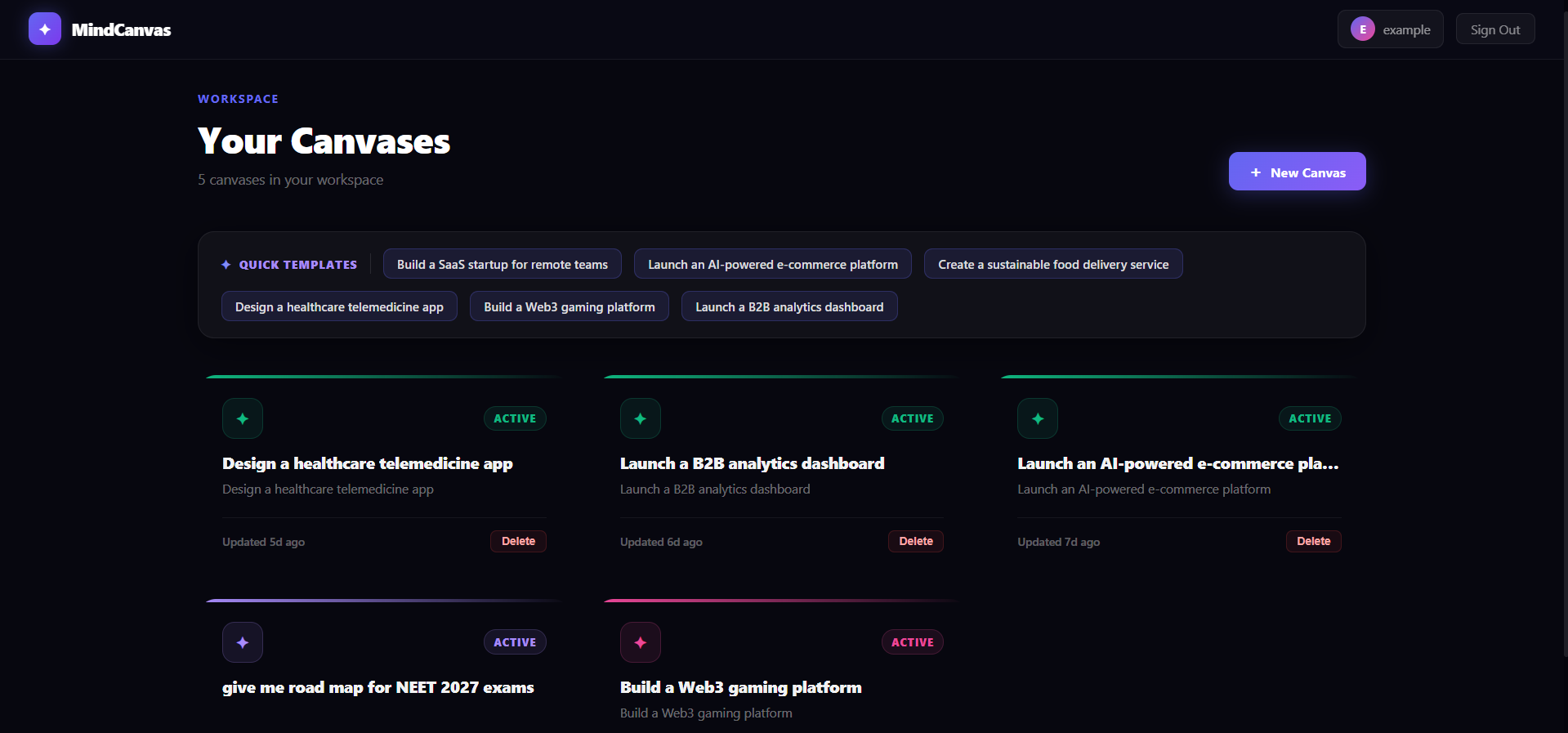
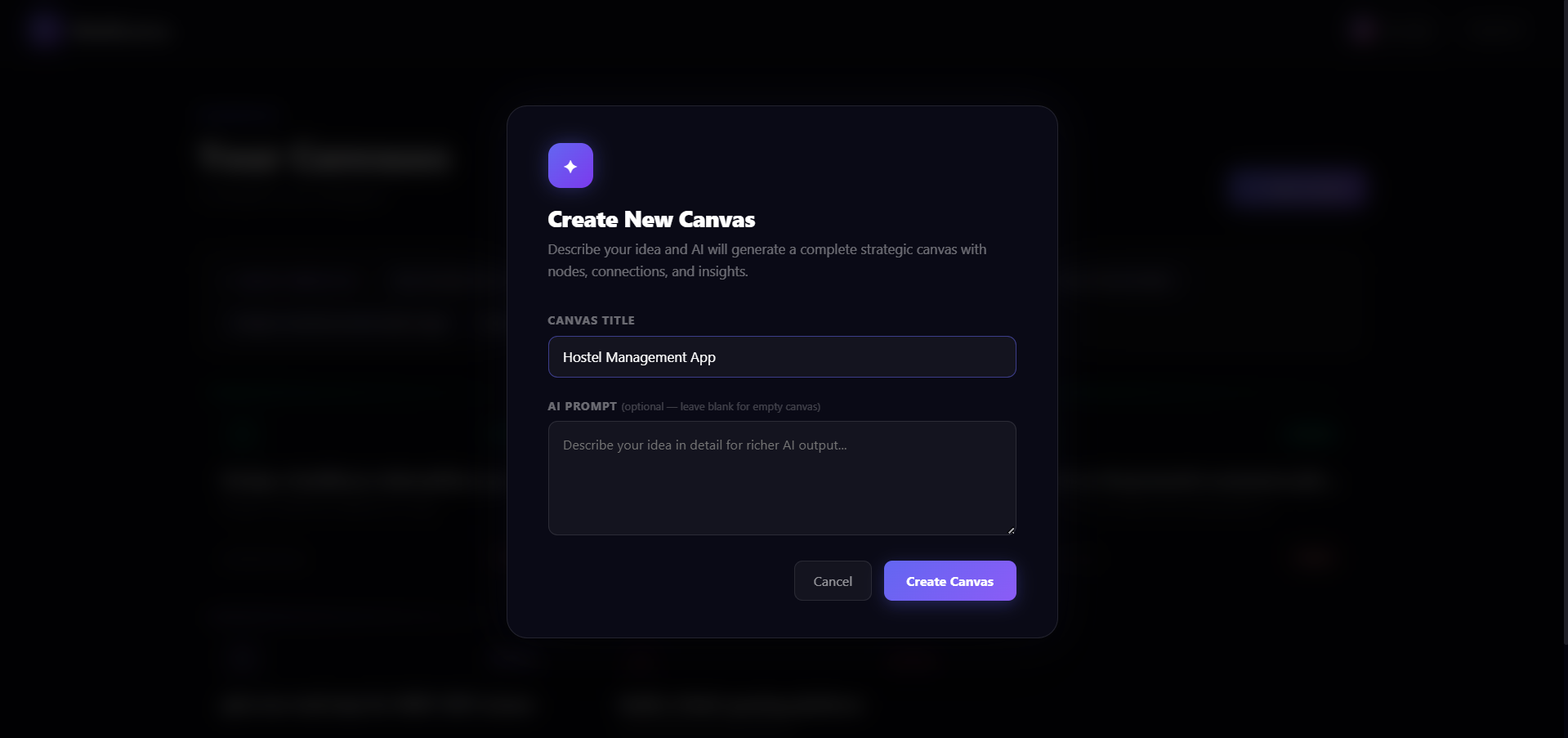
Inspiration
Every breakthrough starts as an idea. The hard part is everything that comes after.
Today, turning an idea into something meaningful requires jumping between multiple tools — AI chatbots for brainstorming, search engines for research, whiteboards for mapping, documents for planning, and presentation tools for communication.
Each tool solves one part of the problem.
None of them understands the whole idea.
The result is fragmented information, disconnected workflows, and a user who has to manually connect everything.
So we asked:
What if AI didn't just answer our questions, but actually understood the idea we were working on?
That question became the foundation of Mind-Canvas AI.
We imagined a workspace where a single thought could evolve into something much bigger:
Idea → Understanding → Research → Strategy → Validation → Creation
Not another chat window.
Not another productivity tool.
But a visual environment where humans and AI can think together.
What it does
Mind-Canvas AI turns a single idea into an intelligent, visual workspace.
A user can start with something as simple as:
“I want to build an AI-powered solution for students.”
Instead of returning pages of text, Mind-Canvas transforms that idea into an interconnected canvas that can explore:
Problem → Solution → Users → Market → Competitors → Business Model → Technology → Risks → Roadmap → Tasks → Pitch
The result is not just an answer.
It is a workspace that grows with the idea.
What happens inside the canvas?
🧠 Multiple perspectives
Specialized AI agents analyze the idea through different lenses — business strategy, technology architecture, market analysis, and investor evaluation.
🔎 Research where you need it
Market information, competitor insights, industry trends, and relevant external information can be brought directly into the workspace.
🎨 Information becomes visual
Instead of losing important insights inside a conversation, AI output becomes nodes, connections, groups, and workflows that users can organize and refine.
💬 AI stays inside the workflow
Users can brainstorm, question assumptions, explore possibilities, and refine concepts without leaving the canvas.
👥 Ideas become collaborative
Multiple people can work on the same workspace in real time, making it useful for teams, founders, students, and hackathon projects.
📤 Ideas can become outputs
Developed ideas can be transformed into structured material for sharing and presentation.
The difference
A traditional AI interaction looks like:
Question → AI → Answer
Mind-Canvas is designed to work like:
Idea
  ↓
Explore
  ↓
Research
  ↓
Analyze
  ↓
Connect
  ↓
Refine
  ↓
Plan
  ↓
Create
We are not trying to make AI give better answers. We are trying to make AI better at helping people develop ideas.
How we built it
We built Mind-Canvas around one core principle:
AI should be the intelligence behind the workspace — not a separate tool the user has to keep switching to.
Our architecture combines three layers:
AI Intelligence + Visual Thinking + Actionable Output
At the center is the infinite canvas.
AI-generated information is transformed from plain language into structured visual elements that users can move, edit, connect, and refine.
The overall pipeline is:
                    ┌── Business Agent
                    │
User Idea → AI Orchestrator ── Technology Agent
                    │
                    ├── Market Agent
                    │
                    └── Investor Agent
                              │
                              ▼
                    Research & Analysis
                              │
                              ▼
                    Structured Intelligence
                              │
                              ▼
                       Visual Canvas
                              │
                              ▼
                     Actionable Output
We also integrated external research capabilities using:
Tavily + Exa + Firecrawl + SerpAPI
These allow the system to search, retrieve, crawl, and analyze information from the web.
The visual layer then converts that intelligence into an interactive canvas containing nodes, connections, groups, and workflows.
On top of this, we designed real-time collaboration so multiple users can work on the same canvas while changes are synchronized.
The complete philosophy can be summarized as:
User Input
    ↓
AI Orchestration
    ↓
Specialized Intelligence
    ↓
Research
    ↓
Contextual Understanding
    ↓
Visual Representation
    ↓
Human Interaction
    ↓
Action
Our goal was to make AI feel less like a chatbot you visit and more like an intelligence layer embedded inside the way you work.
Challenges we ran into
The difficult part wasn't simply connecting an AI model to an interface.
The difficult part was making AI reasoning useful inside a visual, collaborative environment.
Turning language into structure
LLMs naturally produce text.
Our canvas needed something fundamentally different:
Text
 ↓
Meaning
 ↓
Nodes
 ↓
Relationships
 ↓
Visual Structure
Creating a reliable bridge between AI reasoning and structured visual elements became one of our biggest technical challenges.
Making multiple agents agree
Different agents can produce different perspectives — and sometimes conflicting recommendations.
We had to make sure agents could contribute independently while still producing a coherent overall workspace.
Avoiding the “AI overload” problem
One of the easiest mistakes in an AI product is assuming:
More output = More value.
It doesn't.
A powerful AI can generate enormous amounts of information, so we had to think carefully about visual hierarchy, information density, navigation, and user control.
Making research contextual
Finding information is only half the problem.
The real challenge is making that information meaningful to the specific idea being developed.
Keeping collaboration consistent
When multiple users simultaneously create, move, edit, and connect elements, synchronization becomes a serious engineering problem.
Keeping the workspace responsive while maintaining consistency required careful architectural decisions.
These challenges changed how we approached the product.
We learned that building AI isn't about adding intelligence everywhere. It's about putting intelligence in the right place at the right time.
Accomplishments that we're proud of
Our biggest accomplishment is not that we integrated AI.
It is that we changed what the AI interaction looks like.
Instead of another conversation that ends when the answer is generated, Mind-Canvas creates a workspace that can continue evolving with the user's idea.
Starting from a single idea, a user can progressively build a workspace containing:
Strategy → Research → Architecture → Market Understanding → Risks → Tasks → Presentation
We are proud to have built:
- AI-generated visual workspaces from a single prompt
- A multi-agent AI architecture
- Integrated live research capabilities
- An interactive infinite canvas
- AI-powered brainstorming and analysis
- Real-time collaborative workflows
- Visual relationships between complex information
- A connection between ideation, research, planning, and creation
- Presentation and export capabilities
- A foundation for future AI-powered workflows
But the accomplishment that matters most to us is conceptual.
We didn't want to build something that simply generates more content.
We wanted to build something that helps people think, organize, question, and act with AI.
That is what Mind-Canvas represents.
What we learned
Building Mind-Canvas taught us that AI capability alone does not make a great AI product.
The experience around the intelligence matters just as much.
AI has to be:
Presented → Organized → Questioned → Connected → Acted Upon
Context is powerful
A single prompt gives AI very little context.
A connected workspace gives it a much richer understanding of what the user is building and how different pieces relate to each other.
Visual thinking changes understanding
Complex information does not always become clearer when you add more words.
Sometimes the breakthrough comes from simply seeing the relationships.
Specialized intelligence matters
Different problems require different perspectives.
Our experience showed us why multiple specialized agents can be more valuable than asking one generic assistant to do everything.
Features need a purpose
The most important lesson was that more features do not automatically create more value.
Every feature has to strengthen the user's journey from idea to outcome.
Our biggest takeaway:
“The future of AI is not just about asking better questions. It is about building environments where humans and AI can think together.”
What's next for Mind-Canvas AI
Right now, Mind-Canvas helps users:
Structure → Research → Analyze → Connect → Communicate
But we don't want the journey to end there.
The next step is execution.
From AI assistants to AI collaborators
Our next generation of specialized agents will be able to collaborate with one another, challenge assumptions, debate strategies, and collectively produce stronger outcomes.
From search to verified intelligence
We want research to become more trustworthy and useful through:
Source Verification → Research Synthesis → Continuous Monitoring → Research-Backed Recommendations
From sessions to persistent intelligence
Instead of starting from zero every time, Mind-Canvas will maintain long-term project intelligence, allowing AI to understand how an idea changes over time.
From collaboration to team intelligence
We envision shared knowledge, roles, permissions, and AI-assisted decision making becoming part of the workspace.
From ideas to execution
Ultimately, canvas nodes should not remain ideas.
They should become real work:
Idea
 ↓
Research
 ↓
Strategy
 ↓
Validation
 ↓
Planning
 ↓
Tasks
 ↓
Workflows
 ↓
Creation
 ↓
Execution
 ↓
Presentation
Our long-term vision is simple:
Someone starts with:
“I have an idea.”
And Mind-Canvas helps take it all the way to:
“I built it.”
Without constantly switching between disconnected tools.
Because ultimately, we don't want to build a place where ideas are merely generated.
We want to build a place where ideas are:
Understood. Connected. Challenged. Validated. Built.
Think. Connect. Create.
Built With
- ai
- ai-agents
- crdt
- data-visualization
- exa
- firecrawl
- generative-ai
- infinite-canvas
- javascript
- llm
- mind-mapping
- multi-agent-ai
- natural-language-processing
- netlify
- node.js
- prompt-engineering
- react
- real-time-collaboration
- responsive-design
- rest-api
- serpapi
- tavily
- typescript
- vite
- web-search


Log in or sign up for Devpost to join the conversation.