Inspiration
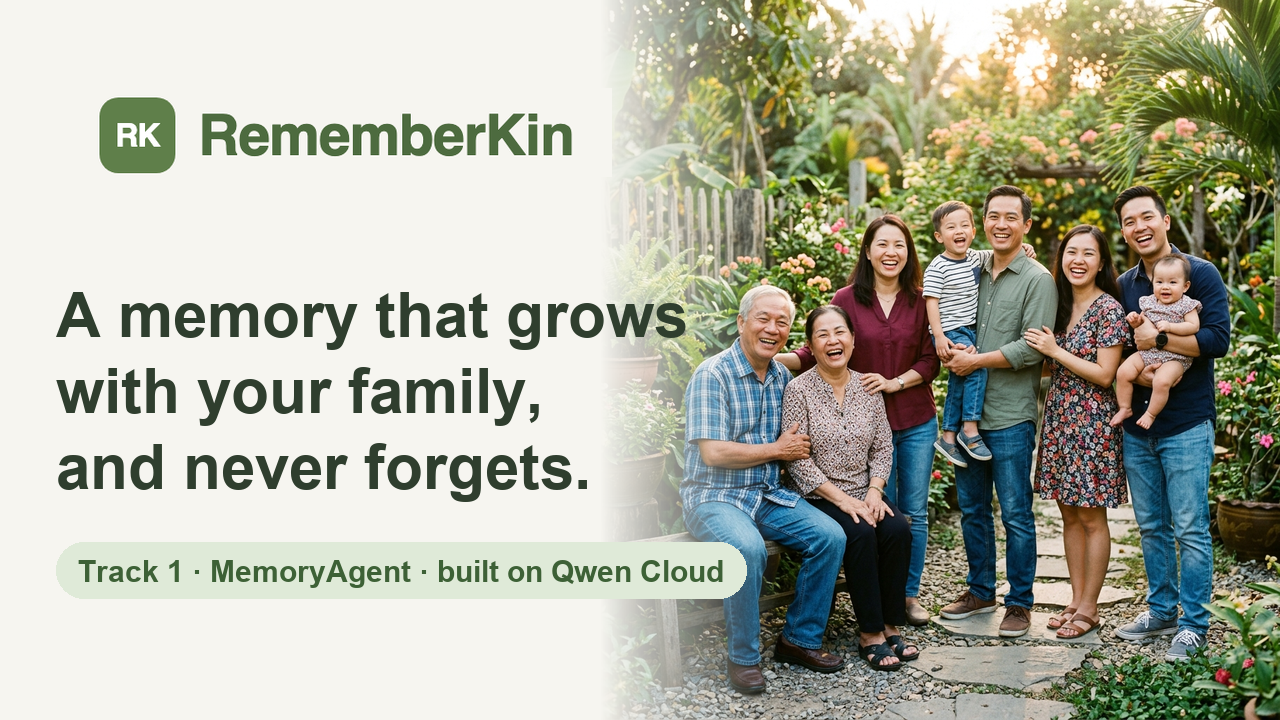
Every family slowly loses its stories. A grandmother's pho recipe, the exact date of a birthday, the afternoon two cousins got lost in the Old Quarter of Hanoi. These details live in people's heads, and when memory fades or someone passes, they're gone. Group chats scroll away, photo albums gather dust, and no tool actually remembers on the family's behalf. We wanted to build an agent that does, one you can simply talk to, that keeps a family's memory alive across generations.
What it does
RememberKin is a family memory agent built entirely on Qwen. You tell it something once, in plain language, a birthday, a recipe, a story, and it extracts the fact, scores how important it is, and consolidates it from short-term into long-term memory. Later, anyone in the family can ask and get a personal answer, even in a completely different session. Log in as a different family member and ask "When is my mother's birthday?" and it still recalls it, fusing profiles, events, and stored memories into one reply. It remembers pictures too: ask where someone went and the real, family-tagged photo appears right in the conversation. Under the hood it runs a 4-layer cognitive memory system (Working, Episodic, Semantic, Procedural), an interactive family tree, AI-generated portraits, and a self-evaluation harness that grades its own accuracy.
How we built it
The frontend is React, TypeScript, and Vite, with a Zustand and TanStack Query state split and a ReactFlow family tree. The backend is Node.js and Express. All AI runs on Qwen Cloud (Model Studio / DashScope): qwen-plus for chat and reasoning, qwen-turbo for extraction, text-embedding-v3 for embeddings, and qwen-image for portraits. Memory is a hybrid store: a Neo4j graph holds the family tree, episodes, and semantic facts, while Qdrant handles vector similarity so we retrieve only the most relevant memories per turn. A node-cron scheduler runs consolidation and reminders. We also ship an MCP server that exposes the memory as tools to any MCP client, a live spend cap that meters every Qwen call, and a simulation harness that runs automated family conversations and scores the agent.
Challenges we ran into
The hardest part was memory that behaves like memory, not a database dump. Deciding what to promote from working to long-term memory, how to reinforce facts mentioned more than once, and how to let stale facts decay took real tuning. Keeping recall accurate within a limited context window meant building a selector that injects only the top-relevant facts per turn instead of stuffing history into the prompt. Cross-session, cross-member recall (the same fact taught by one relative, recalled by another) required carefully fusing graph relationships with vector search. We also engineered a hard spend cap and rate limiting so the app is safe for public judging.
Accomplishments that we're proud of
The whole loop works, live: tell it a fact, watch it move from Working to Semantic memory on the dashboard, log out, come back as a different family member, and it recalls it. That's the literal definition of the MemoryAgent track, shown working rather than claimed. Our self-evaluation harness scored a perfect 100 on memory recall, context relevance, entity extraction, and emotional tone. And it's all genuinely powered end-to-end by Qwen, with photos, a family tree, and an MCP integration on top, built entirely during the hackathon.
What we learned
We learned how much of "agent memory" is really about forgetting and prioritization, not just storage. Confidence scoring, decay, and reinforcement matter more than raw capacity. We got hands-on with Qwen's model lineup and learned to route each task to the right model (qwen-turbo for cheap extraction, qwen-plus for reasoning) to keep quality high and cost near zero. Combining a graph database with vector search taught us that neither alone is enough: the graph gives structure and relationships, the vectors give fuzzy semantic recall, and together they make answers feel personal.
What's next for RememberKin
Next, we want voice input so grandparents can just talk to it, a mobile app, and richer proactive reminders ("it's Grandma Hoa's birthday next week, here's her pho recipe"). We'd deepen the procedural layer so it learns household routines and suggests who to call. Longer term, real families onboarding their own photos and stories, shared multi-family trees, and stronger privacy controls so each member controls exactly what's remembered and shared.
Built With
- alibaba-cloud
- dashscope
- docker
- express.js
- javascript
- jwt
- mcp
- model-studio
- neo4j
- node.js
- qdrant
- qwen
- qwen-cloud
- react
- reactflow
- serverless-devs
- tailwindcss
- tanstack-query
- typescript
- vite
- websocket
- zustand


Log in or sign up for Devpost to join the conversation.