-
-
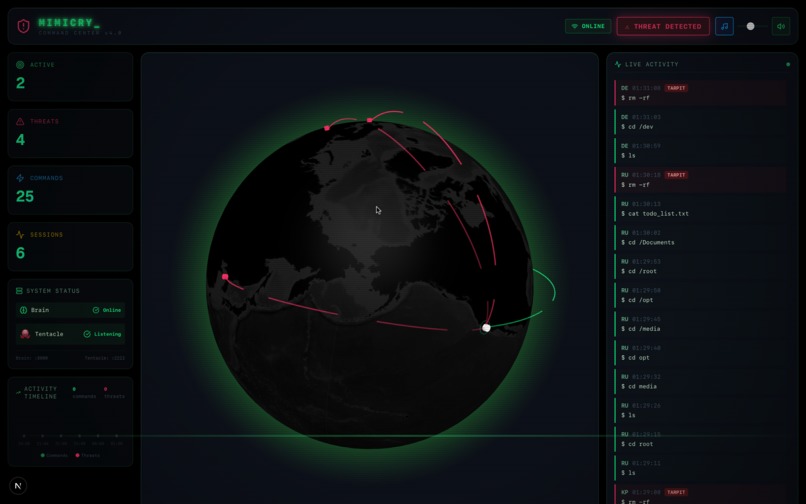
Dashboard
-
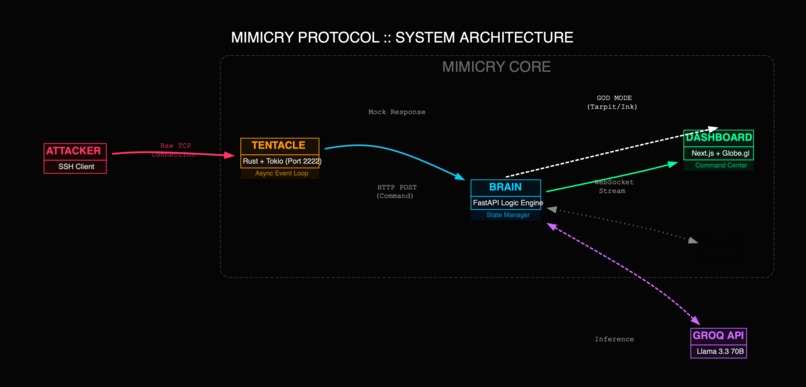
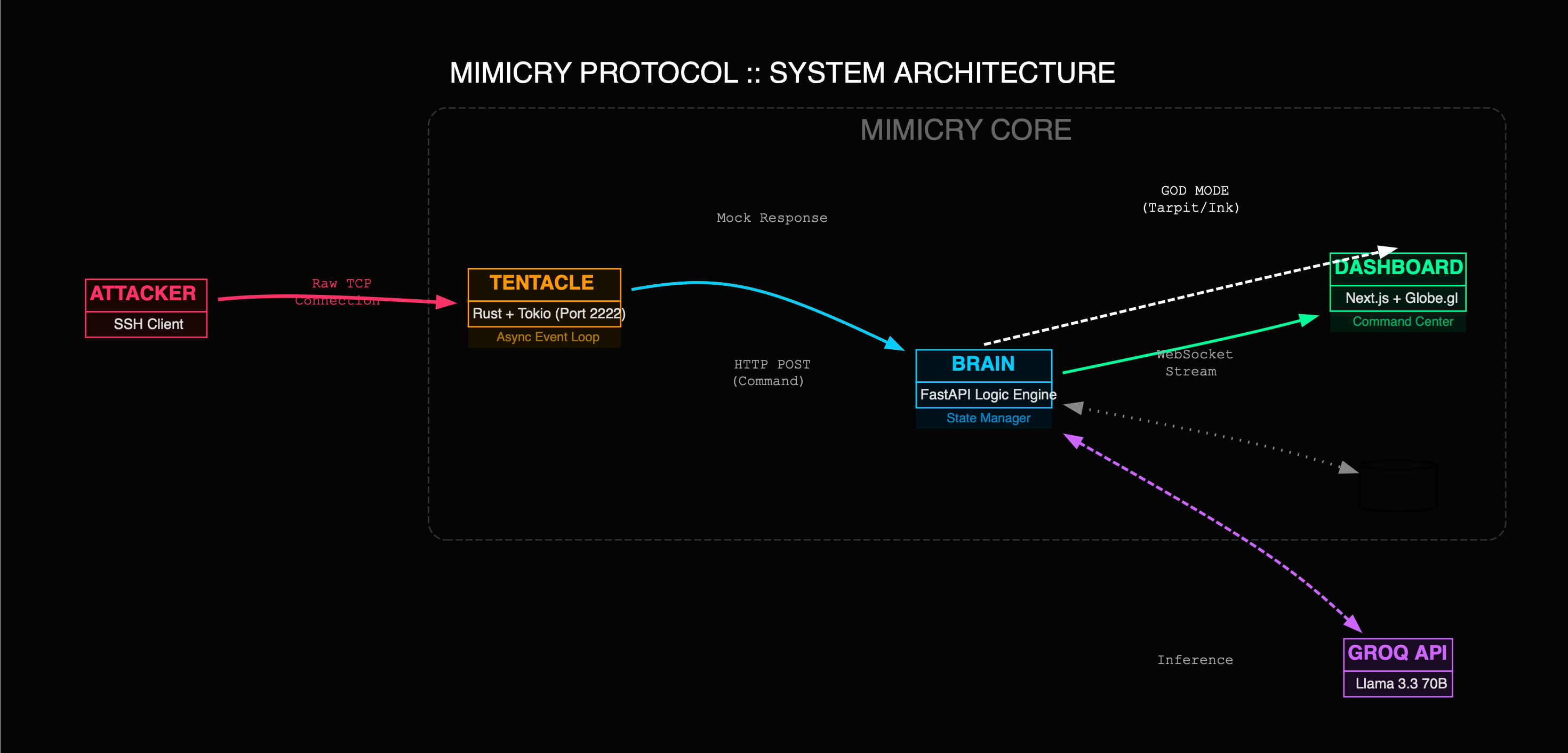
The Architecture
-
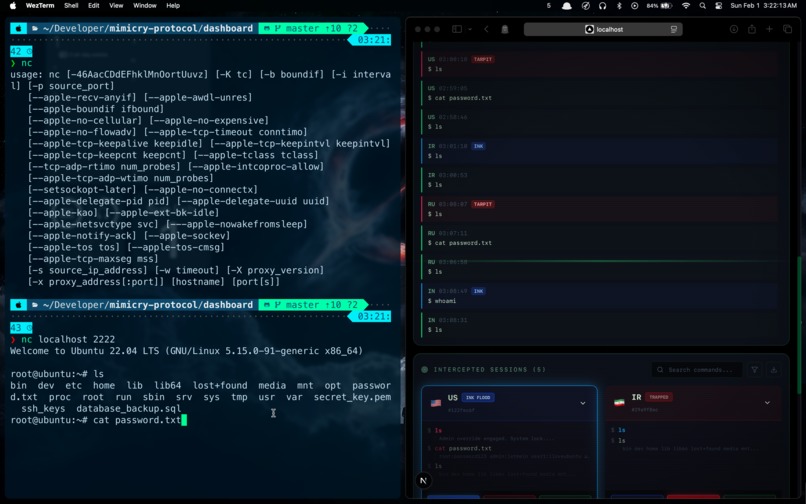
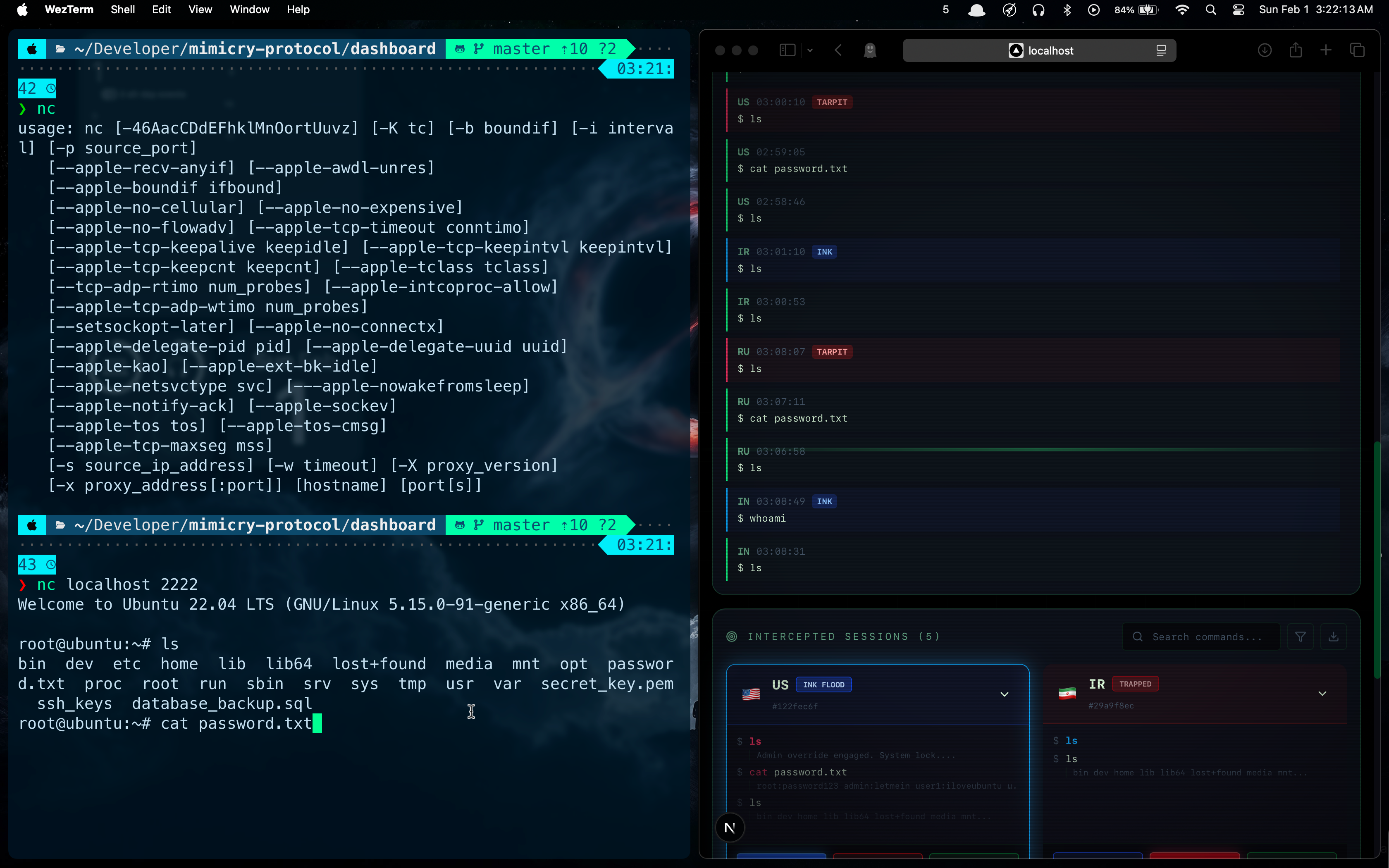
Attacker Terminal Vs Dashboard logs
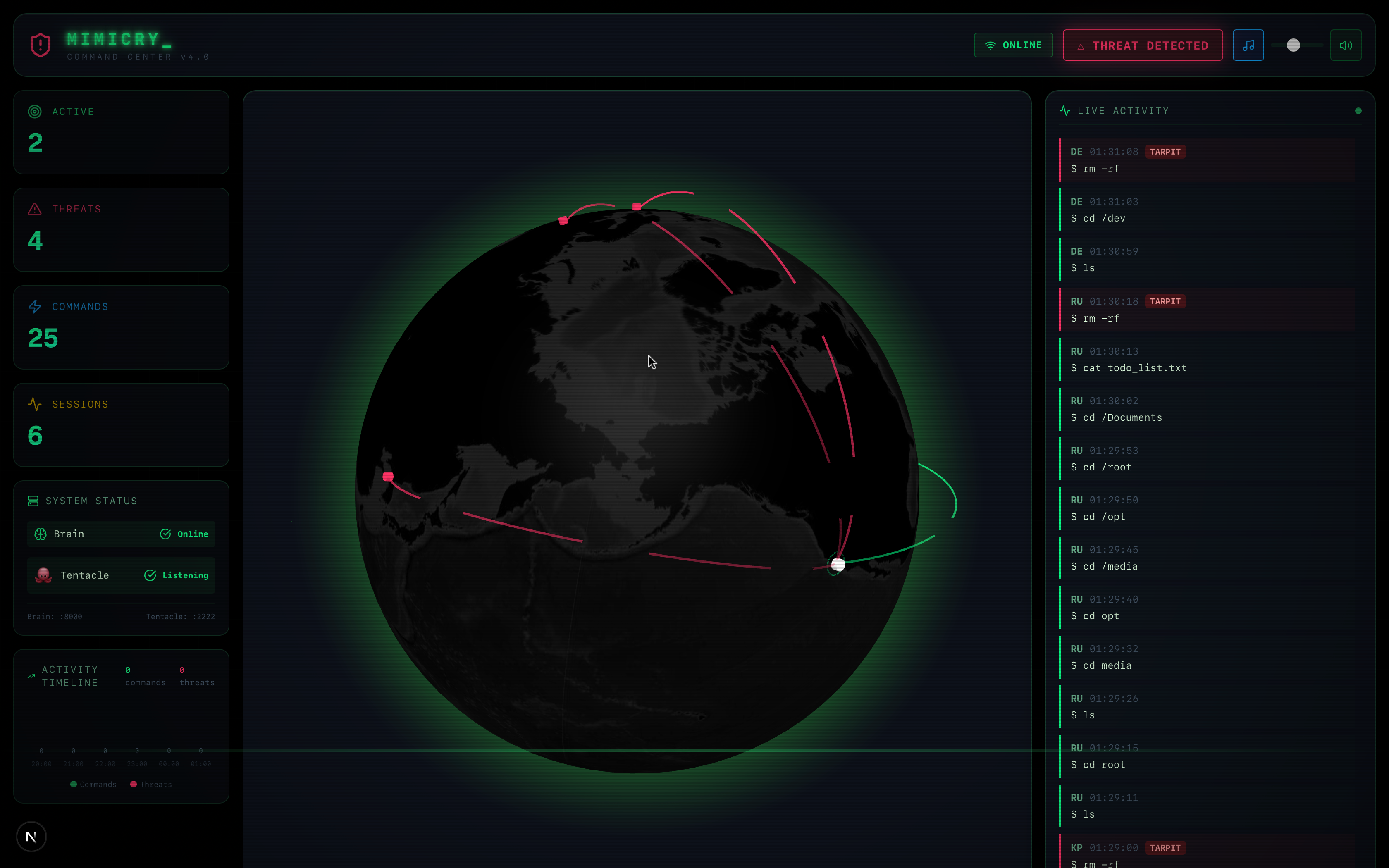
Mimicry Protocol: AI-Powered Deception System
Turning the tables on attackers with intelligent, real-time honeypots.
Inspiration
Traditional honeypots are static and easily detectable. Attackers quickly identify scripted responses and move on. The core question driving this project was: What if a honeypot could think?
The rise of large language models provided the answer. I envisioned a system that could hold convincing conversations with attackers, waste their time with believable fake data, and give defenders a ringside seat to watch hackers operate in real-time — all while gathering valuable threat intelligence.
Mimicry Protocol is the result: an AI-powered deception system that transforms the defensive landscape.
What It Does
Mimicry Protocol is a full-stack honeypot system comprising three core components:
- Tentacle (The Collector): A Rust-based SSH server that accepts connections on port
2222, capturing every keystroke and command in a high-performance async environment. - Brain (The Logic): A Python backend powered by Groq's Llama 3.3 70B model. It generates realistic terminal responses. When a hacker types
ls -la, they see convincing fake files likepassword.txtanddb_credentials.txt. - Dashboard (The Command Center): A cyberpunk-styled React interface featuring:
- Real-time 3D Globe: Visualizes attack origins globally.
- Live Activity Feed: Real-time command logging and session tracking.
- "God Mode" Controls: Operators can TARPIT (slow down latency) or INK (flood the session with fake data) to confuse the attacker.
- Session Analytics: Comprehensive data export and behavioral analysis.
How I Built It
Technical Stack
| Layer | Technologies |
|---|---|
| Frontend | Next.js 16, React 19, Framer Motion, react-globe.gl |
| Backend | FastAPI, WebSockets, SQLite |
| AI Engine | Groq API (Llama 3.3 70B) |
| Honeypot | Rust, Tokio (Async SSH) |
| Audio | Web Audio API (Procedural Synthesis) |
- Custom UI: I designed the interface with a glassmorphism and neon aesthetic using a custom CSS design system to enhance the "War Room" experience.
- Procedural Sound: I avoided static audio files entirely, instead using oscillators to generate sci-fi pings and alarms dynamically via the Web Audio API.
Challenges I Faced
- Latency vs. Realism: Initially, local LLMs (Ollama/Mistral) took 5–15 seconds to respond, breaking the "immersion." Migrating to Groq slashed response times to under 1 second, maintaining the illusion of a real shell.
- State Management: Real-time dashboards require robust WebSocket reconnection logic. I implemented exponential backoff to handle backend restarts gracefully without losing session data.
- Responsive 3D Assets: Getting the 3D globe to resize properly across different screen sizes required complex container management and event listeners.
- Browser Autoplay Policies: To comply with modern security standards, I built a dedicated user-interaction toggle system to enable the ambient procedural audio.
Accomplishments I'm Proud Of
- End-to-End Engineering: Built a complete deception system—from the low-level Rust server to the React frontend—within a single hackathon timeframe.
- Sub-Second Latency: Achieved AI response times fast enough to make the honeypot indistinguishable from a real Linux terminal.
- Active Defense Mechanisms: Developed "God Mode" controls that allow manual intervention, moving beyond passive logging to active adversary engagement.
- Zero-Dependency Audio: Engineered an immersive soundscape using pure code (Web Audio API) rather than external assets.
What I Learned
- Inference Speed is Critical: Groq’s speed makes real-time AI agents genuinely viable for interactive security tools.
- Psychology of Deception: In honeypots, convincing fake data is significantly more effective than sheer volume.
- Resilient Architecture: I gained a deeper appreciation for careful state management in WebSocket-heavy applications to ensure production reliability.
What's Next for Mimicry Protocol
- Threat Intel Export: Automatic extraction of IOCs (Indicators of Compromise) into STIX/TAXII formats.
- Multi-tenancy: Support for deploying a fleet of honeypots across different networks from a single dashboard.
- Attack Pattern Recognition: Implementing ML clustering to identify attack campaigns and TTPs automatically.
- Playbook Automation: Configurable response rules (e.g., auto-TARPIT if specific sensitive files are accessed).


Log in or sign up for Devpost to join the conversation.