-
High Tech Login Security System
🔐 About the Project — BehaviorAuth
💡 Inspiration
Traditional authentication systems rely heavily on static credentials like passwords and OTPs.
However, if credentials are leaked or phished, these systems fail to identify who is actually using them.
This inspired us to explore behavioral biometrics — the idea that how a user behaves (typing rhythm, mouse movement) can act as an additional invisible security layer that is extremely hard to replicate.
BehaviorAuth was built to demonstrate how human behavior itself can become an authentication factor, improving security without adding friction for the user.
🛠️ How We Built It
BehaviorAuth is a full-stack authentication system that combines:
- Password authentication
- Email OTP verification
- Behavioral biometrics
- Device fingerprinting
Frontend
- Captures typing behavior using
keydownandkeyupevents - Captures mouse movement patterns inside input fields only
- Generates a device fingerprint using FingerprintJS
- Sends all data securely to the backend
Backend
- Stores behavioral profiles in MongoDB
- Compares login-time behavior with registration data
- Calculates similarity scores
- Makes authentication decisions based on trust level
🧠 Behavioral Similarity Logic
We analyze multiple behavioral features such as:
- Average typing speed
- Key hold duration
- Typing intervals
- Mouse movement speed
- Mouse path distance
Similarity is calculated using normalized difference:
[ Similarity = 100 - \left(\frac{|A - B|}{\max(A, B)} \times 100\right) ]
Where:
- (A) = stored behavioral metric
- (B) = current login metric
Typing and mouse similarity scores are combined, and authentication succeeds when:
[ \frac{TypingScore + MouseScore}{2} \geq 70\% ]
🔐 Adaptive Authentication Model
BehaviorAuth follows a risk-based access model:
| Verification Status | Access Level |
|---|---|
| Password + OTP + Biometrics | Full Access |
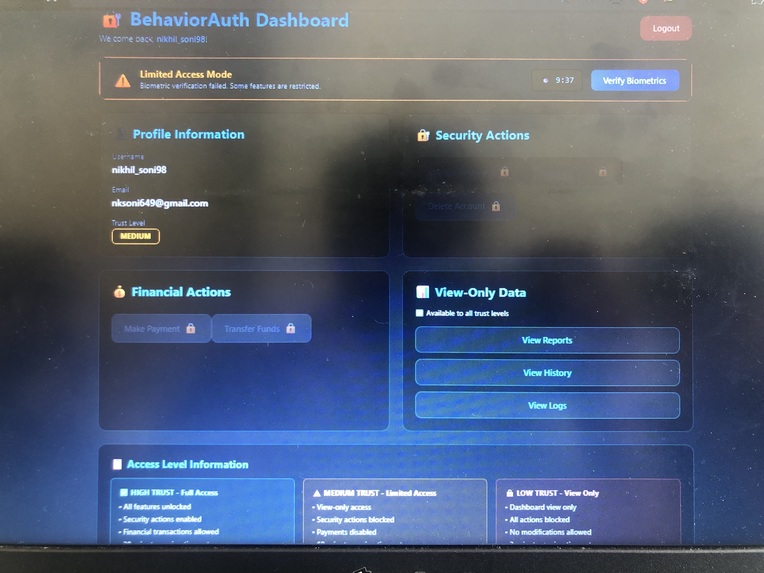
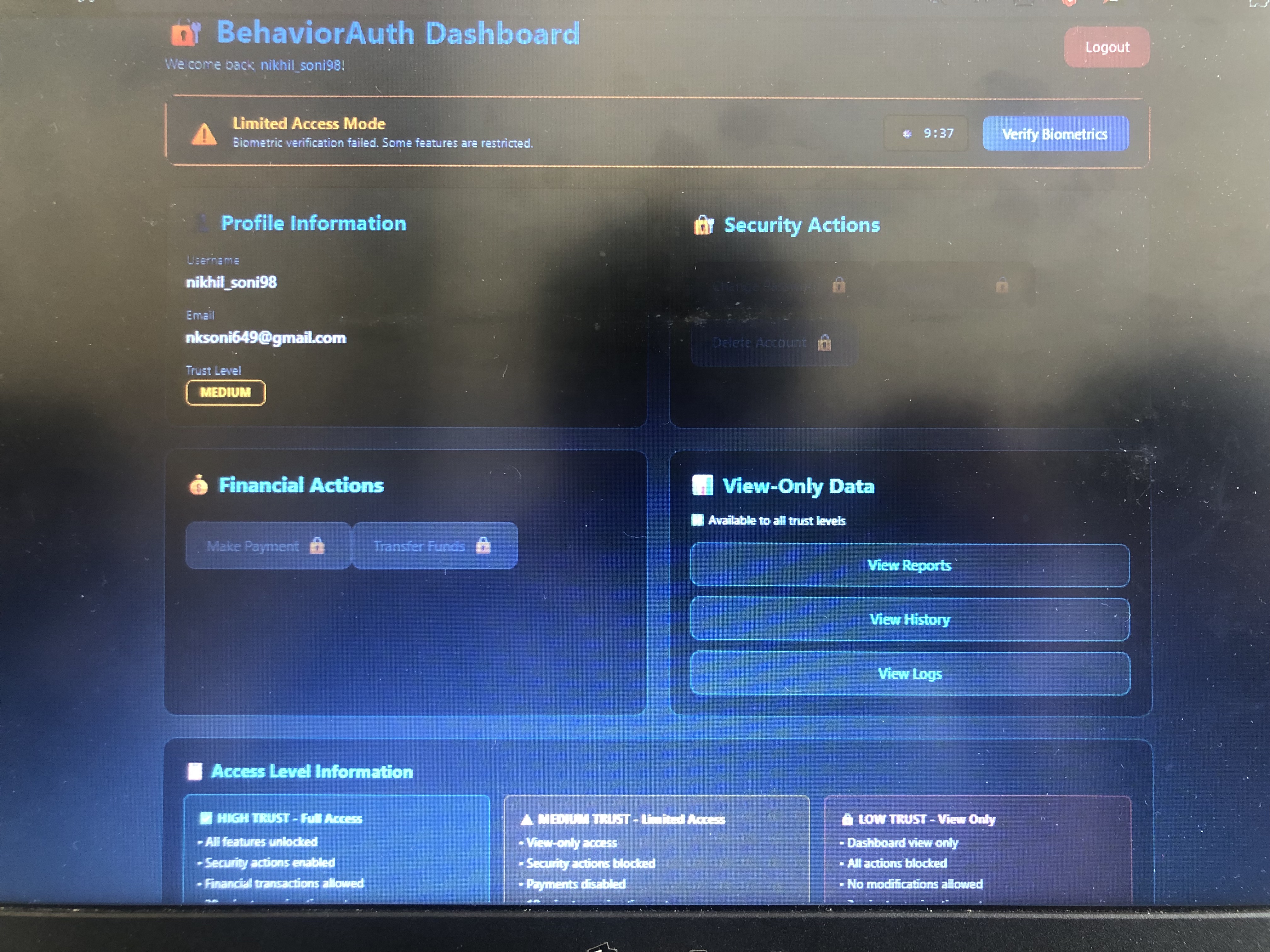
| Password + OTP (Biometric mismatch) | Limited Access |
| Invalid credentials | Access Denied |
This approach avoids false rejections while maintaining security.
📚 What We Learned
- Behavioral data can act as a powerful invisible security layer
- Authentication does not have to be binary — trust can be graded
- UX is critical in security systems to maintain user confidence
- Even simple statistical models can effectively detect anomalies
- Clean separation between frontend capture and backend verification improves reliability
🚧 Challenges We Faced
- Avoiding noisy mouse data from full-screen movement
- Ensuring biometric data resets on failed attempts
- Balancing security strictness with user convenience
- Handling OTP failures during demos (solved using demo OTP mode)
- Designing a UI that feels secure, not intimidating
🚀 Conclusion
BehaviorAuth shows that authentication can go beyond passwords by leveraging how users naturally interact with systems.
By combining traditional credentials with behavioral intelligence, we create a login system that is both secure and user-friendly — suitable for real-world applications like banking, enterprise security, and fraud prevention.
Built With
- atlas
- express.js
- mongodb
- node.js
- react.js
- tailwind.css


Log in or sign up for Devpost to join the conversation.