Inspiration
Most stream games ask chat to leave chat: open a site, enter a room code, install an extension. Yet every stream already has the perfect game material in plain sight: the way its regulars talk. Language models are now good enough to imitate a person's chat style, which turns that into a question a whole room wants to answer: which of these did your friend really say?
What it does
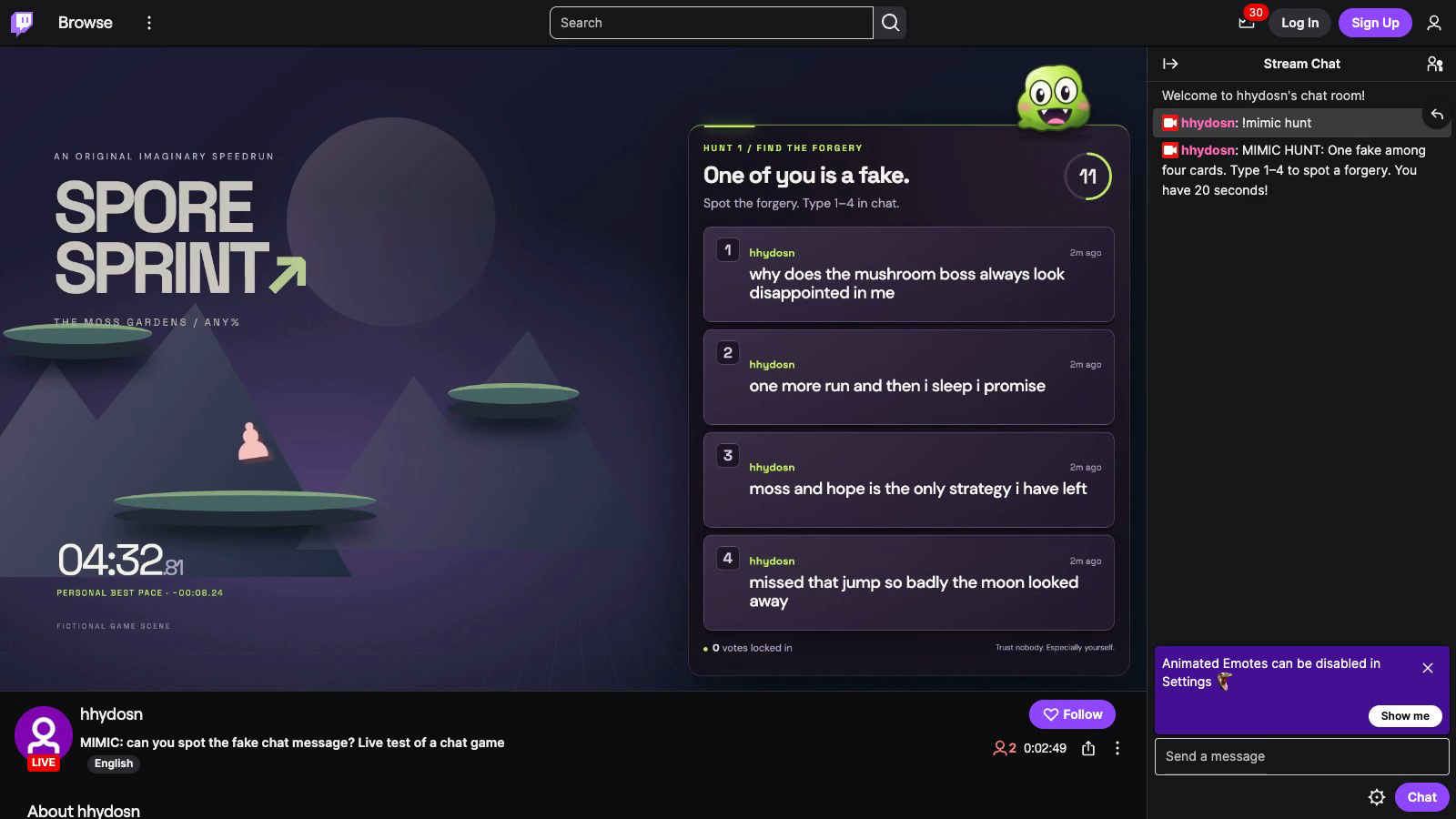
A small creature sits on the stream overlay and feeds on chat, learning how each regular talks. When it hunts, four messages appear on stream. Three are real things chatters said earlier. One is a forgery in a real chatter's voice. Chat has 20 seconds to type 1 to 4.
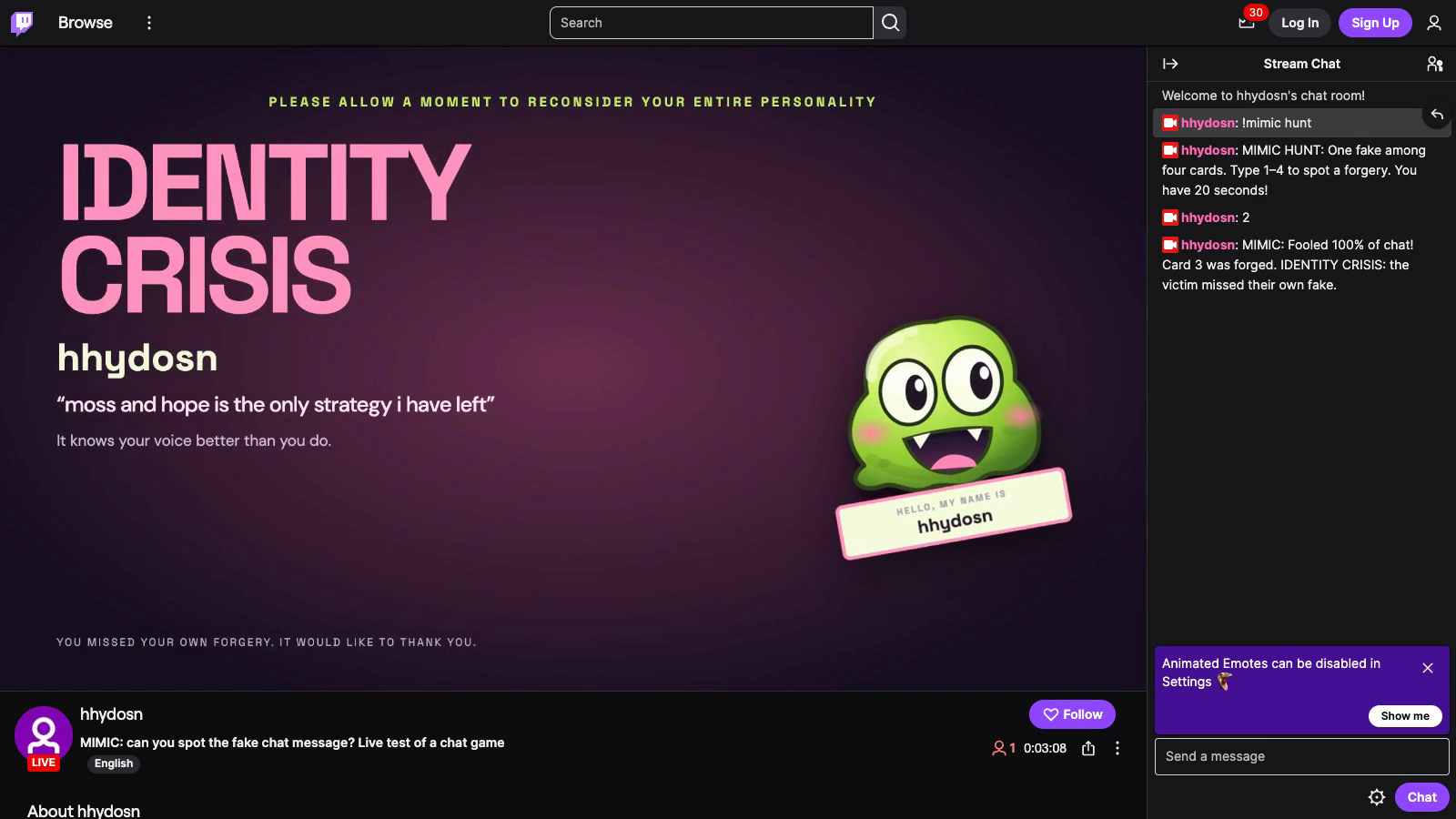
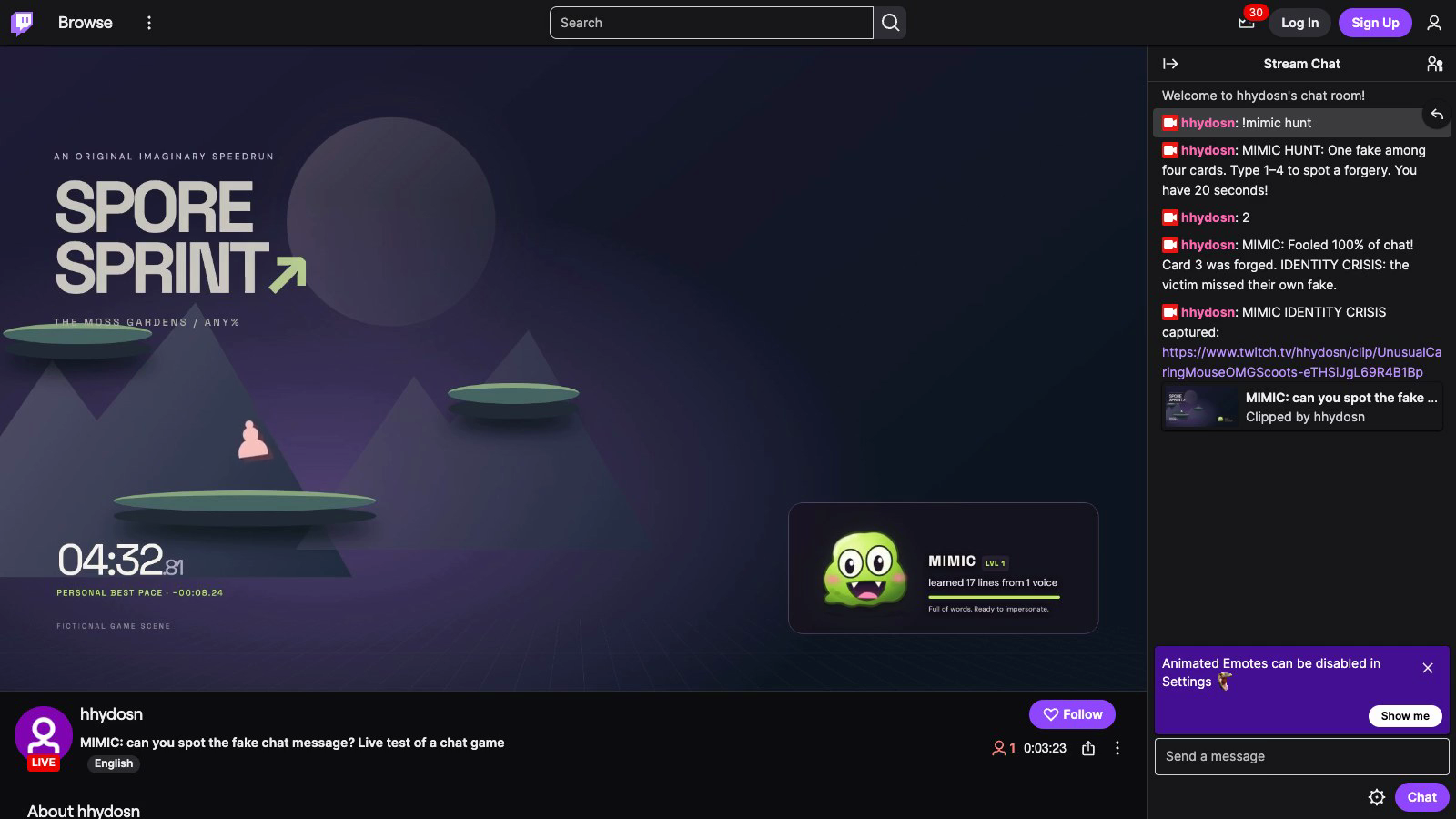
Then comes the reveal. The fake is torn open, the stream sees who was fooled, and a chatter who misses their own forged voice gets an IDENTITY CRISIS, which Mimic clips automatically and posts in chat.
- No install for viewers. It plays with ordinary chat messages, and it works with a handful of people.
- Five levels. The creature visibly evolves as it wins and learns from what fooled you, up to Double Forgery: two fakes among five cards.
- The Streamer Said. "Did I really say that?" Three things the streamer really said, one it invented. Lines can come from the mic in the control room or be typed in.
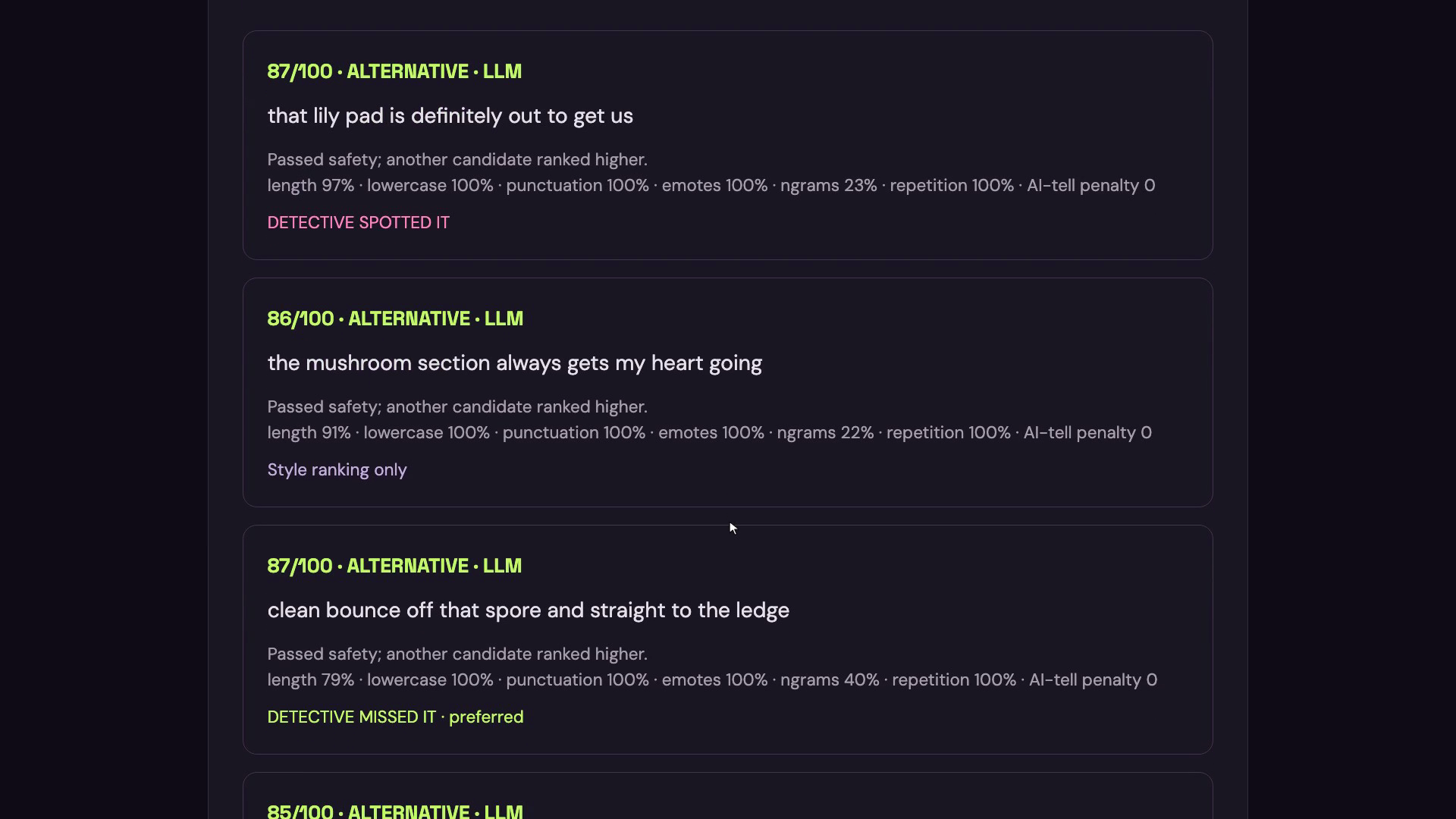
- Forgery Lab. Behind a spoiler click, the streamer sees every candidate, its style score, and why the others were thrown out.
- Stream-native. Twitch OAuth, Helix chat announcements, automatic clips, EventSub raid reactions, an optional channel point reward, and BTTV, FFZ and 7TV emotes.
- Built for a real channel. Deleted and timed-out lines leave the pool at once, chatters can opt out with one command, streamers can veto any round, and raw chat is never written to disk.
Anyone can try it at /try with no account. That mode runs on twelve fictional chatters and is permanently labelled SIMULATED CHAT.
How we built it
Node 22 and Express serve an overlay for an OBS browser source, a control room and a recap page, with a WebSocket keeping them in sync through scene reloads. tmi.js reads chat anonymously, so any public channel works with no credentials. The round engine is a deterministic state machine with an injected clock and random source, which is what makes the whole game testable. Forgeries come from any OpenAI-compatible model with a local Markov fallback, so the game runs with no API key at all. A stylometry ranker scores each candidate against the chatter's habits and an adversarial detective tries to catch them before they reach the screen.
How Codex was used. Mimic was built in one Codex thread, 01a19494-6151-7770-a36a-bace9dd7dbcd. Codex wrote the engine, forgers, overlay, original SVG creature art, simulator voices, control room, landing page, Twitch integration and the tests, and consulted the official API docs as it went. We kept returning to that same thread with codex exec resume, giving it rendered screenshots as image input and the failures we saw on real chat. Each pass became a fix: real lines repeating between rounds, crude lines reaching the screen, near-duplicate cards, channel squatting. Those passes also produced the detective, the display safety gate and the Streamer Round.
Claude Code directed the work around that thread: it wrote the briefs, ran the live Twitch tests, rendered the screenshots, and handled commits and deployment, which the Codex sandbox cannot do.
Challenges we ran into
Answers cannot be typed in public chat before a vote, because everyone would see which cards are human. Using lines people already said earlier in the stream solves that, and it creates the core drama: the real lines are real. It also raised the bar on safety, since a real line on stream is somebody's words. So every line that goes on screen, real or forged, passes a strict local gate and a model screening step, and if nothing passes, the round quietly does not start.
Accomplishments that we're proud of
- It runs live on Twitch: twitch.tv/hhydosn played three rounds with votes in ordinary Twitch messages, Helix announcements, an IDENTITY CRISIS and an automatic clip.
- On live chat from a public channel, a blind LLM judge picked the forgery in 1 of 32 rounds, where random guessing averages 8. npm run eval:forgery reproduces the procedure.
- 70 logic tests and a browser end-to-end run, with no API key or Twitch account needed.
What we learned
Real chat is nothing like simulated chat. Our simulator passed everything, and the first minutes on a real channel surfaced repeats, near-duplicates and lines that must never reach a screen. The fastest loop was to look at real output, then hand Codex exactly what we saw.
What's next for MIMIC
Hosted plans for streamers, per-channel model budgets, season leaderboards across streams, and team hunts during raids.
