-
-

App Icon 1024x1024
-
App Screenshot - No Device Frame

Inspiration
Milna was born out of my own struggle to connect with my family, culture, and community on a deeper level. I grew up as a second-generation South Asian immigrant. My parents came here with two suitcases and built a life from scratch. They gave me every opportunity they never had.
We were close. But like a lot of families, there was still so much I didn’t know. What was it like leaving everything behind? Who were they before they became my parents? What were they like at my age? Somehow, those questions get harder to ask over time.
Life gets busy. Conversations fall into the same patterns like "how are you" and "did you eat?". And it can feel pretty awkward to randomly ask your mom, “So… what’s your biggest regret?” We crave depth, but don't know how to find it.
Then someone gets older or sick, and suddenly we scramble to capture the stories we always assumed we’d have more time to hear. I built Milna to help families have those conversations now — and preserve them for later.
What it does
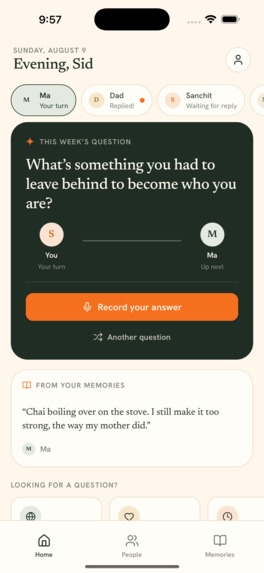
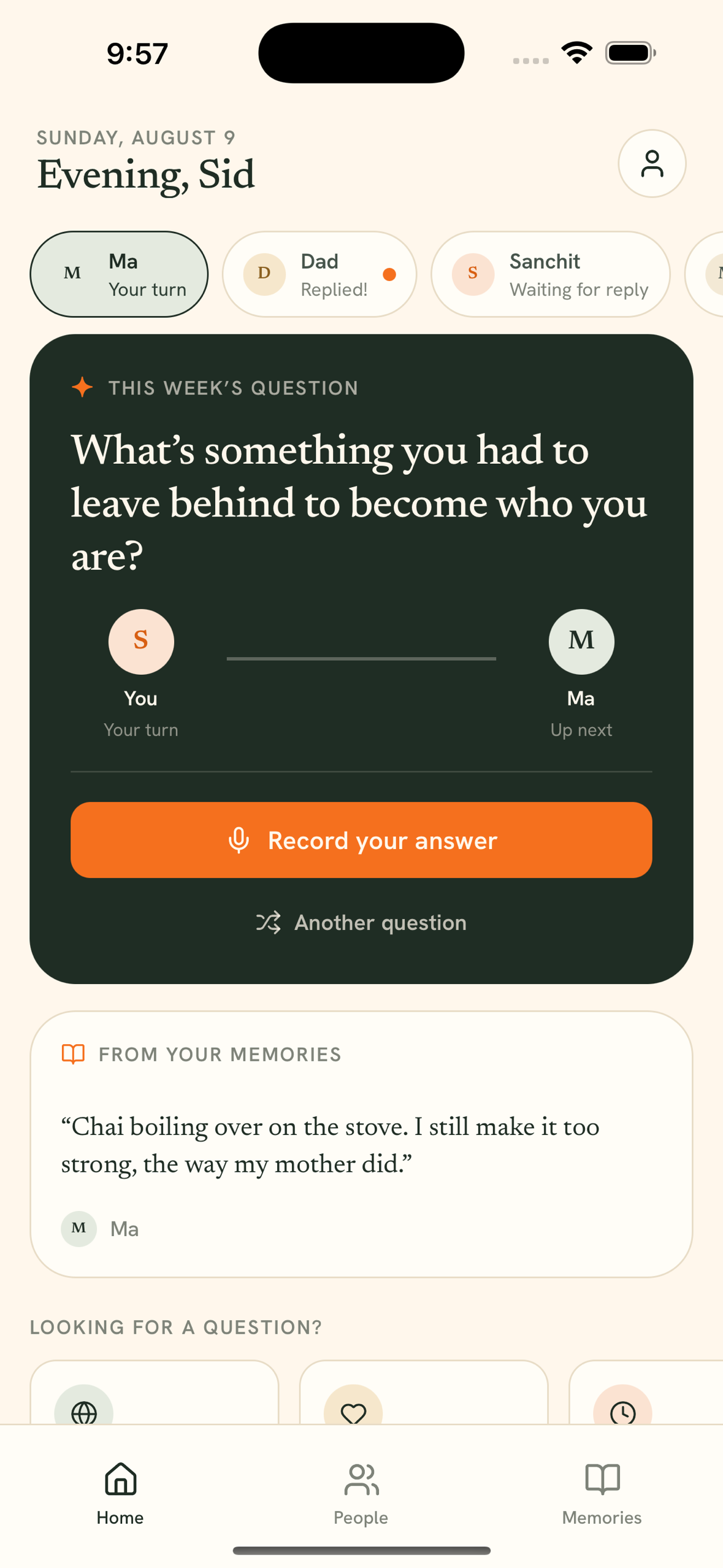
Milna makes meaningful conversations feel easy instead of forced. You get thoughtful questions, record your answer, and send it to someone you care about. They can listen and respond from a simple link without needing to download an app.
AI-generated follow-ups help uncover stories you may never have thought to ask about. And every response is saved, so over time those small conversations become a living collection of someone’s memories, experiences, traditions, personality, and voice. All details that usually disappear in old texts, group chats, or conversations. Especially for immigrant and multicultural families, that can mean preserving pieces of family and cultural history that might otherwise disappear between generations.
How we built it
I built the majority of Milna with help along the way from my founding engineer, SeungHun. The app uses Expo and React Native, with Supabase for authentication, database, storage, row-level security, and server-side functions. Anthropic helps generate questions and follow-ups, OpenAI transcribes recordings, RevenueCat powers Milna+, OneSignal handles notifications, and PostHog helps us understand how people use the product.
The most important technical decision was actually what not to put in the app. At first I thought the whole family would become Milna users. In reality, asking someone to download another app before they can hear your message created way too much friction. So I built a lightweight recipient experience on the web.
When someone receives a Milna recording, they open a tokenized link served through a Supabase Edge Function. The recipient can listen and respond directly from the web — designed to be simple enough for a parent on an older phone, without sacrificing the native experience for the person building the collection. That also supports an important part of our business model: one subscriber can create value for an entire family.
Challenges we ran into
Our biggest challenge wasn't building voice recording or AI. It was getting people to actually start.
Early versions asked people to download an app, choose a question, and convince others to participate. For a product about relationships, every extra step matters.
That forced us to simplify the core experience around one loop: one question and one voice response.
We removed the recipient download requirement, made questions more specific and fun, and started focusing Milna around clearer reasons to use it. Like getting to know a parent better and preserving stories before they're lost. We're still learning how to create enough urgency for something people deeply value but rarely prioritize. That's the hardest problem we're working on.
Accomplishments that we're proud of
We went from idea to a production app in under 30 days, shipped it to the App Store, integrated subscriptions with RevenueCat, and put it in front of real users immediately. But I'm probably most proud that Milna didn't start with an app.
For a full year before launching, we built a community around deeper human connection, hosting 15+ events for 475+ people. That gave us a group of real people to learn from, test with, and build alongside instead of designing the product in a vacuum. Shipaton definitely lit a fire under us to ship faster.
What we learned
Apps are hard because our attention spans are fried. Shipping to real people beats debating the perfect experience. And although it's been nice to have a larger vision, finding a niche use case and building up from there is critical. I'm also really glad we started with a full year of events and community before launching and iterating on the app. Gave me the chance to really understand what these people want and how to deliver it. Plus, zero-cost marketing and trust. Now we have to solve the real distribution problem and think of ways to create more urgency.
What's next for Milna
The consumer app is just the starting point. First I'm building towards richer relationship histories with transcription, search, groups, memories, and in-app gifting + connection rituals. But the bigger idea is a relationship memory "layer". Helping us show up better for each other within our families, communities, and even at work. A new remote employee could can who the people around them actually are. A community can surface the experiences and perspectives that normally stay invisible. A family or friend group can keep a shared history and get suggestions for how to engage with each other better.
We already have plenty of tools designed to capture what people DO. I'm building something that helps us remember who people ARE. And as more of our lives become engrossed in AI, feeds, and synthetic content, authentic human voice only becomes more valuable.
Built With
- claude
- love
- onesignal
- openaigpttranscribe
- posthog
- revenuecat
- supabase

Log in or sign up for Devpost to join the conversation.