-
-
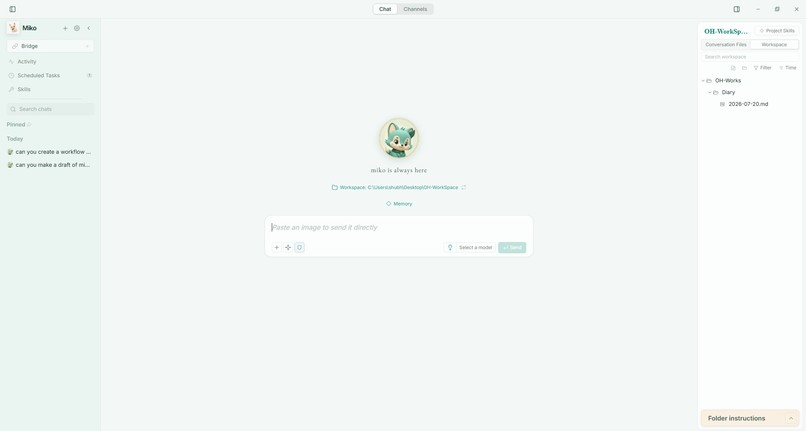
miko home screen
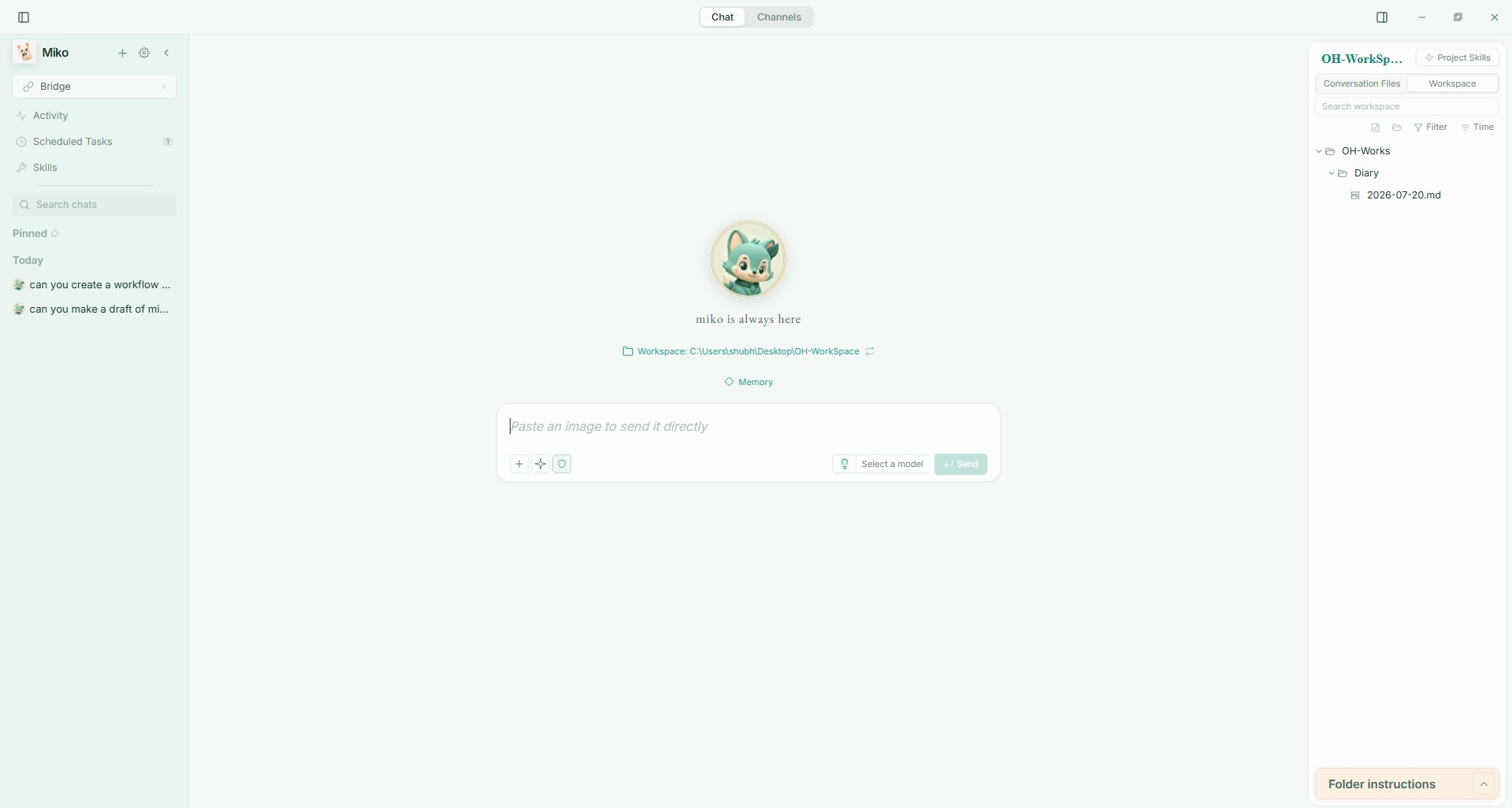
Project Story
Inspiration
Traditional AI assistants are great at answering questions, but they still feel transactional. Every conversation starts from scratch, they forget context, and they rarely feel like a companion that genuinely understands how you work.
I wanted to build an AI agent that feels more like a persistent teammate than a chatbot—something that remembers previous interactions, develops a personality, works autonomously, and can actually operate your computer instead of simply suggesting what to do.
That idea became Miko: a personal AI agent with memory and soul.
What it does
Miko is a desktop AI companion that combines memory, personality, automation, and computer control into a single experience.
Unlike traditional chatbots, Miko can:
- 🧠 Remember conversations and long-term context.
- 🎭 Maintain unique personalities through customizable character templates.
- 💻 Operate your computer using built-in tools.
- 🌐 Browse the web, manage files, execute code, and schedule recurring tasks.
- 🤝 Run multiple independent AI agents that collaborate together.
- 🔌 Extend its capabilities through a powerful plugin and skills ecosystem.
- 📱 Connect across desktop, mobile, and messaging platforms.
The goal is to make interacting with AI feel less like opening another chat window and more like working alongside an intelligent companion.
How we built it
Miko was built as a full-stack desktop application using:
- Electron for the desktop application
- React 19 for the frontend
- Hono for the backend server
- Pi SDK as the agent runtime
- better-sqlite3 for persistent local storage
- Vitest for testing
- A modular plugin architecture supporting tools, skills, providers, routes, widgets, and extensions
One of the most interesting parts of the project was the development workflow itself.
Instead of using AI only for code completion, I collaborated with OpenAI Codex as an engineering partner throughout development. Codex helped accelerate implementation, refactoring, debugging, testing, and documentation, while I focused on product vision, architecture, UX, and technical decisions.
This iterative human-AI workflow allowed me to move significantly faster while maintaining a high-quality codebase and production-ready architecture.
Challenges we ran into
Building Miko wasn't just about adding features—it was about engineering a reliable platform that could support autonomous AI agents.
Some of the biggest challenges included:
- Designing a scalable architecture that could support memory, tools, plugins, automation, and multiple agents without becoming tightly coupled.
- Building a comprehensive test suite for an application with hundreds of interconnected components.
- Setting up a robust CI/CD pipeline to automatically validate builds, tests, and cross-platform compatibility.
- Managing communication between Electron, the backend server, multiple agent sessions, and background services.
- Creating a secure sandbox and permission model for autonomous computer actions.
- Designing a plugin system that is powerful for developers while remaining safe for end users.
- Supporting multiple operating systems while keeping the experience consistent across macOS, Windows, Linux, and mobile.
- Continuously refactoring the codebase as new capabilities were introduced without sacrificing maintainability.
Many of these weren't one-time problems—they required multiple iterations, architectural redesigns, and countless debugging sessions.
Accomplishments that we're proud of
Some achievements we're especially proud of include:
- Building a fully functional multi-agent AI desktop platform.
- Creating persistent memory and personality systems that make AI interactions feel much more personal.
- Developing a flexible plugin ecosystem that allows Miko to continuously expand its capabilities.
- Enabling agents to browse the web, operate the computer, manage files, execute code, and automate workflows.
- Supporting desktop, mobile, and messaging integrations from the same backend.
- Successfully using OpenAI Codex as an engineering partner to dramatically accelerate development while keeping architectural decisions human-driven.
What we learned
Building AI products is about far more than integrating an LLM.
The real challenges lie in software architecture, reliability, developer experience, testing, security, and creating interactions that people genuinely enjoy using.
Working closely with Codex also reshaped how I approach software development. Rather than replacing developers, AI is most powerful as a collaborative engineering partner—accelerating implementation while humans remain responsible for product vision, architecture, critical thinking, and quality.
This project reinforced that the future of software development is human-AI collaboration.
What's next for Miko
Miko is only getting started.
Our roadmap includes:
- Smarter long-term memory and knowledge retrieval.
- More capable autonomous workflows and background agents.
- A community-driven plugin marketplace.
- Deeper integrations with productivity tools and external services.
- Better collaboration between multiple AI agents.
- A richer mobile experience.
- Improved local model support for privacy-first users.
- Better evaluation, observability, and testing infrastructure for autonomous agents.
Ultimately, our vision is simple: build an AI companion that doesn't just answer questions—but remembers, learns, adapts, and grows alongside its user.

Log in or sign up for Devpost to join the conversation.