Inspiration
Every developer has experienced the pain of framework migrations — updating React class components to hooks, replacing deprecated libraries like moment.js, or upgrading Express.js versions. These tasks are tedious, error-prone, and can take weeks for large codebases.
Existing tools like Renovate and Dependabot only bump version numbers in manifest files. They cannot rewrite actual source code when APIs change. Google Research published findings showing that code migration is one of their most significant engineering maintenance costs, even with world-class tooling. The EU Cyber Resilience Act (2026) adds regulatory pressure to keep dependencies updated. AI-generated code often uses outdated patterns, accelerating technical debt.
I built MigrateIQ to fill this gap — an intelligent migration assistant that doesn't just detect outdated code, it actually rewrites it file-by-file, preserving business logic and creating a ready-to-review merge request.
What it does
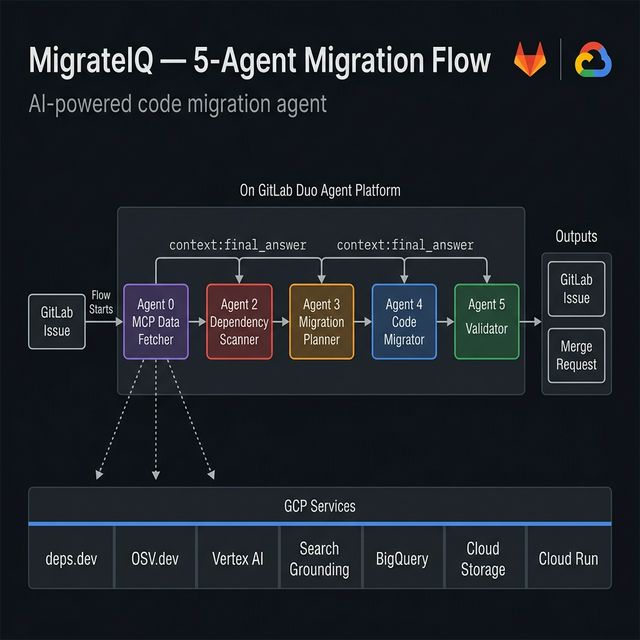
MigrateIQ is a 5-agent flow on the GitLab Duo Agent Platform that automates the entire code migration lifecycle:
MCP Data Fetcher — Dynamically reads the project's
package.json(no hardcoded paths), then executes 4 curl commands viarun_commandto fetch real-time intelligence from an MCP server deployed on Google Cloud Run. Sends the real dependencies to/analyze-projectfor version + CVE analysis via deps.dev and OSV.dev, researches the most critical package migration via Vertex AI Gemini with Grounding with Google Search (/vertex/research-migration), fetches step-by-step migration recipes from the BigQuery pattern database, and uploads a pre-migration report to Google Cloud Storage. Total: 5run_commandcalls (1 cat + 4 curl).Dependency Scanner Agent — Dynamically discovers source files using
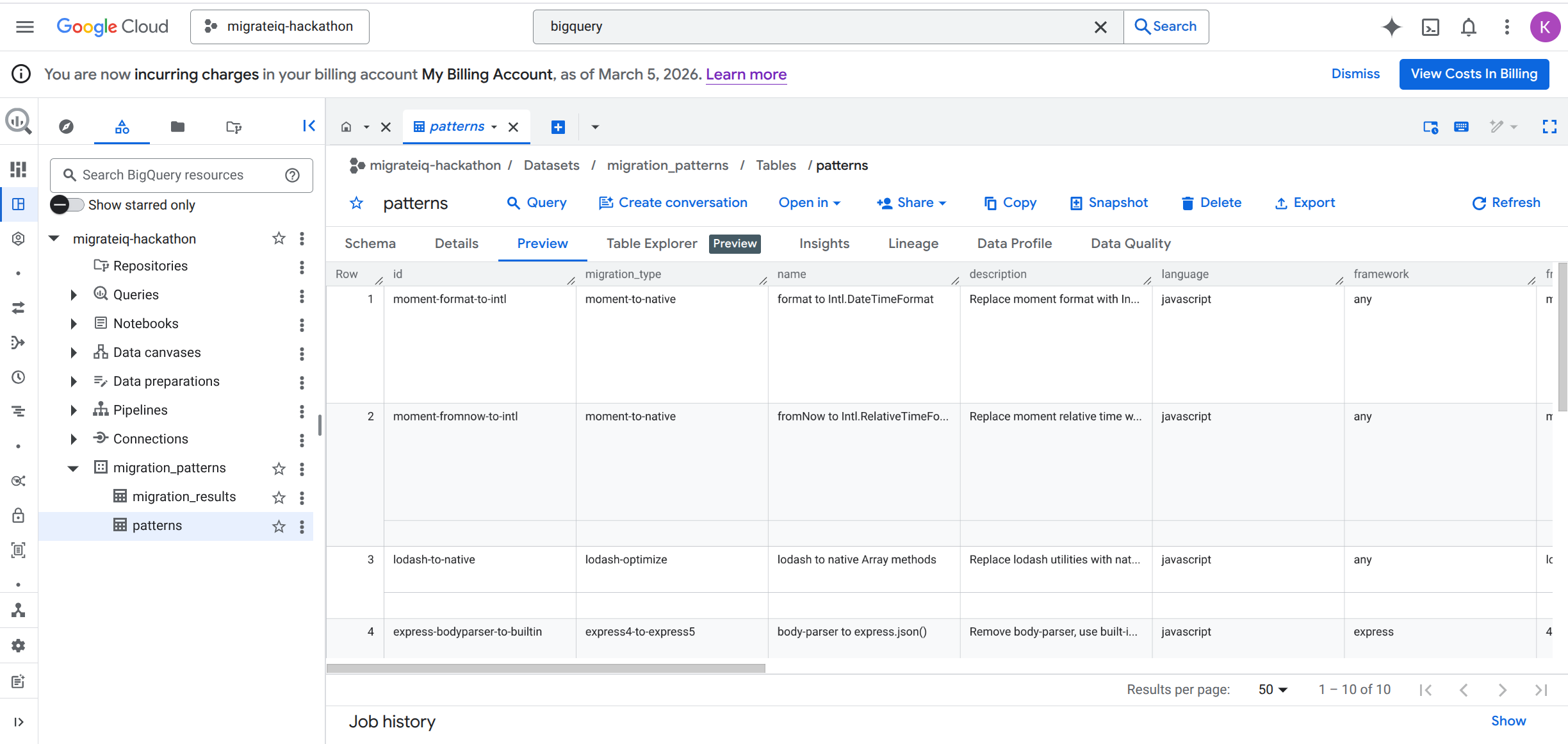
find_files(patterns:*.js,*.jsx,*.ts,*.tsx) and scans for migration patterns usinggrep. Uses the real vulnerability and version data from the Fetcher (not LLM knowledge). Only searches for patterns relevant to the project's actual dependencies. Posts a comprehensive Migration Health Report on the issue with real GHSA IDs, severity categorization, and affected files per pattern.Migration Planner Agent — Reads each discovered file to assess complexity. Creates a file-by-file migration plan with dependency-aware execution order (utilities → tests → server → components → package.json). Incorporates Google Search grounded research data from the Fetcher for breaking changes awareness. Posts the plan as an issue comment with complexity per file, phase rationale, and branch strategy.
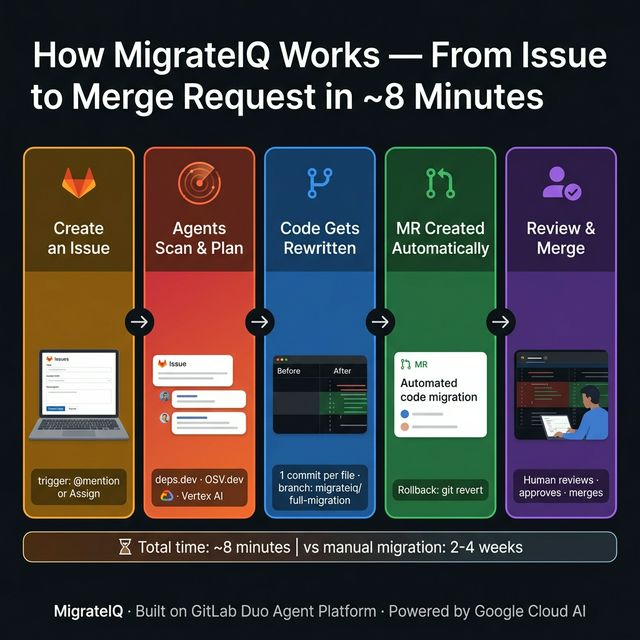
Code Migrator Agent — Reads each source file from the repository and rewrites it applying migration recipes and Google Search grounded research data. Creates one atomic commit per file on a new branch (
migrateiq/full-migration) — commit count matches the number of files in the plan. Handles: React class→hooks, CommonJS→ESM, moment→native Intl, Express 4→5, lodash→native, axios 0.x→1.x. Preserves comments, business logic, anddata-testidattributes.Migration Validator Agent — Archives a completion report to Google Cloud Storage. Creates a comprehensive Merge Request with per-file changelog, testing checklist, rollback instructions, and deployment requirements. Posts a validation report on the MR. Links back to the original issue with completion status and next steps.
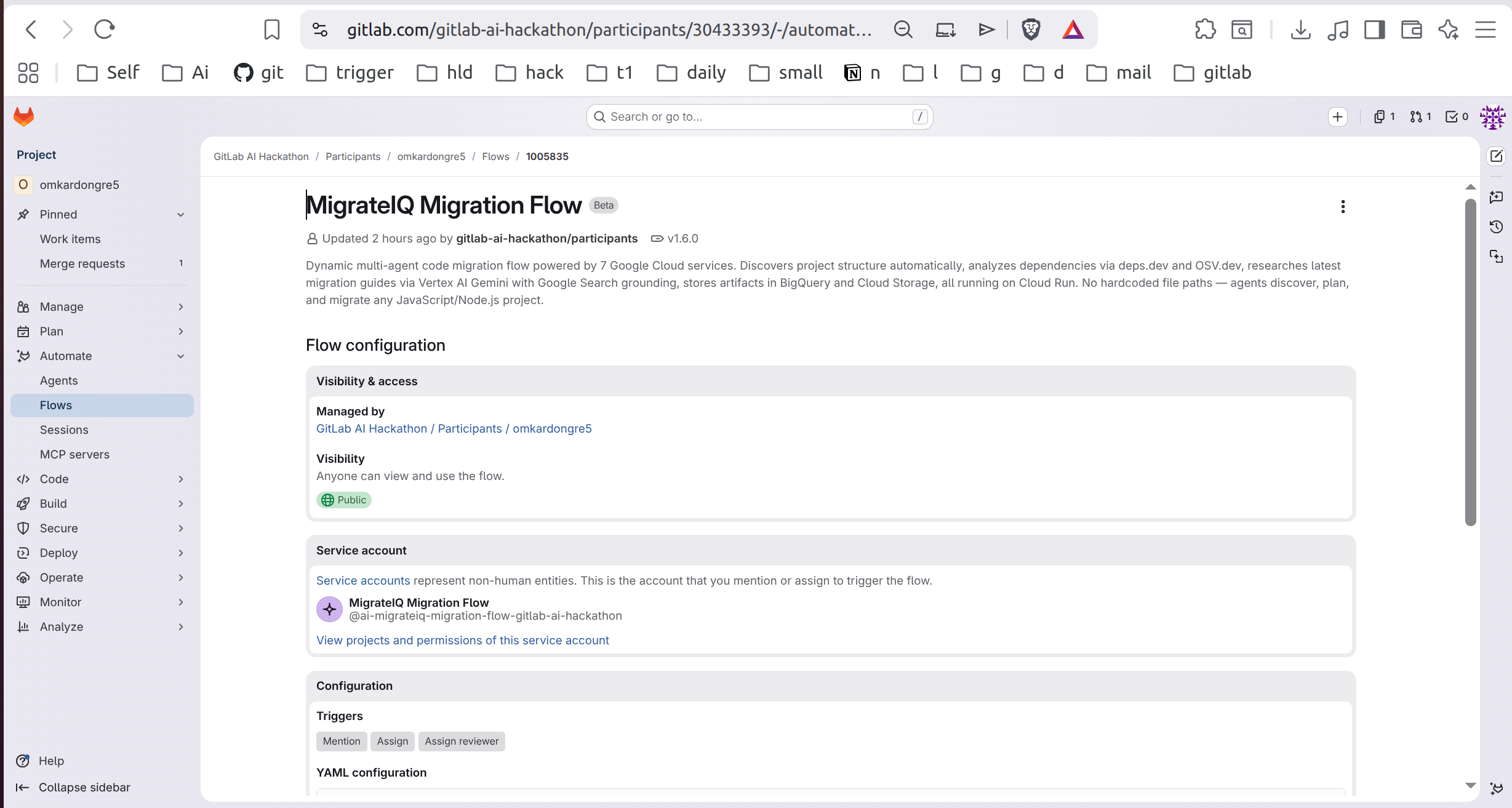
The flow is triggered by mentioning or assigning the MigrateIQ service account on a GitLab issue.
Supported migrations:
- React 17 class components → React 19 functional components with hooks
- CommonJS require()/module.exports → ES Module import/export
- moment.js (deprecated) → Native Intl.DateTimeFormat / Intl.RelativeTimeFormat
- Express 4 body-parser → Express 5 express.json()
- lodash full import → Native Array methods (filter, sort)
- axios 0.x → axios 1.x (full code rewrite: CancelToken→AbortController, interceptor types, error handling)
7 Google Cloud services integrated (all returning real data):
- Google deps.dev — Real-time package version lookups and license information
- Google OSV.dev — Real-time vulnerability scanning with actual GHSA/CVE IDs
- Google Vertex AI Gemini (gemini-2.5-flash) — AI-powered code analysis, migration risk scoring, complexity assessment
- Grounding with Google Search — Live web research via Gemini for latest migration guides, breaking changes, and official docs
- Google BigQuery — Migration pattern database with step-by-step recipes, success rates, and edge cases
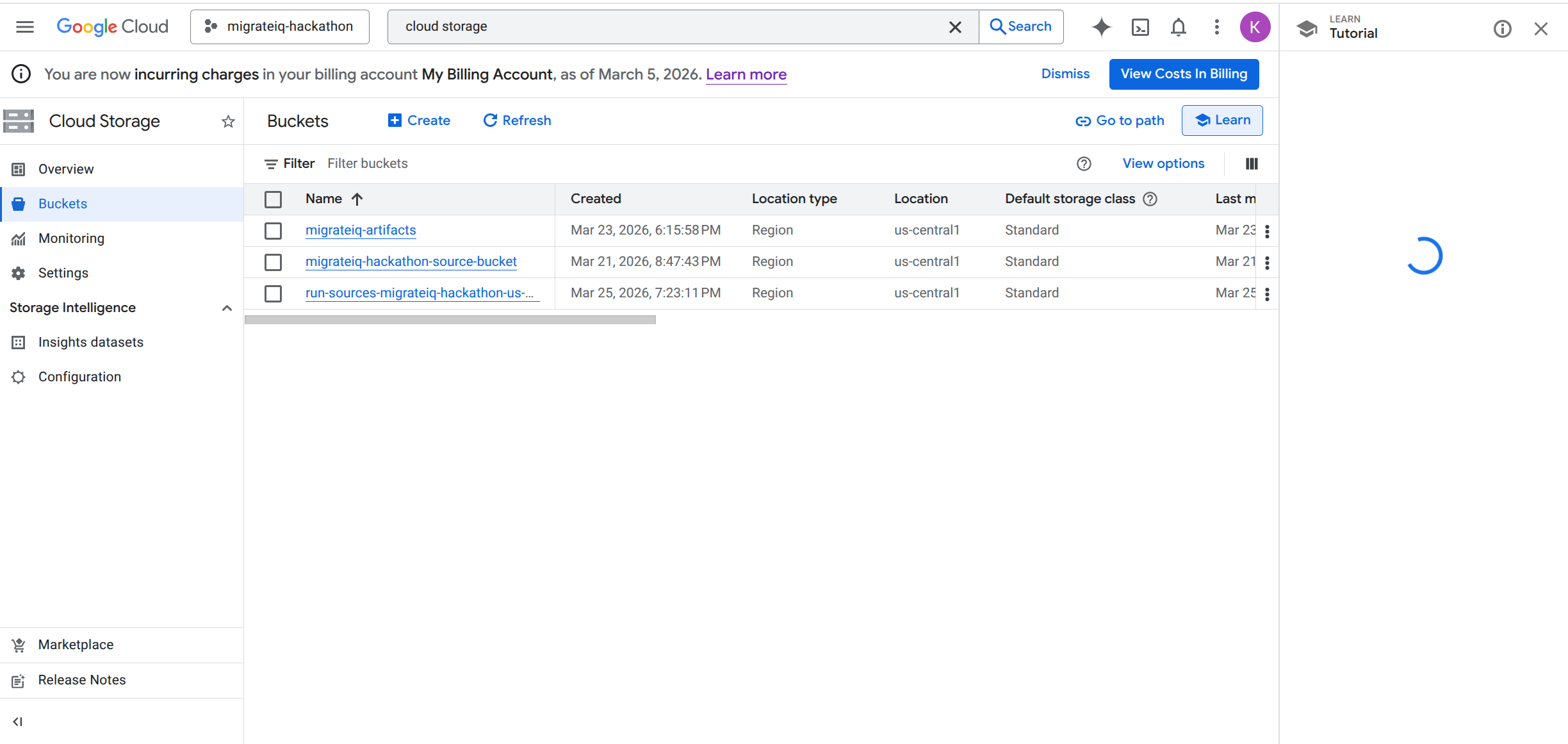
- Google Cloud Storage — Migration report archival with artifact management
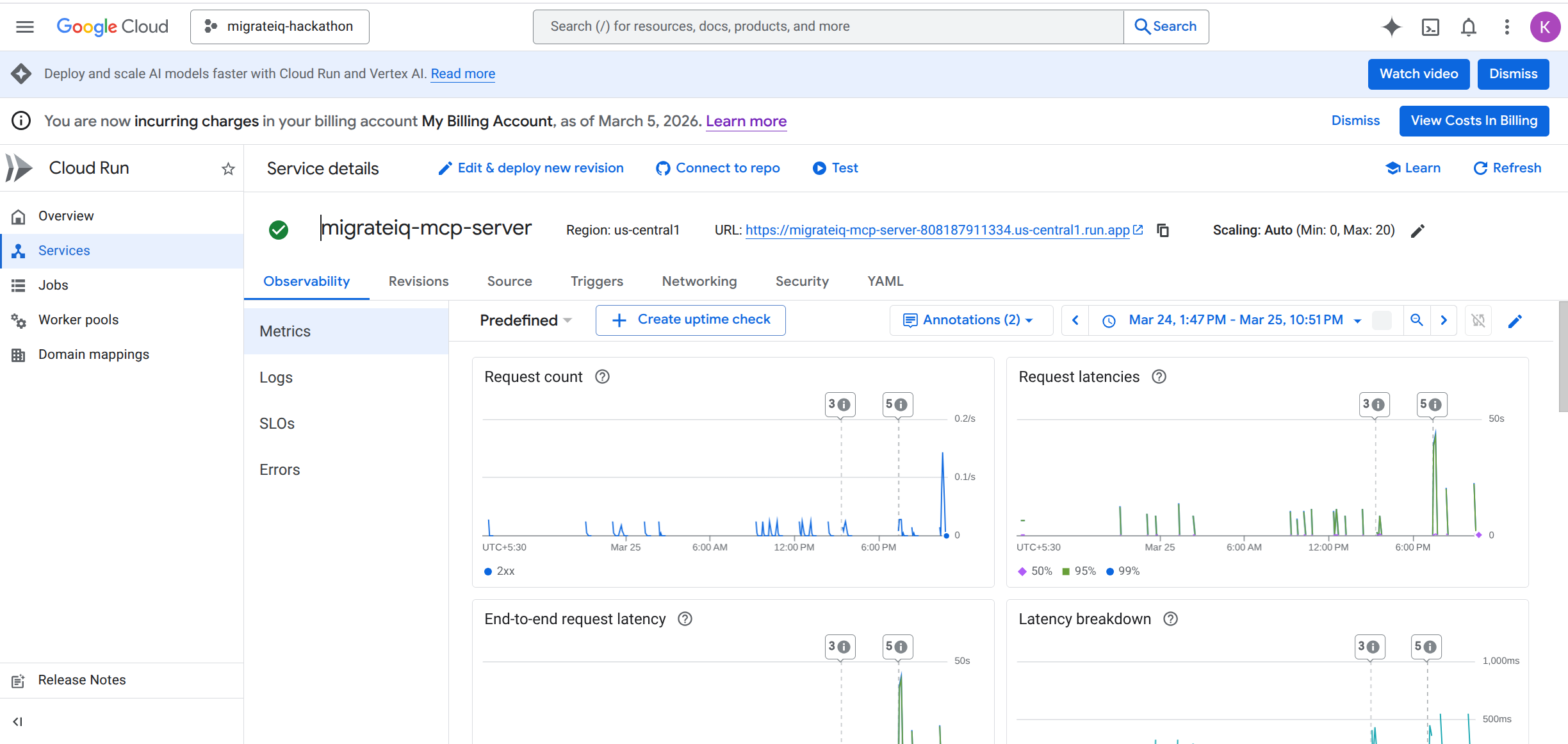
- Google Cloud Run — Hosts the MCP Intelligence Hub server (auto-scaling, serverless)
How we built it
GitLab Duo Agent Platform:
- 5 custom agents with specialized system prompts, each with strict safety guards (NEVER RETRY rules, max tool call limits, numbered call tracking)
- 1 custom flow (YAML) orchestrating all 5 agents sequentially using
context:agent.final_answerfor data passing - Triggers configured for mention and assign events on GitLab issues
AGENTS.mdproviding project context to all agents (tech stack, migration targets, code style rules).migrateiq.ymlconfiguration file for customizable migration rules, exclusion paths, and settings.gitlab/duo/agent-config.ymlwith network policy to allow outbound HTTPS to the Cloud Run MCP server and setup script to install curl in the CI/CD runner
Agent tools used: run_command, list_repository_tree, get_repository_file, read_file, find_files, grep, create_commit, create_merge_request, create_merge_request_note, create_issue_note, get_issue (11 tools)
MCP Intelligence Hub (Node.js on Cloud Run):
- 14 HTTP endpoints integrating 7 Google Cloud services
/analyze-project— Dynamic analysis accepting rawpackage.jsoncontent (deps.dev + OSV.dev)/analyze— Combined deps.dev + OSV.dev dependency health analysis (accepts dependency map)/vertex/analyze-codeand/vertex/suggest-migration— Vertex AI Gemini integration/vertex/research-migration— Vertex AI Gemini + Google Search grounding for live migration research/recipe/{type}— Step-by-step migration recipes from BigQuery pattern database/storage/upload-reportand/storage/reports/{project}— Cloud Storage artifact management- Plus
/dependency,/version,/vulnerabilities,/patterns,/search,/toolsendpoints
Demo repository: A task management application with intentionally outdated code — React 17 class components (3 files, 476+ lines), Express 4 server with body-parser and moment.js, CommonJS modules, lodash full imports, and a Jest test suite.
Challenges we ran into
SRT Network Sandbox blocking MCP server calls — GitLab CI/CD flows use Anthropic Sandbox Runtime (SRT) which blocks ALL outbound network traffic except to the GitLab instance by default. Our curl commands to the Cloud Run MCP server were silently blocked, returning empty responses. We solved this by creating
.gitlab/duo/agent-config.ymlwithnetwork_policy.allowed_domainsto whitelist the MCP server domain and asetup_scriptto install curl.Agent infinite loop from missing retry guards — The fetcher agent's prompt said "call run_command 7 times" but didn't say "NEVER RETRY". When curl returned empty (due to the network sandbox), the agent retried the same command infinitely. We added explicit "NEVER RETRY" rules with numbered call tracking ("call 1 of 7") to every agent prompt.
Project ID resolution in ambient flows — Tools like
create_commitandcreate_issue_notefailed because agents couldn't resolve the project ID in the flow execution context. We solved this by passingcontext:project_idas an explicit input to every agent component.Balancing output quality vs safety — Strict character limits and rigid templates prevented infinite loops but produced minimal output. We iteratively relaxed output constraints while keeping all safety guards, achieving rich production-quality reports without risking agent runaway.
Context passing between agents — Ensuring the scanner's findings were structured enough for the planner, and the planner's output was actionable for the migrator. We used structured text blocks with clear delimiters in
final_answerfor reliable agent-to-agent communication.
Accomplishments that we're proud of
- Full end-to-end flow working in production — 5 agents execute sequentially in ~8 minutes, triggered by a single @mention on an issue
- All 7 Google Cloud services return real data — not mock data, not LLM hallucinations. Real GHSA IDs from OSV.dev, real package versions from deps.dev, real research from Vertex AI Gemini with Google Search grounding (with citations)
- Atomic commits with properly migrated code (one per file) on a dedicated branch, with pipeline passing
- Rich MR description with per-file changelog, testing checklist, rollback instructions, and deployment requirements
- Comprehensive issue comments — Health Report with CVE details and severity, Migration Plan with risk score and execution rationale, completion summary with next steps
- Validation report posted on the MR with migration metrics, testing steps, and deployment requirements
- MCP Intelligence Hub with 14 endpoints integrating 7 GCP services, deployed on Cloud Run
- Configuration-driven —
.migrateiq.ymllets teams customize which migrations to enable, exclusion paths, and settings
What we learned
- The GitLab Duo Agent Platform is powerful for multi-agent orchestration, but CI/CD flow execution uses SRT network sandboxing that requires explicit domain whitelisting
- Prompt engineering for multi-agent flows requires strict safety guards — explicit "NEVER RETRY" rules, numbered tool call tracking, and max call limits prevent agent runaway
- Agent-to-agent communication via
final_answerworks well when output uses clear section delimiters - The flow YAML schema (v1) with components, prompts, routers, and entry_point provides clean orchestration with context passing
- Real-world code migration requires careful prompt design to preserve business logic while transforming patterns
- Network policy configuration (
.gitlab/duo/agent-config.yml) is essential for any flow that calls external services
What's next for MigrateIQ
- Support additional languages: Python (2→3 patterns), Java (Spring Boot 2→3), TypeScript strict mode
- Integration with GitLab's native vulnerability scanning to prioritize security-critical migrations
- Self-evolving pattern learning: store successful migration patterns back to BigQuery and improve accuracy over time
- Support for monorepo migrations (multiple packages in a single repository)
- Automated test generation for migrated code to verify behavioral equivalence
- Organization-wide migration campaigns across multiple repositories
Built With
- anthropic-claude
- express.js
- gitlab-duo-agent-platform
- google-bigquery
- google-cloud
- google-cloud-run
- google-deps.dev
- google-osv.dev
- google-search-grounding
- google-vertex-ai
- javascript
- mcp
- node.js
- react
- yaml


Log in or sign up for Devpost to join the conversation.