-
-
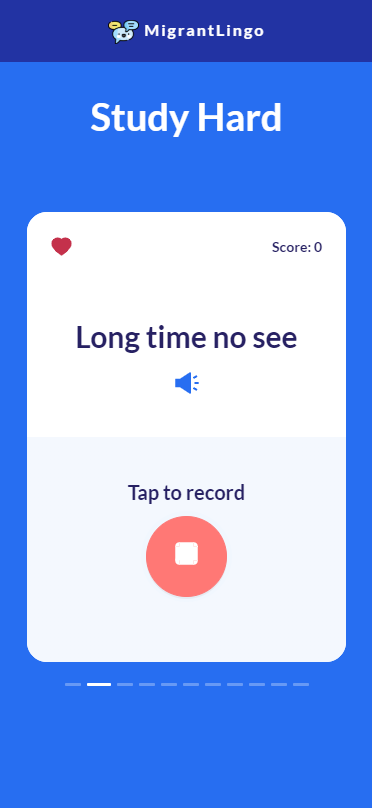
Recording speech and favorite
-
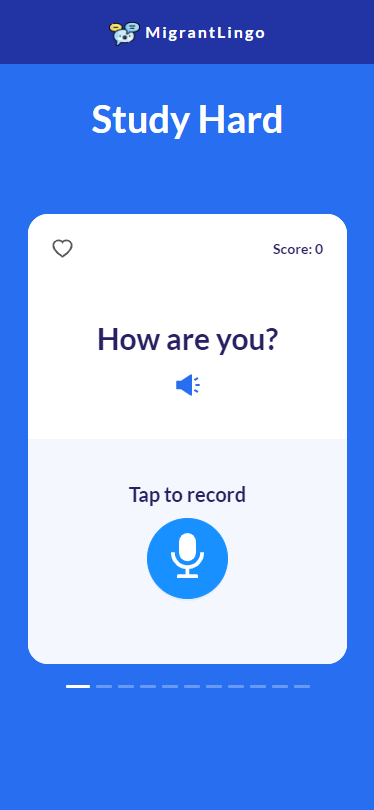
Sample card
-
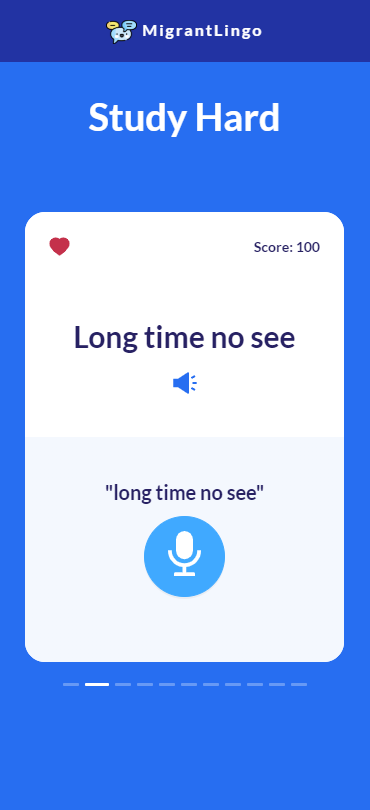
Feedback 1
-
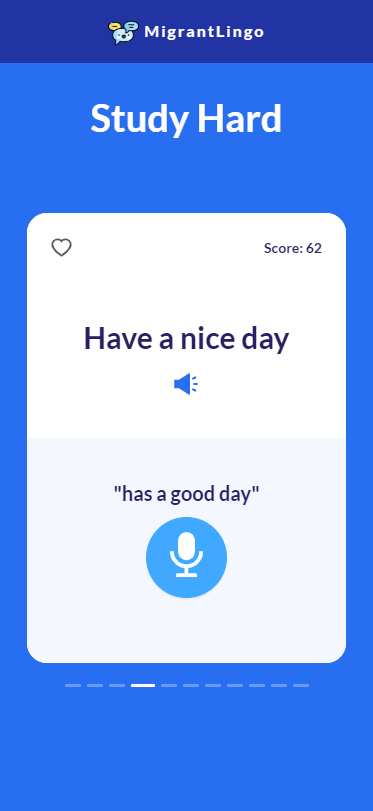
Feedback 2
Main Aim of participating in the Idea Sprint
- We care about Migrant Workers' condition, but believe that some attention should also be paid to longer term needs. More specifically a) Remote and independent learning and b) Learning that boosts their integration with our society.
- We want to prototype and prove the following hypotheses: a) That we can build a simple, cross platform and user friendly tool. b) Speech learning can be automated in a unique way with current technology.
Inspiration and Issues
As the current COVID'19 pandemic hits our Migrant Workers population, there has been more awareness of a few problems and needs:
In the short term, how can we urgently aid them in communicating with frontline workers, the majority of which speak English and may face difficulty communicating in the workers' native tongue?
Also in the short term, how can we support remote learning of Migrant Workers as the situation critically impedes their learning progress?
In the longer term, how can we support better integration of the Migrant Workers in to the Singapore Society?
How MigrantLingo addresses this problem
Our App, MigrantLingo, is chiefly made for Language Learning. Our goal is to prototype a solution that aids language learning with a focus on training speech and listening abilities that to our knowledge, does not yet exist. For this prototype, we assume our users are mostly Bangladeshis who understand Bengali.
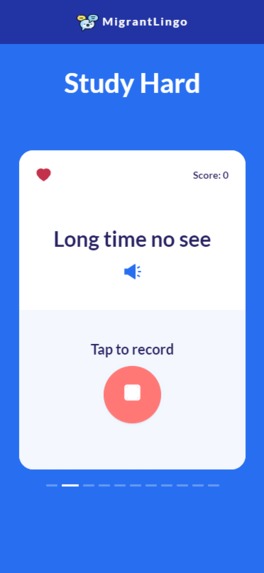
For the immediate aim of facilitating communication, we allow users to bookmark communication cards that are they think will be useful for them.
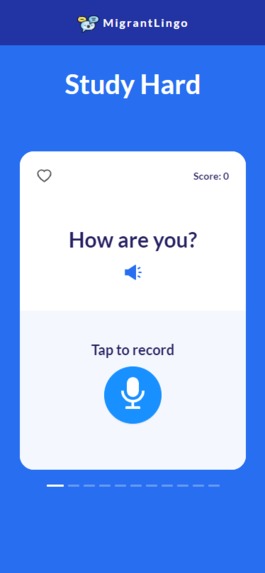
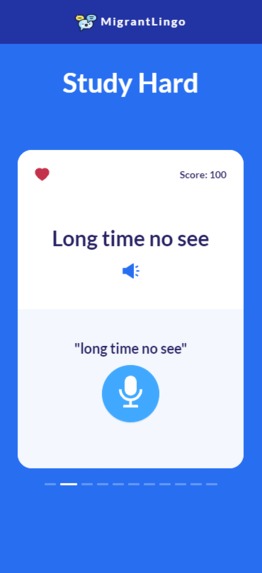
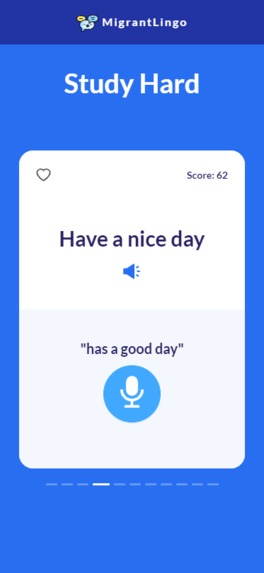
For the longer term aim of enhancing language learning, we prototyped a solution that teaches the users how to speak common English phrases and then immediately test them on it, giving them a score for the accuracy and quality of their pronunciation.
By allowing migrant workers to use this app, we believe they can improve their language learning independently, with a focus on listening and speaking. This boosts their interaction abilities and allow stronger integration into our society.
We built this app as a Mobile first Progressive Web App (PWA) which is complementary to Migrant Workers’ learning as most of them own and use a Mobile Phone. In addition most Mobile Phones can access modern browsers and have microphones.
We believe with a portable learning tool that gives instant feedback, it can be an scalable and effective way to learn, paving the way for better integration of Migrant Workers in our society.
How we built it
We built it with Flask as the backend framework and React as the frontend framework. We used Google Speech and Storage APIs to power most of the things happening in the backend. Finally we deployed it on Heroku.
Accomplishments that I'm proud of
We found up about the IdeaSprint and its deadline on Thursday 1am, and worked to build this in a very short amount time while juggling school lessons and meetings.
Beyond the Idea Sprint, how do you envision your idea/prototype/product scaling and being applied?
How this app will be used:
- If there is actual validation for the usefulness of this product, we envision onboarding more experts and experienced people. People who have experience teaching and working with Migrant Workers will be welcomed to provide feedback and contribute to the future development of the product.
- In a matter of months, we believe such a product can be rolled out to Migrant Workers for their learning and communication needs. In fact, urgent features can be rolled out first so that Migrant Workers can have a portable bank of important expressions that aid in their communication.
There are many ways we can improve this app going forward:
- Nurturing a community around the app: We believe that going forward, the content of this app should be crowd sourced. People with Bengali expertise should be able to create decks of cards that suit a particular theme. This is why we one of our next features planned will be deck creation abilities.
- User accounts and tracking metrics: Users should have a dedicated account that they may track their own learning progress for. With specified metrics, our app becomes more extensible and we are able to use data to enhance learning. One example of that is to build an algorithm that optimises for spaced repetition, hence serving cards that our users perform worse on more frequently and in a timely manner so that language learning is better internalised. (e.g. If a user cannot pronounce a particular expression well, we will keep pushing the card with the expression until the user does it well. Correspondingly, if a user can already pronounce an expression well, we can push it to them less. We will do so in a manner that aligns with the spaced repetition technique of internalising knowledge)
- Actual human voice - currently we use AI synthesised voice for the sample audio. But given the finiteness of sample expressions, we can possibly crowdsource actual human recordings.
- Training a more specific model for speech to text: The current model is heavily biased towards American English. We can tweak the model based on the recordings we receive to train
- This flashcard approach can be extended to testing Reading abilities, such as the ability to recognise what a sentence means. However, reading abilities are still secondary to the main aim of our app.


Log in or sign up for Devpost to join the conversation.