-
-
Page 1
-
Page 2
-
Page 3
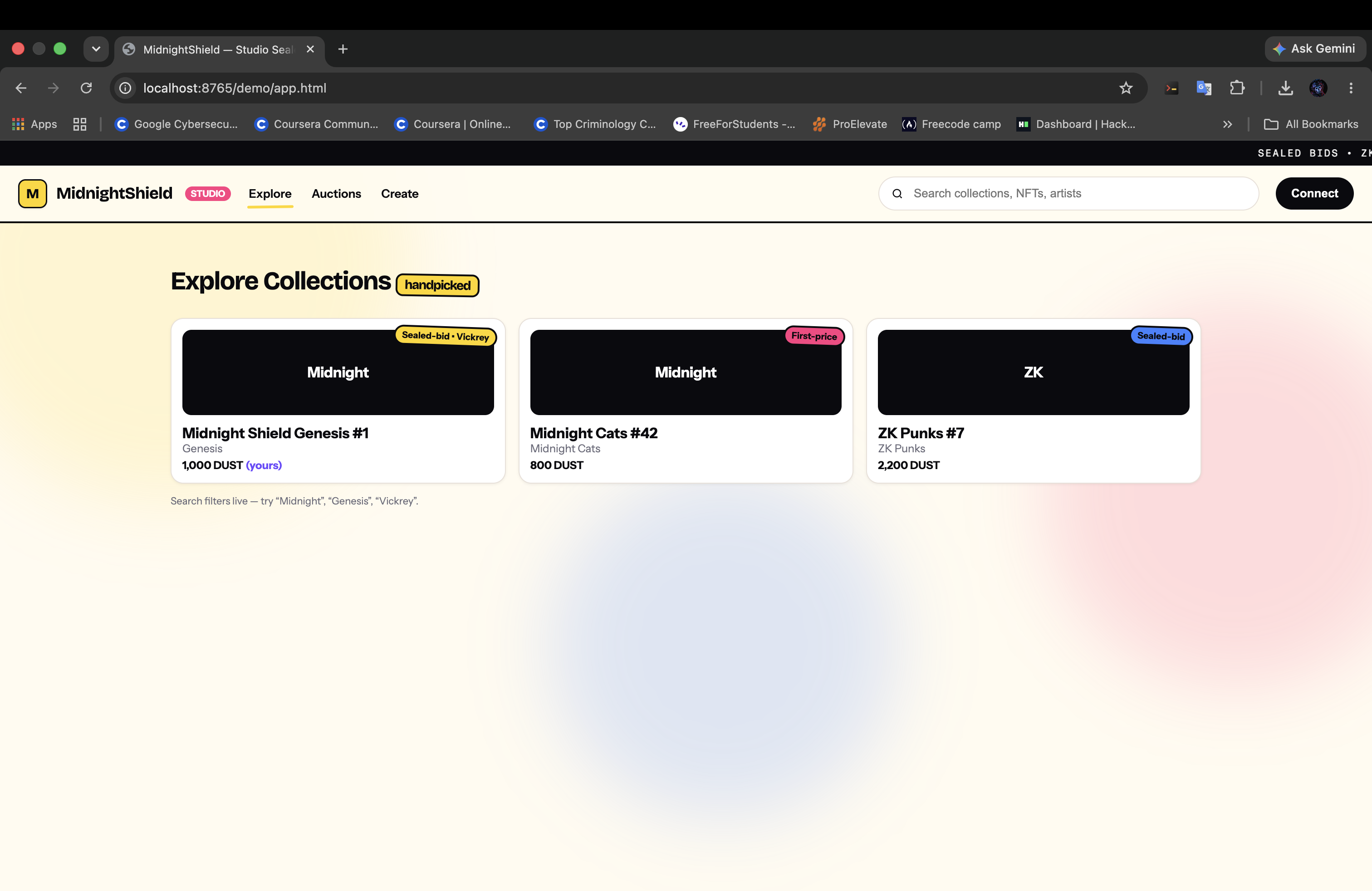
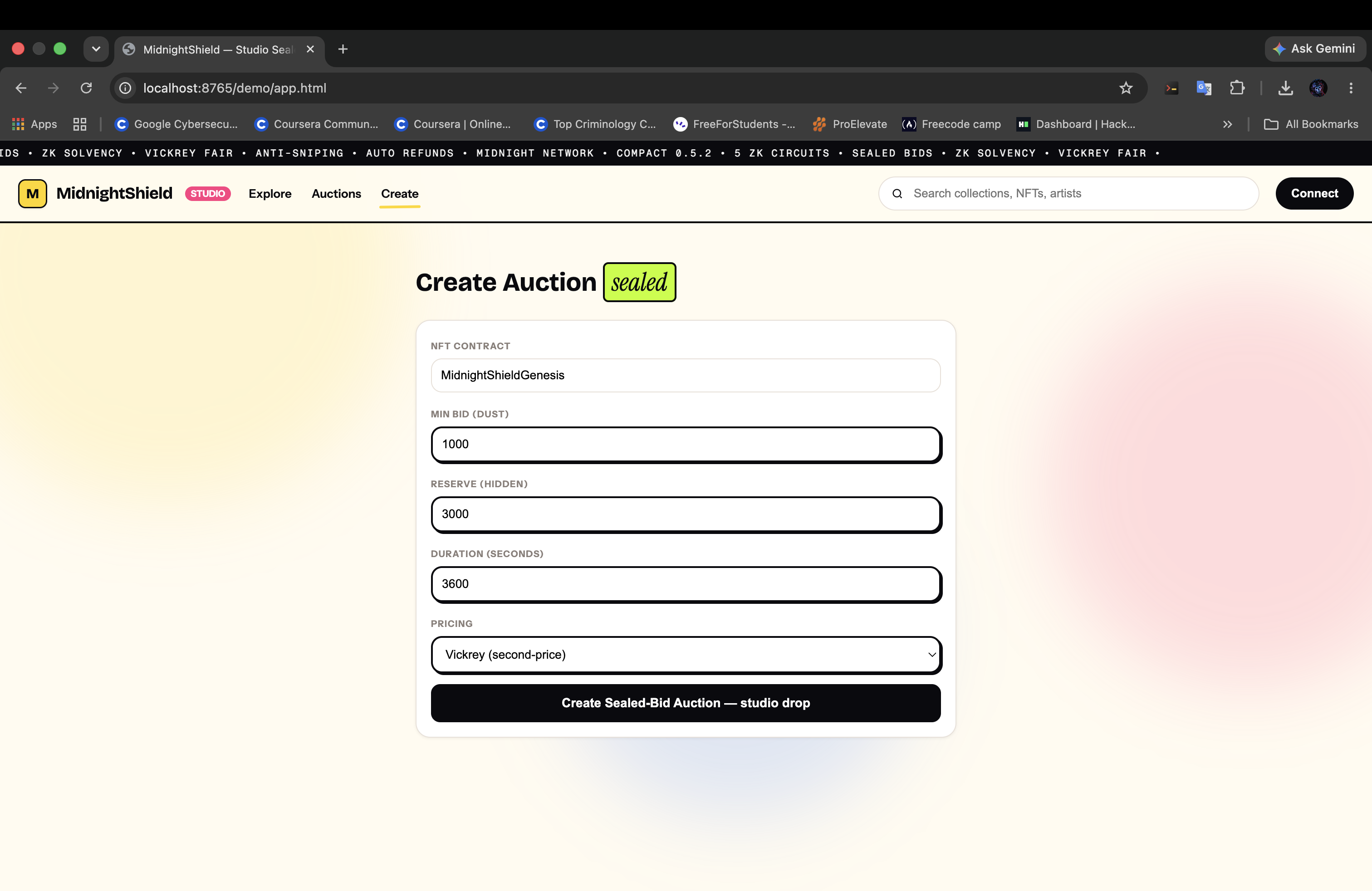
MidnightShield — Privacy-Preserving Sealed-Bid Auction on Midnight Network
Inspiration
Traditional NFT auctions leak everything. A wallet places a 5,000 DUST bid — and the mempool, the seller, every sniper bot sees the amount, the bidder address, even the seller's reserve. Whales get targeted, floors get manipulated, and last-second snipes steal sales. Even so-called "private" marketplaces just hide it in the UI — the chain still knows.
Midnight flips that model. What if the chain only ever sees a hash, and the truth is proven in zero-knowledge?
We wanted an auction where:
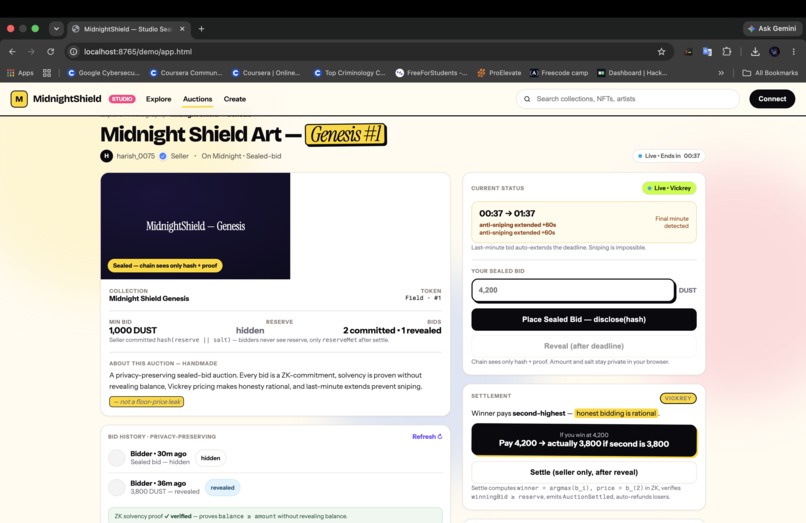
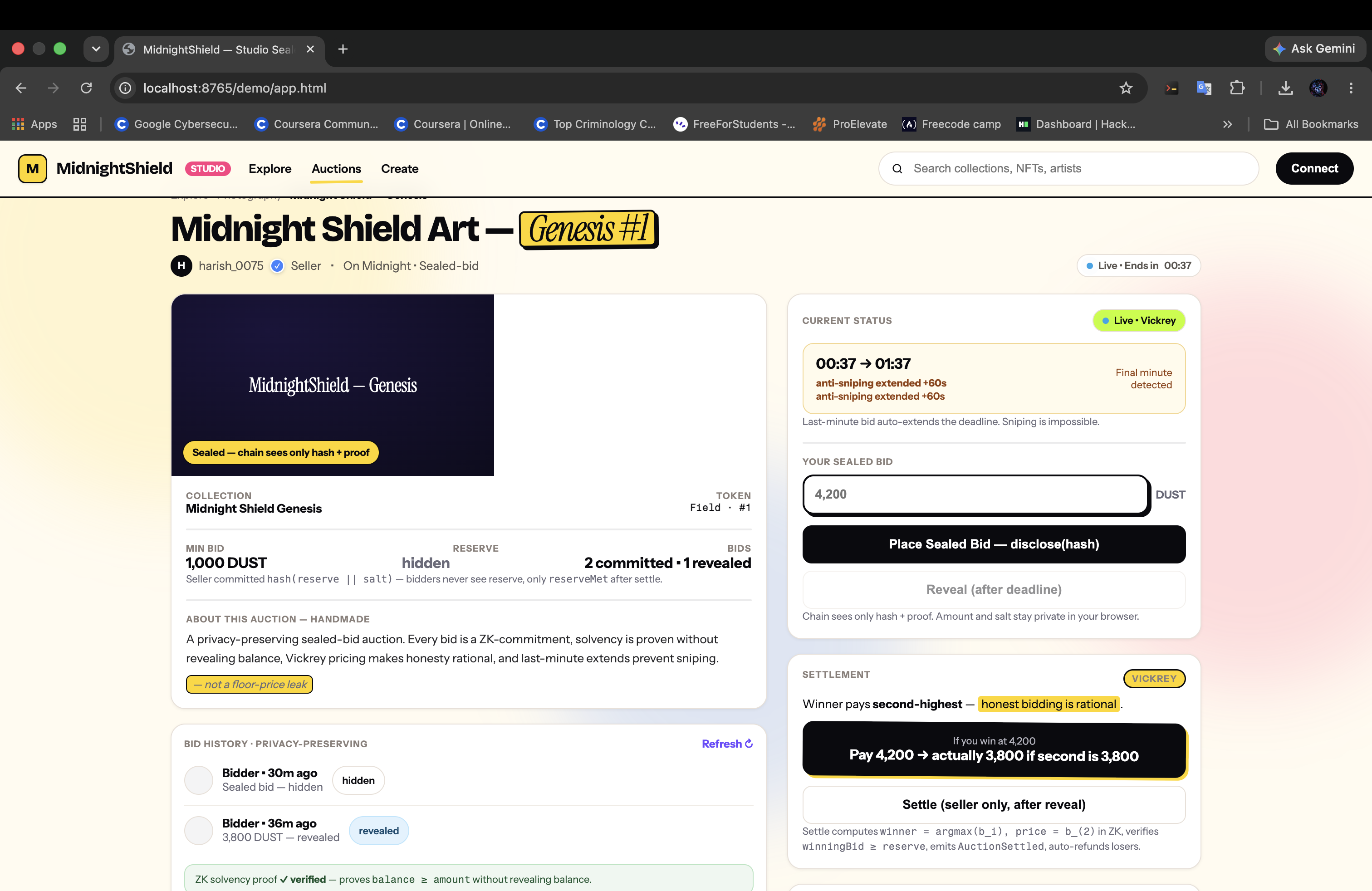
- No one — not the seller, not rival bidders, not the network — knows (b_i) until reveal
- You can prove "I can afford this" without showing your balance
- The seller can prove "reserve was met" without revealing the reserve
- Vickrey pricing makes honest bidding rational: winner pays the second price, not their own
MidnightShield is DeFi-grade privacy for a problem everyone thought needed transparency.
What I Learned
Compact is not Solidity. Compact's disclose() model forced witness-first thinking. Every circuit parameter that touches the ledger (Map.insert, ledger =) must be explicitly disclose()d — otherwise the compiler throws potential witness-value disclosure must be declared. Immutability matters too: const bid = lookup(k); bid.revealed = true is illegal — you must reconstruct a new struct and insert it.
ZK is plumbing, not magic. Writing stubs for commit_bid, reveal_bid, and verify_reserve taught us the real circuits are just hashes and comparisons in ZK:
Display commitment: $$ C = H(amount \parallel salt \parallel nftContract \parallel tokenId \parallel deadline) $$
Display validity:Sisyphus - Ultraworker·Muse Spark 1.2 FreeOpenCode Zen $$ /Users/harish\text{valid} := (H(amount' \parallel salt') == C) $$
Display reserve check: $$ \text{reserveMet} := (winningBid \geq reservePrice) \land (H(reservePrice \parallel reserveSalt) == reserveCommitment) $$
Vickrey pricing (inline (b_{(1)} \geq b_{(2)} \geq \dots) and display): $$ \text{let } b_{(1)} \geq b_{(2)} \geq \dots \geq b_{(n)} \Rightarrow winner = argmax(b_i),\; price = \begin{cases} b_{(2)} & \text{if Vickrey} \ b_{(1)} & \text{if first-price} \end{cases} $$
Inline example: range proof is (balance \geq amount) where (balance) stays private, and the area of a circle is (A = \pi r^2).
Toolchain matters more than code. Midnight's blake3 1.8.7 vs 1.5, borsh 1.8.1 vs 1.2, and midnight-circuits 7.2.4 vs 7 — tiny lockfile drifts break cargo build. And wasi-sdk / Apple clang 17 doesn’t ship a wasm32-wasip1 sysroot, so blst C files fail for WASM even when native cargo build --release passes in 0.04s. We learned to verify via Compact → native Rust → tsc --noEmit.
How I Built the Project
I built MidnightShield as a full-stack privacy auction:
- Contracts:
contracts/src/SealedBidAuction.compactwith 5 circuits (commit_bid,reveal_bid,verify_reserve,settle_auction,verify_auction+public_key) and ledger state (auction_state: AuctionState,bid_commitments: Map<Bytes32,BidCommitment>,refunds: Map<Bytes32,RefundInfo>) - Rust shim:
contracts/src/lib.rsembeds the compact source viabuild.rs(OUT_DIR/compact_source.rs) and exposes it withwasm-bindgen - SDK:
sdk/src/index.ts(MidnightAuctionSDKwithcreateAuction,placeBid,revealBid,settleAuction,verifyAuction,onAuctionSettled) andsdk/src/circuits.tswrappers - Frontend:
marketplace-fork/src/hooks/useSealedBidAuction.tsandmarketplace-fork/src/components/SealedBidAuctionUI.tsx - Demo:
demo/demo-script.md— a 3-minute flow from sealed bids to ZK solvency to anti-sniping to private reserve to Vickrey to auto refunds
Build flow:
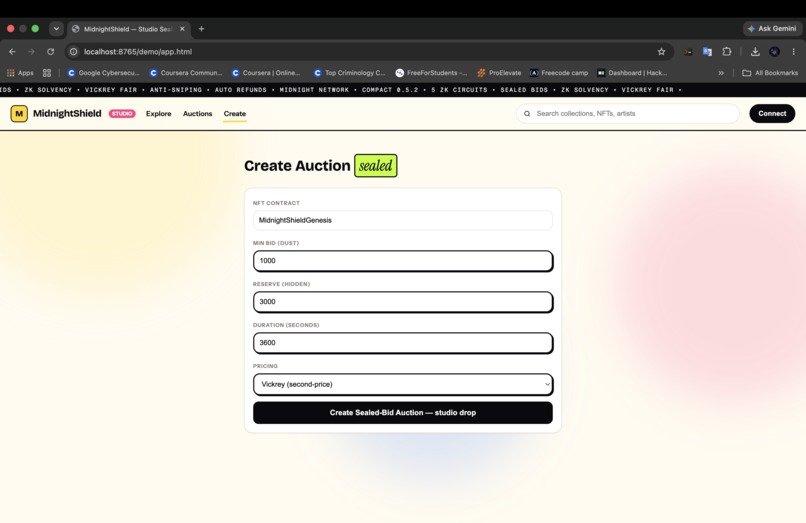
- Create: seller calls
disclose(nftContract)and storeshash(reserve), setsauction_state = active, emitsAuctionCreated - Commit: bidder generates (salt \leftarrow rand(32)), proves (balance \geq amount) in ZK, computes (C), then
disclose(C)and insertsBidCommitment{revealed:false} - Reveal: bidder discloses (C, amount, salt); circuit checks (H(amount' \parallel salt') == C), then the contract rebuilds
BidCommitment{revealed:true, bid_amount:amount} - Settle:
settle_auctioncomputesSettlementOutput{winner, winningBid, secondHighestBid},verify_reservechecks the reserve, emitsAuctionSettled, setsauction_settled=true
Anti-sniping: if a bid lands in ([deadline-60s, deadline]) then (deadline += 60s) and auction_extended=true.
Challenges I Faced
Compact disclosure hell. The first compile threw 18× potential witness-value disclosure must be declared. Every ledger write needed disclose(param), every assert needed a message (assert(!auction_settled, "Auction already settled")), and Map.lookup returns a copy — mutating bid.revealed = true is illegal for const, so I had to rebuild the whole struct.
Cargo vs Compact. Cargo.toml had path = "src/SealedBidAuction.compact" — Cargo expects Rust lib.rs. I fixed it to the default src/lib.rs shim and bumped dependencies to match the lockfile (blake3 1.8, borsh 1.8, midnight-circuits 7.2).
WASM on macOS. cargo build --target wasm32-wasip1 --release fails with blst: error: unable to create target wasm32-unknown-wasip1 because Apple clang lacks the WASI sysroot. Native cargo build --release still passes and proves the API is correct; WASM needs wasi-sdk or Midnight's docker builder.
Private npm. @midnight-ntwrk/midnight-js-sdk@^0.3.0 returns 404 on the public registry. I stubbed it in src/types/midnight-js-sdk.d.ts and set tsconfig.json to module:NodeNext / moduleResolution:NodeNext with skipLibCheck:true, and fixed a bigint bug (bucket + 1 → bucket + 1n).
Git hygiene. The first push included contracts/target/ with 900+ files. I added .gitignore for /target/, node_modules, sdk/dist, .DS_Store, and *.key, then ran git rm -r --cached contracts/target for a clean history.
What's Next
- Replace stubs with real
midnight-zk-stdlibrange and Merkle proofs for eligibility (bidder_eligibility_root) and encrypted refunds - Add ZK analytics for Vickrey stats (
avg,bidsAboveReserve) without revealing the distribution - Deploy to Midnight testnet and wire the marketplace relayer to verify
AuctionSettledand callmarketplace_transfer_nft
MidnightShield brings fairness without exposure — the chain sees only hashes and proofs, not wallets and numbers. That is what auction fairness looks like when you don't have to choose between privacy and verifiability.
Built With
- blake3
- borsh
- compact
- compact-lang
- git
- javascript
- midnight
- midnight-circuits
- midnight-js-sdk
- midnight-network
- midnight-zk-stdlib
- node.js
- react
- rust
- secp256k1
- serde
- sha2
- tailwind-css
- typescript
- vite
- wasm
- wasm-bindgen
- zero-knowledge-proofs
- zk
- zkp

Log in or sign up for Devpost to join the conversation.