Inspiration
What it does
How we built it
Challenges we ran into
Accomplishments that we're proud of
What we learned
What's next for Midnight Club
Midnight Hold’em
“Bluff like nobody’s watching.”
Inspiration
Most blockchain games today are fully transparent by design. While that works for collectibles and simple games, it completely breaks competitive strategy games where hidden information is essential.
Poker became the perfect example of this problem.
In a normal blockchain environment:
- cards become public,
- game state is visible,
- bluffing disappears,
- and competitive integrity collapses.
That inspired us to explore a bigger question:
Can we build a truly competitive multiplayer game on-chain without exposing private game state?
That’s where Midnight became the perfect fit.
Midnight’s confidential smart contract model opened the possibility for something that traditional blockchains struggle with:
- hidden hands,
- private strategy,
- and provably fair gameplay.
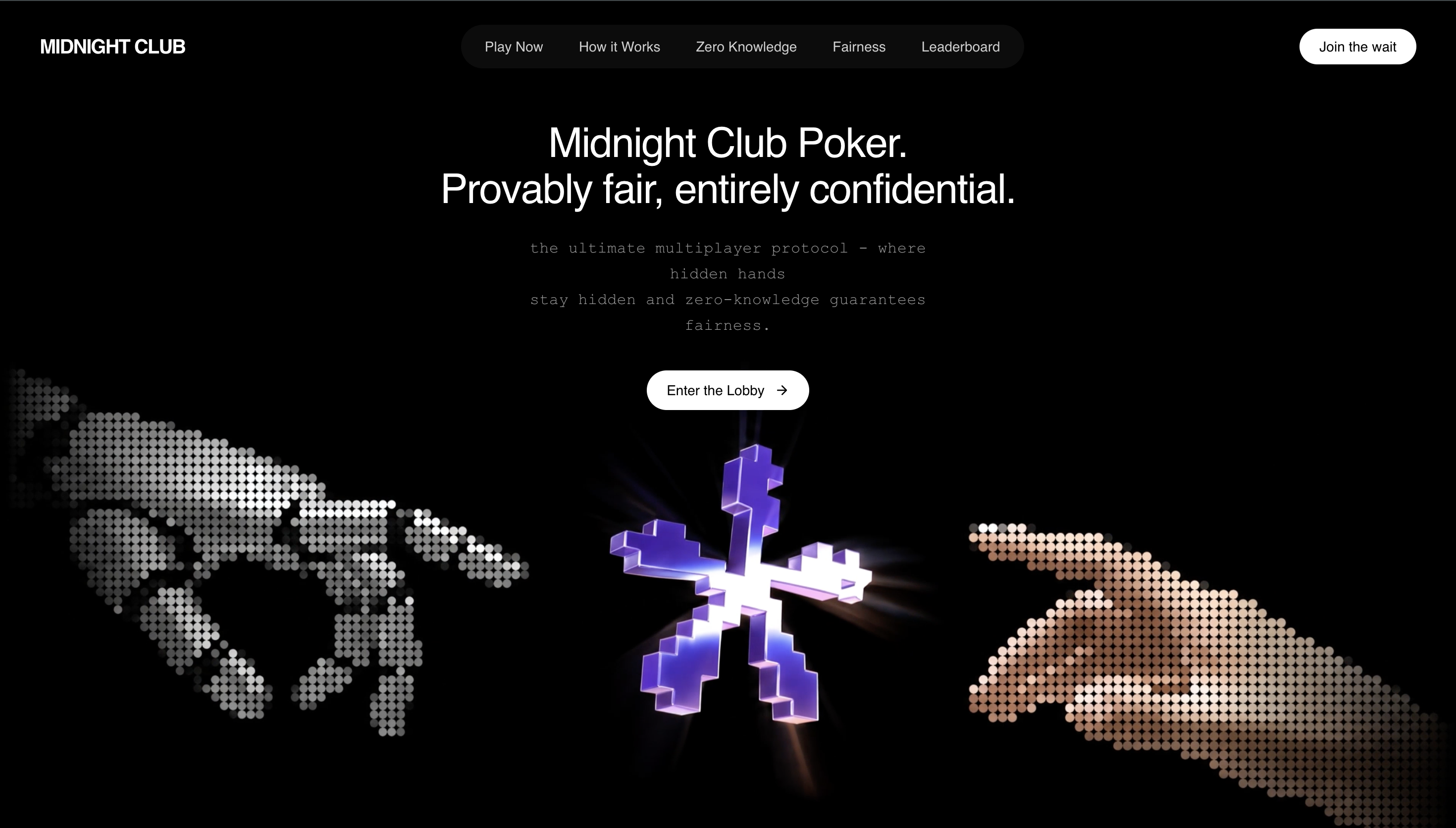
So we built Midnight Hold’em — a cinematic multiplayer poker experience where players can trust the game without revealing their secrets.
What It Does
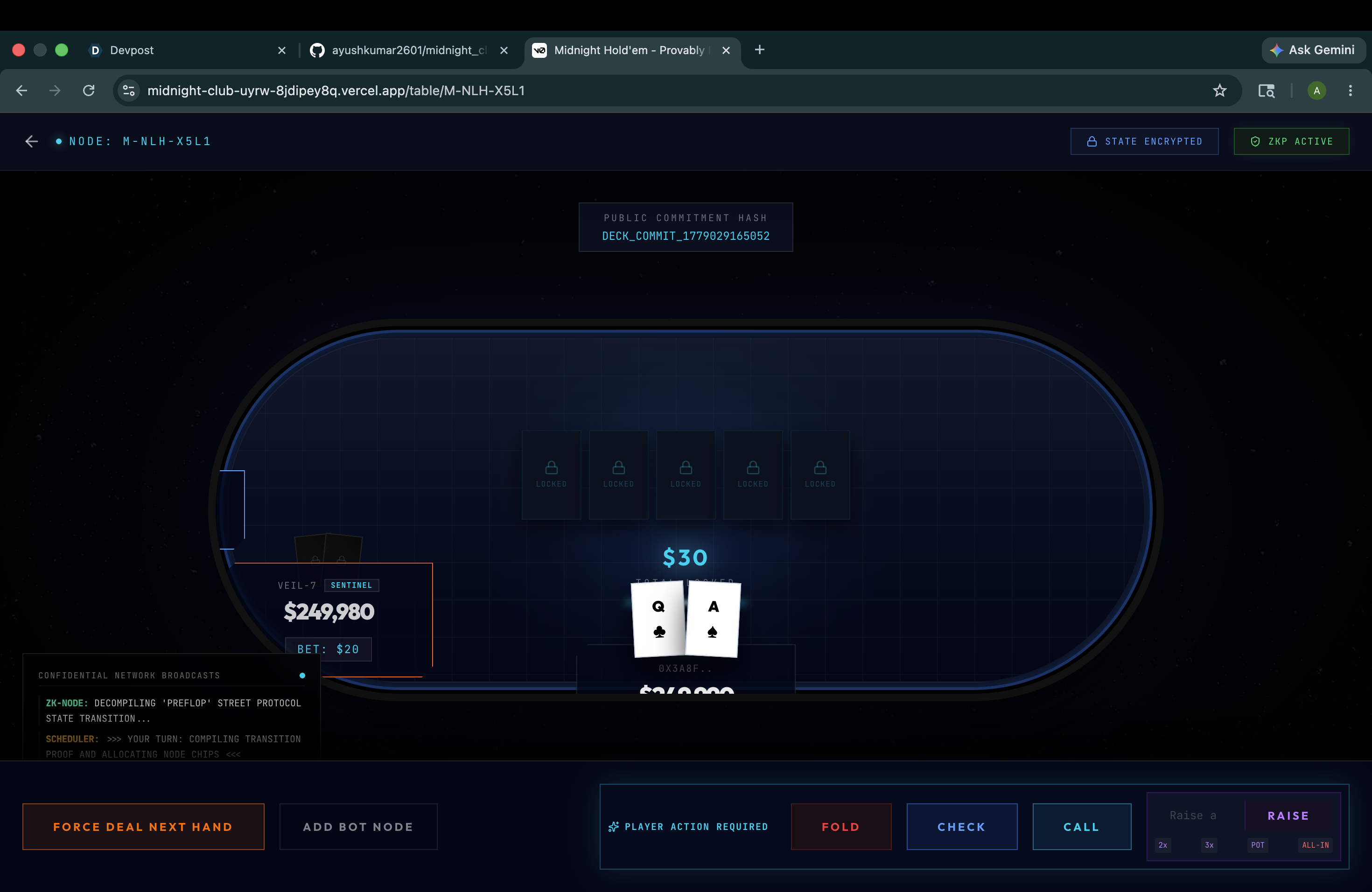
Midnight Hold’em is a real-time multiplayer Texas Hold’em platform powered by confidential gameplay systems.
Players can:
- join live poker tables,
- receive hidden cards,
- bluff and strategize in real time,
- and verify that every outcome is fair.
The core idea is simple:
Hidden information stays private, but fairness remains publicly verifiable.
The platform combines:
- real-time multiplayer networking,
- deterministic poker logic,
- mock confidential proof systems,
- cinematic cyberpunk UI,
- and synchronized gameplay architecture.
How We Built It
Frontend
We used:
to create a dark luxury cyberpunk interface inspired by futuristic casino systems and tactical multiplayer games.
The frontend includes:
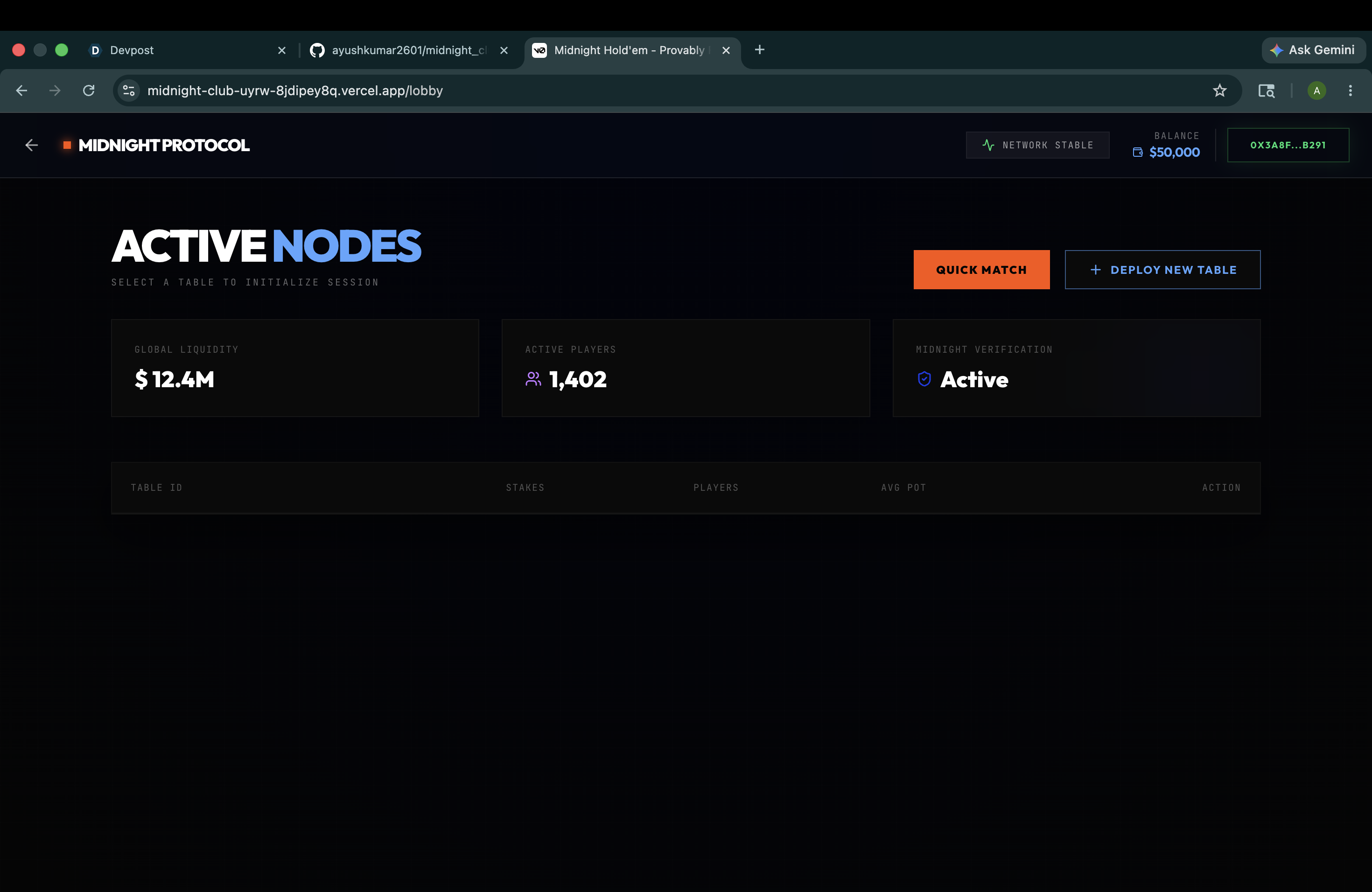
- a live multiplayer lobby,
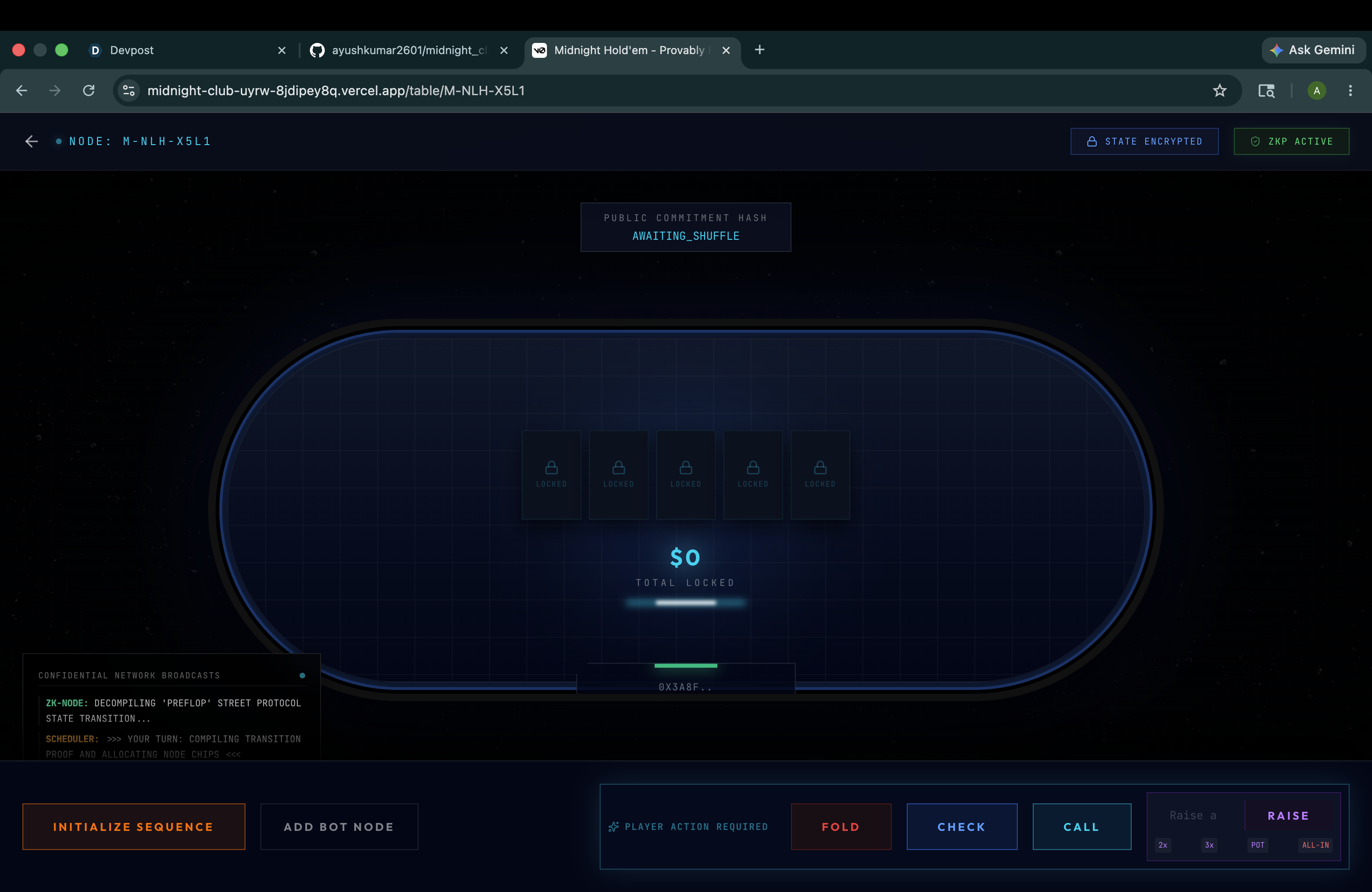
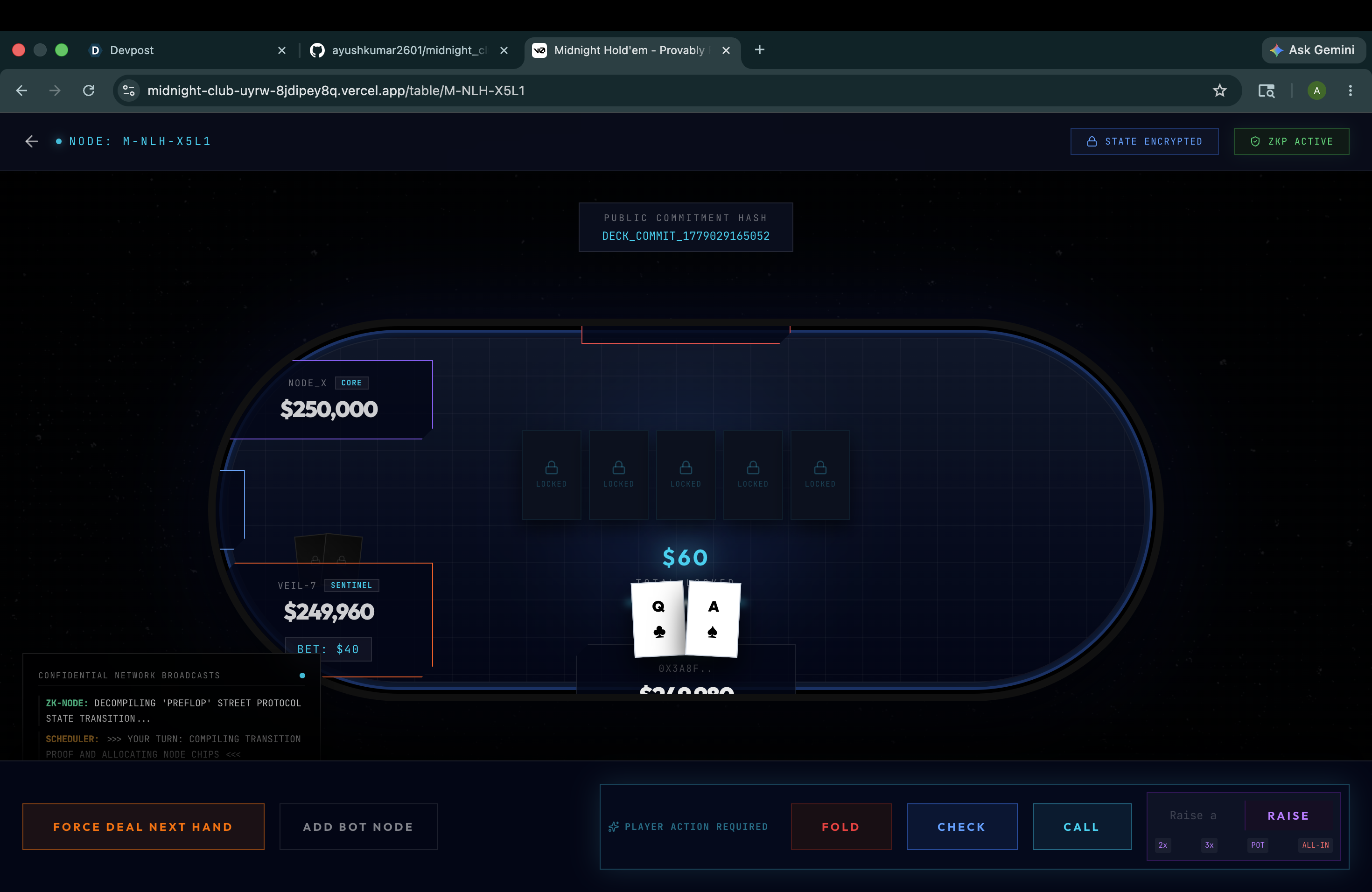
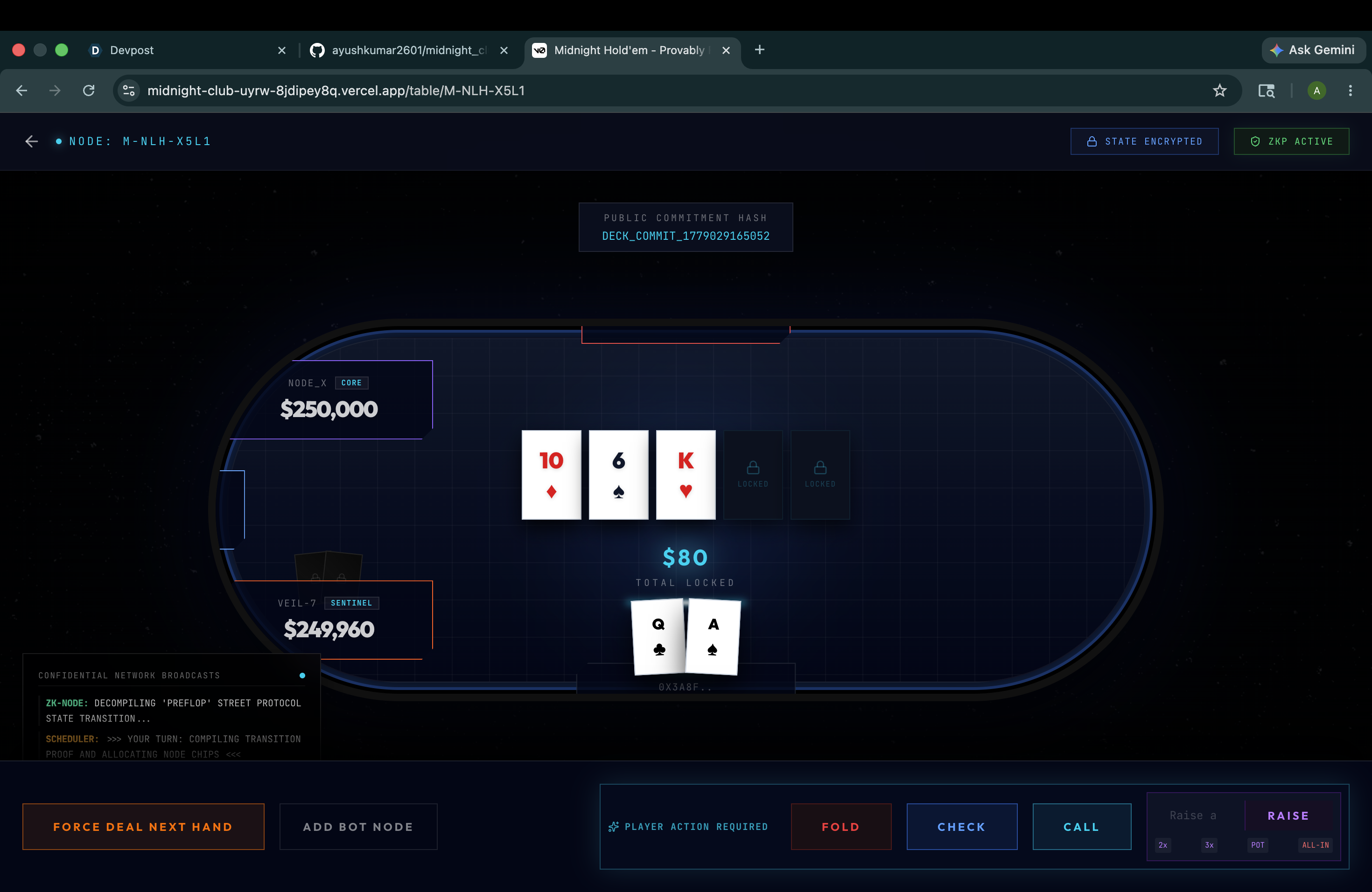
- animated poker tables,
- holographic visual systems,
- cinematic transitions,
- and responsive gameplay synchronization.
Backend & Multiplayer
For real-time gameplay we built:
- a Socket.IO-based multiplayer layer,
- deterministic poker engine logic,
- round management systems,
- betting validation,
- and synchronized room states.
The backend handles:
- turn progression,
- betting actions,
- game lifecycle,
- pot calculations,
- and showdown resolution.
Midnight Integration Concept
Using Midnight as inspiration, we designed the platform around confidential game-state architecture.
We implemented:
- hidden player hands,
- mock proof verification,
- secure gameplay flows,
- and simulated confidential validation systems.
Our goal was to demonstrate how Midnight could power an entirely new category of multiplayer games where privacy is part of gameplay itself.
Challenges We Faced
1. Real-Time Multiplayer Synchronization
Keeping multiple players synchronized across:
- betting rounds,
- turn order,
- card reveals,
- and reconnect flows
was significantly more difficult than expected.
We had to carefully manage:
- socket lifecycle,
- state synchronization,
- and race conditions.
2. Deterministic Poker Logic
Poker has a surprisingly large number of edge cases:
- ties,
- side pots,
- all-ins,
- reconnect scenarios,
- invalid actions,
- and betting validation.
Building a stable game engine required extensive restructuring and testing.
3. Balancing Visuals with Performance
The cinematic holographic UI involved:
- 3D transforms,
- layered glows,
- animated particles,
- and motion-heavy interactions.
We had to optimize rendering carefully to avoid excessive re-renders and maintain smooth gameplay.
4. Designing Around Confidential Gameplay
Traditional multiplayer systems assume all players can access shared state.
But poker fundamentally depends on hidden information.
Designing systems where:
- players only see their own hands,
- while the game still remains verifiable,
became one of the most interesting technical challenges of the project.
What We Learned
This project taught us that:
- privacy is not just a security feature,
- it can become a gameplay mechanic.
We also learned:
- how complex real-time multiplayer systems become at scale,
- how important deterministic game architecture is,
- and how much product experience matters in hackathon projects.
Most importantly, we explored how confidential smart contracts could unlock entirely new categories of decentralized applications beyond finance.
Future Vision
Midnight Hold’em is more than a poker game.
It’s a prototype for:
- confidential multiplayer infrastructure,
- trustless competitive gaming,
- and private strategy-based web3 experiences.
Future expansions could include:
- ranked matchmaking,
- tournament systems,
- replay verification,
- spectator modes,
- and fully cryptographic proof validation powered by Midnight.
Final Thoughts
Blockchain gaming often sacrifices gameplay quality for decentralization.
We wanted to reverse that.
With Midnight Hold’em, we explored a future where:
- privacy,
- fairness,
- ownership,
- and competitive integrity
can all exist together in a seamless multiplayer experience.
Play in the dark. Win in the light.
This project is highly viable for the Gaming track
Built With
- css
- express.js
- framer
- motion
- next.js
- node.js
- react
- shadcn
- socket.io
- tailwind
- typescript
- ui

Log in or sign up for Devpost to join the conversation.