-
-
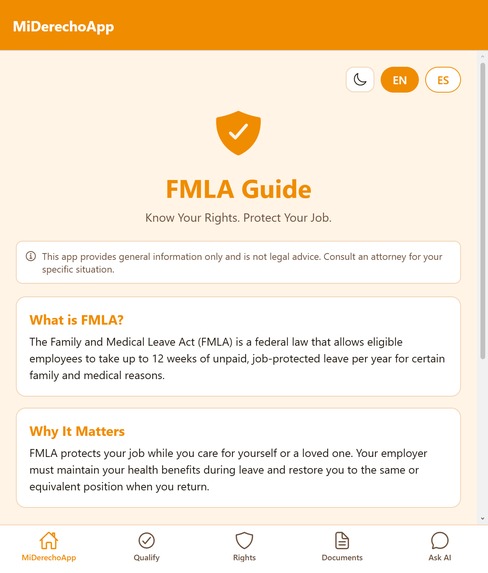
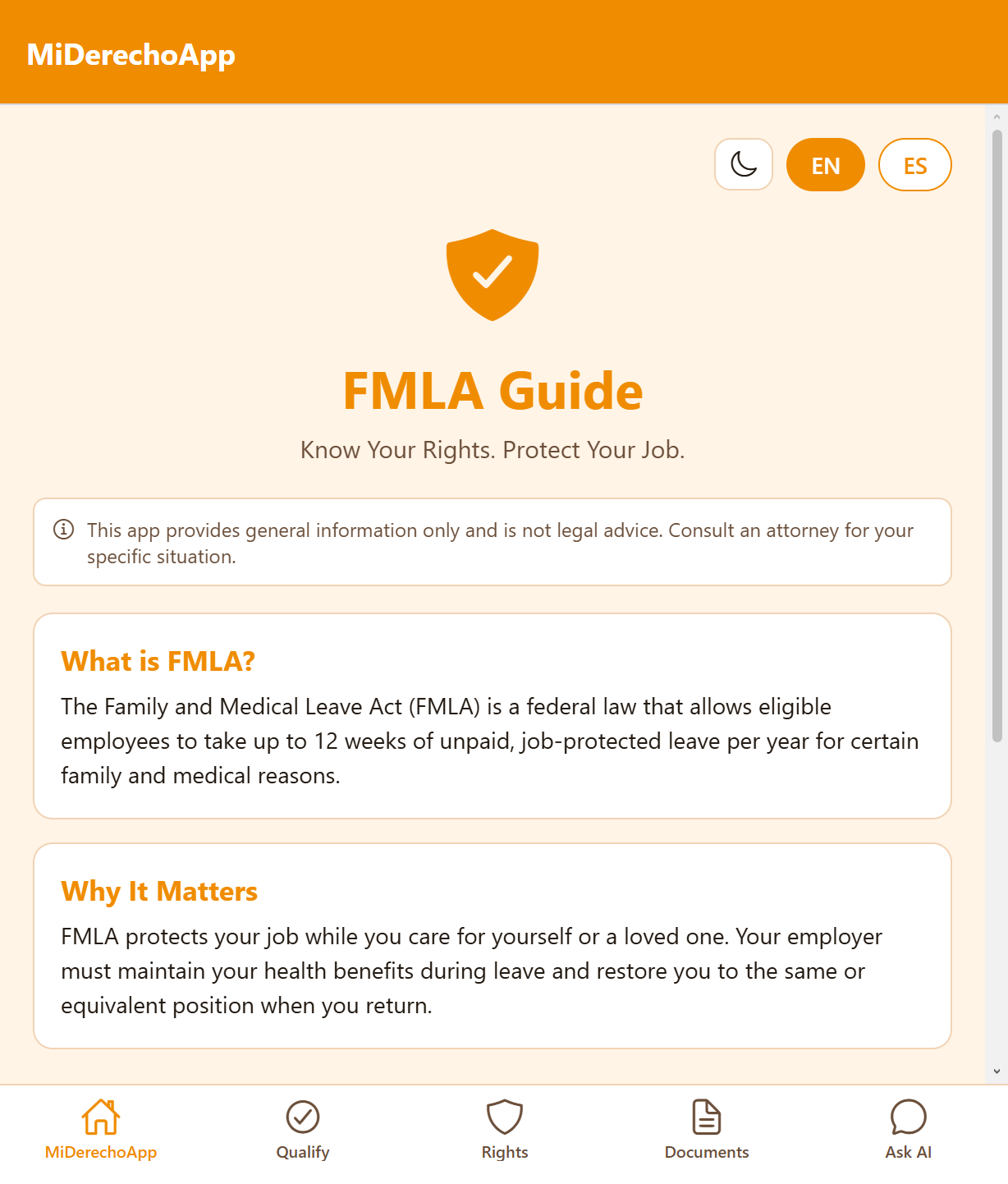
This is the dashboard/ Title page
-
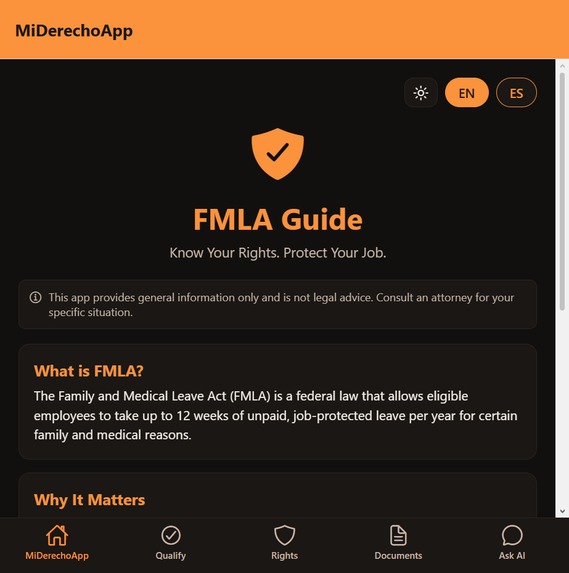
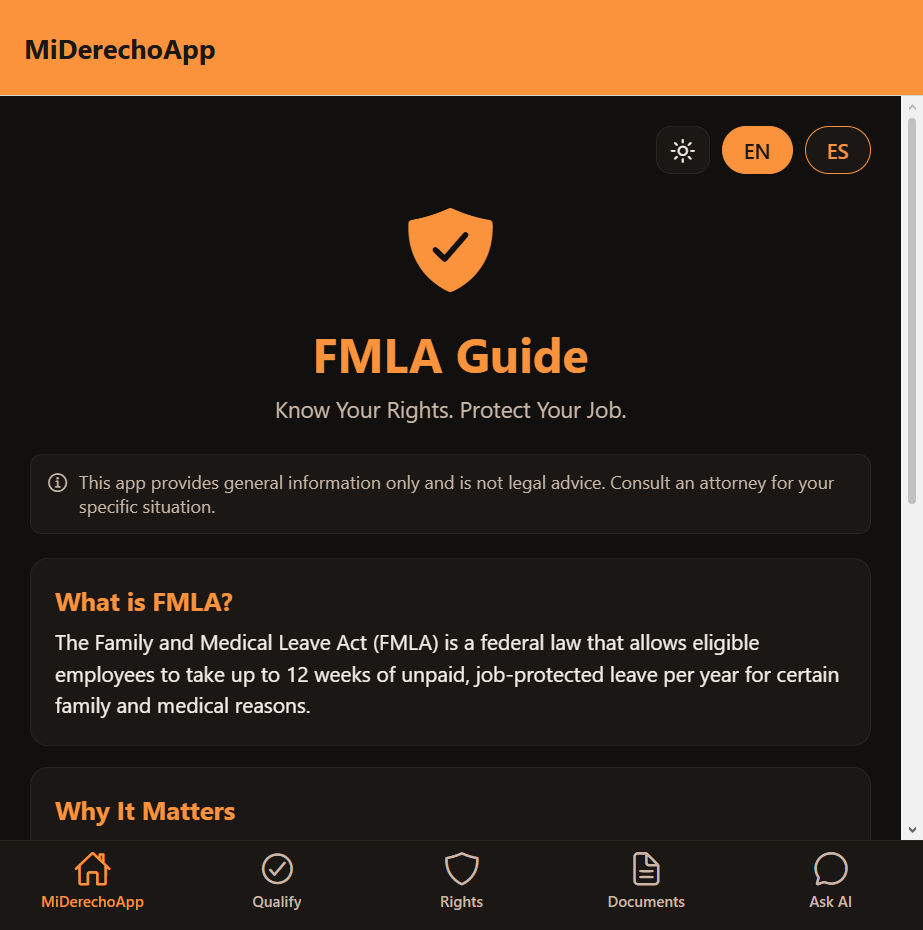
Toggled Dark mode
-
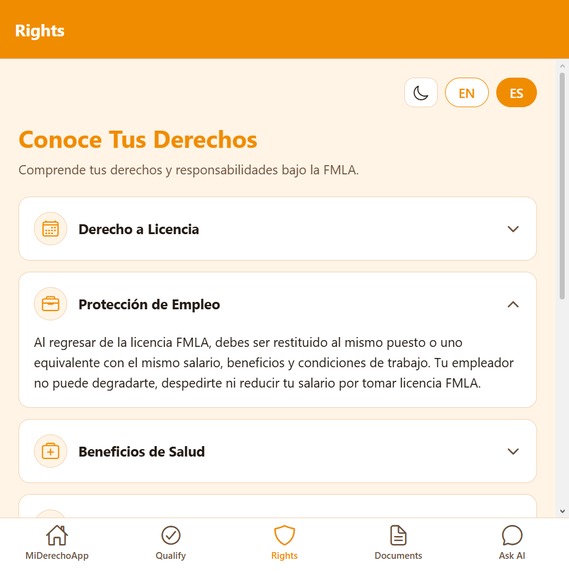
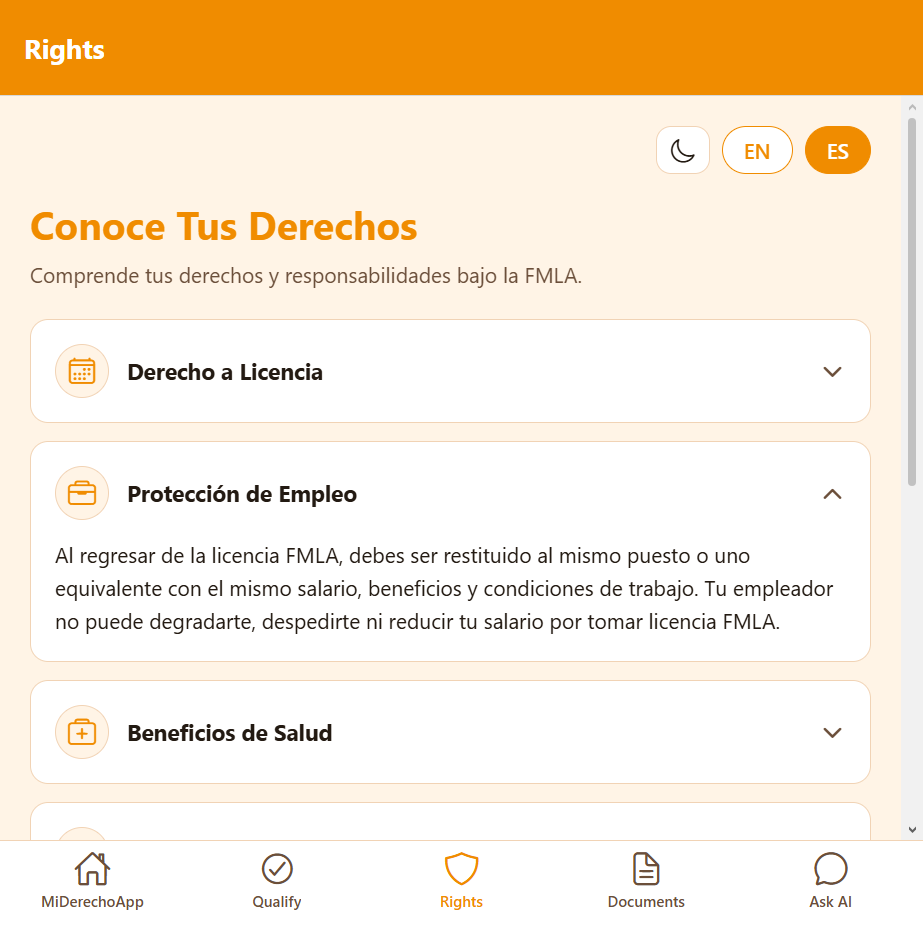
Spanish show
-
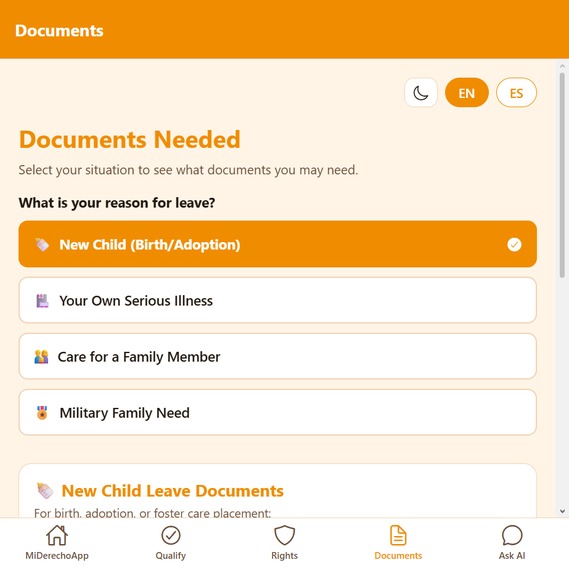
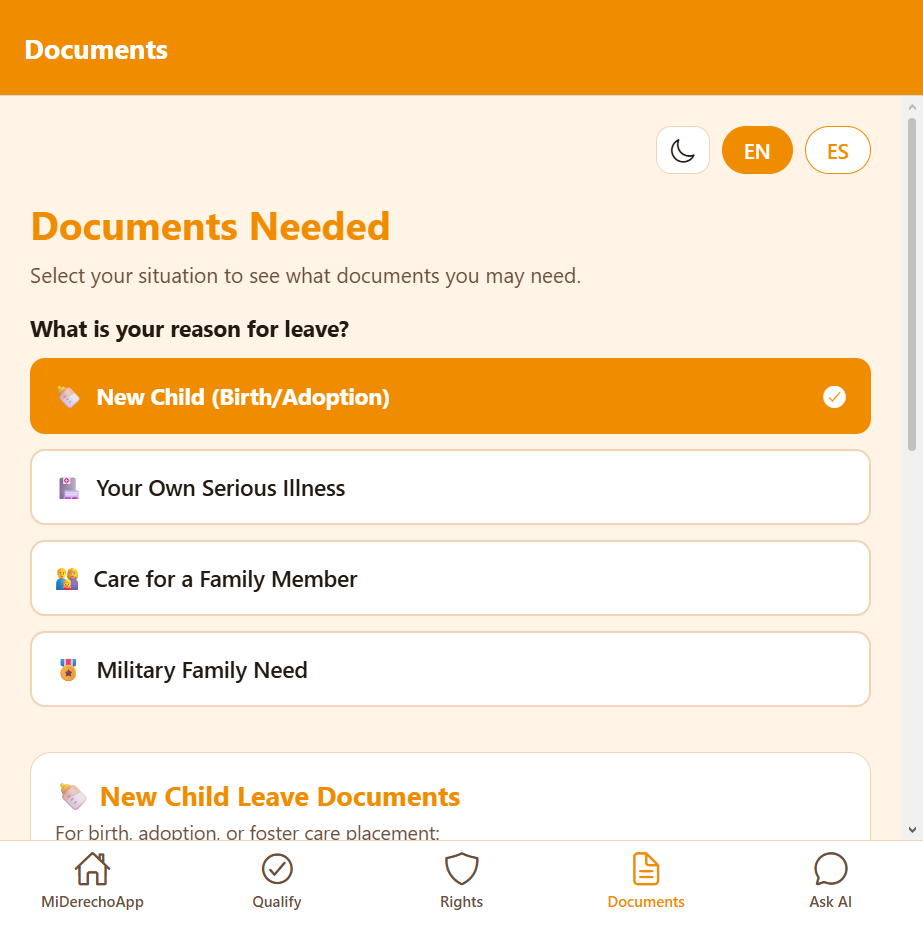
Guided area for possible documentation need.
-
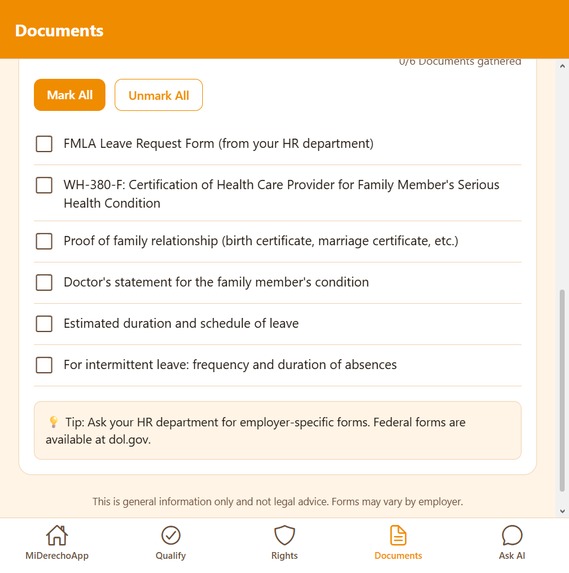
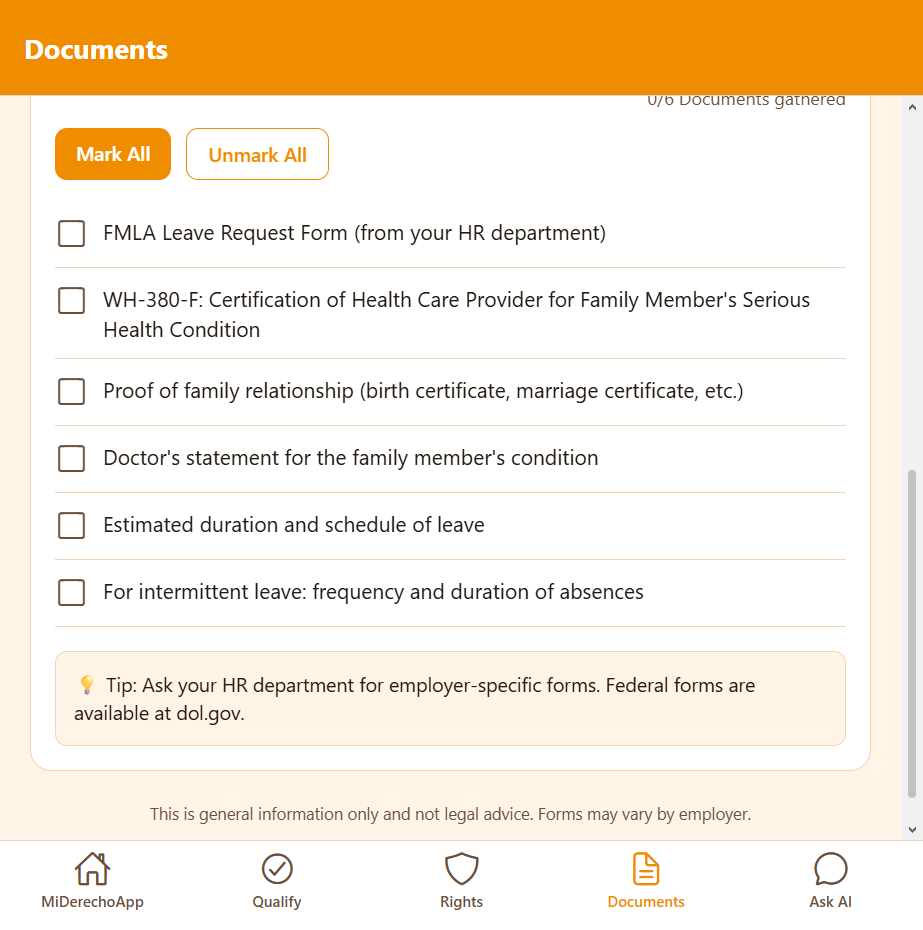
Documentation example need and "Ask HR" area.
Inspiration
Every day, workers across the United States go through some of the hardest moments of their lives — a serious illness, a new baby, a parent who needs care — without knowing that federal law protects their job during those moments. The Family and Medical Leave Act has existed since 1993, yet countless employees have never heard of it. One of our team members works at Sedgwick, a leading claims management company, and processes FMLA claims professionally every day. The most heartbreaking part of the job is not the paperwork — it is the phone calls from employees who had no idea they had this right in the first place. Workers who have been at the same company for years, paying into their benefits, raising families, and never once being told that their job could be protected during a medical crisis. This is not a knowledge gap that should exist. Employers are required to inform employees of their FMLA rights, yet in practice, many workers — especially Spanish-speaking workers in communities like the Rio Grande Valley — fall through the cracks. We built MiDerechoApp to bridge that gap. Because knowing your rights should not depend on who you know, what language you speak, or whether you can afford an attorney.
What It Does
MiDerechoApp is a bilingual (English/Spanish) mobile and web application that puts FMLA knowledge directly into the hands of workers. The app features four core tools:
• Do I Qualify? — A step-by-step eligibility checker that walks employees through the four key FMLA criteria with a clear result and plain-language explanation. • Know Your Rights — Expandable information cards covering eight essential areas of FMLA rights, including job protection, health benefit continuation, anti-retaliation protections, and intermittent leave. • Documents Needed — An interactive checklist personalized to the employee’s specific situation: new child, serious illness, family care, or military family need — with a progress tracker to stay organized. • Ask AI Assistant — A Claude AI-powered chat assistant that answers specific FMLA questions in plain language, automatically detecting and responding in the user’s language — English or Spanish — with no configuration required. Every feature is available in both English and Spanish with a single tap, designed for workers who may be in the middle of a crisis and need clear answers fast.
How We Built It
MiDerechoApp was built in 24 hours by a team of three Computer Science students from UTRGV using the following technology stack: • React Native + Expo — Cross-platform mobile and web framework, allowing us to build once and deploy on iOS, Android, and web. • Expo Router — File-based navigation for clean and maintainable screen structure. • TypeScript — Type-safe development to minimize runtime errors during rapid development. • Anthropic Claude API — Powers the AI chat assistant with context-aware, bilingual responses grounded in FMLA knowledge. • React Native Paper — Material Design component library for a polished and accessible user interface. • GitHub — Version control and collaboration across the team. • Render.com — Web deployment for a publicly accessible live demo. The FMLA content was written and verified by our team member with direct professional experience processing FMLA claims at Sedgwick, ensuring accuracy and real-world relevance throughout the app.
Challenges We Ran Into
Building a full-stack bilingual AI-powered mobile app in 24 hours came with its share of obstacles: • GitHub Submodule Conflict — Because Expo initialized its own .git folder inside our project directory, Git treated fmla-app as a nested submodule rather than a regular folder, preventing our teammate from pulling the latest changes. We resolved this by removing the nested .git directory and re-adding the files as standard tracked content. • AI Chat Integration — Integrating the Anthropic Claude API into a React Native environment required building a custom hook (useFMLAChat) to manage conversation state, streaming responses, language detection, and error handling — none of which we had built before. • React Native Paper Compatibility — Installing React Native Paper triggered a missing module error due to a corrupted cache. We resolved it by doing a clean reinstall using npx expo install and clearing the Metro bundler cache with the --clear flag. • Bilingual State Management — Keeping language state consistent across screens while also resetting conversation and checklist state on language change required careful coordination of React state and component lifecycle.
Accomplishments That We’re Proud Of
• A fully working AI chat assistant built from scratch in 24 hours — something none of us had ever built before. The assistant understands FMLA context, responds in the user’s language automatically, and handles multi-turn conversations gracefully. • True bilingual support across every screen, every feature, and every AI response — not as an add-on, but as a core design principle from the very beginning. • A first hackathon experience for one of our teammates, who jumped in, learned rapidly, and contributed meaningfully to the final product. We are incredibly proud of her growth throughout this process. • Domain accuracy — thanks to real-world FMLA claims experience on our team, every piece of content in the app reflects what employees actually face, not just what the law says on paper. • A complete, demo-ready product covering four distinct features with a clean UI, live AI integration, and web deployment — all within a single hackathon day.
What We Learned
This hackathon pushed us well beyond our comfort zones in the best possible way. Technically, we learned how to integrate a large language model API into a mobile application — including managing conversation history, handling asynchronous streaming responses, and building a custom hook architecture around an external AI service. The AI chatbot was something entirely new for all of us, and watching it respond accurately to real FMLA questions in two languages felt like a genuine breakthrough moment. Beyond the code, we learned that team dynamics matter as much as technical skill in a hackathon. Clear role separation, consistent communication, and trusting each other’s strengths made it possible to build something this complete in such a short time. We also learned that the best products come from real problems — and having someone on the team who lives and breathes FMLA claims every day made every design decision sharper and more grounded.
What’s Next for MiDerechoApp
MiDerechoApp was built in 24 hours, but the problem it solves is not going away. Our next steps: • Organizational partnerships — We want to partner with community organizations, worker advocacy groups, labor unions, and HR departments across the Rio Grande Valley and beyond to distribute MiDerechoApp to the workers who need it most. • App Store publication — Package and publish MiDerechoApp on the Apple App Store and Google Play Store to make it freely available to any worker with a smart- phone. • Expand beyond FMLA — FMLA is just one of many workplace rights employees don’t know they have. We envision MiDerechoApp growing into a comprehensive worker rights platform covering ADA accommodations, OSHA protections, wage and hour laws, and more. • Employer onboarding integration — A tool employers can use during onboarding to proactively inform new employees of their FMLA rights — addressing the root cause of the problem our team member witnesses every day. • Offline support — Ensure the informational content is accessible even without an internet connection, for workers in areas with limited connectivity. MiDerechoApp started as a hackathon project. We intend to finish it as something real. Disclaimer: MiDerechoApp provides general informational content only and does not constitute legal advice. Users are encouraged to consult a qualified employment attorney or their HR department for guidance specific to their situation.
Built With
- anthropic
- claude
- claudecode
- codex
- expodev
- gpt5.2
- omni
- openai
- opus4.6
- react-native
- typescript


Log in or sign up for Devpost to join the conversation.