Inspiration
Financial professionals are overwhelmed by the speed and volume of market news. Important information is scattered across multiple sources, while its impact on specific assets is often unclear.
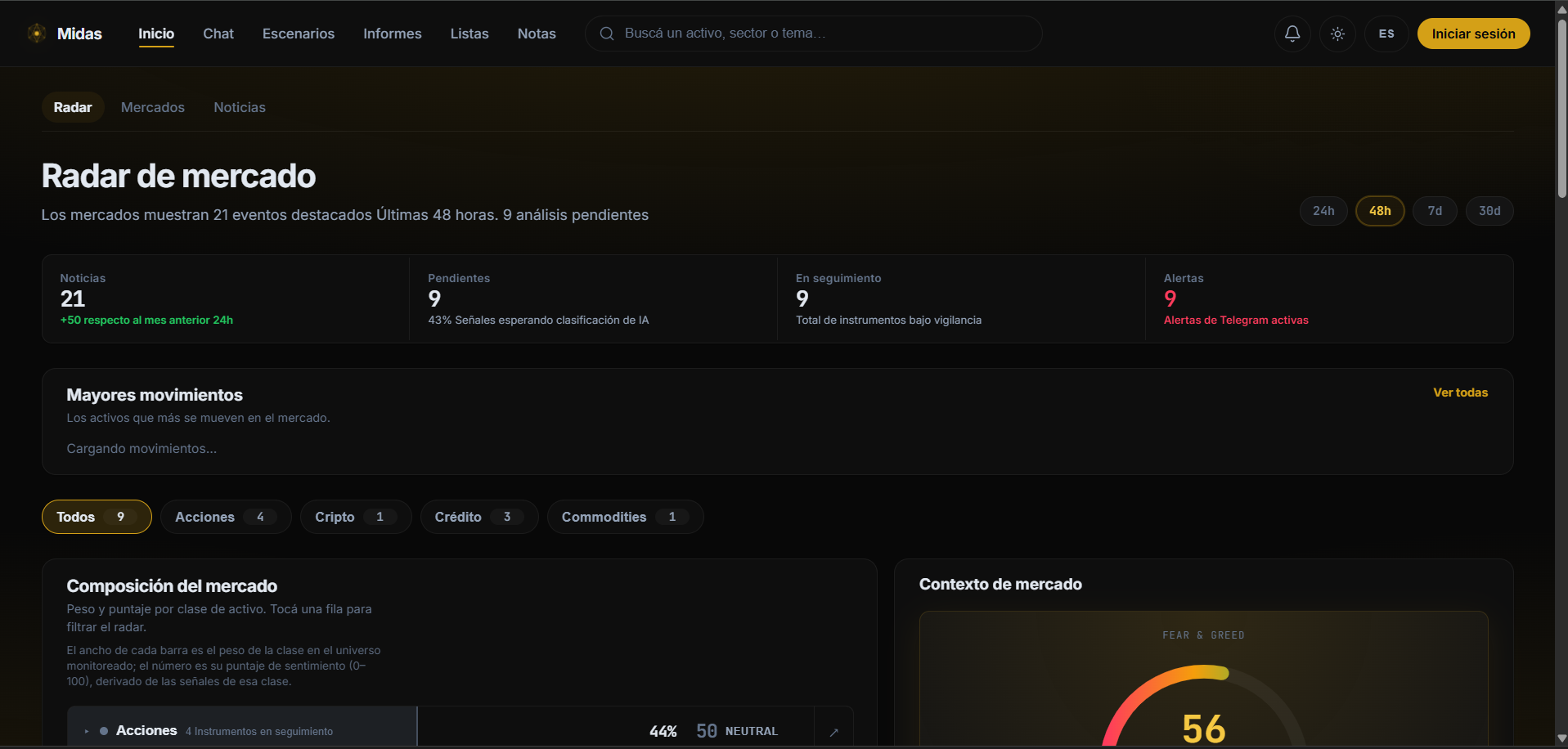
We built Midas to turn raw market information into explainable intelligence. It connects news, market data, historical analogs, and AI analysis in one workspace—helping people understand not only what happened, but why it matters and what to investigate next.
What it does
Midas is a bilingual market-intelligence workspace and AI advisory desk.
It provides:
- A market radar that links news to stocks, ETFs, crypto, commodities, and other instruments.
- Explainable signals with impact classification, confidence levels, price movements, historical comparisons, and cited sources.
- A multi-agent chat where specialized agents such as Analyst, Quant, Advisor, Macro, Sentiment, and Consequence Chain collaborate through a Supervisor.
- A visible routing trace that shows how each response was produced.
- Briefings organized around watchlists, with review, escalation, and justification workflows.
- Scenario Lab simulations that explore “what if?” events through causal chains, impact maps, historical evidence, and compliance review.
- Telegram alerts and commands for briefings, signals, simulations, and monitoring notifications.
- Voice interaction and visual market charts.
Midas never executes trades or promises returns. It produces research, alerts, and proposals while keeping a human in the loop.
How we built it
We built Midas with a FastAPI backend and Angular frontend.
The backend uses LangGraph to orchestrate a fleet of specialized AI agents. A Supervisor routes each request to the appropriate specialists, and multiple agents can work in parallel before their findings are synthesized into one answer.
The system follows hexagonal architecture. LLMs, market-data providers, news sources, vector search, memory, and notifications are isolated behind interchangeable ports and adapters. This lets us change providers without rewriting the business logic.
Our data layer combines news from multiple sources with market data from providers such as yfinance, CoinGecko, FRED, Marketaux, NewsAPI, Finnhub, RSS, and SEC EDGAR. Supabase provides authentication and persistence, while pgvector supports historical analog retrieval.
The frontend uses Angular standalone components and Signals. Chat responses stream through Server-Sent Events, while the Boardroom interface visualizes agent activity, contributions, tools, and citations in real time.
Challenges we ran into
One of our biggest challenges was coordinating several specialized agents without making the system feel like a black box. We needed routing, parallel execution, synthesis, streaming, and visible traceability to work together.
We also had to deal with noisy and inconsistent financial data. News sources differ in format, coverage, timestamps, and asset naming, so linking articles to instruments and grounding claims required careful normalization and evidence handling.
Another challenge was balancing powerful financial analysis with responsible behavior. We designed compliance into the product so that Midas provides research actions and alerts—not financial promises, trade execution, or personalized orders.
Finally, we had to make the demo reliable despite external API limits and network uncertainty. Fixture fallbacks, caching, structured outputs, and graceful degradation helped us keep the experience functional even when a live provider was unavailable.
Accomplishments that we’re proud of
We are proud to have built a complete end-to-end product rather than just a chatbot prototype.
Midas connects real market and news data to a usable radar, an AI agent fleet, explainable signals, briefings, review workflows, scenario simulations, and Telegram notifications.
We are especially proud of:
- The multi-agent Supervisor and visible routing trace.
- The Scenario Lab, which connects simulation, causal reasoning, quantification, compliance, and monitoring.
- Evidence labels that distinguish current data, historical analogs, and reasoning.
- The human-in-the-loop review workflow.
- The architecture’s provider independence and clean separation of responsibilities.
- A product experience designed for both analysts and compliance-conscious organizations.
What we learned
We learned that reliable AI products require much more than a good prompt. They need orchestration, typed contracts, data validation, persistence, observability, and clear failure behavior.
We also learned that explainability must be part of the system design from the beginning. Sources, confidence, agent contributions, and reasoning boundaries should be visible—not added as an afterthought.
Another important lesson was that safety constraints can improve the product. By focusing on research, alerts, and reviewable recommendations instead of automated trading, Midas becomes more trustworthy and easier to integrate into real workflows.
Most importantly, we learned how much stronger an AI product becomes when engineering, product design, branding, and compliance are developed together.
What’s next for Midas
Next, we want to make Midas production-ready and expand its usefulness beyond the hackathon demo.
Our priorities are:
- Complete the production deployment to AWS App Runner and Vercel.
- Finish full Spanish and English support for AI-generated content.
- Connect Scenario Lab monitoring directly to the frontend.
- Strengthen the requirement for multiple independent news sources.
- Improve historical retrieval and RAG quality.
- Add Slack, Microsoft Teams, email, and enterprise data-source integrations.
- Support enterprise SSO and customer-specific market universes.
- Improve scheduled monitoring, alert personalization, and notification controls.
- Add richer briefing exports and analytics for research teams.
Our long-term vision is for Midas to become an intelligent, auditable market-research layer that helps organizations make better-informed decisions while keeping humans firmly in control.

Log in or sign up for Devpost to join the conversation.