-
-
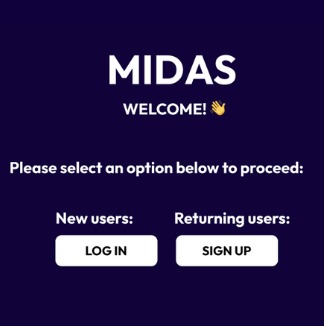
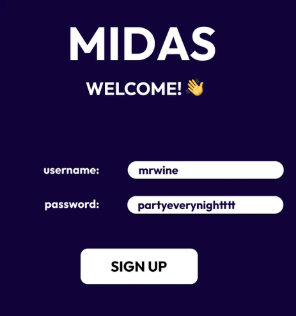
User Sign-In/Sign Up
-

User Account Login
-
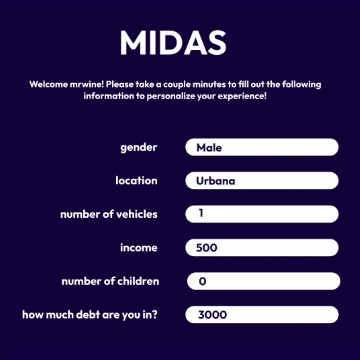
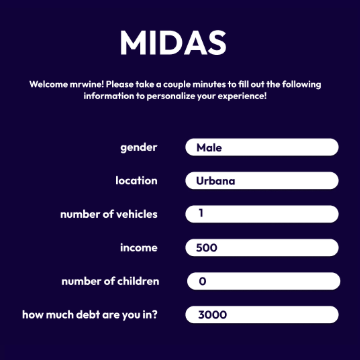
User Set-Up
-
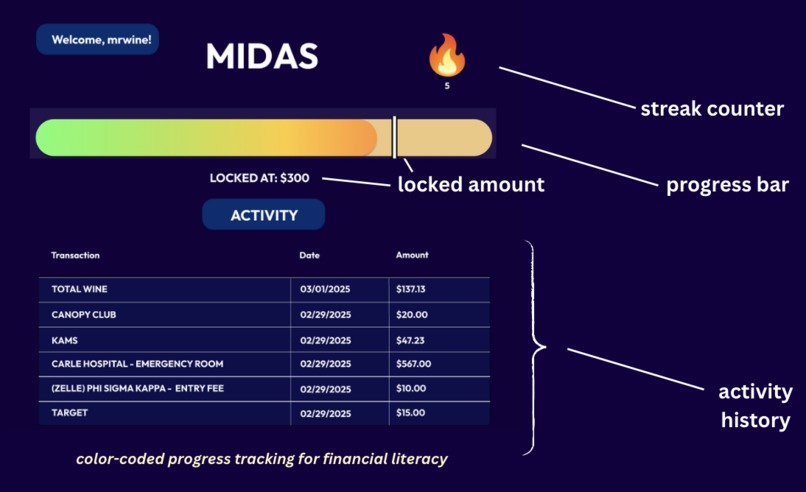
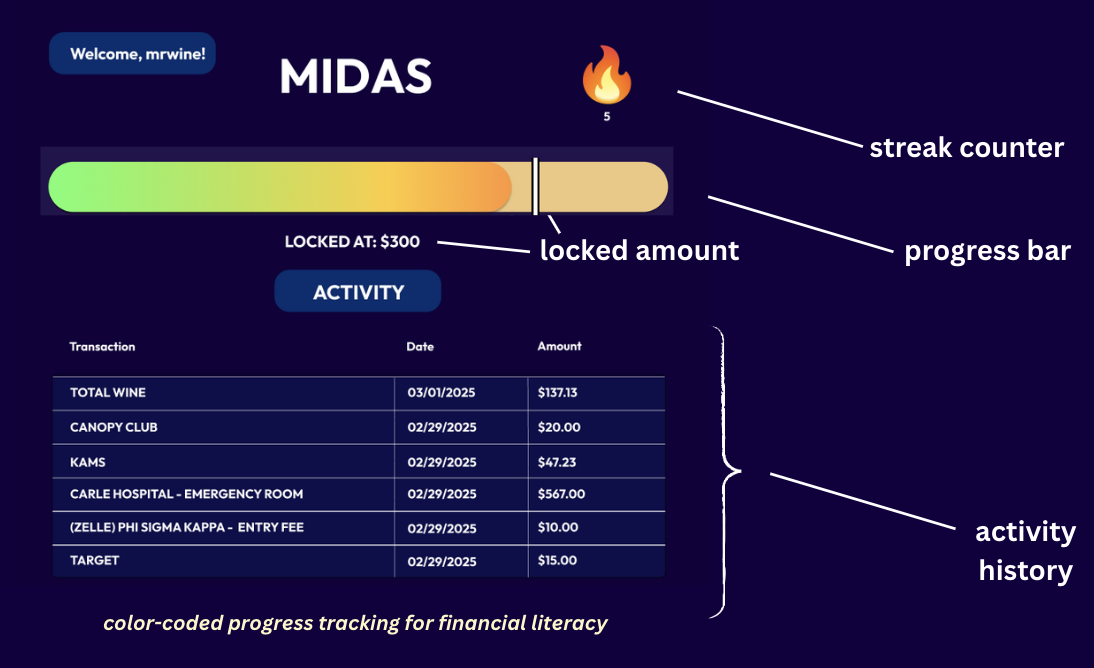
Main Page
Inspiration
Debt management is a significant issue in the United States, affecting many individuals due to high-interest credit card debt, student loans, and overspending resulting from a lack of financial literacy. According to the Council on Foreign Relations, the average student loan balance per borrower "increased by 39 percent from 2008 to 2022," as reported by US News and World Report. Additionally, The Economist highlights that "by the age of 35, master's graduates earn no more than those with just a bachelor's degree, indicating a decline in the return on investment for advanced degrees." Beyond student loans, many Americans struggle with overspending and lack proper budgeting tools, leading to financial instability. Traditional budgeting guides often track spending but fail to enforce consistent spending habits, or help users prioritize debt repayment effectively.
What It Does
To address these challenges, we developed MIDAS, an automated debt management tool that goes beyond expense tracking. MIDAS actively enforces smart budgeting and repayment strategies, assisting users from various backgrounds in overcoming debt. This is how MIDAS works:
Automated Debt Allocation
Upon receiving income, MIDAS automatically locks away a portion for debt payment. This amount is determined by a machine learning model that considers fixed loans (such as housing mortgages and car payments) and adjusts based on the user's cost of living. For instance, if a monthly car payment is $3,000, the model may lock away $3,000 or $4,000 depending on the user's location. This approach provides a buffer for unexpected expenses like credit card payments. In high cost-of-living areas like California, exactly $3,000 might be locked away, whereas in lower cost-of-living areas like Arkansas, $4,000 could be reserved to account for surprise expenses.
Bank Account Integration
MIDAS links directly with users' bank accounts, eliminating the need for manual expense entry. This feature ensures that all expenses are tracked automatically, reducing the risk of forgetting to log transactions and simplifying the budgeting process. This is what we hope to do with banks.
Gamification for Motivation
To encourage consistent financial habits, MIDAS incorporates gamified elements. Users earn "streaks," represented by animated fire icons, for each month they avoid accessing locked funds. This visual motivation helps reinforce positive financial behavior. This will be in a future implementation.
How We Built It
Our development process involved several key technologies:
Backend
We utilized Capital One’s Nessie API to handle financial data and Firebase for secure data storage and authentication.
Frontend
The user interface was built using React.js, providing a responsive and intuitive experience.
UI/UX Design
Figma was employed for designing the user interface, ensuring a user-friendly and visually appealing layout.
Challenges We Ran Into
As a team with three out of four members participating in a hackathon for the first time, we encountered several challenges:
Defining a Clear Vision
Initially, we struggled to establish and maintain a clear project vision and pathway, which is crucial for cohesive development.
Learning New Technologies
Navigating and learning new technologies on the fly presented a steep learning curve, requiring quick adaptation and problem-solving.
Team Coordination
Ensuring effective communication and task delegation among team members was challenging but essential for integrating various components of the project.
Accomplishments That We’re Proud Of
Despite the challenges, we achieved several milestones:
Ideation to Implementation
Successfully transforming an idea into a functional tool within the limited timeframe of the hackathon.
Collaboration
Working cohesively as a team, leveraging each member's strengths, and supporting each other’s learning and development.
Functional Prototype
Developing a working prototype of MIDAS that integrates key features such as automated debt allocation and gamification elements.
What We Learned
Throughout this project, we gained valuable insights:
Team Collaboration
The importance of clear communication, task delegation, and maintaining a unified vision.
Technical Skills
Enhanced our proficiency in technologies like React.js, Firebase, and API integration.
User-Centric Design
Recognized the significance of designing with the end-user in mind, ensuring the tool is intuitive and addresses real pain points.
What's Next for MIDAS
We envision several future enhancements for MIDAS:
Advanced AI Integration
Implementing artificial intelligence to optimize debt repayment schedules, adjust budgets based on spending history, and suggest priority payments using existing financial forecasting models.
Personalized Adjustments
Factoring in job-based cost-of-living variations, debt deadlines, and interest rates to provide more tailored financial advice.
Credit Card Controls
Adding features that allow users to manage not only debit card, but also credit card spending, directly through MIDAS, promoting better credit utilization and debt management.
We are proud of what we have created and accomplished, particularly the process of ideating, building, testing, and developing a tool like MIDAS within the limited timeframe of the hackathon. This experience required strong collaboration and focused teamwork. MIDAS is a solution designed for the real world, aiming to build better financial literacy and discipline. With MIDAS, you can "turn your fortunes around with a touch!"
Built With
- capital-one-api
- fast-api
- figma
- flask
- machine-learning
- netlify
- react
- streamlit


Log in or sign up for Devpost to join the conversation.