-
-
Data-Driven Micro-Payouts
Inspiration
Splitting money inside a group is harder than it looks. A creator squad, an open-source team, or a small agency earns a pool of money, and then someone has to decide who gets what. The proof of who did the work is scattered across GitHub commits, invoices, screenshots and hour logs. Someone ends up working it out in a spreadsheet, a few cents go missing in the rounding, people disagree about the numbers, and the payments go out one at a time.
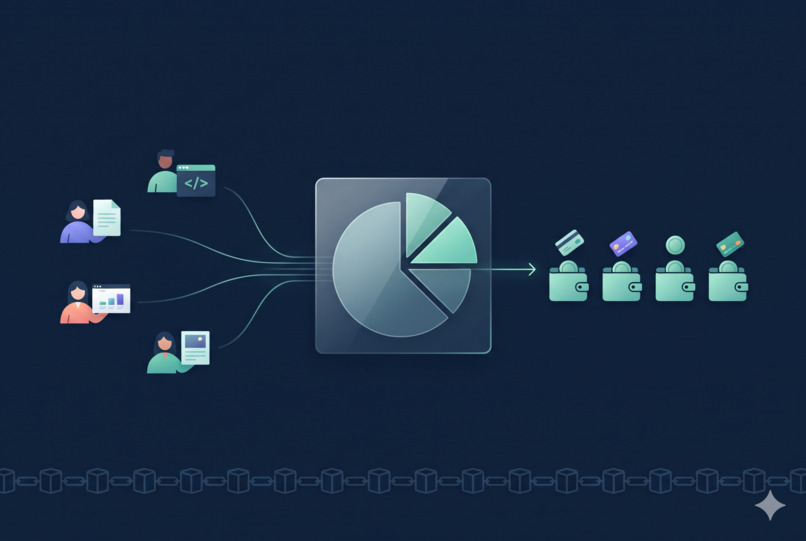
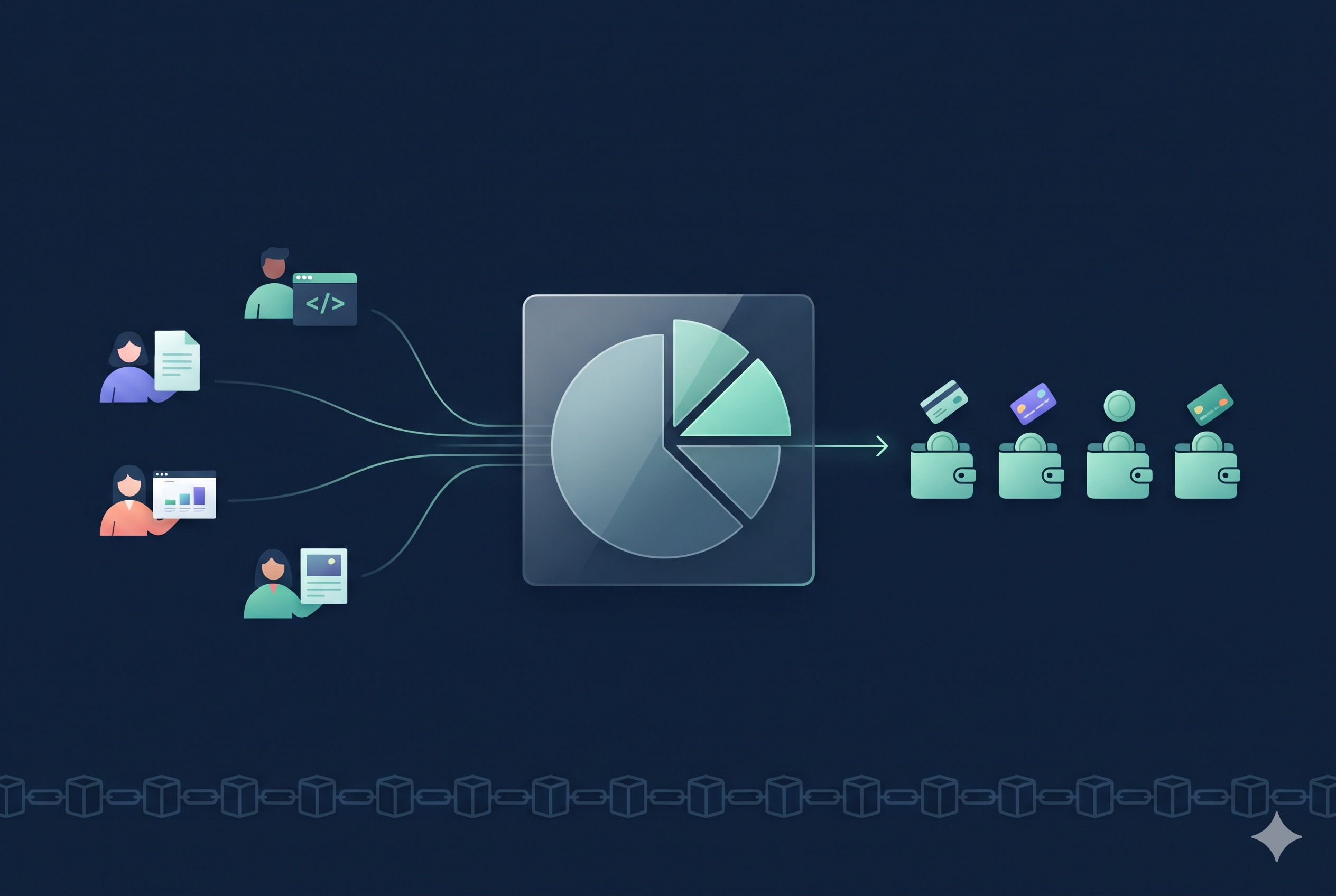
We wanted to see if this could be done in a way where every person can check the result. The idea was to let AI do the reading of messy evidence, let plain code do all the arithmetic, and pay everyone in one PayPal batch.
What it does
MicroSplit AI takes contribution evidence and turns it into a payout.
You upload files such as GitHub links, PDF invoices, screenshots, CSVs or audio notes. Each file is hashed so any later change is detectable. A multimodal AI model reads the files and pulls out structured facts: who did what, when, and how much. Each fact comes with a confidence score, and duplicate files or conflicting records are flagged for a human approver.
Once the facts are approved, the split itself is done by deterministic code, not by the AI. All money is handled as integer cents, and rounding uses the largest-remainder method, so the payouts always add up to the pool exactly. The approved split is then sent through the PayPal Payouts v1 batch API (sandbox), and the status moves from Draft to Approved, Sent and Paid.
There are two extra features. The first is a consistency streak bonus. A squad can set aside a small share of the pool (5% by default, 10% at most) for members who contribute on consecutive days. Days are counted in each member's own timezone, and approvers can grant "freeze days" with a written reason so that a legitimate break doesn't reset a streak. The second is opt-in focus sessions. A member can log when they worked on a task. The app stores only the member, the task, and the start and end times. It never records keystrokes, screenshots or window titles, and members can delete their sessions at any time. Focus sessions count as evidence for an approver to review and never change a payout directly.
Every event is written to a SHA-256 hash chain, and the ledger page has a "Verify Chain" button that checks the whole chain.
A worked example from the demo: a $1,000.00 pool with a 5% consistency bonus gives a $50.00 consistency pool and a $950.00 work pool. Maya and Sam have equal work weight, so each gets $475.00 from the work pool. Maya has a 100-day streak and Sam has none, so Maya gets the whole $50.00 bonus. Maya is paid $525.00, Sam is paid $475.00, and the total is exactly $1,000.00.
How we built it
The app is built with Next.js (App Router) and TypeScript, styled with Tailwind CSS and Framer Motion. The data layer uses Prisma with a PostgreSQL schema. Payments go through the PayPal Payouts v1 batch API in sandbox mode. The audit ledger uses SHA-256 hash chaining through crypto-js, and the app is deployed on Vercel.
The main design rule is that the AI never touches the money. The model only proposes facts from the evidence. Everything after that is ordinary code:
Built With
- crypto-js
- eslint
- framer-motion
- nextjs
- node.js
- paypal
- paypal-payouts-api
- postcss
- postgresql
- prisma
- react
- sha-256
- tailwindcss
- turbopack
- typescript
- vercel

