Inspiration Retrieval-Augmented Generation (RAG) is one of the most powerful paradigms in modern AI, but standard implementations have become increasingly bloated. Developers often have to stitch together heavy vector databases, complex indexing pipelines, and third-party cloud services just to query local documents.
We asked ourselves a simple question: What if you could perform lightning-fast document retrieval and question-answering with a lightweight, minimal-dependency backend that runs anywhere? That’s why we built microRAG—a streamlined, high-performance RAG system designed to bring context-aware AI back to the basics without sacrificing speed or reliability.
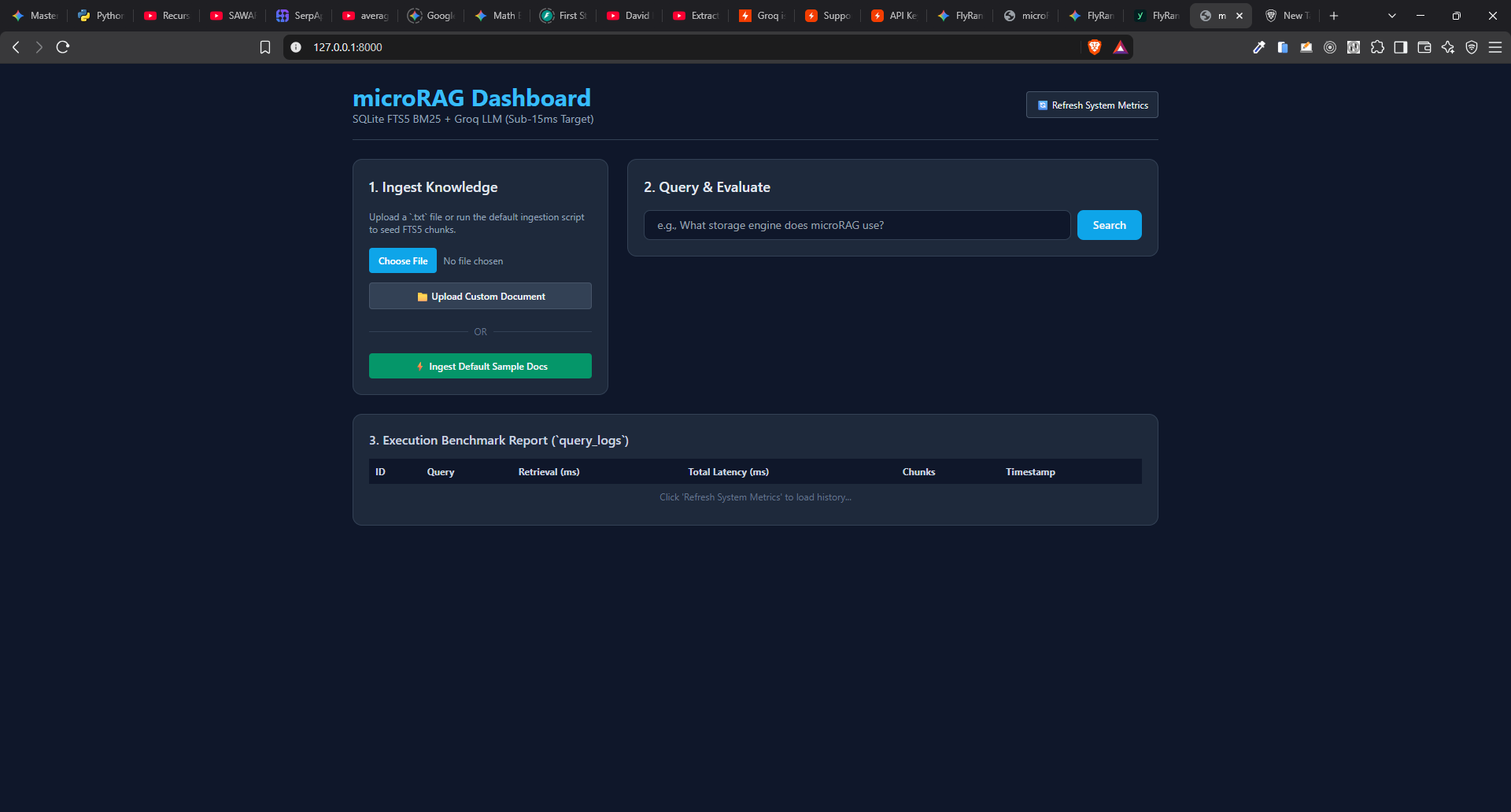
What it does microRAG is an end-to-end, lightweight document ingestion and retrieval engine. It allows users to upload documents, automatically chunks and indexes the content, and performs high-speed context retrieval to feed into Large Language Models for accurate, source-grounded answers.
Document Ingestion: Parses uploaded files and breaks them down into structured text chunks.
Hybrid Search & Indexing: Employs SQLite with Full-Text Search (FTS5) for low-latency context matching without requiring an external vector server.
Fast Query Pipeline: Retrieves relevant document passages in milliseconds and formats them into an optimized prompt context for LLM generation.
Performance Logging: Tracks query latency, chunk retrieval counts, and performance metrics in real time.
How we built it We engineered microRAG with simplicity and developer experience in mind:
Backend API: Built using FastAPI and Python, exposing clean RESTful endpoints for document upload (/api/ingest/file), querying, and system health checks.
Data Storage & Retrieval: Utilized SQLite with custom schema design for document chunks and query logs, incorporating FTS5 (Full-Text Search) with Porter stemming for fast token-based search.
Runtime Adaptability: Engineered custom filesystem handling to detect production vs. local environments, allowing the app to run seamlessly locally or deploy serverlessly.
Challenges we ran into Deploying a file-heavy, database-backed Python application to a serverless environment like Vercel presented several real-world engineering hurdles:
Read-Only Serverless Filesystems: Serverless environments enforce read-only execution layers. SQLite attempting to create database files or write-ahead logs (PRAGMA journal_mode = WAL;) caused runtime crashes. We solved this by routing database paths dynamically to the ephemeral /tmp volume in production and conditionally bypassing WAL mode.
Missing C Extensions in Serverless Python: AWS Lambda/Vercel Python runtimes lack standard SQLite fts5 module compilation. We implemented graceful exception fallbacks so the ingestion engine degrades safely to standard database queries without throwing uncaught 500 errors.
Multipart Form-Data Handling: Ingesting file uploads in FastAPI required explicit handling of python-multipart dependencies across build environments to prevent serverless module import failures on startup.
Accomplishments that we're proud of Zero Heavy Dependencies: Built a fully functional RAG pipeline without needing heavy vector DB infrastructure or multi-gigabyte dependencies.
Production-Grade Resilience: Successfully solved read-only filesystem limitations and missing binary modules to achieve stable deployments on serverless runtimes.
Millisecond Latency: Achieved near-instant retrieval times for context lookup and query logging.
What we learned Serverless Edge Cases: Deeper insights into how serverless container lifecycles, ephemeral storage (/tmp), and read-only filesystems impact database-driven Python applications.
Pragmatic AI System Architecture: You don't always need complex vector embeddings or costly managed cloud databases to build effective context retrieval systems—traditional full-text indexing in SQLite can be remarkably fast and effective.
What's next for microRAG Hybrid Vector Indexing: Integrate lightweight local embedding models (like ONNX runtime embeddings) alongside SQLite FTS5 for hybrid keyword + semantic search.
Persistent Managed Storage: Add optional connectors for managed cloud SQLite (such as Turso/libSQL) to persist document indexes across serverless container cold-starts.
Multi-Format Parsing: Expand native file support to complex PDFs, Markdown trees, and codebases with syntax-aware chunking.
Interactive UI: Develop a polished dashboard for visualizing context chunks, confidence scores, and query execution timelines.

Log in or sign up for Devpost to join the conversation.