Inspiration
We were inspired by the undeniable link between mental well-being and professional productivity. In a world where young adults face increasing pressure, existing solutions often treat mental health and career development as separate issues. We wanted to build a single, compassionate platform that addresses both in a seamless, stigma-free way. Our goal was to create a digital companion that doesn't just track your feelings but actively guides you toward feeling better and moving forward with personalized, actionable advice.
What it does
MicroMood is an AI-powered web app that acts as your personal mental health and career companion. Users can:
- Track Their Mood: Describe their feelings and stress level through an intuitive interface.
- Receive Instant Analysis: Our custom sentiment analysis engine provides immediate feedback on their emotional state.
- Get Personalized Micro-Tasks: The app generates small, contextual actions tailored to the user's current mood. This could be a breathing exercise for anxiety or a 10-minute coding challenge for motivation.
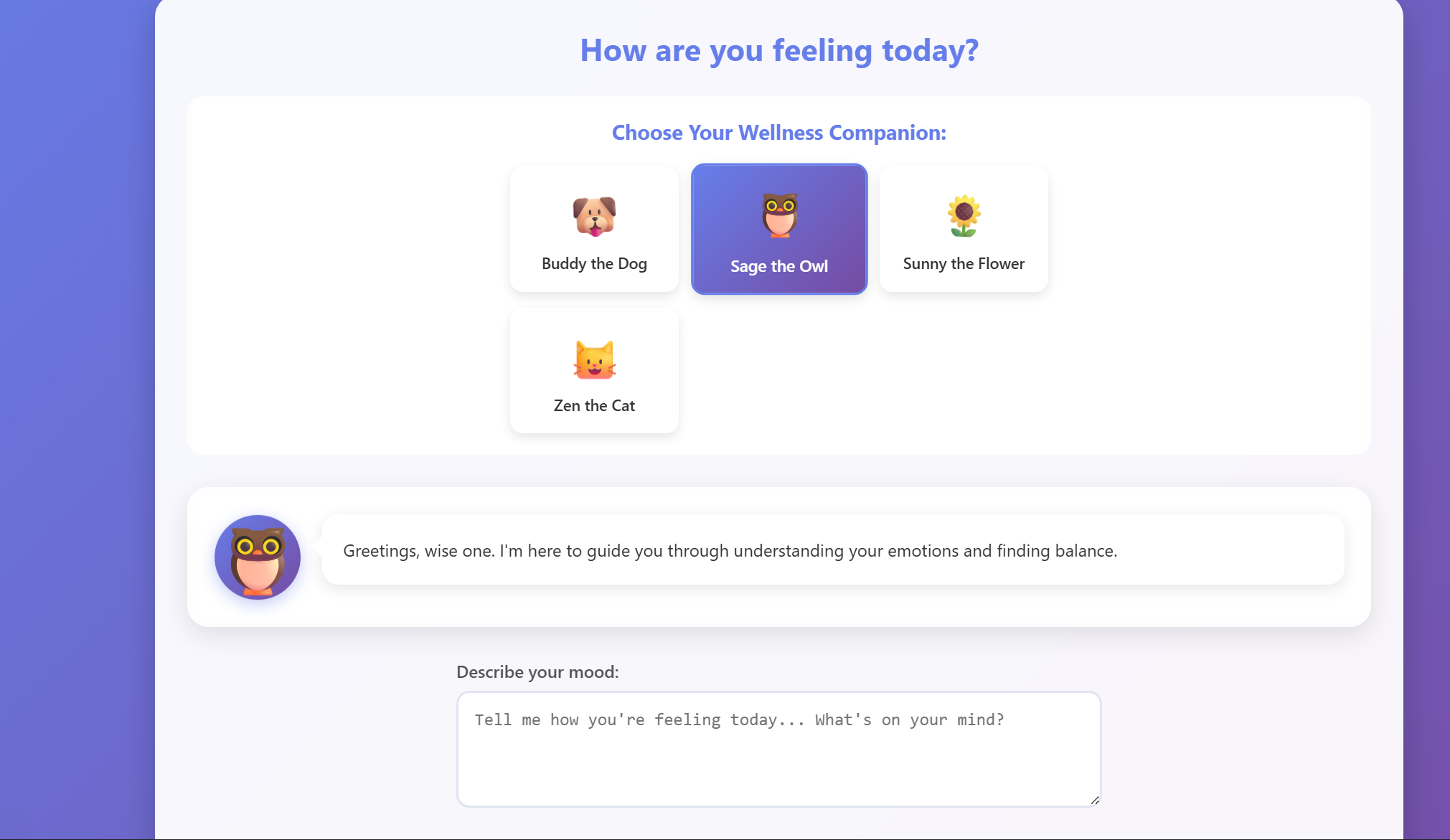
- Choose a Supportive Companion: Users can interact with one of four unique characters (Buddy the Dog, Sage the Owl, Sunny the Flower, or Zen the Cat), each offering different personality-driven support.
- Visualize Progress: A built-in dashboard with interactive charts helps users see their emotional trends and stress patterns over time.
- Enjoy Complete Privacy: All data is stored locally on the user's device, ensuring 100% confidentiality.
How we built it
MicroMood was built as a responsive single-page application (SPA) with a focus on front-end technology.
- Frontend: HTML5, CSS3, and vanilla JavaScript for a lightweight, fast experience.
- Data Visualization: Chart.js for building the interactive mood and stress timeline graphs.
- Data Storage: The browser's
localStorageAPI to keep all user data private and secure on their device. - Sentiment Analysis Engine: We built a custom engine in JavaScript that uses keyword matching with extensive libraries of positive and negative words to analyze user input and calculate a sentiment score and polarity.
- Design: A custom UI/UX design was created from scratch to be calming, intuitive, and engaging.
Challenges we ran into
- Building a Custom Sentiment Engine: Without relying on external APIs, creating an accurate enough sentiment analysis system using pure JavaScript was a complex challenge. Balancing the keyword libraries and fine-tuning the scoring algorithm required significant iteration.
- Data Management & UI Sync: Ensuring the Chart.js graphs updated in real-time as new mood entries were added, and seamlessly managing data flow between
localStorageand the application state, presented several debugging hurdles. - Character System Integration: Designing the four distinct character personalities and ensuring their responses were contextually relevant to the user's mood analysis required careful planning and creative writing.
- Time Constraint: The entire application was designed, coded, and debugged in an intensive 8+ hour development sprint, which required focused effort and rapid problem-solving.
Accomplishments that we're proud of
- Creating a Fully Functional App in a Sprint: Delivering a complex, feature-complete application with custom AI, data visualization, and a unique character system in just over 8 hours.
- Prioritizing User Privacy: Building a system that respects user data by keeping everything client-side, with no backend or data collection.
- Seamless Integration: Successfully merging the two domains of mental health support and career development into one cohesive, natural user experience.
- The Character System: Designing four lovable and distinct characters that users can genuinely connect with for different types of support.
What we learned
- The Power of Vanilla JS: We deepened our understanding of advanced JavaScript concepts and how to build complex features without heavy frameworks.
- UI/UX for Mental Health: Designing for an application in this space requires a special emphasis on empathy, tone, and simplicity to avoid overwhelming the user.
- Algorithm Design: Creating even a simple sentiment analysis algorithm from scratch provides invaluable insight into the world of Natural Language Processing (NLP).
- Project Scoping: We learned to effectively scope a project for a hackathon, balancing ambition with what is achievable within a tight deadline.
What's next for MicroMentor
- Expanded Task Library: Building a much larger database of micro-tasks and resources for both mental health and career growth.
- Advanced NLP: Integrating a more sophisticated natural language processing API for even more accurate sentiment and theme detection (e.g., detecting anxiety about interviews vs. anxiety about social situations).
- Push Notifications & Scheduling: Implementing gentle, reminder-based check-ins to help users build a consistent habit.
- PWA Implementation: Packaging MicroMood as a Progressive Web App (PWA) so users can "install" it on their phones for easier access.
- Community Features (Optional & Privacy-Focused): Exploring anonymized, opt-in features where users can see aggregate data about common stressors or share encouraging messages.


Log in or sign up for Devpost to join the conversation.