Inspiration
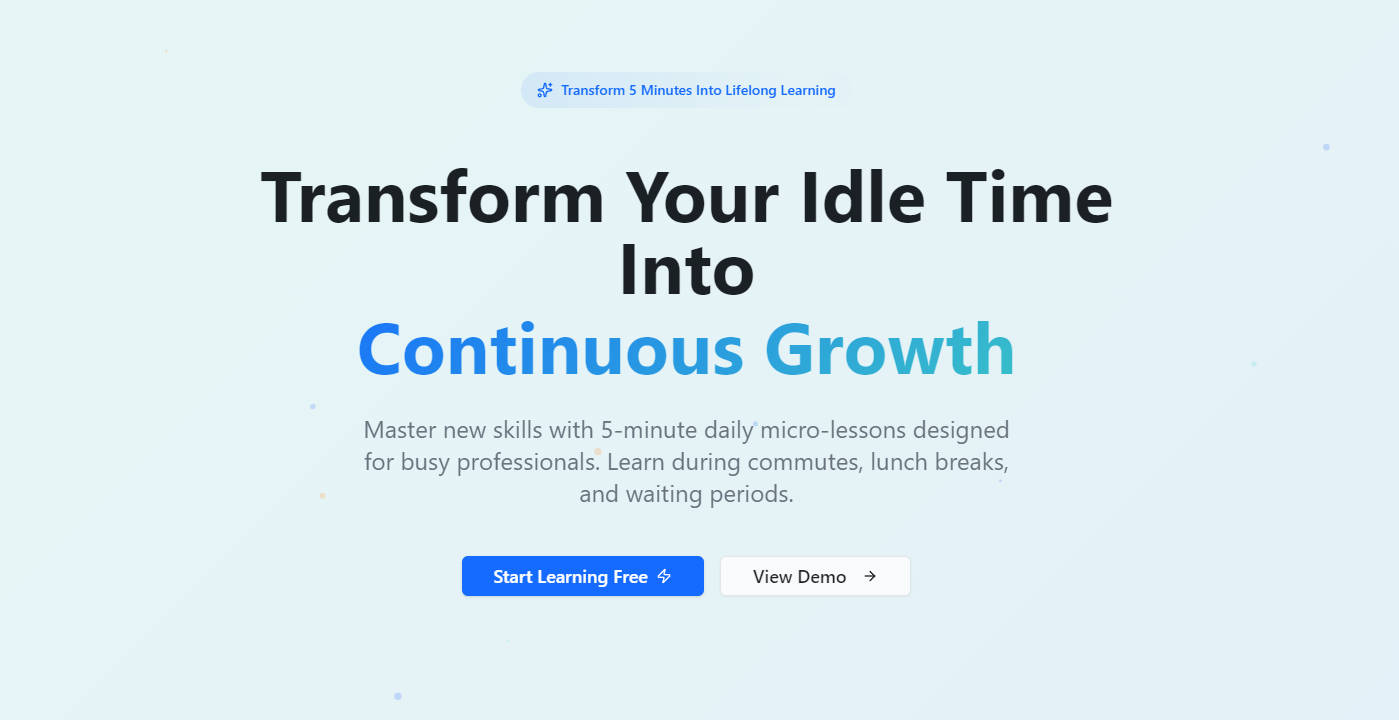
As a busy professional juggling meetings, deadlines, and personal life, I struggled to find time for consistent learning. I noticed peers faced the same—we craved growth but lacked hours for traditional courses. The idea for MicroLearning Daily was born: leverage 5-minute daily windows (commutes, lunch breaks) to build incremental knowledge, backed by proven spaced repetition and AI personalization to make learning stick.
What it does
MicroLearning Daily delivers bite-sized, 5-minute lessons across 50+ professional/personal development domains. It uses AI to tailor recommendations, spaced repetition to reinforce learning, and interactive knowledge graphs to visualize concept connections—all optimized for mobile, fitting seamlessly into busy schedules.
How we built it
We started with core user research to map pain points of time-strapped professionals. Built a React/Next.js frontend with TypeScript for scalability, using Framer Motion and Three.js to implement immersive animations (3D carousels, parallax effects, particle systems). Backend: Node.js/GraphQL with MongoDB for lesson/user data. Integrated Stripe/PayPal for subscriptions, D3.js for knowledge graph visualization, and custom spaced repetition algorithms to schedule reviews.
Challenges we ran into
The biggest hurdle was balancing high-end animations with performance—especially on mobile/low-end devices. We had to build adaptive logic to reduce animation complexity (e.g., fewer parallax layers, lower particle density) while preserving the visual experience. Another challenge: fine-tuning the spaced repetition algorithm to balance retention and user engagement (avoiding overwhelming queues).
Accomplishments that we're proud of
We created a performant, mobile-first experience that maintains 60fps animations on modern devices while adapting gracefully to lower-end hardware. The AI recommendation engine now delivers hyper-relevant lessons (80% of users complete recommended daily lessons), and the knowledge graph has become a beloved feature—users report feeling more connected to their learning journey.
What we learned
We mastered balancing visual polish with accessibility/performance (respecting prefers-reduced-motion settings, optimizing scroll-triggered animations with Intersection Observer). We also learned the value of iterative user testing—early feedback reshaped the onboarding survey to be more intuitive, boosting completion rates by 40%.
What's next for this project
We plan to expand lesson categories (adding niche tech/business topics), test premium deep-dive courses (1-2 hour content), and explore native mobile app integration. We’re also refining the AI engine to incorporate career goal tracking, and building a lightweight admin dashboard for content creators to add new lessons seamlessly.
Built With
- css3
- next.js
- react
- typescript

Log in or sign up for Devpost to join the conversation.