Inspiration
This project started with a very non-space problem: my feet.
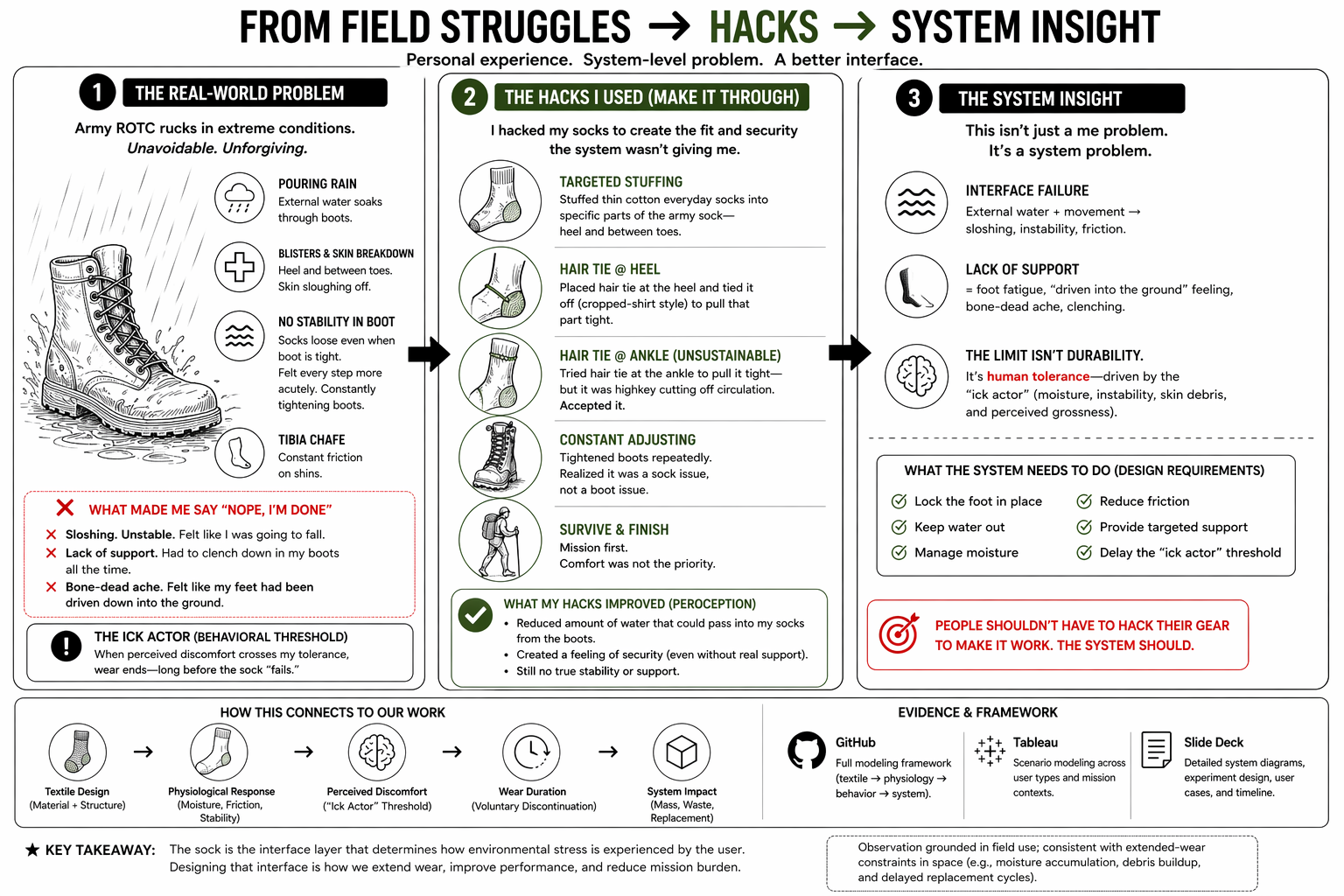
During Army ROTC training, I was regularly rucking long distances under heavy load, often carrying close to 1/3 of my body weight. My boots rarely fit perfectly, and after every ruck my feet were raw, blistered, and constantly adjusting to friction, pressure, and moisture.
So I started hacking my own solutions. Layering socks, modifying compression, and even using makeshift methods (like using a hair tie to reduce heel gapping) just to make it through.
At some point, it clicked.
If users are consistently modifying a product to make it work, the product itself is failing.
What stood out wasn’t just the physical discomfort—I could tolerate blisters.
What I couldn’t tolerate was the psychological discomfort:
- wet fabric sloshing inside the shoe
- loss of fit and stability
- buildup of heat, friction, and general “grossness”
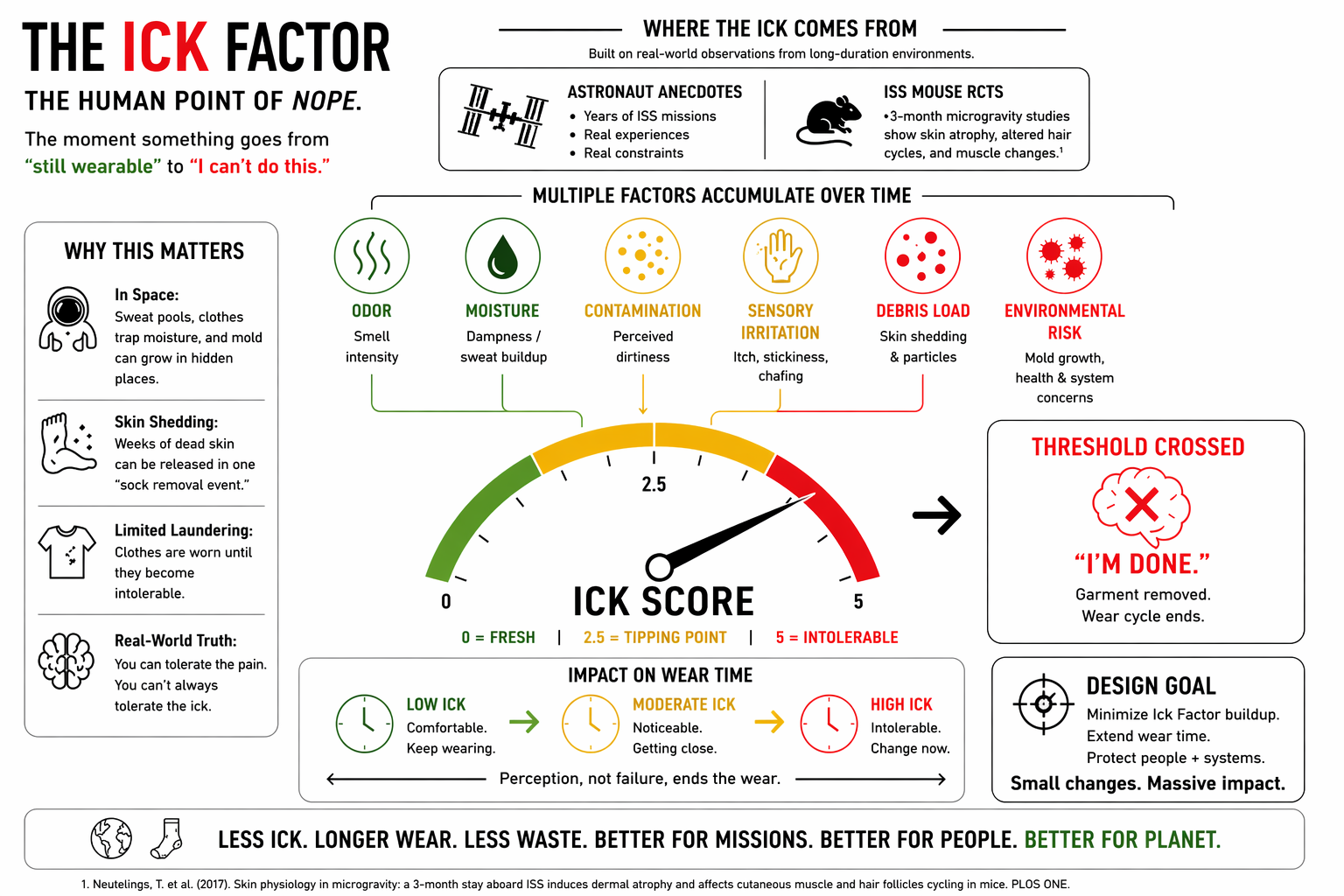
This is what I later formalized as a behavioral threshold:
$$ \text{Wear ends when perceived discomfort} > \text{user tolerance} $$
Months later, while exploring fashion for space with my team, we began asking how clothing could function as a system rather than just apparel.
This led to a simple question:
What happens to clothing when you cannot take it off?
On the International Space Station, garments are worn until they become uncomfortable due to moisture, odor, or skin irritation, then discarded.
The parallel was immediate.
$$ \text{Constraint} \neq \text{material failure} $$
$$ \text{Constraint} = \text{human tolerance} $$
What it does
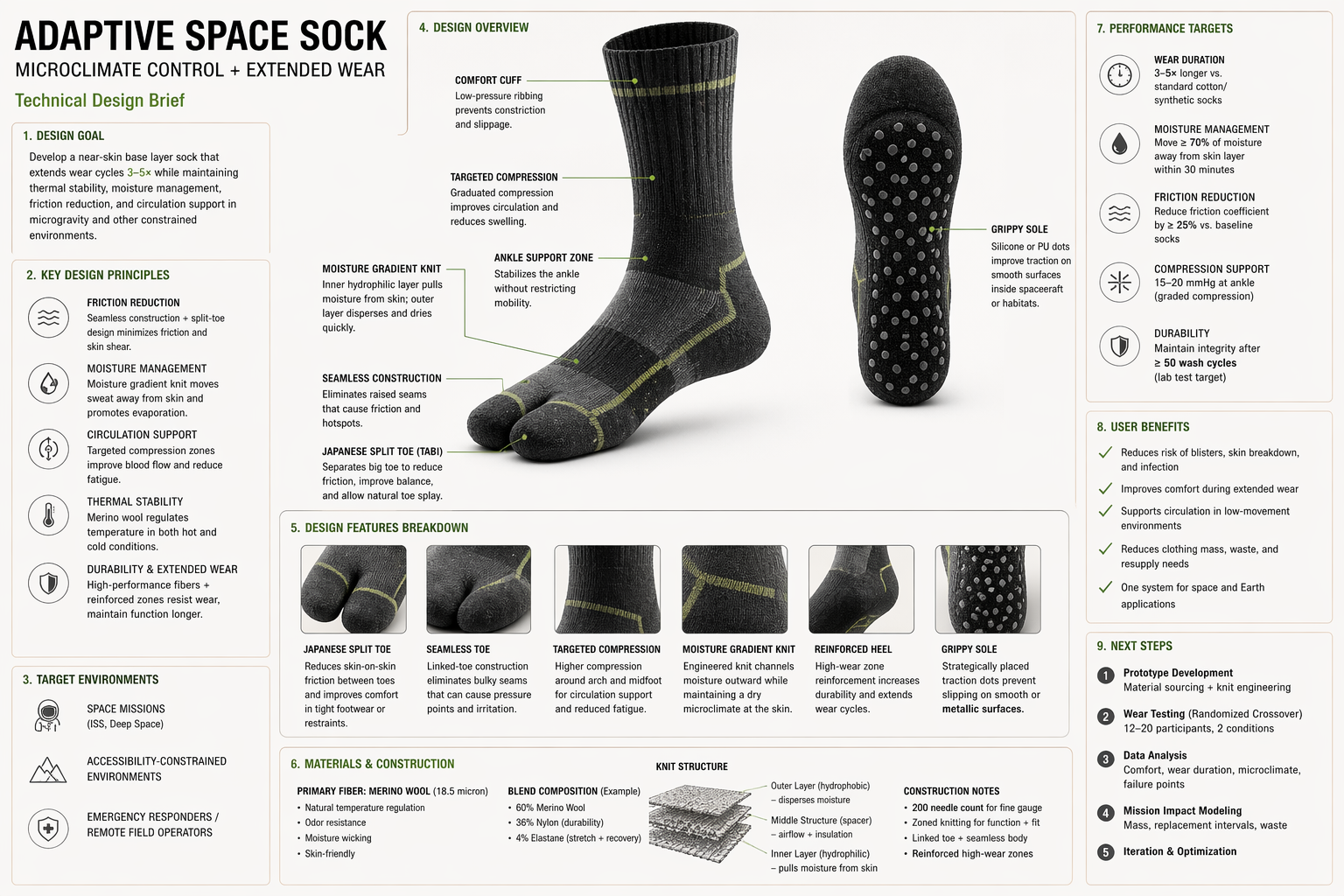
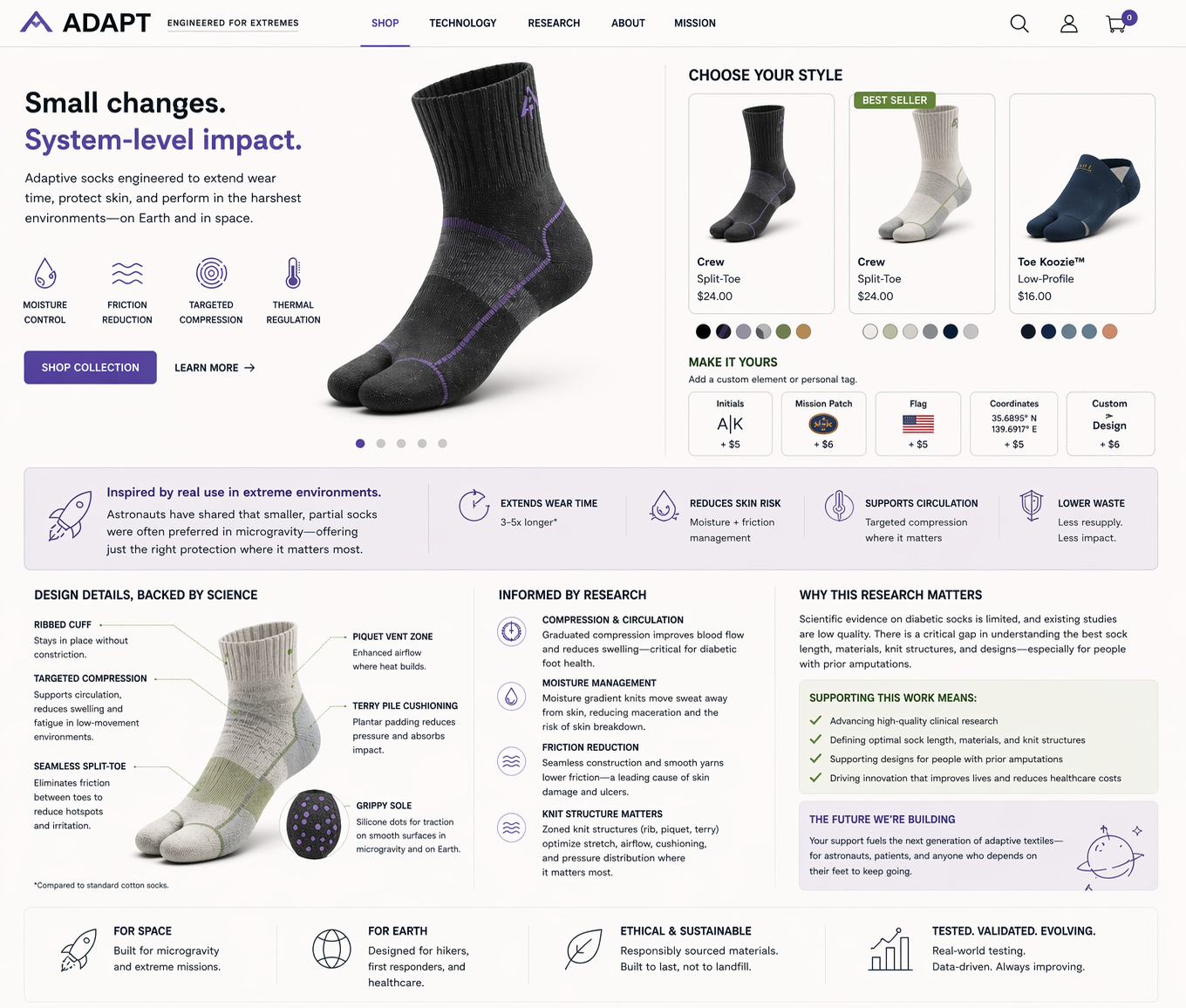
We are developing a near-skin wearable system that extends how long garments can be worn without discomfort, hygiene breakdown, or performance loss.
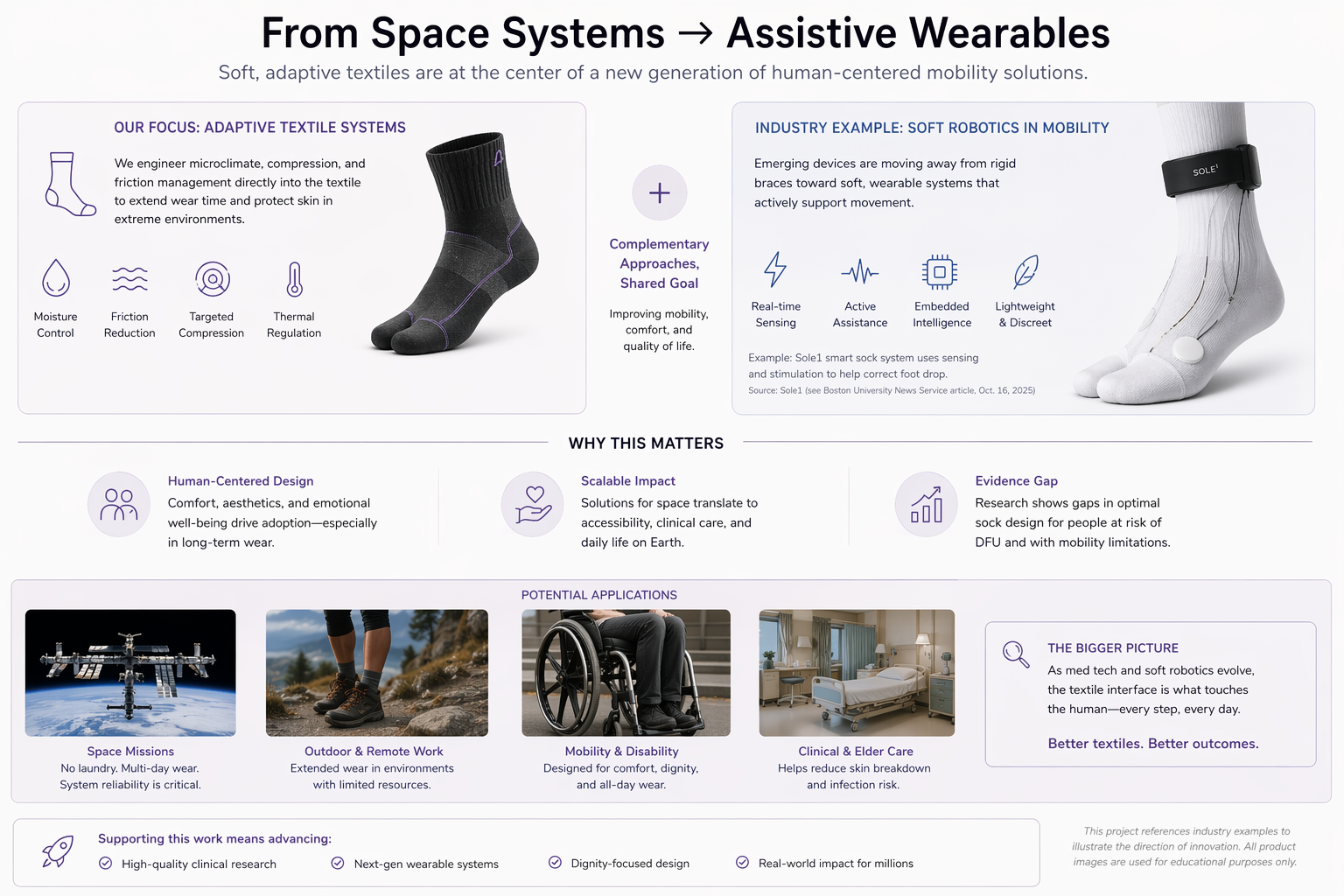
Our current prototype focuses on socks—one of the highest-stress, highest-turnover garments across environments:
- space missions
- military and field use
- healthcare and clinical populations
- athletics and performance
The system targets key failure points of extended wear:
- moisture buildup and saturation
- friction and pressure-induced hotspots
- odor accumulation
- perception-driven rejection (“ick factor”)
By extending wear duration, this system reduces:
- replacement frequency
- resupply mass
- storage constraints
- material waste
How we built it
We approached this as a multi-layer system, not just a materials problem.
Material Layer
We worked with The Merino Softwear Company Ltd, a technical textile developer specializing in performance merino systems for extreme environments.
Key properties:
- thermoregulation
- odor resistance
- moisture transport and buffering
- reduced mass and volume
Structural Layer
We designed a multi-zone knit architecture:
- targeted compression zones → support circulation and reduce fatigue
- seamless construction → eliminate friction points
- reinforced heel/toe → durability under stress
- split-toe structures → reduce inter-toe friction
- silicone grip zones → enable stabilization in microgravity
We also explored selective coverage (“toe koozie”):
protecting high-friction regions while reducing unnecessary heat and moisture load
Modeling Layer (GitHub)
We built a multi-layer modeling framework:
- Textile → Physiology Model
- Behavioral Model (“Ick Factor”)
- System / Mission Model
Together:
$$ \text{Design} \rightarrow \text{Physiology} \rightarrow \text{Perception} \rightarrow \text{Wear Duration} \rightarrow \text{System Impact} $$
Testing Framework
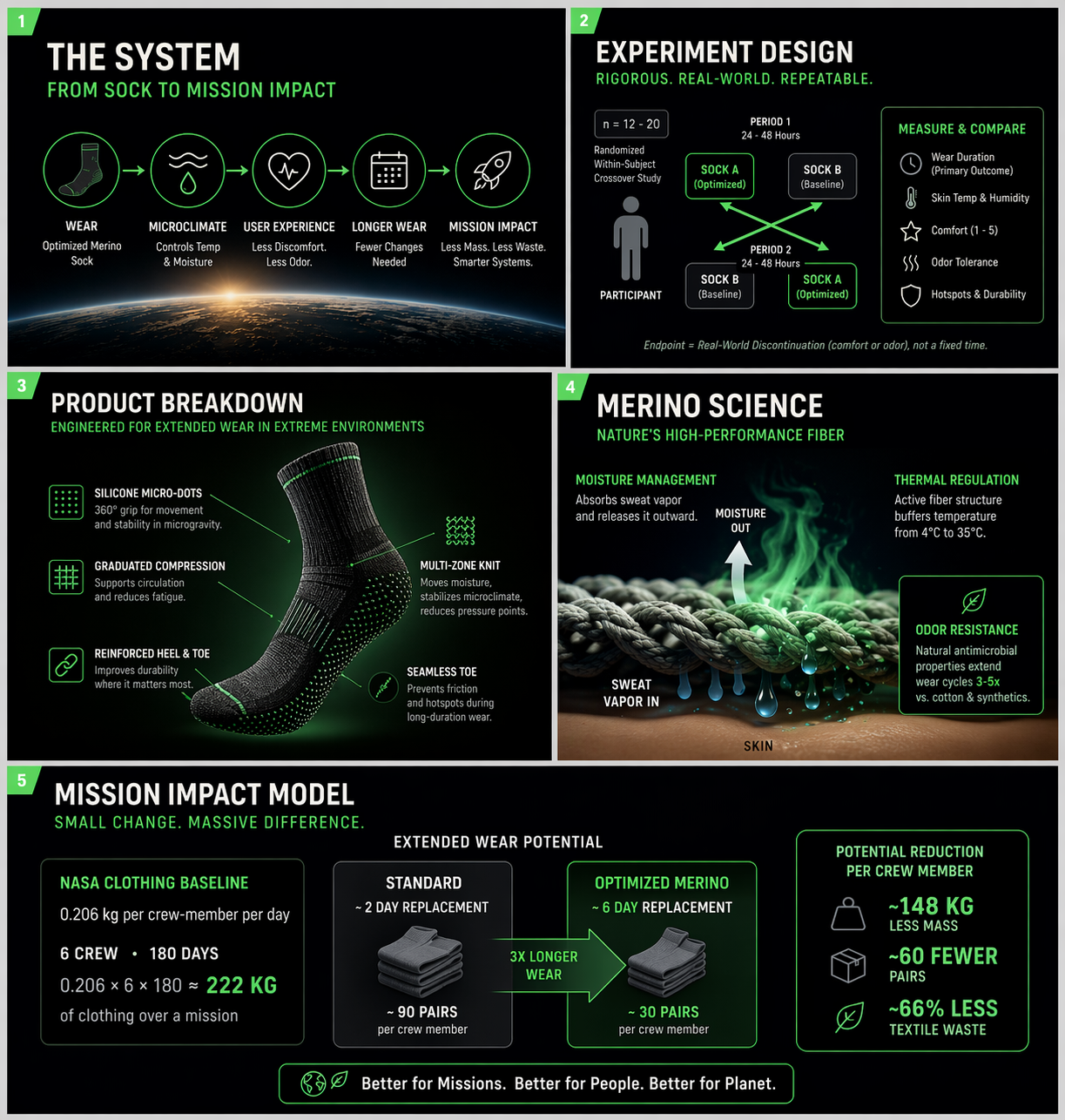
We designed a randomized within-subject crossover study:
- baseline vs optimized systems
- 24–48 hour wear intervals
- endpoint = voluntary discontinuation (comfort/odor)
We measure:
- temperature and humidity
- comfort and perception
- wear duration
Supporting Work
- GitHub repository → full modeling framework
- Tableau analysis → scenario modeling across user types
- Slide deck → system diagrams, product breakdown, experiment design
A shorter version was presented live. A longer version includes expanded user cases and a detailed timeline. :contentReference[oaicite:0]{index=0}
Challenges we ran into
- Translating subjective discomfort into something modelable
- Integrating behavioral thresholds with physical measurements
- Designing experiments around real-world discontinuation instead of fixed endpoints
- Bridging textile design with physiology and system-level outcomes
- Coordinating testing across environments with different constraints
Accomplishments that we're proud of
- Built a multi-layer system model incorporating behavior, not just materials
- Identified and formalized the “ick factor” as a real design constraint
- Developed a prototype grounded in engineering and human-centered design
- Connected textile design directly to mission-level outcomes
- Created a framework that extends across space, healthcare, and consumer use
What we learned
Extended wear is not limited by a single factor.
It is determined by the interaction between:
- material properties
- fit and structure
- environment
- human perception
We observed that:
- moisture transport delays discomfort more effectively than absorption alone
- small structural changes (seams, compression, fit) have large effects
- users stop wearing garments before structural failure
Most importantly:
perception—not durability—ends the wear cycle
What's next for Microclimate Systems for Extended Wear in Space
- Continue materials validation and extended wear testing
- Integrate real-time sensing for microclimate monitoring
- Validate with clinical and human factors experts
Expand behavioral modeling (compliance and perception)
Scale to:
- military and field systems
- healthcare and rehabilitation
- extreme environments
- performance wear
- military and field systems
Long-term goal:
bridge space-grade systems with real-world adoption
Built With
- ai
- basic-statistical-modeling
- data.nasa.gov
- experimental-design-(randomized-crossover-study)
- human-factors-methodology
- literature
- materials-engineering-(merino-composite-systems)
- python
- tableau
- textile-engineering)


Log in or sign up for Devpost to join the conversation.