-
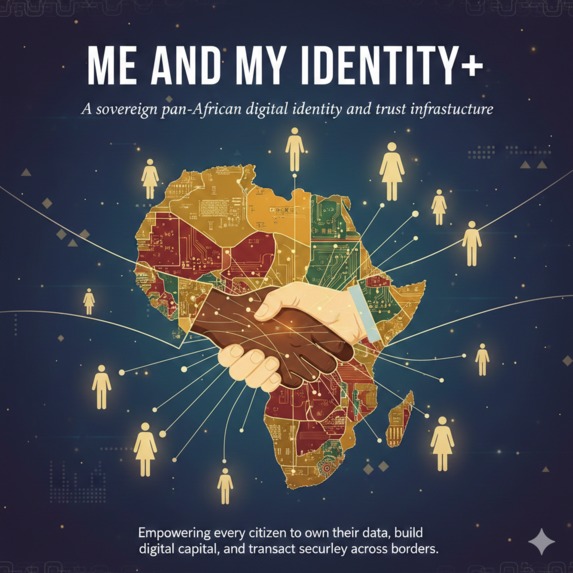
A sovereign pan-African digital identity and trust infrastructure empowering every citizen to own their data, build digital capital.
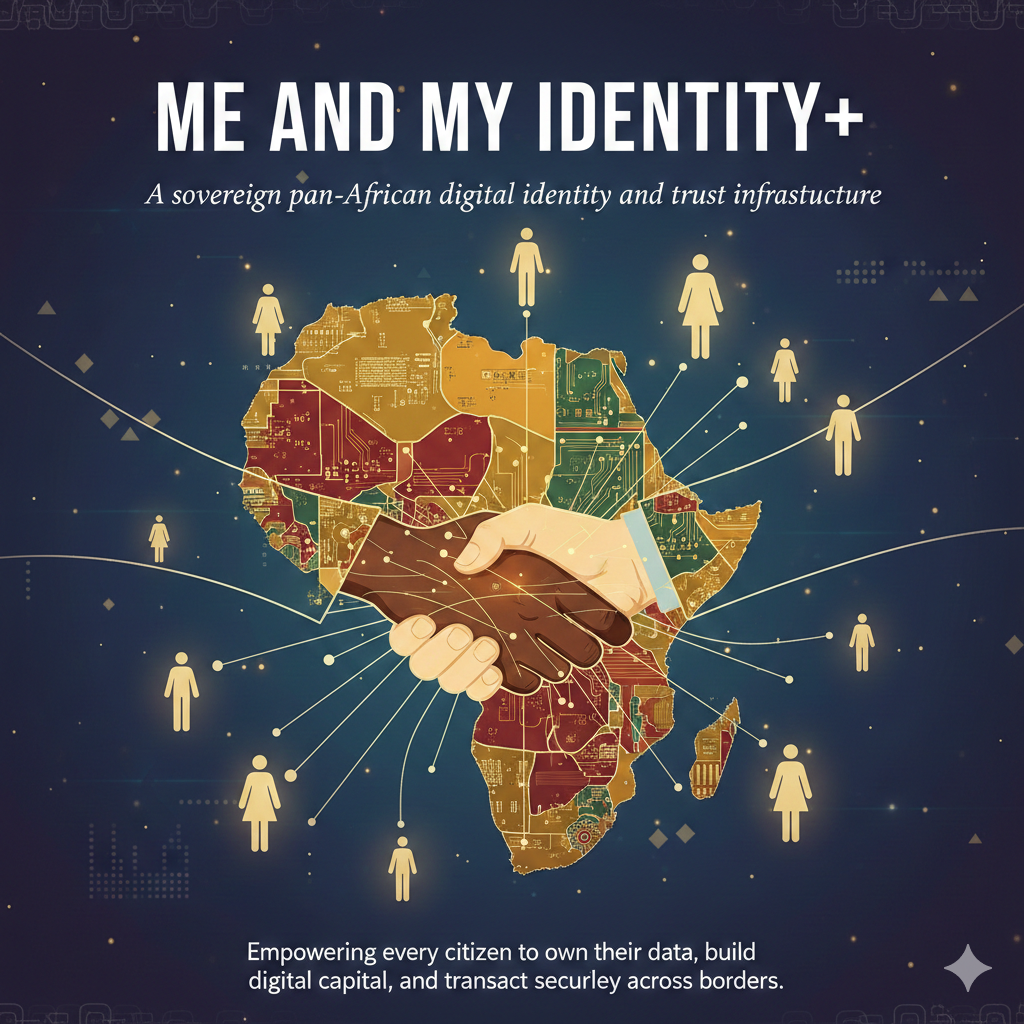
ME AND MY IDENTITY+
Inspiration
Across Africa, millions of citizens remain digitally invisible.
No verifiable identity.
No portable credentials.
No trusted cross-border recognition.
Educational records, university diplomas, school certificates, professional qualifications, and personal documents are often fragmented, paper-based, or difficult to authenticate. When citizens move across borders, they frequently lose access to proof of who they are and what they have achieved.
This lack of trusted portability limits mobility, employment, entrepreneurship, and financial inclusion.
Existing national digital identity systems have demonstrated that large-scale digital infrastructure is possible. Sovereign financial messaging systems have shown that digital infrastructure is also geopolitical infrastructure.
However, most existing models are centralized and state-controlled.
We asked a deeper question:
What if African citizens could own and control their identity, credentials, and qualifications — not just be registered in a system?
ME AND MY IDENTITY+ was born from the belief that identity should be:
- Self-sovereign
- Cryptographically secure
- Citizen-controlled
- Interoperable across borders
- Economically activable
- Resistant to geopolitical dependency
What it does
ME AND MY IDENTITY+ is a pan-African sovereign digital identity and trust infrastructure.
It provides:
- Self-sovereign digital identity
- Verifiable academic, professional, and personal credentials
- Portable educational and qualification records
- Digital capital scoring
- Secure transaction messaging layer
- Distributed trust network across institutions
The platform integrates into a single citizen-controlled wallet:
- University diplomas and academic degrees
- School records and transcripts
- Professional certifications and licenses
- Administrative and personal documents
All credentials are cryptographically signed, portable, and instantly verifiable without needing to contact the issuing institution.
Each citizen owns a cryptographic identity defined as:
[ ID = H(PK \parallel metadata) ]
Where:
- ( PK ) = public key
- ( H ) = secure hash function
Every credential issuance, validation, or transaction is signed:
[ Signature = Sign_{SK}(data) ]
Trust is not assigned by authority — it is built over time through verifiable interactions.
The system connects identity, education, qualifications, transactions, and reputation into a unified digital capital framework that enhances mobility and opportunity.
How we built it
We designed the architecture as a layered sovereign trust stack.
Identity Layer
- Decentralized Identifiers (DIDs)
- Public-private key cryptography (ECC)
- Citizen-controlled wallet storage
- Zero-knowledge proofs for selective disclosure
Credential Layer
- Universities, schools, institutions, and organizations issue digitally signed credentials
- Diplomas, certificates, and personal documents stored locally in the citizen wallet
- Verification possible without contacting the issuer
- Privacy-preserving selective data sharing
Trust & Digital Capital Engine
We implemented a transparent scoring mechanism:
[ TrustScore = \alpha T + \beta C + \gamma V ]
Where:
- ( T ) = transaction reliability
- ( C ) = certified credentials (academic, professional, institutional)
- ( V ) = validated interactions
- ( \alpha, \beta, \gamma ) = public weighting parameters
Secure Messaging Layer
- Encrypted transaction messaging protocol
- Mandatory cryptographic signatures
- Distributed validation nodes
- Cross-border interoperability
Governance & Infrastructure
- Multi-stakeholder node operation
- Open protocol specifications
- Regional distributed hosting
- Fault-tolerant network architecture
The system is not a cryptocurrency.
It is not a centralized registry.
It is a sovereign digital trust infrastructure.
Challenges we ran into
Balancing decentralization and governance
Too much centralization creates vulnerability.
Too much decentralization creates fragmentation.
Designing strong security without complexity
Cryptographic robustness had to work on low-end devices.
Cross-border interoperability
Legal, regulatory, educational, and institutional diversity across African states complicates harmonization.
Avoiding surveillance or social scoring abuse
We designed the trust engine to empower citizens without creating a dystopian monitoring system.
Infrastructure constraints
Connectivity limitations, hosting sovereignty, and resilience requirements shaped our architecture.
Accomplishments that we're proud of
- Designed a citizen-first sovereign identity model
- Integrated diplomas, school records, qualifications, and personal documents into one portable framework
- Built a transparent digital capital scoring system
- Created a modular architecture adaptable to different national contexts
- Ensured mathematical verifiability of core system actions
- Positioned the project as infrastructure, not just a product
Most importantly:
We reframed identity and qualifications as assets owned and controlled by the citizen.
What we learned
- Identity and education are political as much as technical.
- Sovereignty requires architectural independence.
- Trust can be mathematically modeled but must remain human-centered.
- Mobility depends on credential portability.
- Interoperability is as much governance design as software design.
- Building infrastructure requires long-term systems thinking.
What's next for ME AND MY IDENTITY+
- Publish a detailed technical whitepaper
- Develop a functional prototype of the citizen wallet
- Establish partnerships with universities and educational institutions
- Define open protocol standards
- Launch a pilot with institutional partners
- Formalize a governance framework
- Open-source core protocol components
- Build regional node and academic partnerships
Long term:
ME AND MY IDENTITY+ aims to become the foundational sovereign digital trust layer for African citizens — enabling identity ownership, credential portability, cross-border mobility, and economic participation in a resilient and interoperable ecosystem.
Built With
- docker
- ecc
- fastapi
- grpc
- kafka
- kubernetes
- node.js
- postgresql
- python
- react-native
- redis
- sha
- tls
- w3c
- webcryto
- zkp

Log in or sign up for Devpost to join the conversation.