-
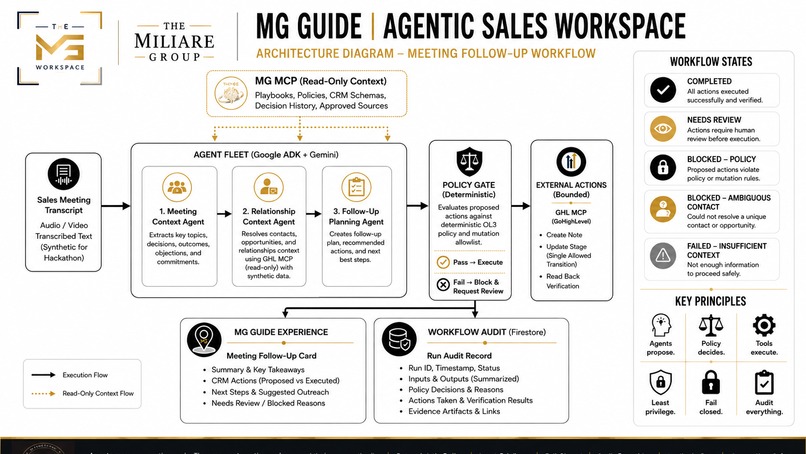
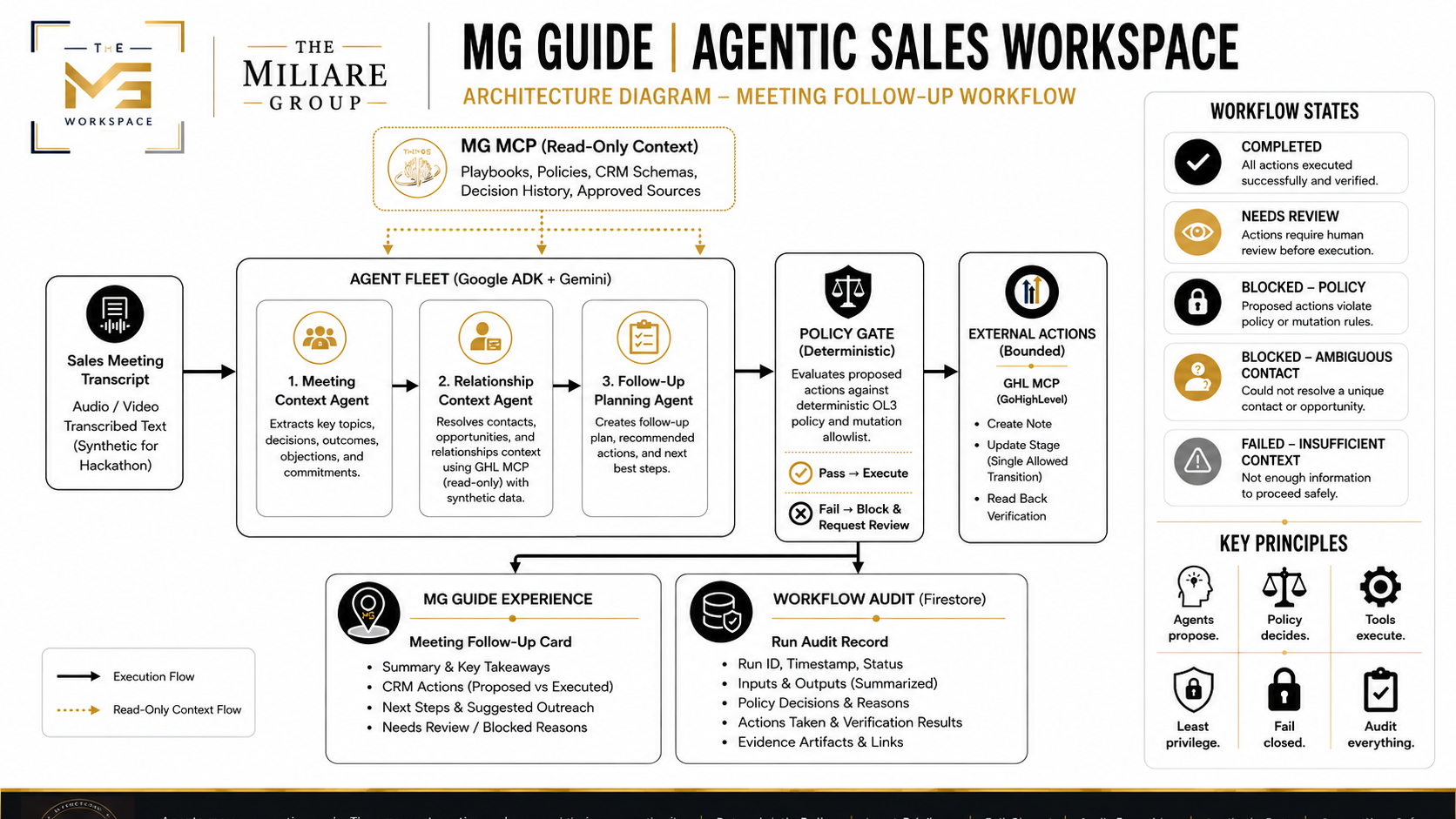
MG Guide architecture: three specialized agents turn meeting transcripts into governed follow-up, audit state, and bounded CRM actions.
-
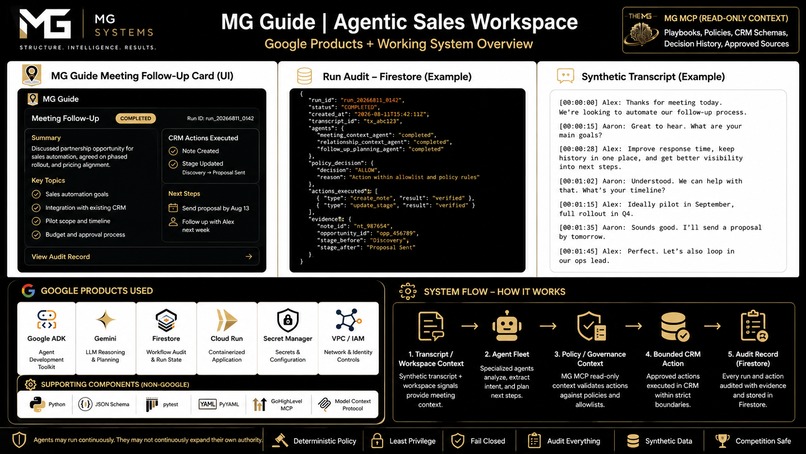
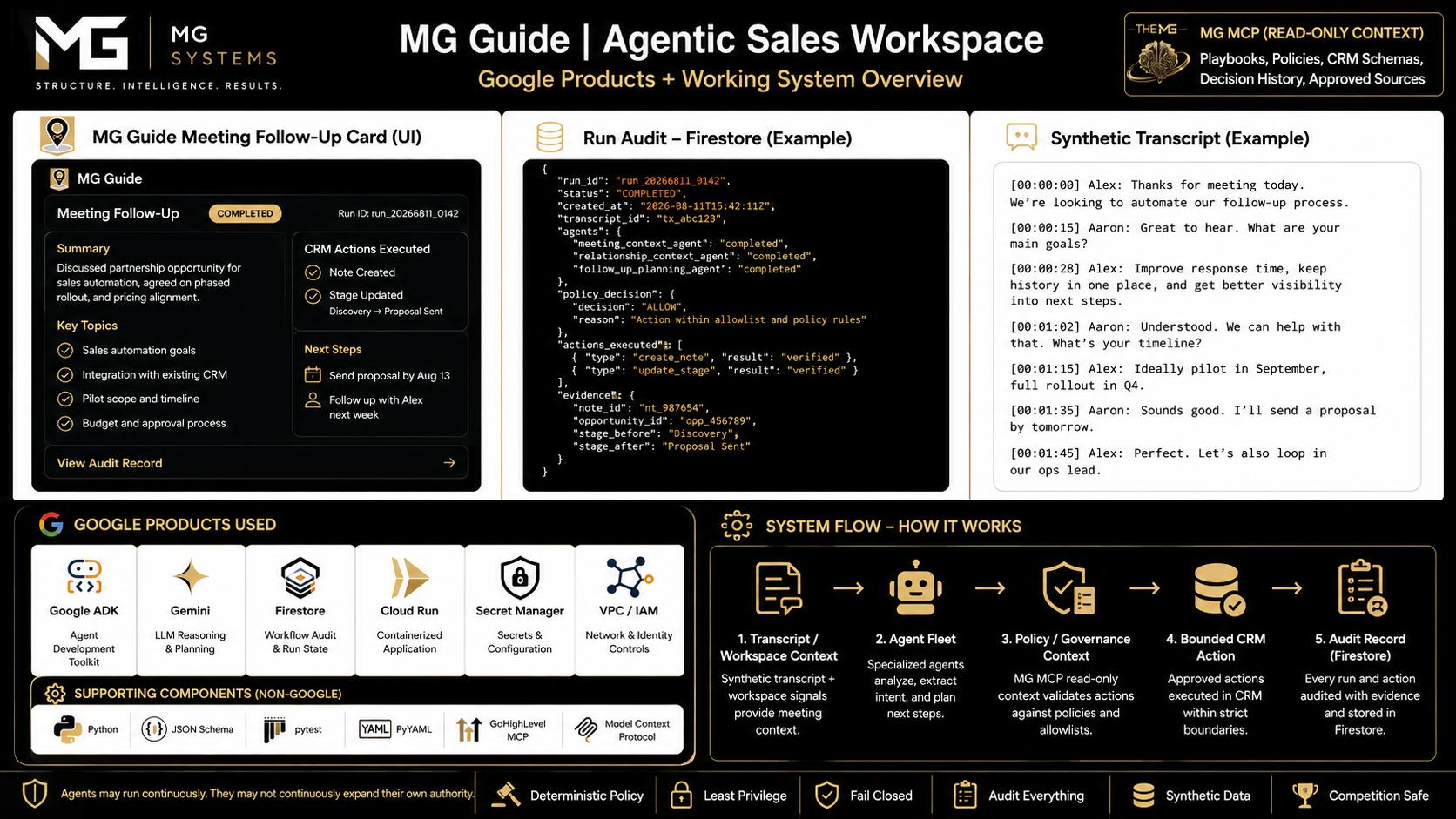
Working system view: synthetic transcript, MG Guide follow-up result, Firestore audit record, and the Google tech stack behind the demo.
-
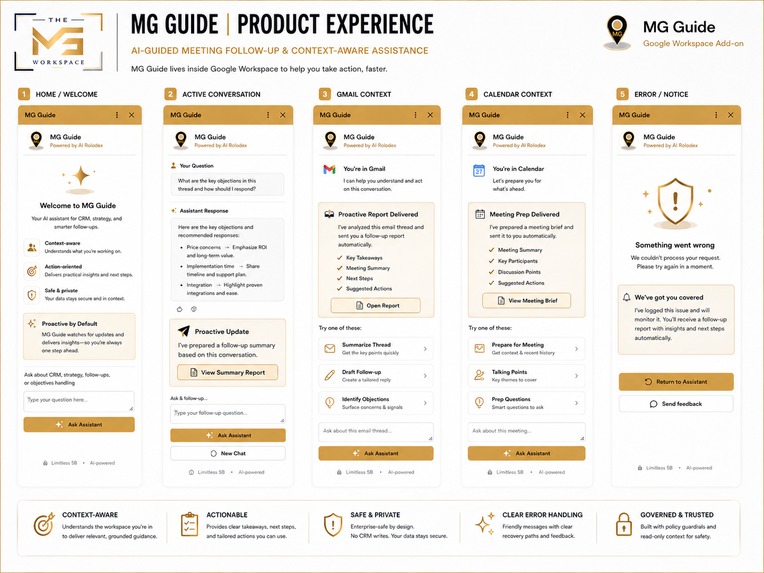
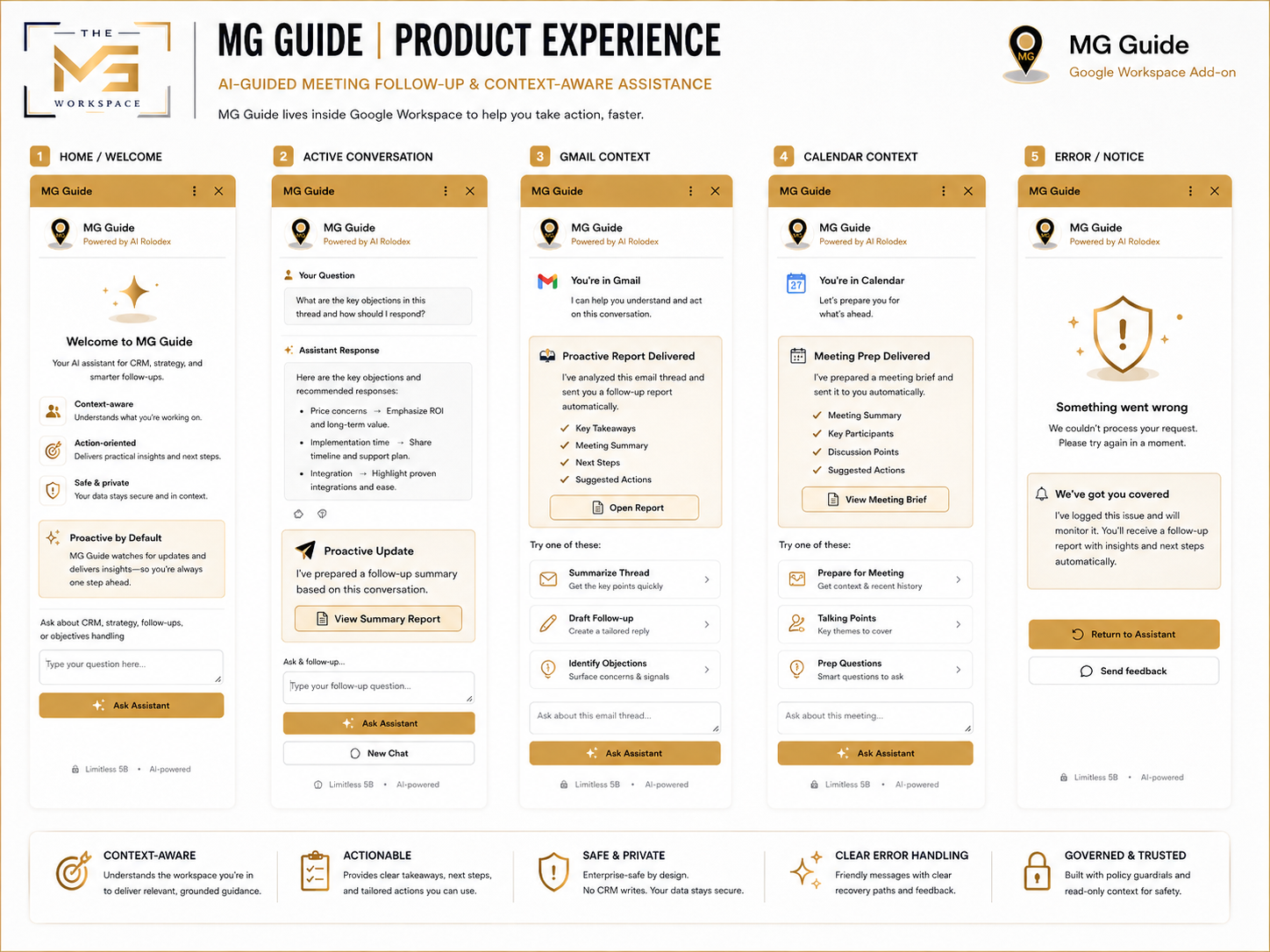
MG Guide inside Google Workspace: context-aware meeting and follow-up assistance designed to help users act without losing context.
-
The MG Workspace: the domain user-facing environment where MG Guide brings together meeting context, follow-up, and governed sales workflows
MG Guide | Agentic Sales Workspace
Inspiration
Financial services used to be built around in-person conversations. Since COVID, much more of the business has moved online. Meetings happen on video, notes live in different places, CRM records fall behind, and important personal context can get lost between one conversation and the next.
We saw a simple gap: the meeting may be digital, but the follow-up is still often manual.
An advisor still has to remember what was said, identify the right contact, update the CRM, decide what should happen next, and carry personal details forward so the next conversation does not feel like starting over.
MG Guide was built to close that gap.
What it does
MG Guide turns a meeting transcript into structured follow-up work.
The real-world workflow is designed around meetings happening in Google Workspace. Google Meet can capture the meeting recording and transcript, and MG Guide takes the transcript from there. For this hackathon, we use approved synthetic transcripts so we can demonstrate the workflow safely without exposing private client information.
The transcript is processed by a small team of specialized agents:
- Meeting Context Agent — uses Gemini 3.5 Flash to understand what was discussed: the summary, needs, objections, commitments, next step, and opportunity signals.
- Relationship Context Agent — connects that meeting to the correct relationship and CRM context.
- Follow-Up Planning Agent — prepares the recommended follow-up and the next action for the salesperson.
Google ADK coordinates these agents in order inside our hosted MG Guide Orchestrator on Google Cloud Agent Runtime.
The important design choice is that the agents do not get unlimited authority. They can understand, organize, and recommend, but a deterministic policy layer decides whether an external action is allowed. If the system is not sure which CRM record is correct, it stops and asks for review instead of guessing.
In simple terms:
Meeting transcript → understand the conversation → understand the relationship → plan the follow-up → verify it is safe → update the salesperson's next-step state.
Why this matters
The goal is not just better meeting notes. The goal is better continuity between conversations.
MG Guide is designed to preserve context such as:
- what the person is trying to accomplish;
- what concerns or objections came up;
- what each person committed to do;
- what should happen next;
- what changed since the last conversation; and
- what the salesperson needs to remember before following up.
That context can then support CRM documentation, follow-up preparation, meeting prep, and future relationship workflows.
For a salesperson, the experience becomes less about retyping notes and rebuilding context, and more about starting the next conversation already informed.
How we built it
We built the project as one focused end-to-end workflow rather than trying to replace an entire CRM.
- Gemini 3.5 Flash on Vertex AI extracts structured meeting context.
- Google ADK coordinates the Meeting Context, Relationship Context, and Follow-Up Planning agents.
- Google Cloud Agent Runtime hosts our
mg-guide-orchestratordeployment. - Cloud Run hosts the competition judge surface.
- Cloud Firestore is used for bounded workflow audit/state proof.
- HighLevel REST v3 is the current CRM integration boundary.
- Structured schemas, synthetic fixtures, automated tests, and deterministic policy checks keep the agent handoffs predictable.
Our hosted acceptance run proved that the deployed MG Guide Orchestrator can execute all three specialized agents in sequence on Google Cloud and return a response successfully.
CRM and follow-up boundary
We have also been building the CRM effect path carefully.
During the competition we proved live, exact-contact connectivity to an approved synthetic HighLevel CRM record through the REST v3 API. We also have historical proof of a separate one-shot, human-authorized synthetic CRM write and read-back verification.
For the current judge path, we do not claim that the exact Gemini-derived meeting content was written to HighLevel in the same live run. The current note-create/read-back path is separately governed and tested before any live execution is allowed.
That separation is intentional. We want the demo to show exactly what has been proven instead of making a bigger claim than the evidence supports.
What we demonstrate
Successful workflow
A synthetic meeting is processed through all three agents, the relationship is matched, the follow-up is prepared, and MG Guide reaches a completed next-step state.
Fail-closed workflow
If the relationship is ambiguous, MG Guide stops and returns a needs-review state. It does not guess and it does not perform an unauthorized CRM action.
That is one of the most important parts of the project for us: sometimes the safest and most useful agent behavior is knowing when not to act.
Challenges
The hardest part was not summarizing a transcript. The hard part was connecting AI reasoning to real business workflow without giving the AI unlimited authority.
We had to solve for:
- multiple specialized agents sharing structured context;
- relationship and CRM identity resolution;
- clear failure states;
- secure credential and runtime boundaries;
- auditability;
- deterministic authorization; and
- honest proof of what happened in a live system versus what happened in a safe demo.
Accomplishments we're proud of
- Gemini 3.5 meeting-context extraction with structured schema validation.
- A three-agent Google ADK workflow: Meeting Context, Relationship Context, and Follow-Up Planning.
- A hosted
mg-guide-orchestratordeployment on Google Cloud Agent Runtime. - A successful hosted run showing all three agents executing in order.
- SUCCESS and AMBIGUOUS_CONTACT fail-closed scenarios.
- Deterministic policy enforcement before external action.
- Cloud Run deployment proof for the judge surface.
- Firestore workflow audit/state proof.
- Live HighLevel REST v3 exact-contact connectivity against an approved synthetic record.
- Historical bounded synthetic CRM write/read-back proof under a consumed one-shot authorization.
- A public evidence trail that separates pre-existing MG foundations from the work completed during this hackathon.
What we learned
Agent quality is not only model quality.
Useful business agents also need identity, memory and context, permissions, failure handling, provenance, audit trails, and clear boundaries around what they are allowed to change.
We also learned that a blocked result can be a successful enterprise outcome. If the system cannot confidently identify the right person or record, stopping is better than making the wrong change quickly.
What's next
Our broader vision is an Agentic Sales Workspace that helps a salesperson move from one conversation to the next without losing the human context in between.
That means continuing to connect meeting transcripts, relationship context, CRM state, follow-up planning, and salesperson-facing workflows while keeping external actions governed and auditable.
The long-term goal is simple: use AI to reduce the administrative work around relationships without reducing the quality of the relationship itself.
Built With
- cloud-firestore
- cloud-run
- gemini-3.5-flash
- google-adk
- google-cloud-agent-runtime
- google-workspace
- highlevel-rest-v3
- python
- vertex-ai

Log in or sign up for Devpost to join the conversation.