-
-
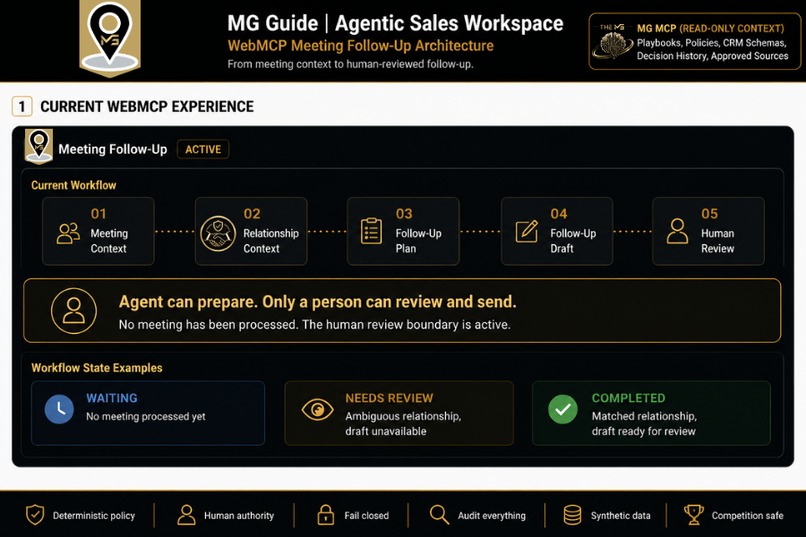
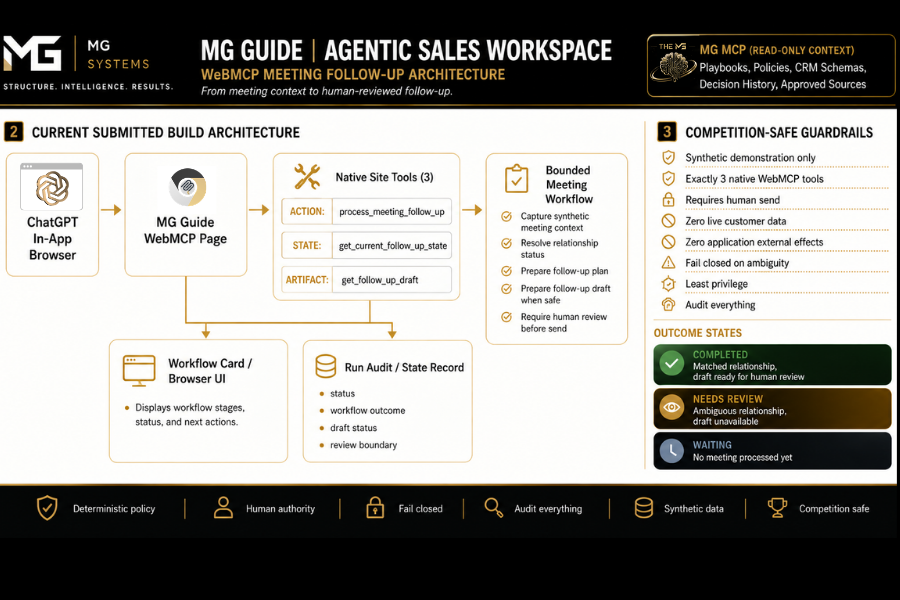
Current WebMCP experience: ACTION → STATE → ARTIFACT turns meeting context into a human-reviewed follow-up draft.
-
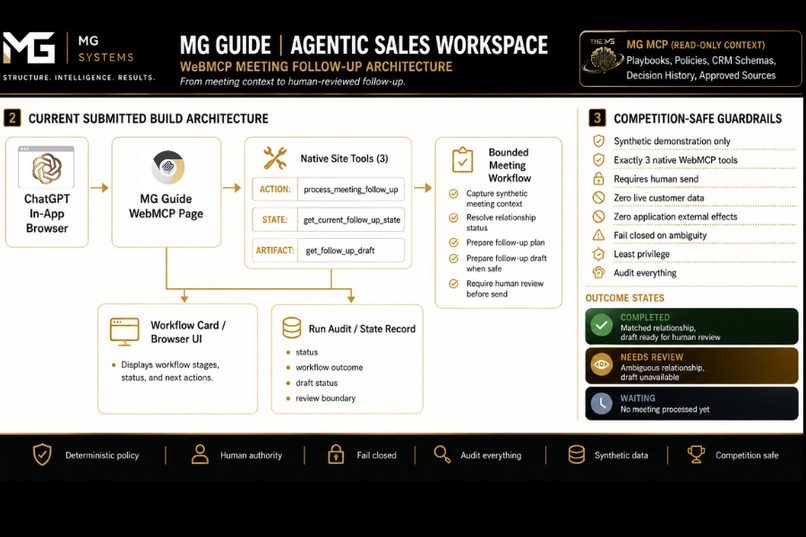
WebMCP build architecture: ChatGPT browser discovers 3 native tools backed by a bounded synthetic MG Guide workflow.
-
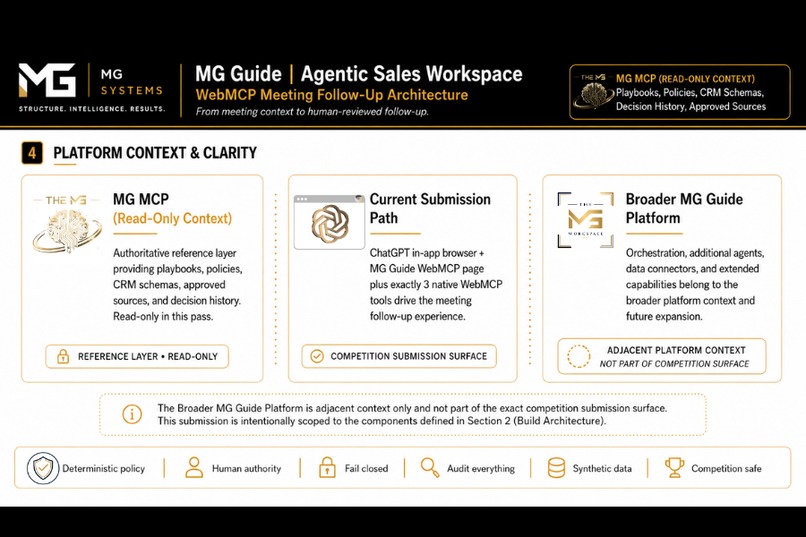
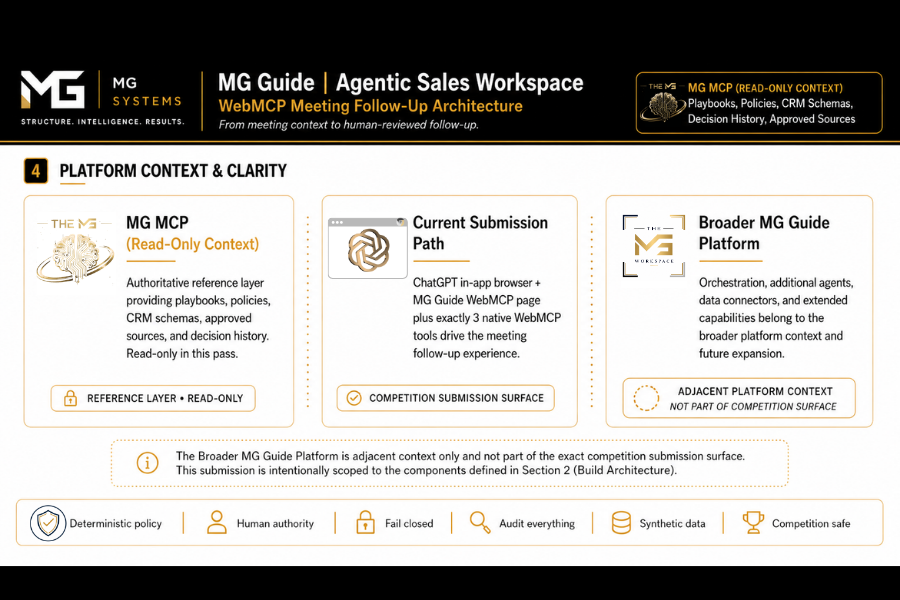
Platform context: the competition surface stays bounded while MG MCP and the broader MG Guide platform remain adjacent context.
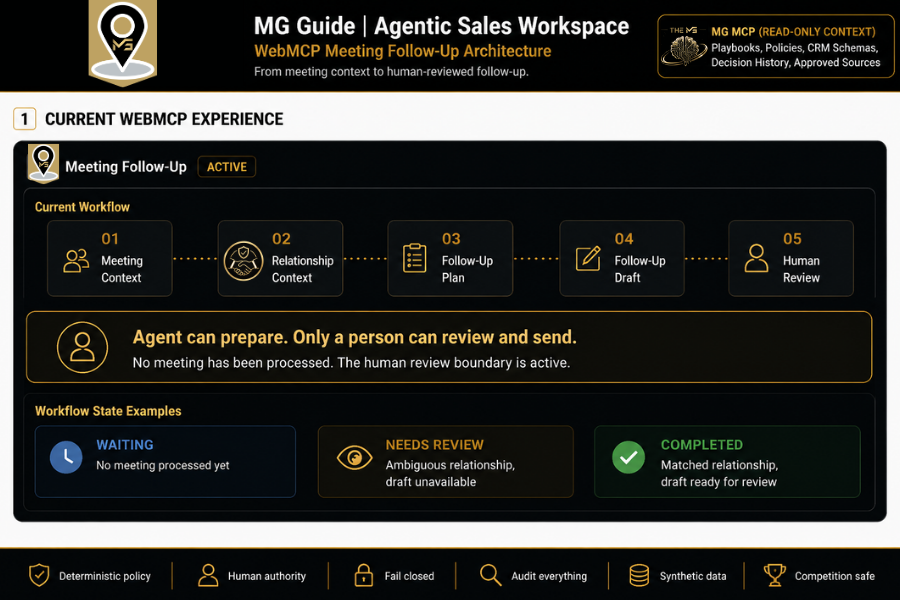
MG Guide | Agent-Native Follow-Up
MG Guide started from a practical problem we see in relationship-driven sales: the meeting may happen virtually, but the real work often starts after the call ends.
Someone still has to remember what mattered, connect the conversation to the right relationship, determine the next step, and prepare a thoughtful follow-up. That work matters because relationships are personal, but it can also become repetitive and fragmented across meetings, notes, CRM systems, inboxes, and different tools.
We have been building MG Guide as part of a broader effort to create a governed AI workspace that can work behind salespeople and sales teams without taking judgment or relationship ownership away from them.
Our goal is simple: let AI help prepare the work, while the person remains responsible for the relationship.
For The WebMCP Challenge, that idea took on a new form.
What WebMCP changed for us
Before this challenge, MG Guide already had a meeting follow-up workflow and the broader foundation we had been building around meeting context, relationship context, follow-up planning, and governed AI workflows.
WebMCP gave us a new way to think about how an AI agent could interact with that experience.
Instead of building a separate interface just for an agent, or asking an agent to interpret buttons and page structure, we could let the website itself clearly expose the actions that were safe and useful for an agent to perform.
That led us to a simple model:
ACTION → STATE → ARTIFACT → HUMAN CONTROL
The agent can help process the meeting, understand the current follow-up state, and retrieve the prepared follow-up draft. The person still reviews the result and decides what happens next.
That became one of the most important lessons from the project:
The website itself can become a shared workspace between a person and an AI agent.
What we built for the challenge
For the WebMCP Challenge, we meaningfully extended the existing MG Guide experience with a browser-native WebMCP layer.
The live MG Guide page now exposes exactly three capabilities to a compatible browser agent:
- ACTION — process the meeting follow-up
- STATE — understand where the follow-up currently stands
- ARTIFACT — retrieve the draft that was prepared
This creates one shared experience instead of one interface for the person and another interface for the agent.
When everything is clear, MG Guide can prepare a useful follow-up draft.
When the relationship is unclear or ambiguous, the system stops and asks for human review instead of guessing.
That distinction matters to us. In relationship-based work, a good AI system should know not only when it can help, but also when it should stop.
Agent can prepare. Only a person can review and send.
What we learned
This challenge changed how we think about agent-native software.
The page can be the shared contract
One of our biggest takeaways was that an AI agent does not always need its own separate interface.
The same page a person uses can expose a small, intentional set of capabilities that an agent can understand and use. That keeps the human and the AI working from the same experience instead of creating two disconnected versions of the workflow.
Safe refusal is part of good design
We intentionally built an ambiguous-contact scenario into the demo.
If MG Guide cannot confidently connect the meeting to the right relationship, it does not continue automatically. It stops.
That may look like less automation, but for us it represents better automation.
Trust is especially important when AI is working around relationships, financial conversations, customer information, and follow-up communication.
Human control should be designed in from the beginning
We did not want “human in the loop” to be a sentence we added at the end of the project. We wanted it reflected in the experience itself.
The agent can prepare context, state, and a draft, but the final customer-facing action remains with the person.
That boundary became one of the clearest principles of the project.
Browser behavior matters more than we expected
We also learned that making an agent-capable web experience reliable is not only about the AI.
Browser behavior, tool discovery, origin boundaries, caching, and how the page is served all affect whether the experience actually works for a person and an agent together.
That pushed us to think more seriously about the browser as part of the agent environment, not simply as a screen.
Where this is leading us
The WebMCP Challenge also surfaced a bigger idea for the future of MG Guide and the governed AI ecosystem we are building around our sales teams.
This challenge primarily demonstrates an outbound pattern:
MG Guide exposes safe capabilities from our governed environment to a browser agent.
But we are increasingly interested in the opposite direction too.
What happens when a salesperson finds useful information somewhere else on the web and wants to intentionally bring that information back into their governed AI workspace?
For example:
- useful research before a meeting;
- a company website;
- an article relevant to a relationship;
- publicly available information about a business;
- information a salesperson intentionally selects while preparing for a conversation.
We do not want that to become uncontrolled web scraping or automatic memory collection.
Instead, we see an opportunity for a governed intake experience.
The person could intentionally select information, identify why it matters, and bring it into MG Guide with context about where it came from and what it is allowed to inform.
That information could then become evidence available to the governed AI environment without automatically becoming permanent memory or authorizing an external action.
WebMCP and a future Chrome extension companion
This is also where a browser extension becomes interesting to us.
On websites that support WebMCP, we would prefer to use the structured capabilities the site intentionally exposes.
But many websites will not expose WebMCP immediately. A future Chrome extension companion could provide a user-controlled bridge.
The salesperson could choose the information they want to bring into MG Guide, explain what they want to use it for, and send it through the same governed intake boundary.
Conceptually:
WebMCP-enabled website
→ structured information selected through the site's declared capabilities
→ governed intake
→ MG Guide
Website without WebMCP
→ information explicitly selected by the person through a browser extension
→ governed intake
→ MG Guide
In both cases, the important part is not simply collecting more information.
The important part is preserving:
- where the information came from;
- why the person brought it in;
- what workflow it is allowed to support;
- whether it should remain temporary or become durable context;
- and what actions still require human approval.
That is becoming an important part of how we think about building AI for real sales teams.
The larger vision
MG Guide is ultimately one piece of a broader governed AI ecosystem we are building to work behind salespeople and sales teams from a virtual perspective.
We do not see the goal as replacing the salesperson.
We see the goal as reducing the amount of time they spend reconstructing context, searching across systems, preparing repetitive work, and trying to remember what happened across dozens of relationships.
The human should be able to spend more time on judgment, communication, leadership, and the relationship itself.
The AI should help organize and prepare the work around them.
WebMCP gave us a practical glimpse of what that can look like directly inside the browser.
Existing project vs. new WebMCP work
MG Guide existed before the WebMCP Challenge.
The pre-existing project included the core meeting-follow-up workflow and the broader foundation we were building around meeting context, relationship context, follow-up planning, Google Workspace, and our governed MG Guide architecture.
During the WebMCP Challenge submission period, we significantly extended that work with:
- a new browser-agent interaction model;
- a shared human-and-agent web experience;
- the WebMCP tool surface;
- safer ambiguity handling;
- browser-held workflow state;
- dedicated WebMCP testing;
- live browser validation;
- and the challenge-specific presentation and judge experience.
We documented that distinction clearly in the public repository so the challenge-period work can be evaluated independently from the foundation that came before it.
Try it
Live product:
https://ai-rolodex-landing-831270426395.us-east4.run.app/mg-guide/
Public source:
https://github.com/themg-max/mg-guide-agentic-sales-workspace
Judge start:
JUDGE_START_HERE.md
WebMCP judge guide:
competition/webmcp/README.md
Testing guide:
competition/webmcp/JUDGE_TESTING.md
Competition Delta:
competition/webmcp/COMPETITION_DELTA.md
What this demonstrates
MG Guide turns post-meeting follow-up into a shared human-agent workflow:
The agent prepares, the person understands, and the human remains in control.
For us, that is the most important promise behind the project.
Built With
- css
- google-cloud-run
- html
- javascript
- python
- webmcp