Knowledge should be something you can enter
Metnor is an interactive learning runtime for the moment a learner says: “I understand the words, but I still can’t see how it works.”
Most learning tools answer that gap with more text. Metnor answers with a living scene: learners watch an idea unfold, inspect the parts that matter, replay the sequence, and change the variable that moves the system. The goal is not to make explanations prettier but it is to help learners build a usable mental model.
What Metnor does
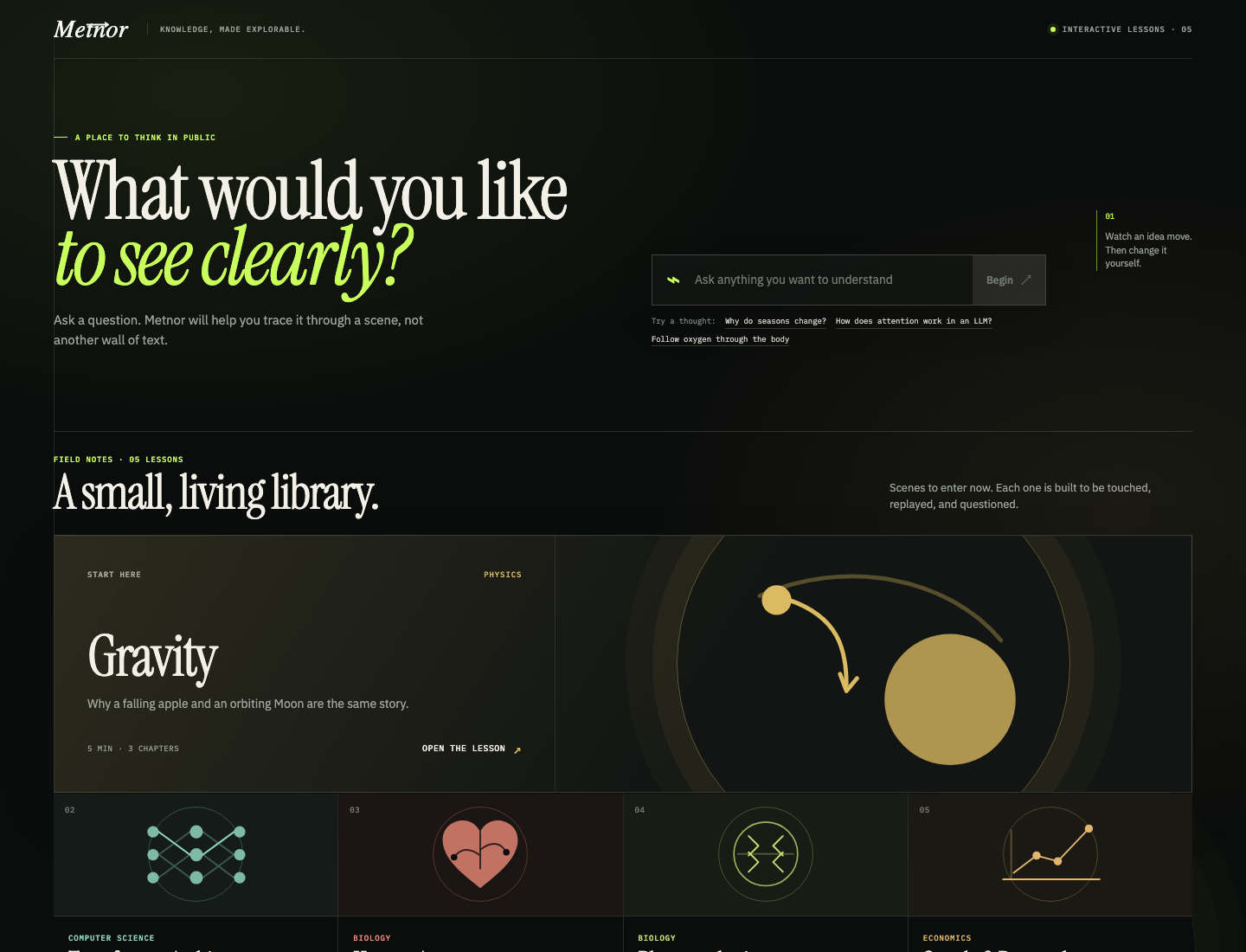
Metnor ships as a polished, offline-first web app with five narrated interactive lessons:
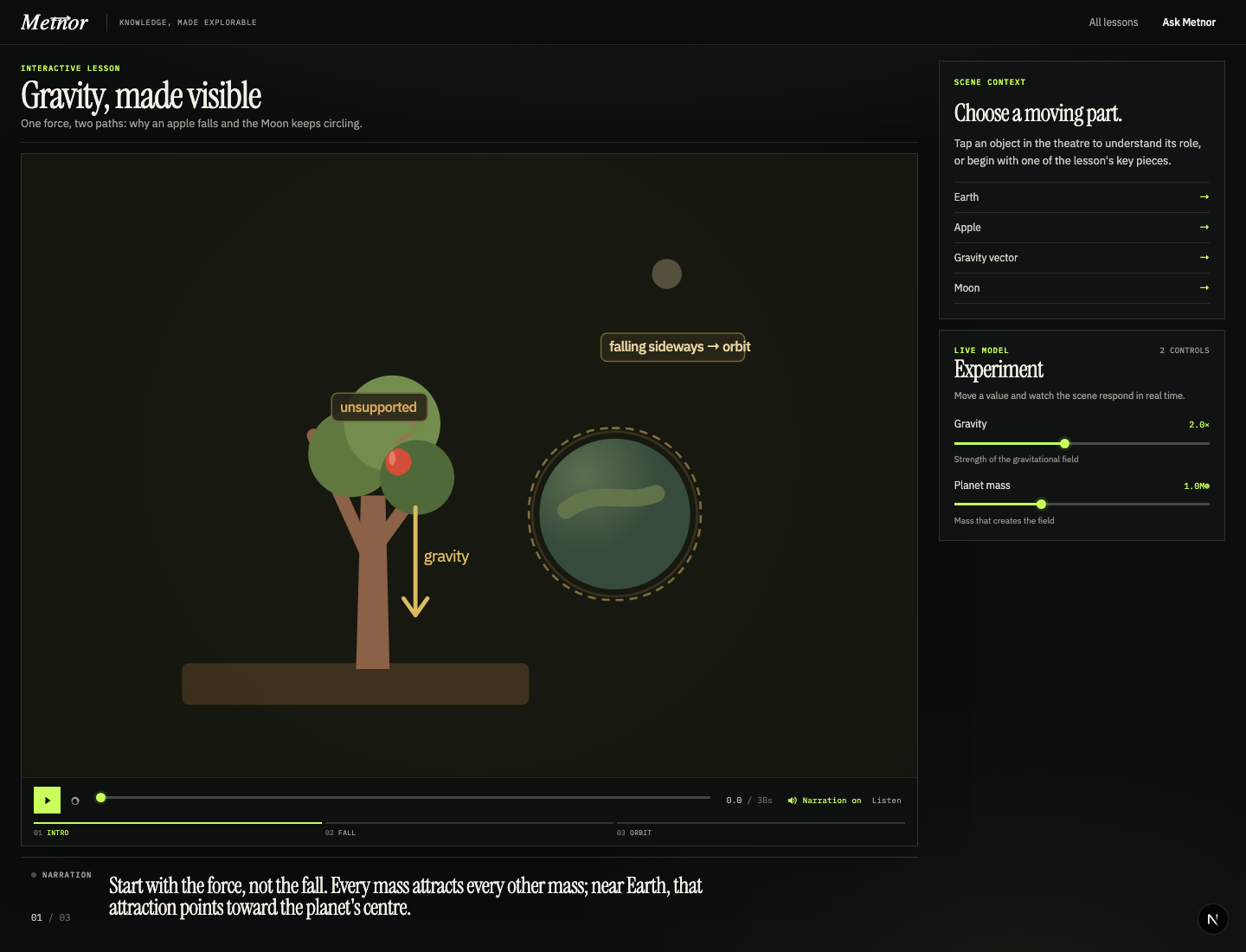
- Gravity: connect a falling apple, Earth, and the Moon to see why falling and orbiting are one story.
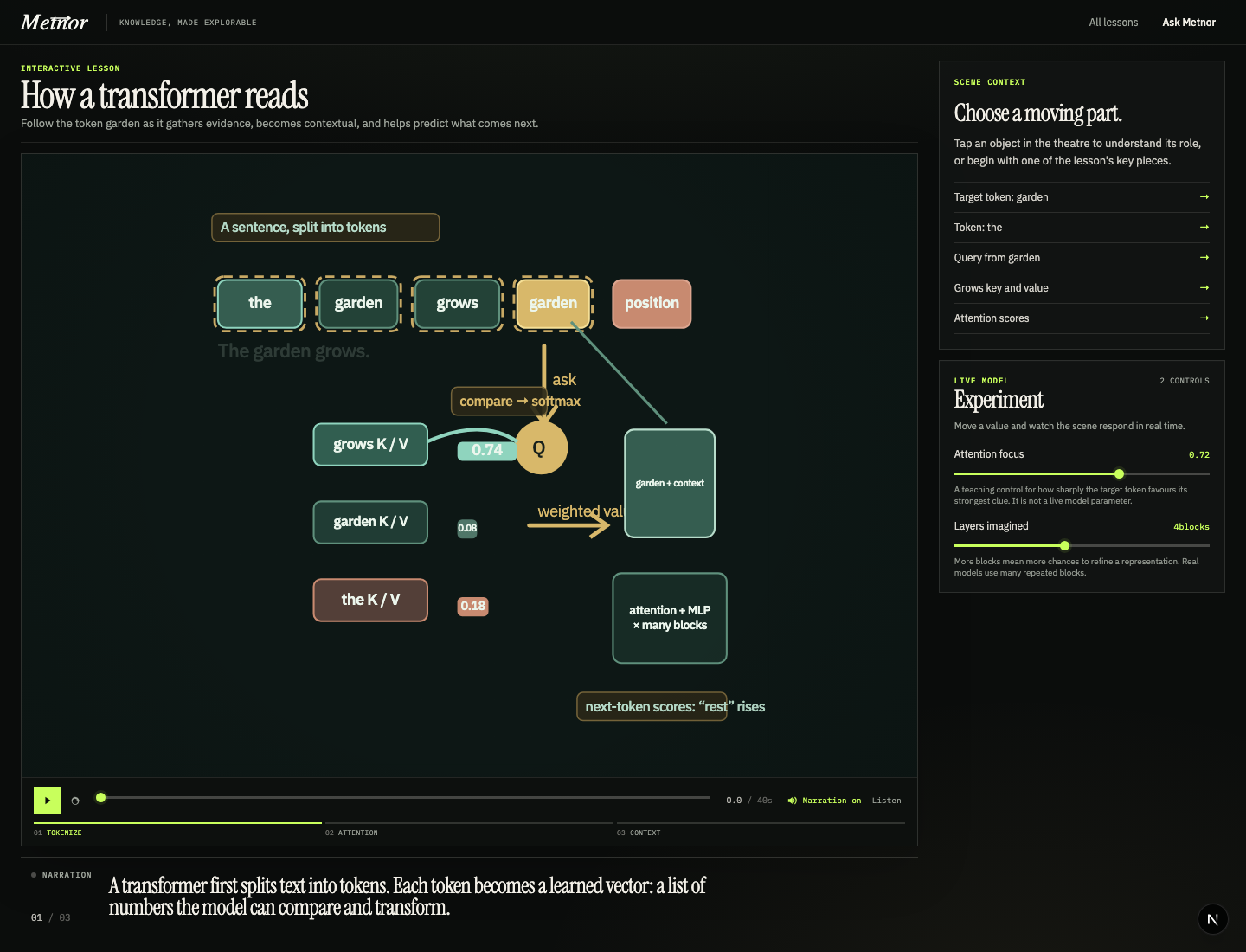
- Transformer architecture: follow tokens through attention, context, and next-token prediction.
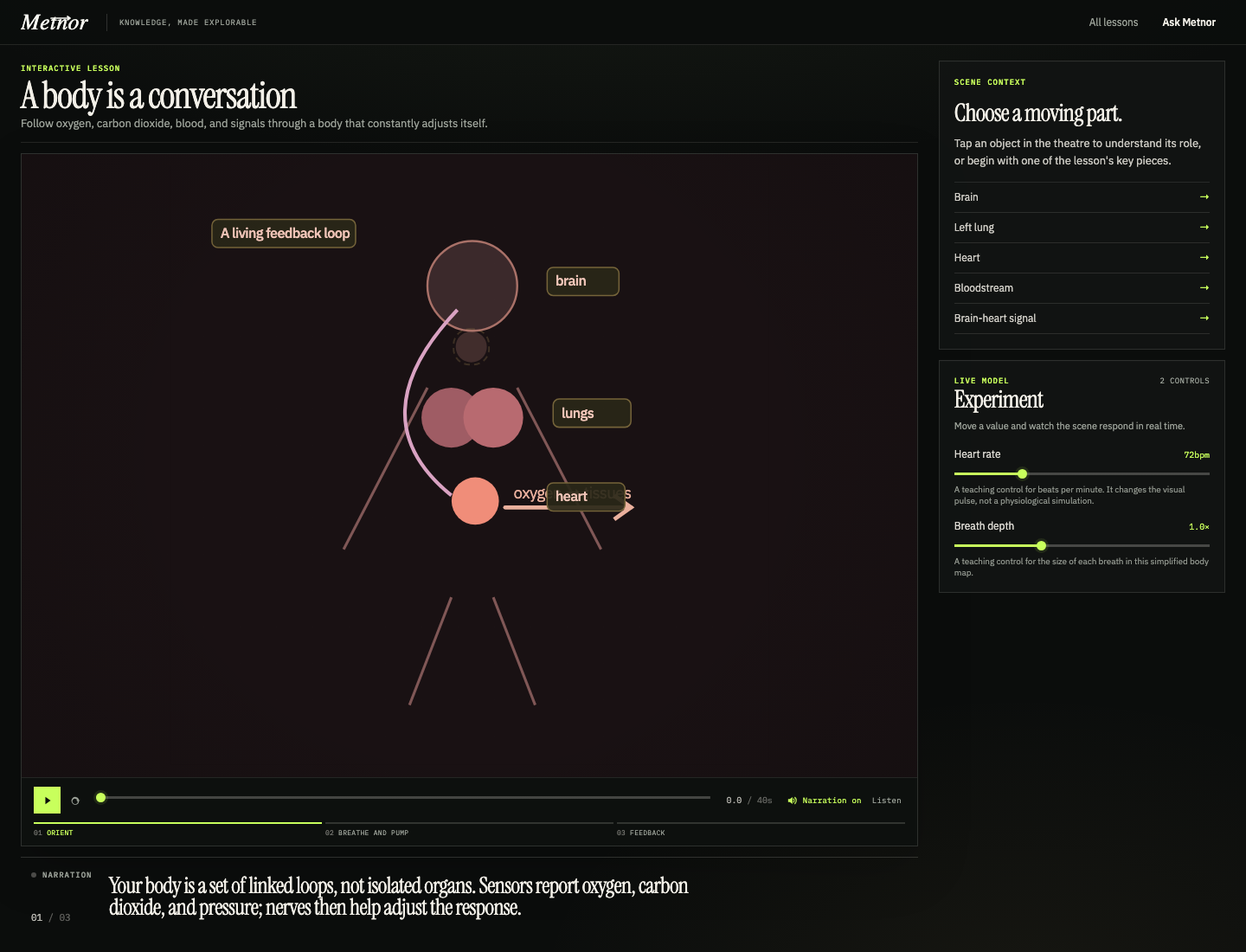
- Human anatomy: explore how major body systems work together.
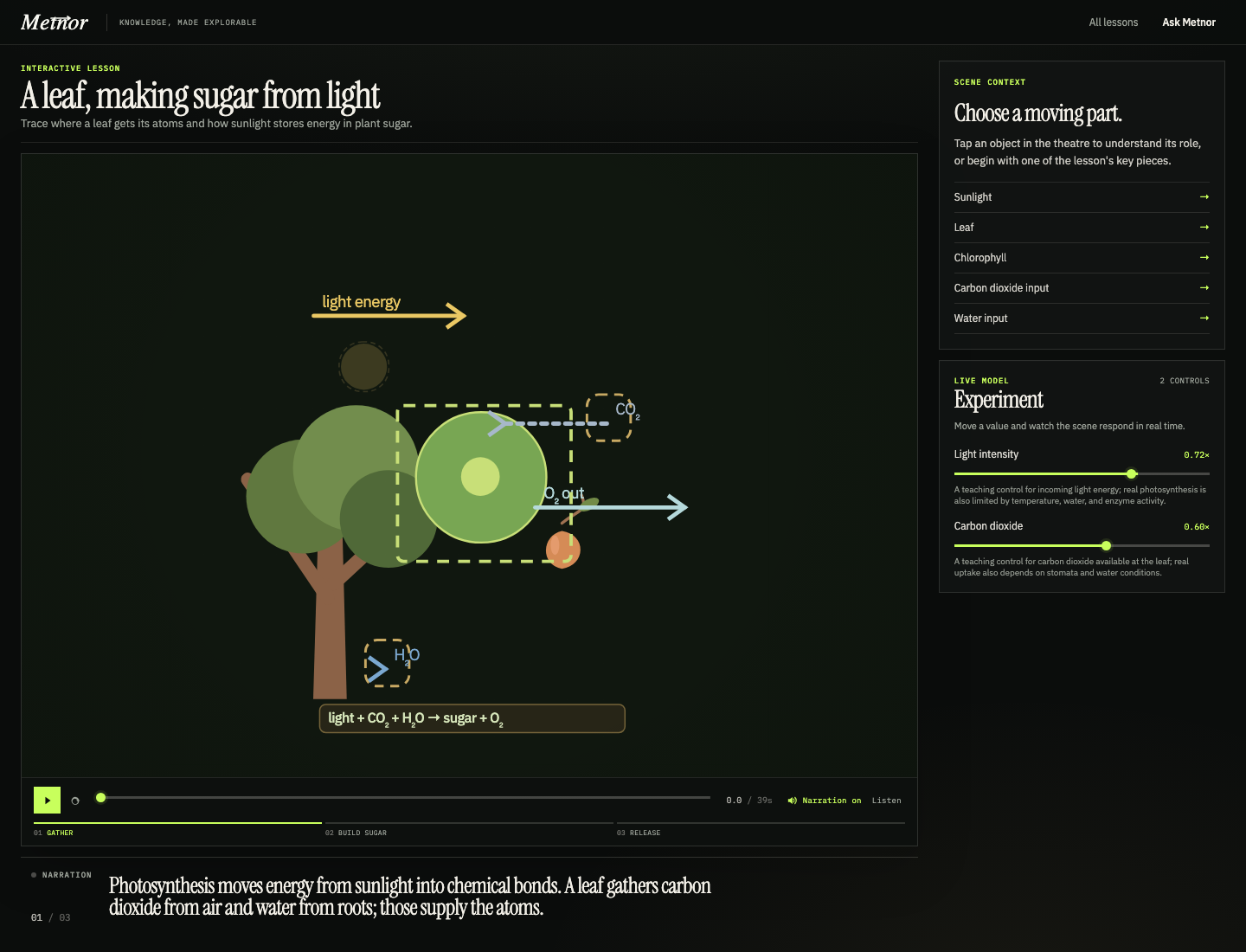
- Photosynthesis: trace light, water, and carbon dioxide as a leaf stores energy.
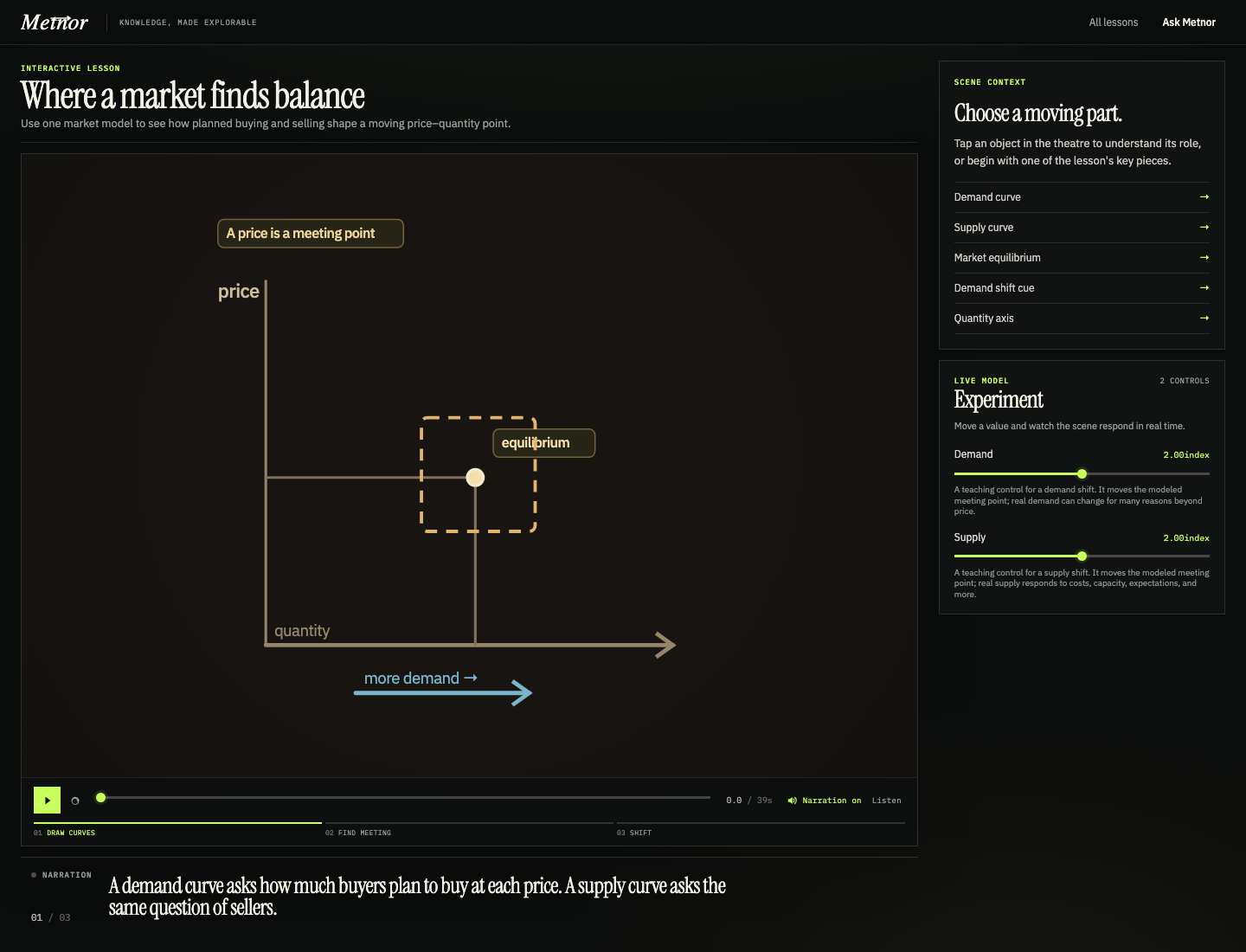
- Supply and demand: change market conditions and watch equilibrium move.
Every lesson shares the same runtime. Learners can press play, select any object for a contextual explanation, replay a scene, use keyboard-accessible controls, and manipulate simulation variables in real time. The experience works without an account, API key, or network-dependent demo data.
How it works
Metnor separates lesson planning from lesson rendering. A portable Scene contract contains objects, relationships, narration, timeline events, interactions, and simulation variables. A generic React/SVG renderer validates and turns that data into an explorable lesson without creating one-off UI code for every subject.
Scene JSON → validation → runtime store + timeline → generic SVG renderer
                                      ↘ inspect, replay, narrate, simulate
That architecture is the ambition behind Metnor: a future learner prompt should be able to become a safe, structured, interactive learning experience rather than a static answer.
Why this matters
The hardest concepts are often relational and dynamic. Reading that gravity curves an orbit, that attention changes a token’s context, or that supply and demand meet at equilibrium does not automatically produce understanding. Metnor puts those relationships on a stage learners can interrogate.
We designed the experience around a simple standard: if a six-year-old cannot follow the explanation, the explanation is not clear enough yet.
Built with Codex and GPT-5.6
Codex and GPT-5.6 were central to the build, not an afterthought. We used Codex to accelerate the product and engineering work: defining the portable Scene schema and validation boundary; building the reusable React/SVG runtime; creating the primitive registry, playback, selection, narration, and simulation systems; and iterating on the five data-driven lessons and responsive interaction details.
The optional server-side OpenAI Responses integration uses GPT-5.6 to plan a lesson as structured JSON or to answer a learner’s question in the context of the active scene, selected object, current simulation values, and recent conversation. Model output is validated before rendering, and the app falls back to curated local lessons when credentials are unavailable.
What is next
Metnor is already a working interactive lesson library. Next, we will connect the prompt-to-Scene planning path directly to the learner flow, add authoring and teacher review tools, and make the library collaborative. Our long-term bet is ambitious: every difficult idea should be as explorable as a well-designed simulation not trapped in a paragraph.
Built With
- codex
- gemini-tts
- gpt-5.6
- next.js
- openai-api
- react
- svg
- typescript
- zustand


Log in or sign up for Devpost to join the conversation.