-
-
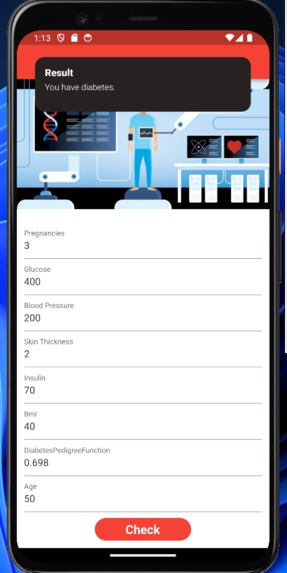
Diabete's Affected
-
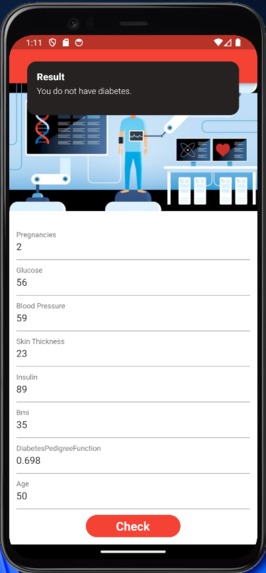
UnAffected Persoon
Inspiration
The inspiration behind the Mellitus diabetes prediction app was to create a user-friendly and accessible tool that empowers individuals to assess their risk of diabetes. With the increasing prevalence of diabetes worldwide, early detection and awareness of risk factors are crucial for better management and prevention of the disease. The app aims to bridge the gap between machine learning technology and public health by offering a simple yet effective solution for predicting the likelihood of diabetes based on individual health data.
What it does
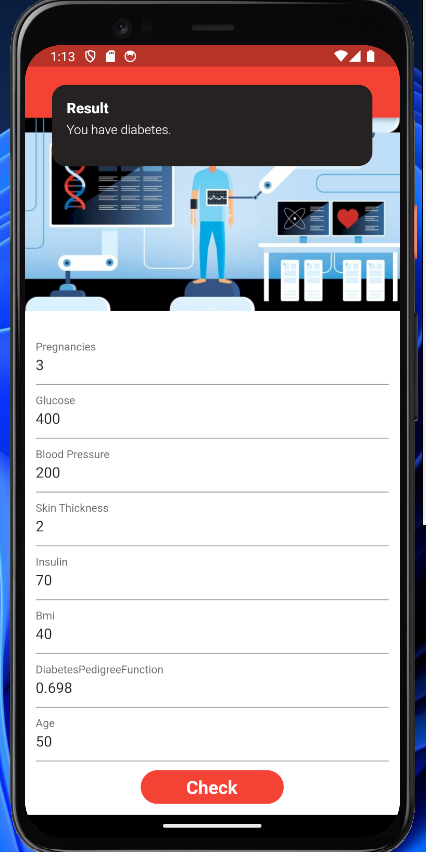
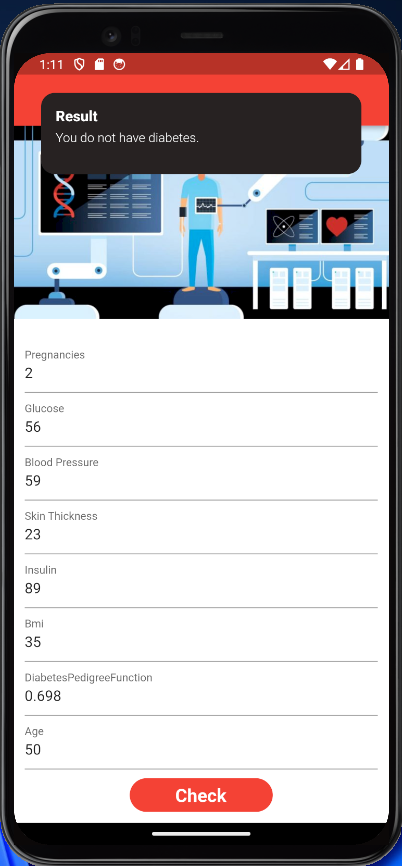
The Mellitus diabetes prediction app utilizes an ensemble learning model to analyze user-provided health data, including pregnancy count, glucose level, blood pressure, skin thickness, insulin level, BMI, diabetes pedigree function, and age. Users can input these parameters through an intuitive and visually appealing interface. The app then processes the data through its backend system and returns a prediction of the likelihood of the user having diabetes. It provides users with valuable insights into their health and acts as an early warning tool for potential diabetes risks.
How we built it
The Mellitus diabetes prediction app was built using a combination of modern technologies. The backend of the application was implemented in Go, which provides a robust and efficient foundation for handling prediction requests through a RESTful API. The backend API was then deployed on Microsoft Azure cloud using VMWare virtual machines to ensure scalability and reliability.
The frontend was developed using Flutter, enabling seamless cross-platform functionality and a delightful user experience. Flutter's expressive UI toolkit allowed us to create a visually appealing and responsive interface for users to input their health data.
The machine learning model, responsible for the predictive analysis, was built in Python, utilizing powerful libraries such as scikit-learn and pandas to create an ensemble learning model. Python's rich ecosystem of data science libraries and tools enabled us to efficiently preprocess the data, train the ensemble model, and make accurate predictions.
For deployment, the Go backend was containerized using Docker, which facilitated easy deployment and management. The Docker container was then deployed on Microsoft Azure's Virtual Machines powered by VMWare technology. This deployment approach provided us with a scalable and robust infrastructure to handle prediction requests from a growing user base.
The Azure cloud infrastructure ensured high availability and allowed us to easily scale resources as the app's usage increased. We set up load balancing and auto-scaling to handle varying levels of traffic and ensure a smooth user experience even during peak times.
By leveraging the strengths of each technology stack and deploying on Microsoft Azure, we created a comprehensive and user-friendly Mellitus diabetes prediction app that is not only accurate in its predictions but also reliable and scalable for a wide range of users.
Challenges we ran into
During the development of the Mellitus diabetes prediction app, several challenges were encountered. Integrating the different components, such as the backend, frontend, and machine learning model, required careful coordination to ensure smooth communication and seamless functionality. Additionally, acquiring and preprocessing the relevant health data for training the machine learning model was a non-trivial task, as data quality and privacy concerns had to be addressed. Furthermore, optimizing the ensemble learning model to achieve high prediction accuracy while maintaining real-time response times posed a significant technical challenge.
Accomplishments that we're proud of
Despite the challenges, the team behind the Mellitus diabetes prediction app is proud of several accomplishments. Firstly, successfully implementing the ensemble learning model and integrating it into a user-friendly application was a significant achievement. The seamless collaboration between the Go backend and the Flutter frontend resulted in a smooth user experience. Additionally, achieving a high level of prediction accuracy through the ensemble learning model, making the app a reliable tool for assessing diabetes risk, was a notable accomplishment. Lastly, adhering to data privacy and security measures to protect user information demonstrated a commitment to user trust and ethical practices.
What we learned
Throughout the development of the Mellitus diabetes prediction app, the team gained valuable insights and experience. Working on an interdisciplinary project involving different technologies taught us the importance of effective communication and collaboration between team members with diverse expertise. We learned the intricacies of implementing an ensemble learning model, fine-tuning its parameters, and optimizing its performance. Furthermore, the process of handling sensitive health data reinforced the significance of data privacy and security in healthcare-related applications.
What's next for Mellitus diabetes prediction app .
The journey of the Mellitus diabetes prediction app does not end here. Moving forward, we have several exciting plans to enhance and expand the app's capabilities. One of our primary objectives is to continuously improve the predictive accuracy of the model by incorporating more diverse and comprehensive datasets. This will allow us to refine the app's predictions and provide more personalized risk assessments. Additionally, we aim to introduce features like personalized health recommendations, educational resources on diabetes prevention, and integration with wearable health devices to offer real-time monitoring and feedback. Finally, we plan to collaborate with healthcare professionals to validate and further optimize the app's predictive capabilities, ensuring that it becomes a valuable tool in the fight against diabetes.
By continuing to innovate and iterate, we are committed to making the Mellitus diabetes prediction app a powerful and accessible resource for individuals seeking proactive measures for their health and well-being.


Log in or sign up for Devpost to join the conversation.