-
-
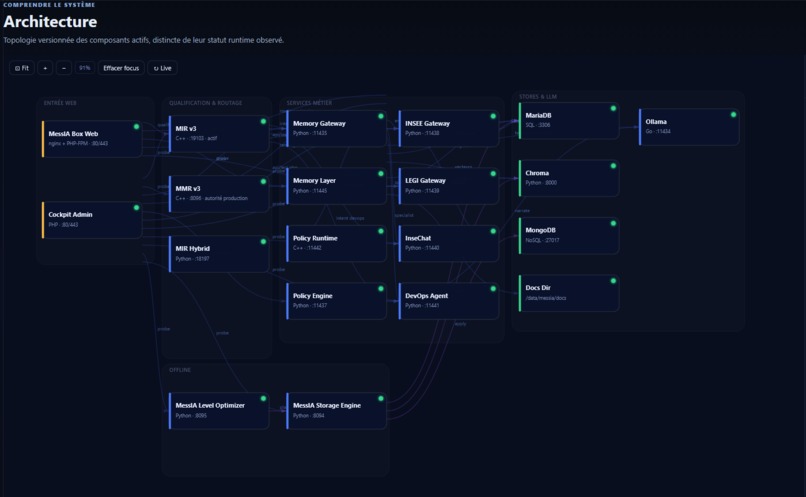
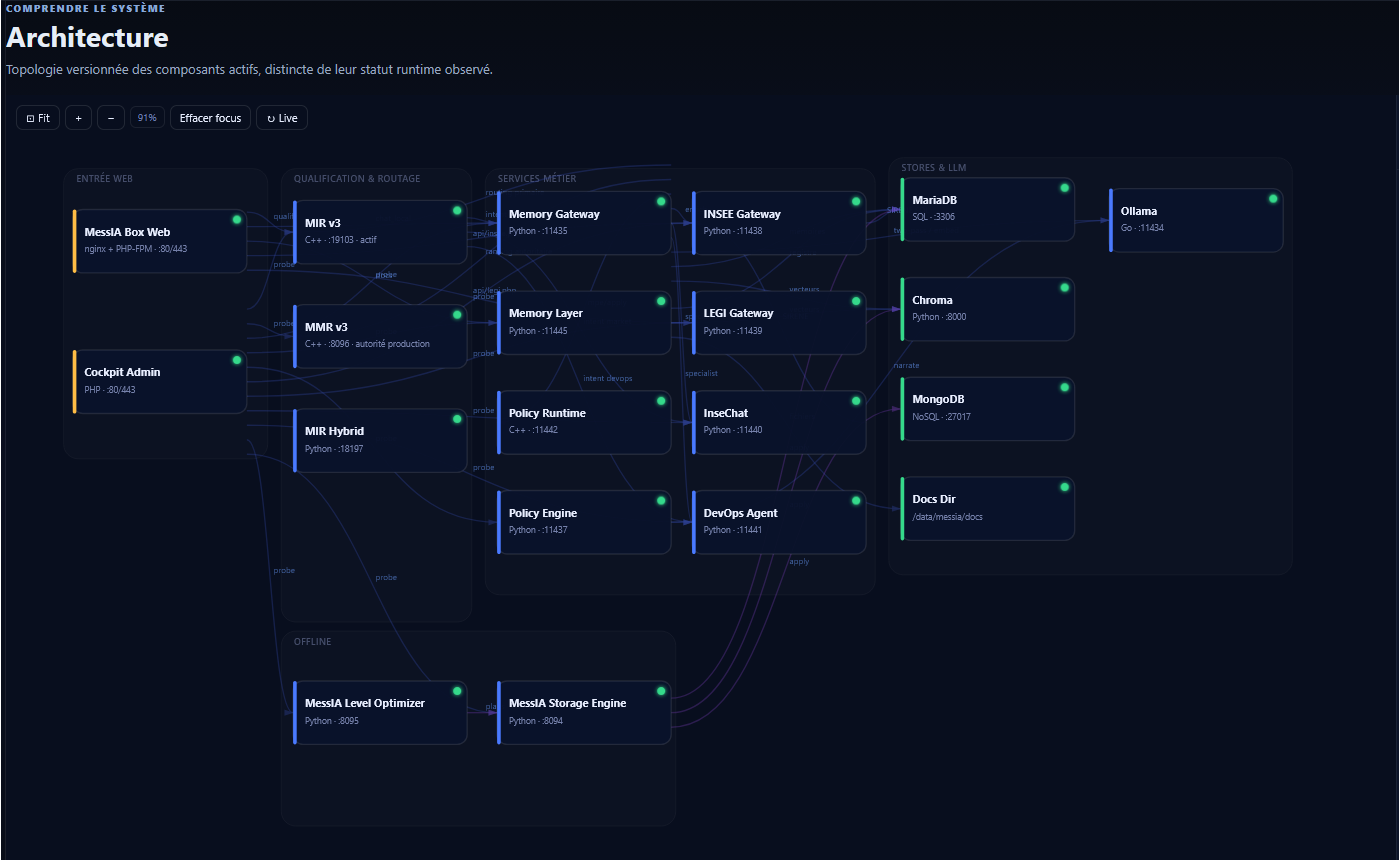
MessIA’s governed architecture for routing, memory, local AI services, policy enforcement, and traceable decisions.
-
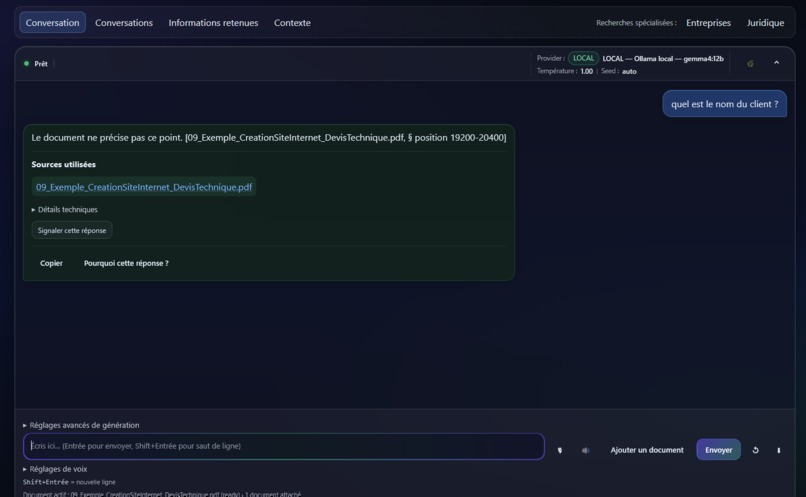
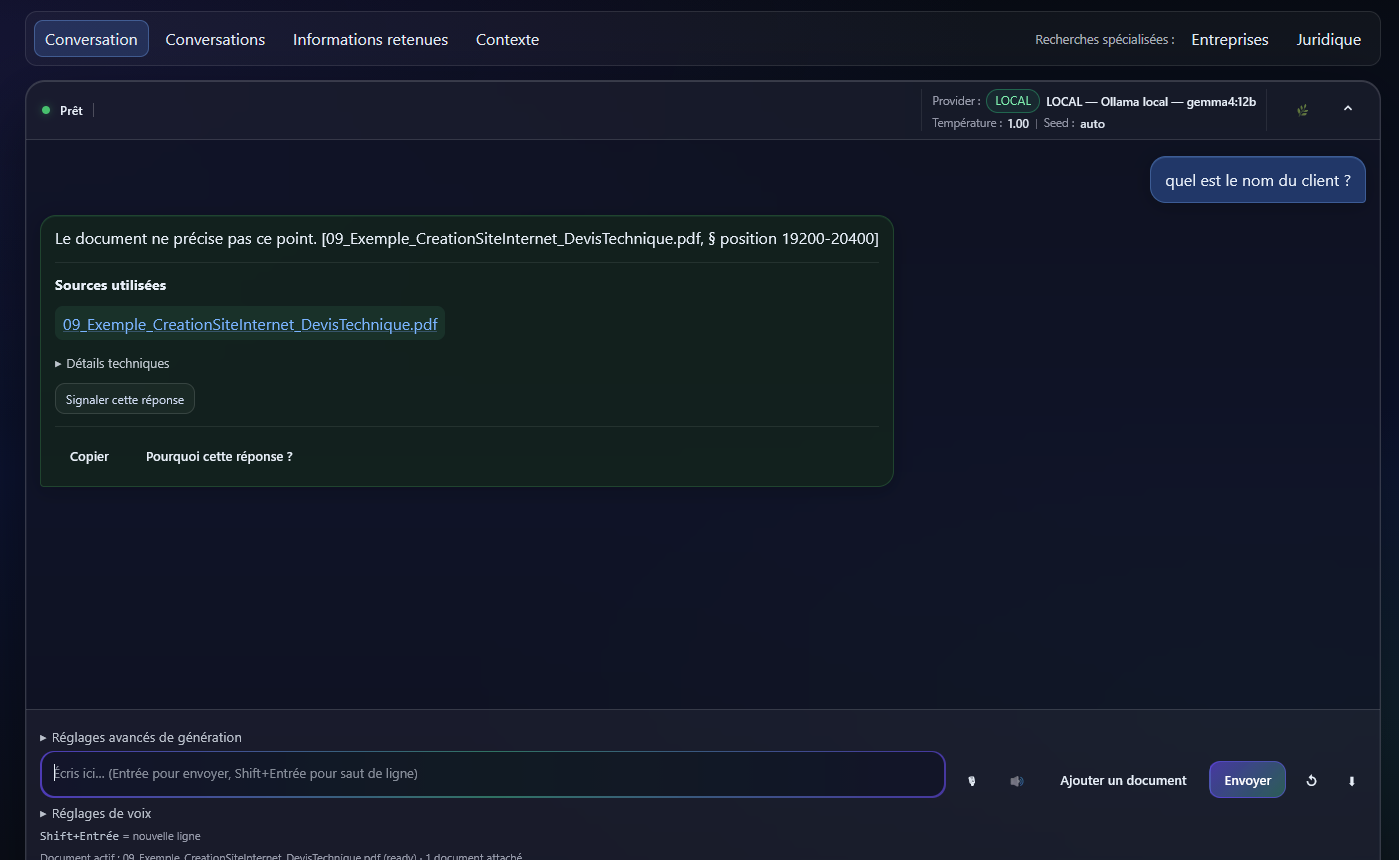
Document-grounded Q&A in MessIA, showing a local answer, cited source, and an explainable response workflow.
-
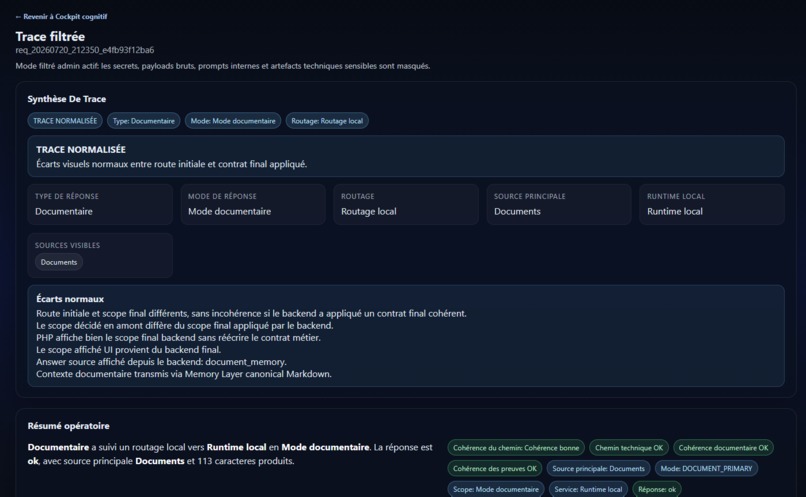
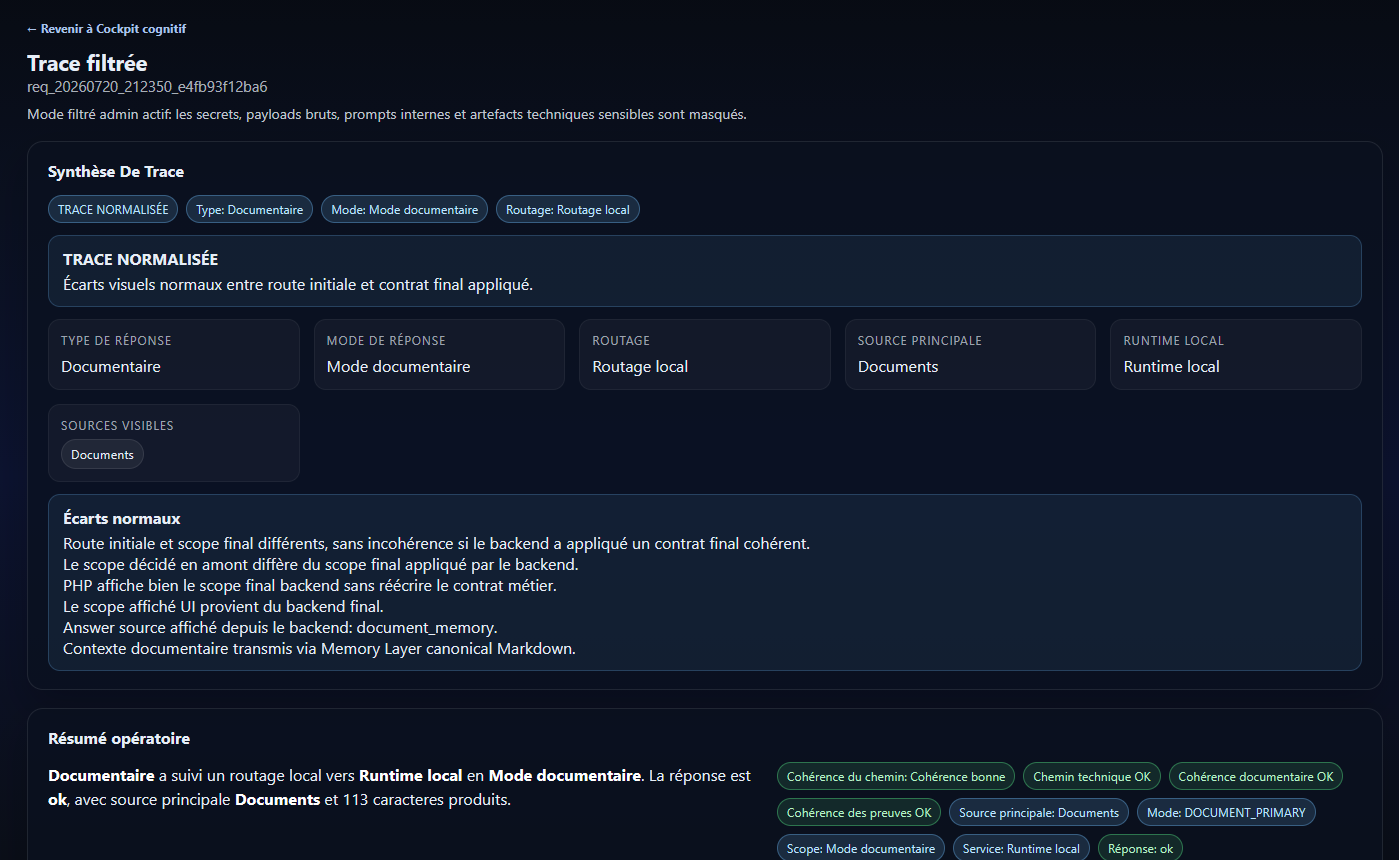
Filtered decision trace in MessIA, showing the path from user question to documentary answer and final runtime evidence.
Inspiration
MessIA began as a long-term effort to build a sovereign, local AI system that could operate on dedicated hardware without reducing intelligence to a single model call.
The project was inspired by a simple problem: most AI assistants can generate convincing answers, but they often hide how those answers were produced. They may retrieve documents, use memory, or call tools, yet the user cannot clearly see which path was chosen, which evidence was used, or whether the system should have answered at all.
MessIA was designed around a different idea: the language model should not be the sole authority. It should operate inside a governed architecture that qualifies requests, applies scope, selects evidence, manages memory, and exposes decisions to human review.
What it does
MessIA is a local, multi-service cognitive AI architecture that goes beyond a chatbot or a traditional RAG pipeline.
It combines:
- deterministic request routing;
- governed conversational and documentary memory;
- specialist retrieval services;
- policy enforcement;
- local language-model execution;
- decision traces and cognitive supervision;
- human-controlled administration and validation.
MIR qualifies the request and determines the appropriate execution path. MMR ranks and selects relevant memory when memory use is allowed. Documentary and specialist gateways own their respective retrieval domains. The Memory Gateway orchestrates the request, while policy and trace layers make the final path inspectable.
The language model generates the response only after the system has prepared the authorized context.
How we built it
MessIA runs locally on a dedicated machine and uses a multi-service architecture.
The application layer is primarily built with PHP and JavaScript. Runtime services use Python and C++, with MariaDB, Chroma, MongoDB, and local models served through Ollama.
The main request flow is:
User request -> MessIA application -> Memory Gateway -> MIR v3 routing -> scoped memory, document, or specialist retrieval -> MMR v3 ranking when memory is allowed -> policy and trace layers -> local LLM response
MessIA was not created in one week. It is a long-term project.
During OpenAI Build Week 2026, I used GPT-5.6 and Codex to accelerate a focused engineering milestone aimed at making the system more coherent, governable, testable, and understandable.
The work completed during the week included:
a consolidated administration and operations interface; a cognitive cockpit for inspecting decisions, anomalies, and improvement cycles; filtered end-to-end decision traces; document ownership and lifecycle controls; provider and model governance; removal of legacy routes and non-canonical copies; stronger access-control, regression, and security tests; stabilization of the documentary workflow and MMR v3 integration; an English reviewer-facing repository, evidence summary, and demo.
GPT-5.6 was used as an engineering reasoning partner for architecture review, debugging, test planning, documentation, and analysis of routing and memory boundaries.
Codex was used as a controlled repository agent. It inspected code and Git state, ran targeted tests, proposed minimal corrections, reviewed exclusions, prepared documentation, and generated explicit commands for human approval.
Codex was never given autonomous authority over production services, databases, secrets, commits, tags, or deployment changes.
Challenges we ran into
The hardest challenge was not generating text. It was preserving clear authority boundaries between routing, memory, retrieval, policy, and generation.
During the week, several regressions exposed how easy it is for a complex AI system to drift toward a conventional RAG design. One documentary failure was caused by a ranking contract that deduplicated chunks at the wrong level, reducing useful context. Another failure came from an obsolete UI test that still expected a legacy model selector after the interface contract had intentionally changed.
These issues reinforced an important lesson: tests must validate the current semantic contract, not preserve obsolete implementation details.
A second challenge was preparing a private local system for external review without exposing the production machine. MessIA cannot be reproduced by opening a public URL or cloning one repository. The final submission therefore relies on a real demo video, a private source repository, sanitized evidence, explicit architecture documentation, and independently validated test results.
Accomplishments that we're proud of
The submitted version includes:
a real local multi-service deployment; governed documentary and memory workflows; end-to-end decision traceability; cognitive and operational supervision interfaces; role-based provider and model governance; validated legacy cleanup; extensive PHP, JavaScript, Python, UI, documentary, MIR, and MMR tests; a private, sanitized GitHub submission snapshot; a live demonstration of the actual MessIA instance.
The Build Week also helped clarify what MessIA fundamentally is: not a chatbot with extra tools, but a governed cognitive architecture in which the language model is only one controlled component.
What we learned
The Build Week confirmed that the most important part of a serious AI system is often not the model itself.
Reliable AI requires:
explicit routing authority; controlled memory boundaries; source ownership; observable decisions; security and privacy by design; human validation before activation.
I also learned that observability is not only an operational feature. It changes how the product is understood. Once users can inspect routing, sources, scope, and consistency checks, the system no longer looks like a black-box chatbot.
What's next for MessIA
The next stage is to evolve the current cognitive runtime into a governed cybernetic control loop.
The goal is not to let MessIA rewrite its own objectives. The goal is to allow it to detect drift, evaluate outcomes, identify weak decisions, and recommend controlled improvements while preserving human authority.
Future work will also focus on:
broader document-format validation; stronger multi-tenant testing; reproducible deployment packaging; deeper memory-quality evaluation; controlled pilots with small businesses; continued separation between canonical services and application orchestration.
MessIA is moving toward a local cognitive infrastructure that is not only capable, but also understandable, inspectable, and governable.

Log in or sign up for Devpost to join the conversation.