-
-
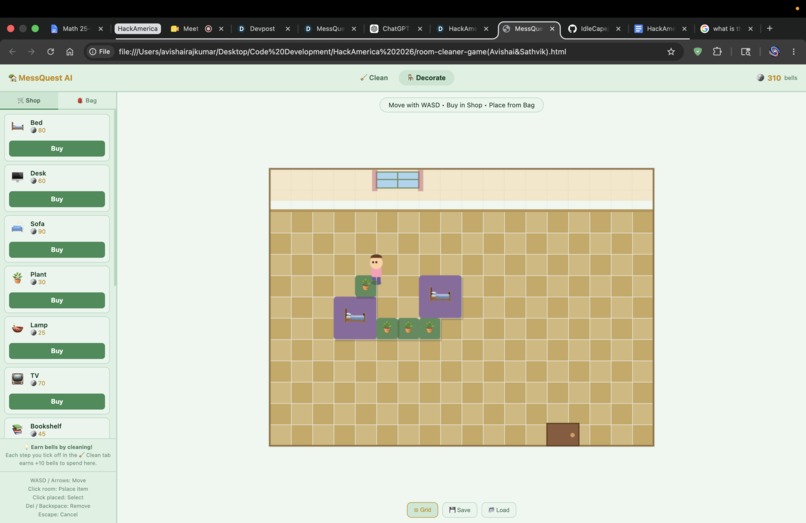
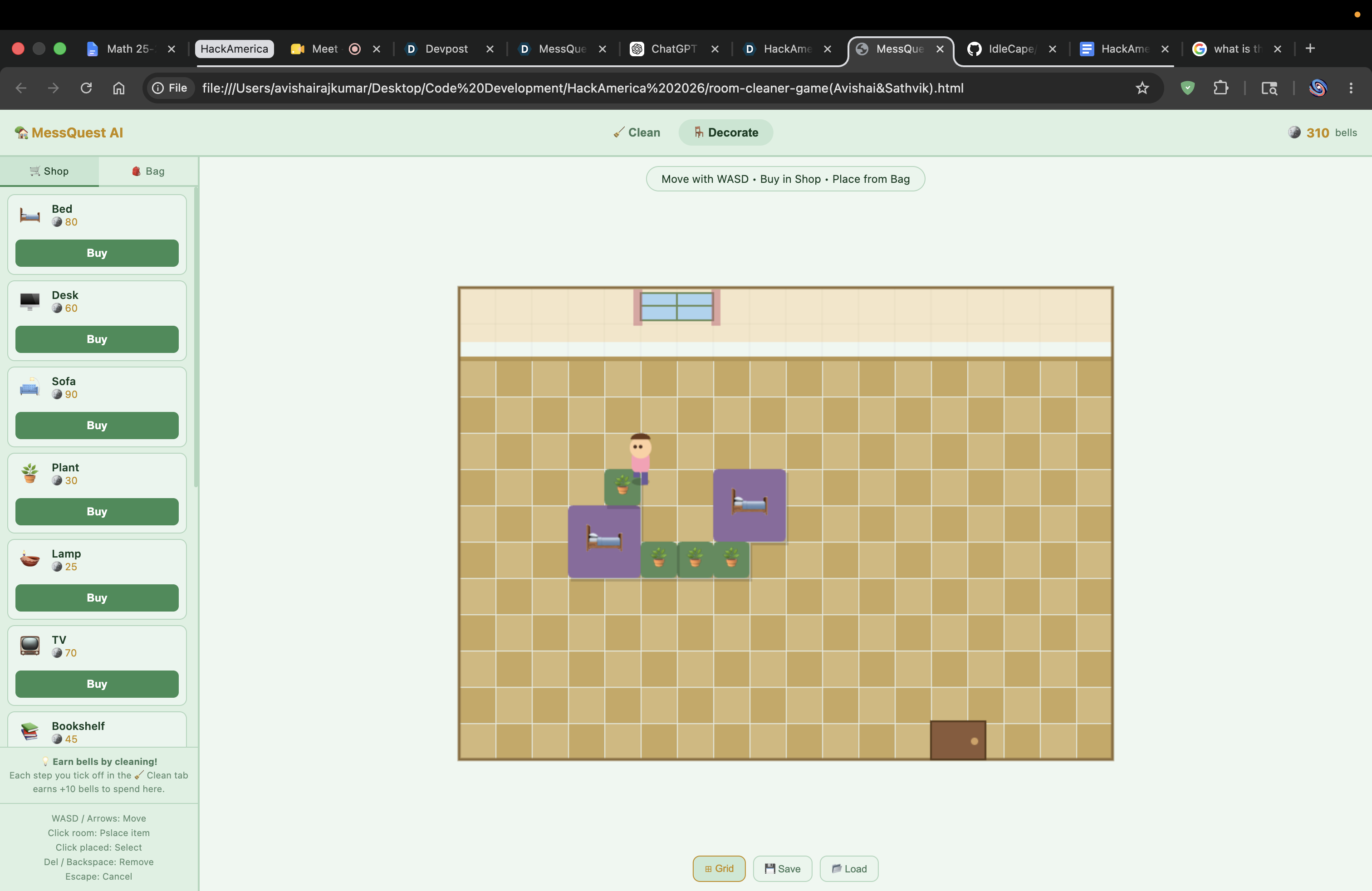
Tokens from cleaning -> Customize online world
-
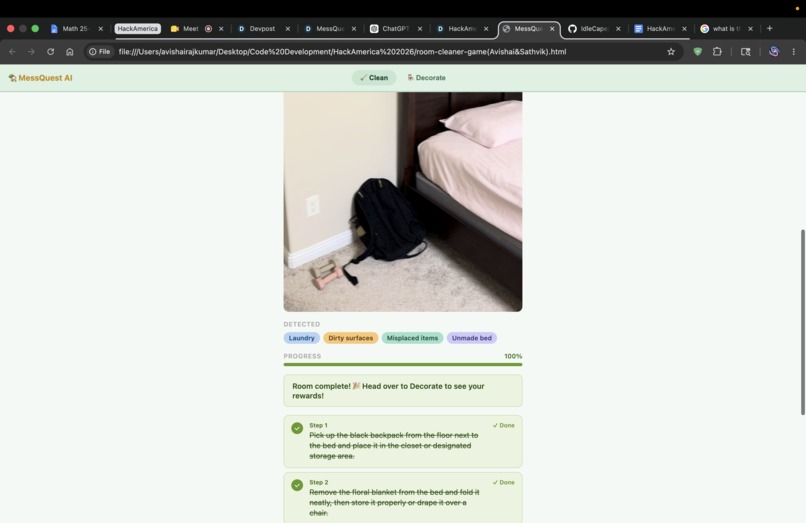
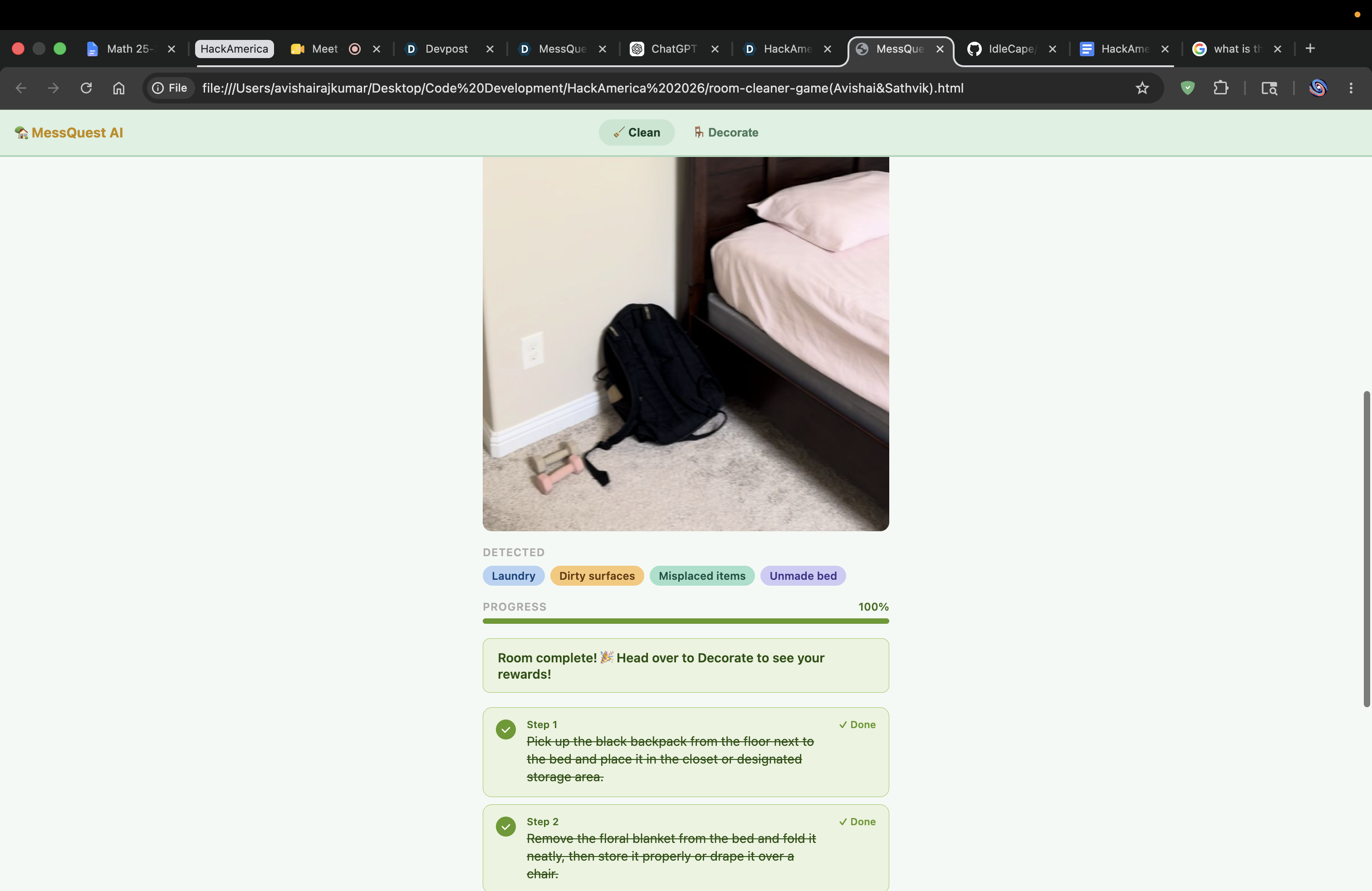
AI analysis -> task generation
Inspiration
We all sometimes feel lazy to clean our rooms, thinking that it requires too much energy. Most of us teenagers are used to having an incentive, such as money, to do so. But as we grow older we must take up this responsibility without external rewards. Recently, Riyansh was playing Animal Crossing and liked the decorative choices. The incentive of an online game where users can customize their room with fancy furniture serves as a natural extension, solving this problem.
What it does
Aptly named MessQuest AI, our game motivates teenagers to clean their room with a customization game reward system.
When users boot up the application, they are welcomed by the clean screen which requests a video or image of their dirty room. Once the user uploads the image, a backend anthropic API analyzes the room, giving 5 concrete and actionable steps the user can take to clean their room. Each time they complete a task, they gain 50 bells, or tokens they can use in the decorate game.
Once done, the user can move to the decorate tab in which they can shop and place neatly designed furniture to create an online room that they would adore. They can choose from a variety of furniture pieces: mirrors, beds, plants, and many more! These were coded with custom sprites.
How we built it
We used everybody's favorite tools - Claude and Gemini - to code this project.
The team focused on engineering prompts that gave these AI tools enough specificty to make the desired game. For example, the very first prompt was "Can you code (don't do it yet) an application with artifical intelligence which is inputted a video recording of someone's room and then the app outputs 5 concise bullet points describing high-impact simple tasks they can take to do clean?"
With many iterations, we combined the cleaning AI with the decorating game, rolling out a full product.
Challenges we ran into
As our first Hackathon, we needed to access the technology required to submit. Claude and other AI coding tools were free, but an API key was a significant purchase for us. After evaluating our options, we decided to get the Anthropic Sonnet API.
Another challenge, the crux of our work, was designing adequate prompts such that the AI could generate our desired project. We studied many YouTube videos about methods to be specific, utilized other AI tools for generating drafts of prompts, and collaborated on final queries.
Finally, it was a massive headache trying to properly hide our API key. We watched many YT videos, asked AI multiple queries, phoned our friends, and still were unable to successfully do so. With persistence, we managed to attempt it calmly and were ultimately able to see what was missing.
Accomplishments that we're proud of
Our clean 'n decorate idea was befitting of our first Hackathon: it was plausible, useful, and aesthetic.
Using artifical intelligence inside our app was relatively easy, but produced an impressive result.
As a team, we delegated tasks and communicated effectively. This enabled us to ideate, build, design, and present something better than we individually could have.
What we learned
The power of vibe coding really stood out to us. There really are almost no technical requirements for development, as any idea that can be described in detail can be created by AI coding tools. This allows us to create more freely and changes the focus from the how to code to what to code. We covered this by creating a project that relates to us and is useful.
What's next for MessQuest AI
As messy students, we will use MessQuest in our daily lives, keeping us consistent with cleaning.
To flush out the original game further, we will add extra game modes to cater towards a larger audience.
We will also consider adding a game component educating readers on proper and sustainable cleaning methods.

Log in or sign up for Devpost to join the conversation.