Inspiration
Creating believable 3D characters is still surprisingly hard for small teams. A single character is not just a mesh: it needs a clean body shape, consistent multi-view appearance, skeleton, skinning, motion compatibility, collision checks, and runtime validation. During OpenAI Build Week, we wanted to explore whether an AI-assisted pipeline could turn character intent into usable, animated 3D avatar assets faster.
MeshAlive started from a simple question: can we make generated characters actually move well, instead of just looking good in a static preview?
What it does
MeshAlive is an AI-assisted character generation and validation pipeline. Given a character template or description, it helps produce standardized 3D character candidates, checks their visual and structural quality, and tests whether they can survive real animation scenarios.
Our system focuses on the parts that usually break in generated 3D assets:
- multi-view character consistency
- mesh quality and body proportion checks
- rigging and skinning readiness
- face and head stability during motion
- walking, running, and action animation tests
- collision and penetration detection
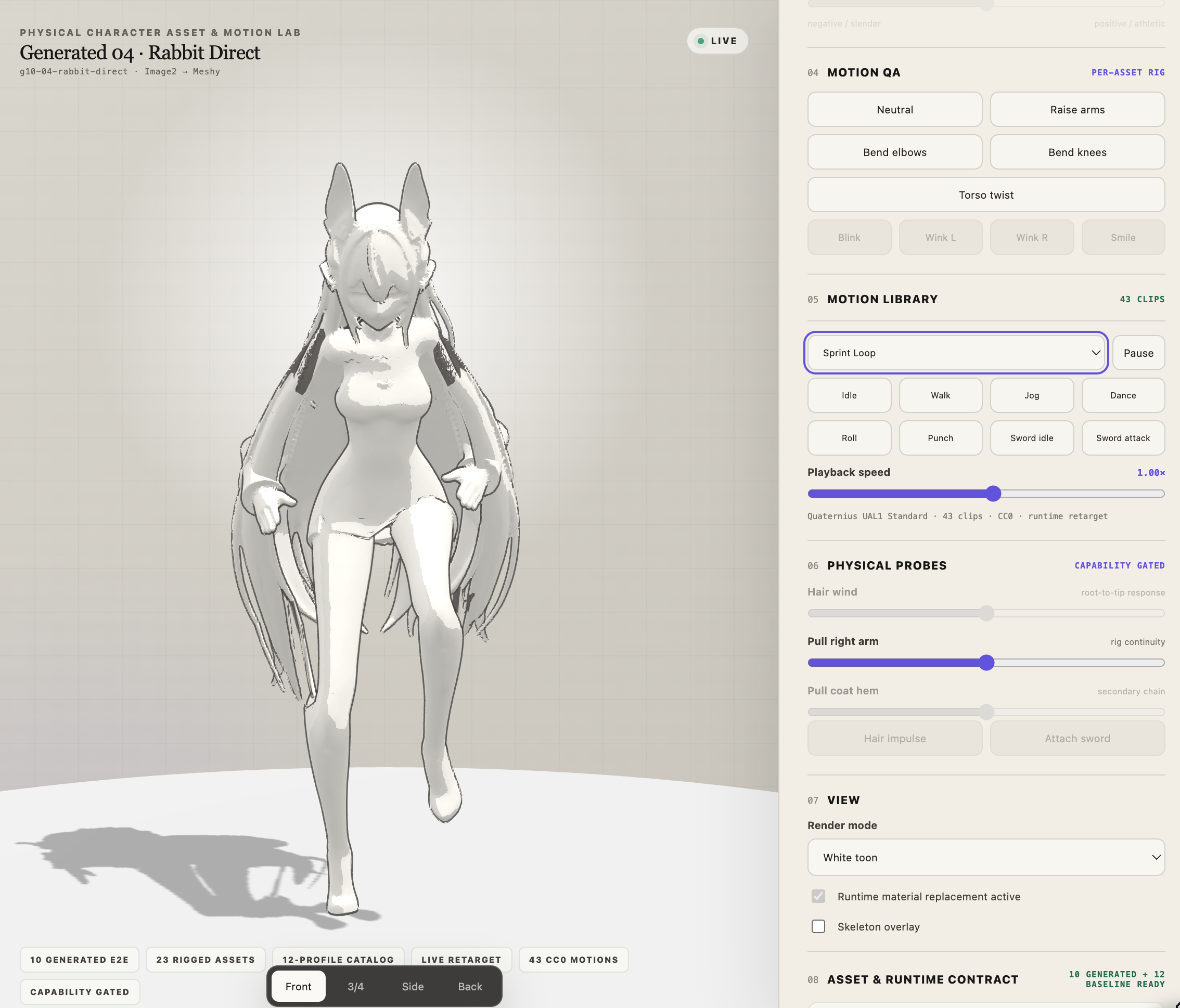
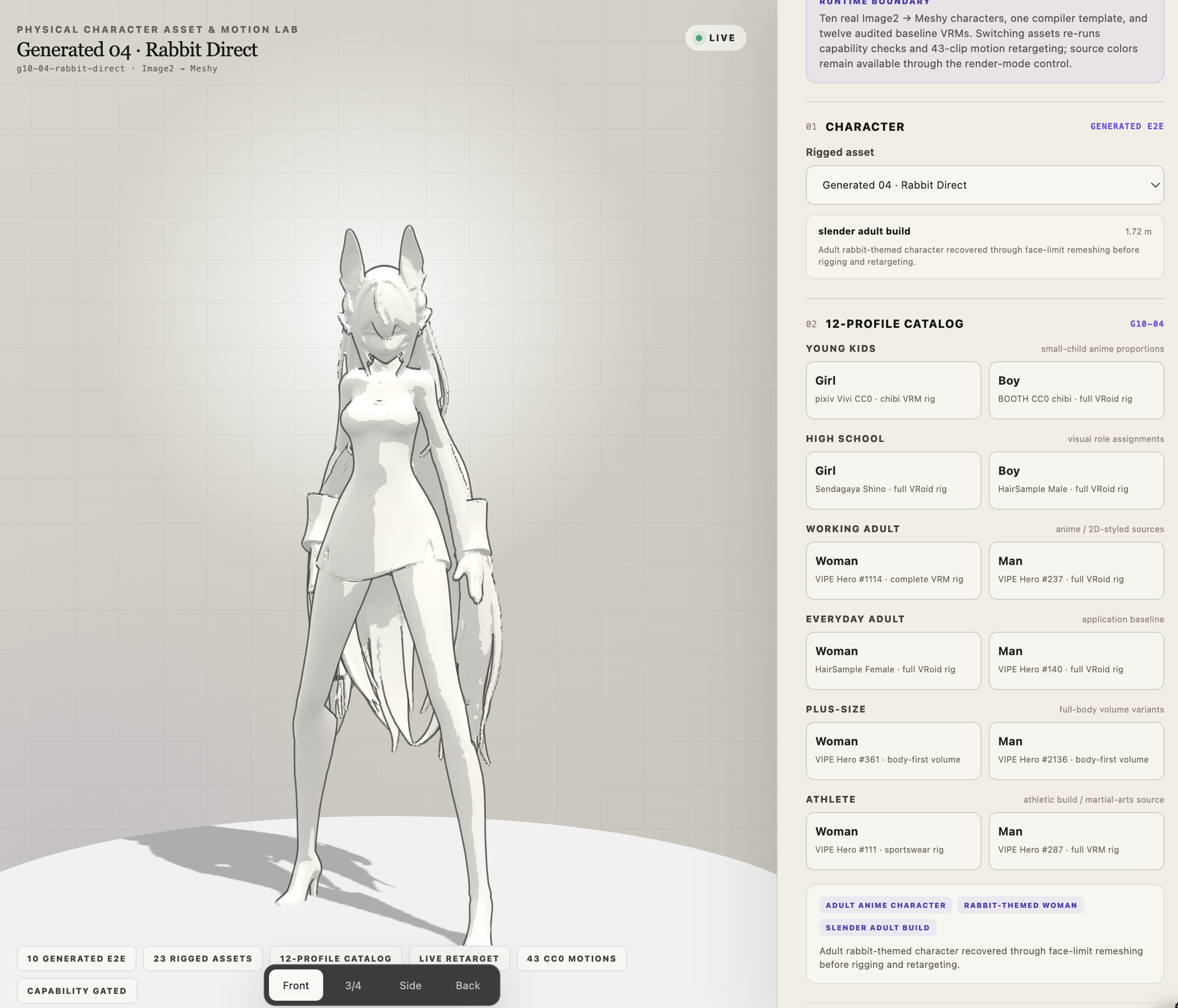
- WebGL preview and review dashboards
Instead of treating a generated 3D model as “done,” MeshAlive treats it as a candidate that must pass a set of practical QA stages before it is useful.
How we built it
We built MeshAlive as a local pipeline combining OpenAI models, Codex-driven development, 3D asset generation tools, Blender automation, and WebGL visualization.
The workflow is roughly:
- Define character specs and reusable templates.
- Generate standardized reference views for each character.
- Convert references into 3D candidates.
- Run static quality checks for proportions, topology, and visual consistency.
- Test semantic body regions such as head, torso, limbs, clothes, and accessories.
- Apply or evaluate rigging and skinning.
- Retarget motions such as walking, running, and action poses.
- Detect visual failures like clipping, unstable faces, broken limbs, and bad gait.
- Present results in a browser-based review dashboard.
Codex helped us rapidly build and iterate on the pipeline, tests, QA scripts, and frontend viewers. We used the project not only to generate assets, but also to build a repeatable evaluation loop around them.
Challenges we ran into
The biggest challenge was that generated 3D assets often look acceptable in a static view but fail once animated. We saw issues such as clothes merging into the body, hair becoming part of the head mesh, hands not matching props, legs moving outward during gait, faces deforming during running, and body parts clipping through clothing.
Another challenge was standardization. Different characters cannot always share the same skeleton, body proportions, or motion assumptions. A kid, high-school student, adult worker, athlete, and larger body type all need different validation thresholds and sometimes different rigging strategies.
We also had to be careful with local compute resources. Running Blender, motion QA, WebGL checks, and large batch experiments can become expensive on a laptop, so part of the project became learning how to build safer, more incremental validation.
Accomplishments that we're proud of
We are proud that MeshAlive goes beyond a pretty demo. It gives us a real testing mindset for AI-generated 3D characters.
Some highlights:
- Built an end-to-end character generation and review pipeline.
- Created a browser dashboard for inspecting generated assets and QA results.
- Designed a Golden-10 style benchmark for testing multiple character templates.
- Added motion checks for walking, running, collisions, and body stability.
- Identified concrete failure modes in generated 3D assets instead of hiding them.
- Used Codex heavily to iterate on scripts, frontend tools, QA logic, and debugging.
Most importantly, we learned that “3D generation” is only half the problem. The other half is proving that the asset is usable.
What we learned
We learned that high-quality character generation needs both creativity and verification. A model can generate something visually impressive, but animation exposes whether the mesh, skeleton, skinning, and proportions are actually correct.
We also learned that reusable templates and standardized views are extremely important. Without consistent input views and clear QA criteria, every generated asset becomes a one-off experiment. With a pipeline, failures become measurable and fixable.
Finally, we learned that AI coding tools are especially powerful when the task requires many connected pieces: generation, automation, 3D processing, testing, and frontend visualization.
What's next for MeshAlive
Next, we want to make MeshAlive more robust across a wider set of character types and motion categories. Our immediate goal is to expand the Golden-10 benchmark, improve rigging reliability, and make the QA dashboard clearer for comparing which generated assets are ready to use.
Longer term, we imagine MeshAlive as a character asset compiler: you describe the character you want, and the system not only generates it, but also verifies that it can move, interact, and survive real runtime conditions.
Built With
- 3dcharacter
- animation
- natural-language-processing
- platform


